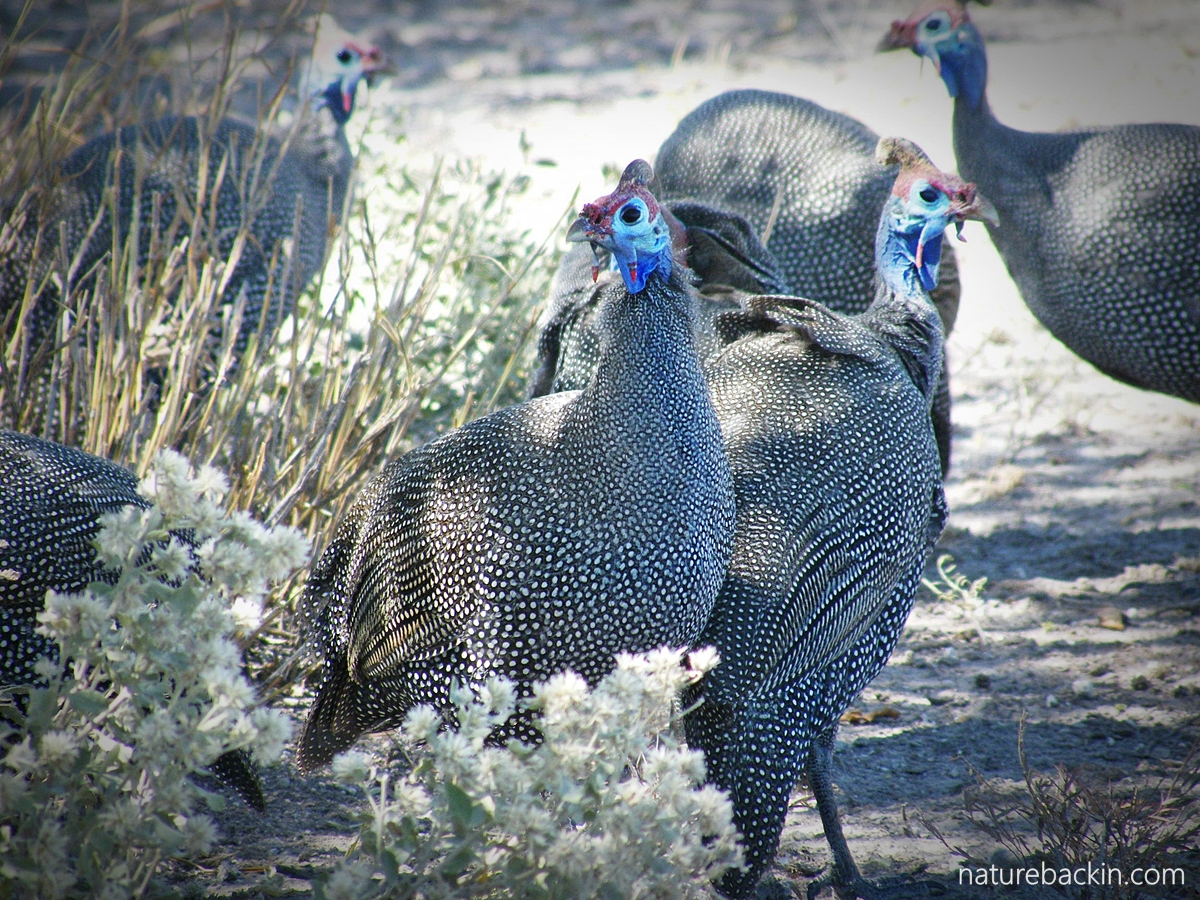
The pearl-spotted feathers, the bony casque adorning the head, and the red and blue facial skin and wattles are distinctive, plus their gregarious habits and noisy calls make the helmeted guineafowl hard to ignore. And, moreover, this species is widespread across sub-Saharan Africa.
The guineafowl family (Numididae) is endemic to Africa. It comprises four genera containing six species. The two species that occur in southern Africa are the helmeted guineafowl (Numida meleagris), and the southern crested guineafowl (Guttera edouardi).
Generally, guineafowls forage on the ground and can walk up to 10 km a day or more. When threatened they usually run, although they can fly to escape threats, such as predators and wildfires, and they fly up into trees at night where they roost communally.
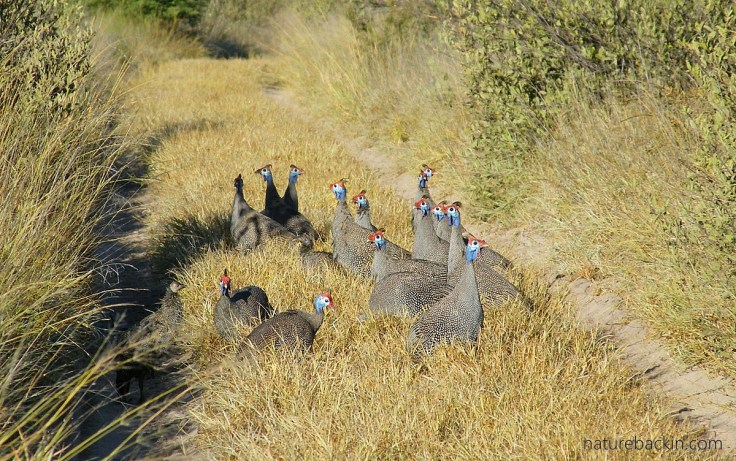
Helmeted guineafowls in the grassed “middelmannetjie” between the tracks on a road in the Central Kalahari Game Reserve in Botswana. The individuals without the red and blue facial skin and wattles are juveniles. The birds allowed us to admire them through the windscreen before they eased off into the longer grass next to the road.
Like other guineafowls, helmeted guineafowls are adapted to a wide range of habitats. They are omnivorous, eating seeds, insects and bulbs. They use their strong claws to scratch for food, and have been observed scratching through elephant dung in search of food.
They commonly congregate at waterholes to drink, socialise, dust bath and preen in the late afternoon and early morning.
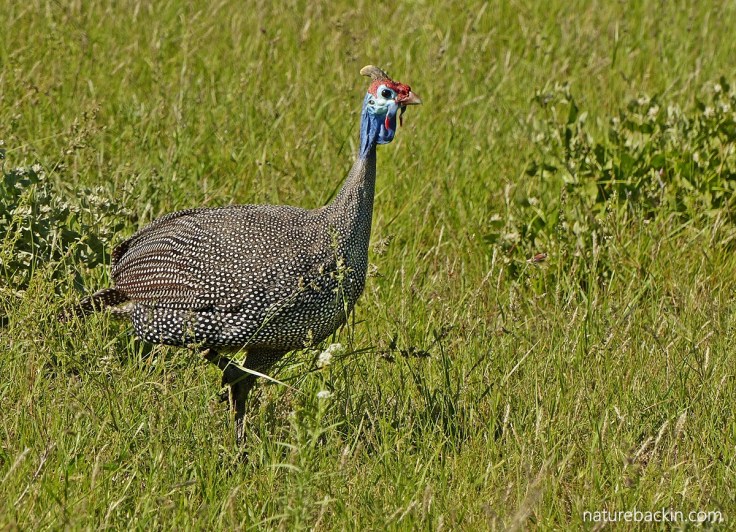
Helmeted guinea fowl are 53—58 cm (21—23 in) in length and weigh about 1.3 kg (2.9 lb). Although the body shape is a bit different, they are roughly the size of a large chicken.
Helmeted guineafowls have long been domesticated in parts of Africa, and more recently, introduced domesticated birds are farmed in the Americas, regions in Europe and Asia, and in Australia, sometimes with feral populations arising from the domesticated bird populations. Domesticated birds vary quite a bit in size and colouration.
Helmeted guineafowls have a reputation for suppressing unwanted insects, including ticks, around homesteads and farmlands.
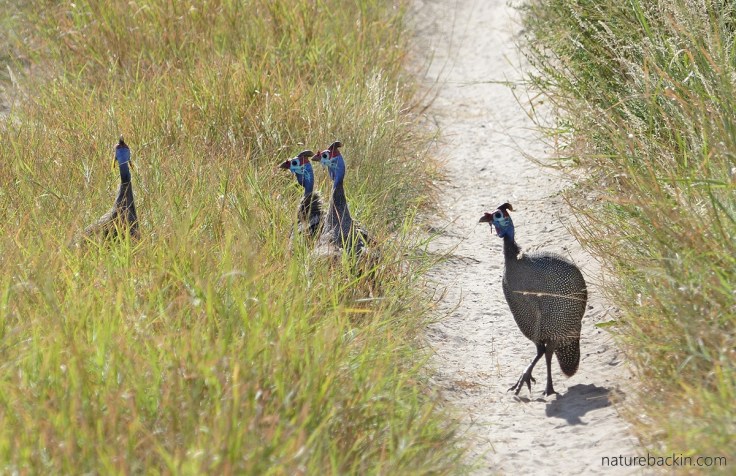
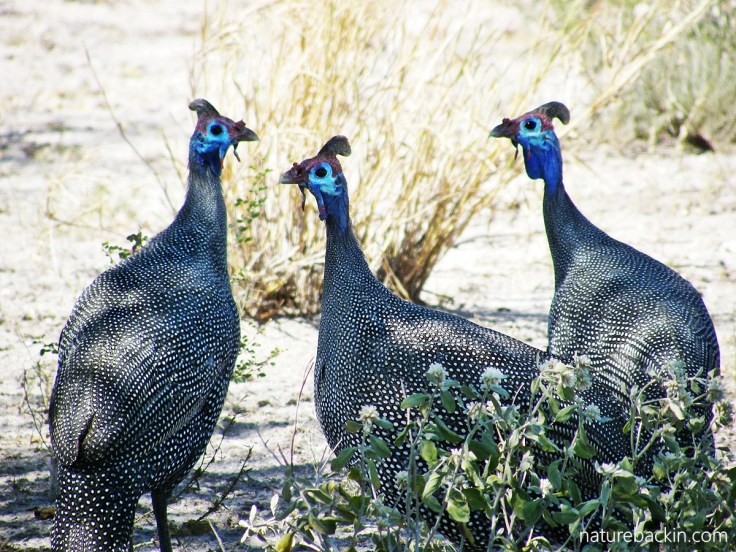
In the above photo the helmeted guineafowl’s strong feet are visible in the bird on the right. The view of the bird on the left shows how when viewed from behind the wattles can resemble long decorative earrings.
Helmeted guineafowls are monogamous. When breeding, the females tend to choose the nesting site. Nests are formed from scraping twigs and grasses together and the nests are lined with soft plant material and feathers. The nests are concealed in dense vegetation.
During the courting period, the male brings the female nuptial gifts of food items, which serve to help the female build up reserves prior to egg-laying and then incubating the eggs when she is not able to feed much. The eggs of helmeted guineafowls are unusually thick-shelled and cost the female a lot of energy to produce. The egg clutches laid by one female usually number 7—12 eggs.
Interestingly, helmeted guineafowls often practice intra-specific brood-parasitism; that is, when females dump their eggs in the nest of another female, leaving her to incubate the eggs. In such instances there can be up to 40 eggs in a nest. The eggs are narrow and more pointed at one end, causing the eggs to roll together if bumped so they tend not to scatter away from the nest.
When the chicks (known as keets) hatch, for the first two weeks or so the male mostly cares for them as the female needs to replenish her reserves after the incubation period. The chicks are precocial at hatching and soon leave the nest, but for a time they are unable to regulate their body temperature and so, with the chicks following them around, the adults need to keep them warm by finding food for them to metabolize. The parents are fierce defenders of their young. At about two weeks of age the keets are able to fly and family units begin to reassemble into larger flocks for increased protection.
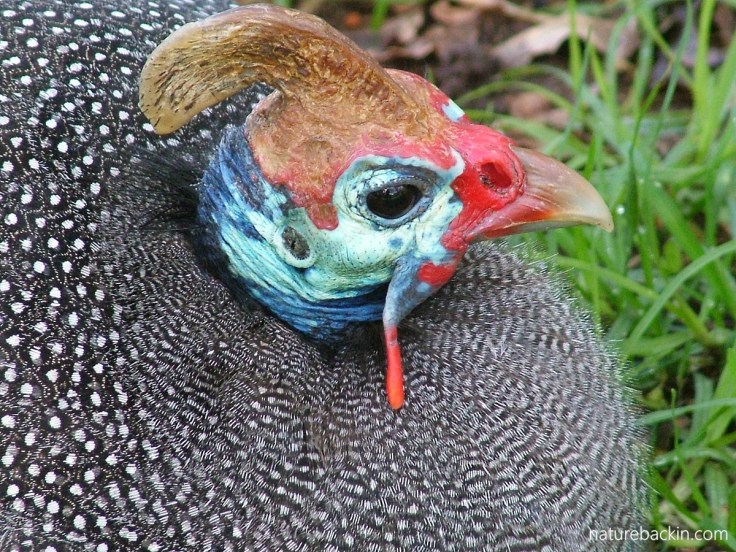
A helmeted guineafowl in close-up showing the spots and dots on the plumage, the bare facial skin and the wattles, and the bony casque on top of the head. The casque is the reason for them being called helmeted. This photo was taken in Kirstenbosch National Botanical Gardens in Cape Town.
Nine subspecies of helmeted guineafowl have been identified, with several of these subspecies occurring in southern Africa. Differences in appearance between the subspecies are mostly related to the shape, size and colour of the casque and facial wattles.
Helmeted guineafowls are known for their distinctive calls, including the alarm call that members of a flock also use as an early warning system. Once when in Chobe National Park in Botswana we heard guineafowl making a commotion, we stopped to see that they were warning of the presence of a young leopard. They were just about mobbing the leopard whose cover had been entirely blown by the alert and watchful guineafowls. To hear some of the calls of the helmeted guineafowl click here.
The southern crested guineafowl will be featured in my next post.
Sources:
🔖A-Z Animals. 2026. Guinea Fowl, Numididae, Spotted sentinels of the savanna. https://a-z-animals.com/animals/guinea-fowl/; 🔖Emmett, Megan. [n.d.] Helmeted Guineafowl Behaviour. South Africa Online. https://southafrica.co.za/helmeted-guineafowl-behaviour.html; 🔖Riddles, Ricardo. 2015. Helmeted Guinea-fowl. South African National Biodiversity Institute (SANBI). https://www.sanbi.org/animal-of-the-week/helmeted-guinea-fowl/; 🔖Wikipedia. 2026. Helmeted guinea fowl. https://en.wikipedia.org/wiki/Helmeted_guinea_fowl; 🔖Wild Ambience. 2026. Helmeted Guineafowl. Call and Sounds. https://wildambience.com/wildlife-sounds/helmeted-guineafowl/?srsltid=AU7gw4WJ-Aya44pljAX0PiIdZs4BlSXFbjr3msNvYZLiIPz3zyPNNzL2
Posted by Carol

Discover more from letting nature back in
Subscribe to get the latest posts sent to your email.


Leave a Reply