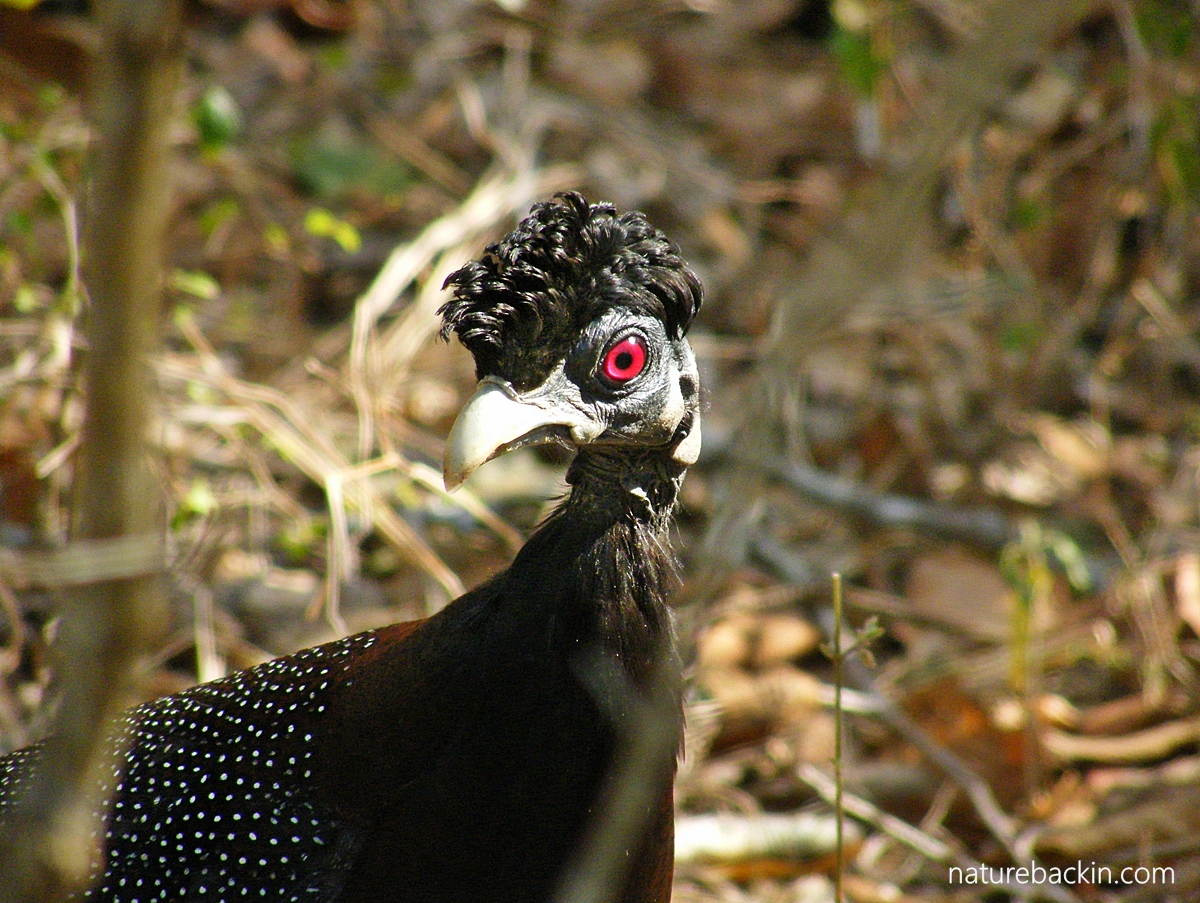
The southern crested guineafowl (Guttera edouardi) has a distinctive curly feathered crest that almost comically resembles a wig. They prefer denser vegetation to the helmeted guineafowl (Numida meleagris), and occur in and on the margins of more forested vegetation and thickets.
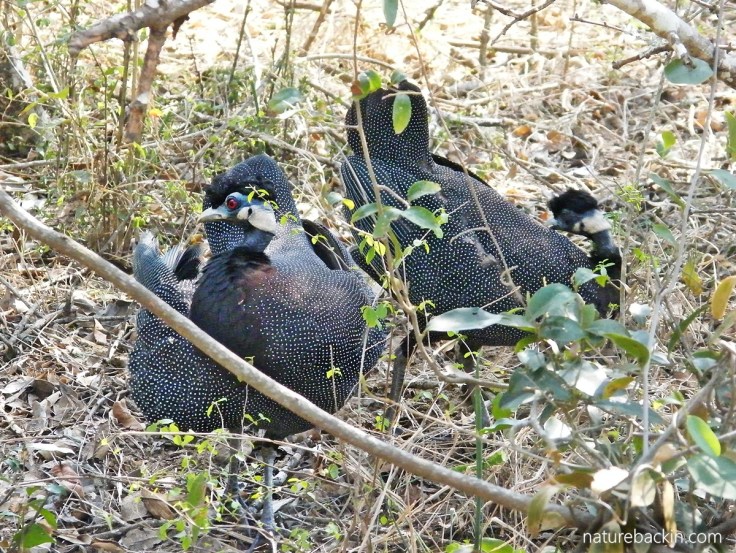
Southern crested guineafowl in woodland at the Kuleni Game Park near Hluhluwe in KwaZulu-Natal.
As mentioned in the previous post, although guineafowl species are endemic to Africa, helmeted guineafowl were introduced from the Guinea coast of West Africa (hence the name guineafowl) into Europe in the late 15th century. These introduced birds are likely to be the ancestors of the domesticated birds known today not only in Europe but also elsewhere, including in North America and Australia. Interestingly, much further back in time, guineafowls are thought to have been domesticated by the ancient Egyptians about 1475 BCE, the Greeks about 400 BCE, and the Romans by 72 CE. However, these strains later died out in Europe.
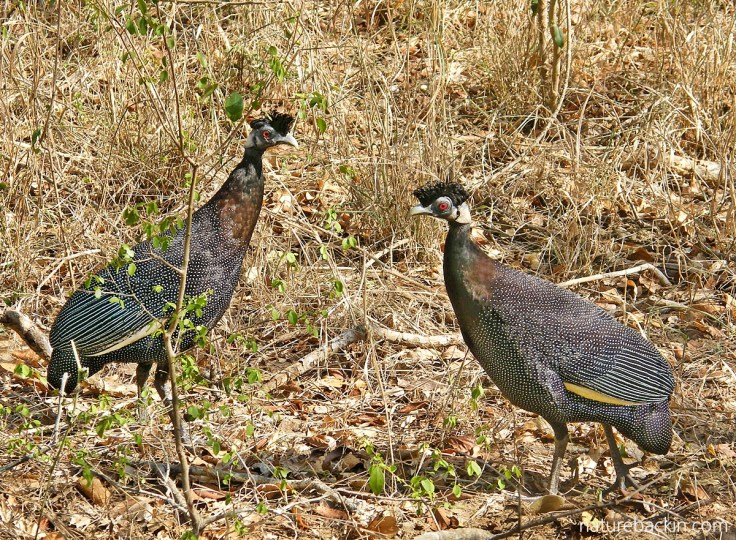
The spots of the southern crested guineafowl are white tending towards blue on the wings where they form stripes. The pale edge of the flight feathers is visible at the bottom of the folded wings.
The range of the southern crested guineafowl extends from the north eastern regions of South Africa further north into Zimbabwe and Mozambique and up into southern Zambia and southern Tanzania.
There are three other species in the genus, these being the plumed guinea fowl (Guttera plumifera) found in central Africa, the eastern crested guinea fowl (Guttera pucherani) found in East Africa as far north as Somalia, and the western crested guinea fowl (Guttera verreauxi) with a large range that includes regions in West Africa and parts of Central Africa as far east as western Kenya, with populations also occurring in parts of Angola and Zambia.
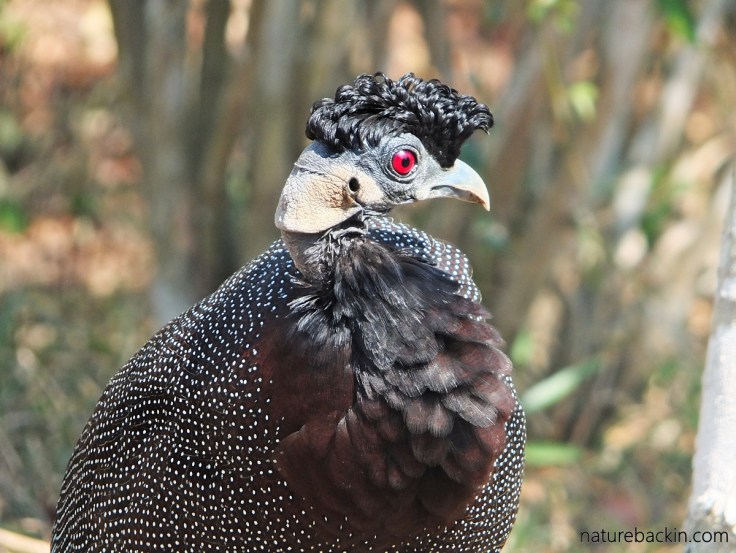
Although named for the unique curly crest, the red eyes are also distinctive and striking features of the southern crested guineafowl. The bare skin of the face and neck is thought to play a role in thermoregulation. The beautiful feathers of the jabot below the throat are not spotted.
Although preferring denser vegetation than the helmeted guineafowls, the social, breeding and foraging behaviours of the southern crested guineafowls are similar. They keep in touch when foraging in dense vegetation with frequent soft contact calls.
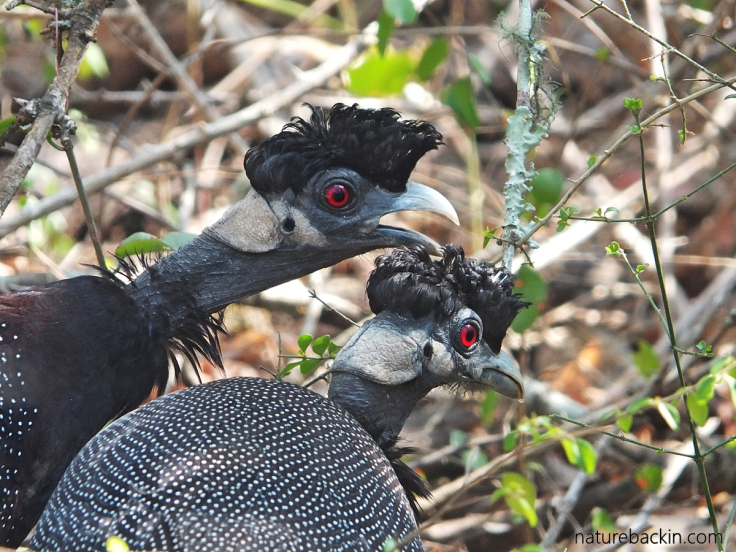
These two were part of a group foraging in a woodland area at Kuleni Game Park.
Like helmeted guineafowls, southern helmeted guineafowls have an omnivorous diet and usually forage while walking in family groups. They are known to follow troops of monkeys moving overhead, so that they can pick up any fruit or seeds that the monkeys may drop from the trees.
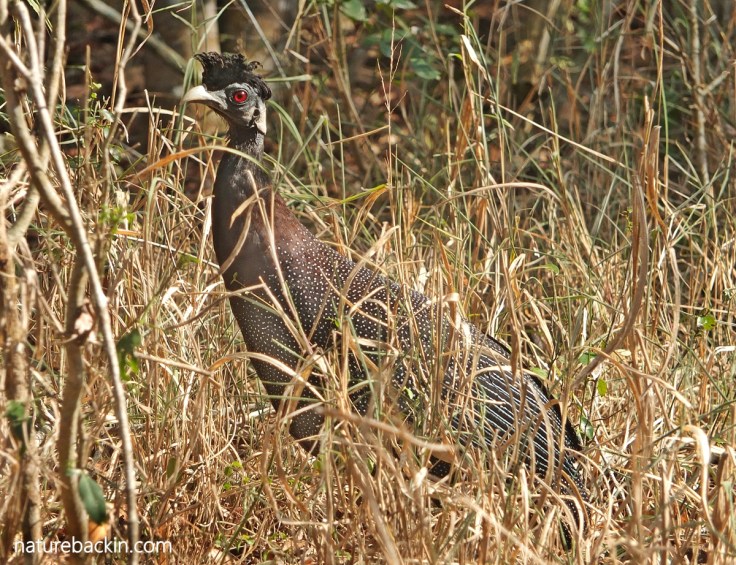
The dots and spots provide camouflage by breaking up the shape of the body especially when partially concealed by vegetation.
Typically, southern crested guineafowls are a lot shyer than the more wide-spread helmeted guineafowls that are adapted to more varied and open habitats. Also, the cover of the denser vegetation favoured by the southern crested guineafowls keeps them more concealed than the helmeted guineafowl.
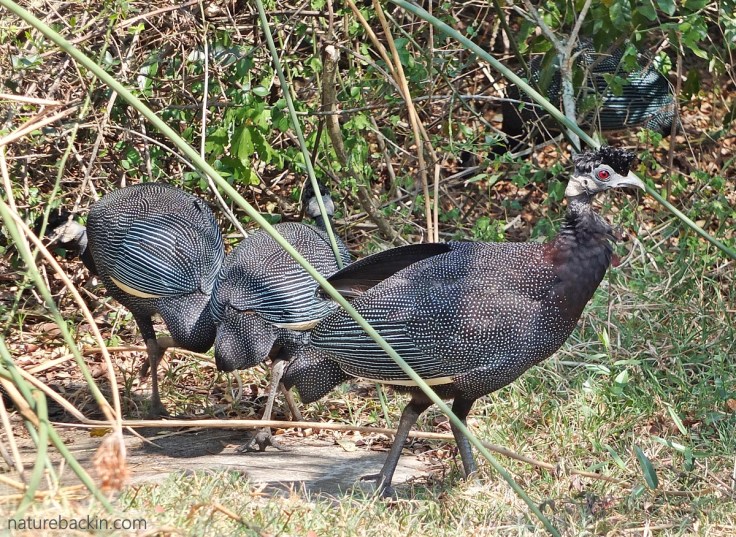
Southern crested guineafowls often form flocks of up to 20 or more individuals, although smaller family groups are also common.
As the species has a large range, its status in the IUCN Red List is categorised as Least Concern, but their dependence on woodland habitats means they are sensitive to forest fragmentation and changes in land use.
Sources:
🔖Cornell University. 2026. Southern Crested Guineafowl (Guttera edouardi). eBird. https://ebird.org/species/cregui4?siteLanguage=en_ZA&continue; 🔖EBSCO. 2026. Research Starter: Crested guineafowl. https://www.ebsco.com/research-starters/zoology/crested-guineafowl/; 🔖 Jacob, Jacqueline and Pescatore, Anthony. 2022. Guineafowl. Veterian Key. https://veteriankey.com/guineafowl/#:~:text=The%20term%20guineafowl%20is%20the,black%2C%20plumed%2C%20crested%20and%20vulturine; 🔖Wikipedia. 2026 Southern crested guinea fowl. https://en.wikipedia.org/wiki/Southern_crested_guinea_fowl
Posted by Carol

Discover more from letting nature back in
Subscribe to get the latest posts sent to your email.


Leave a Reply