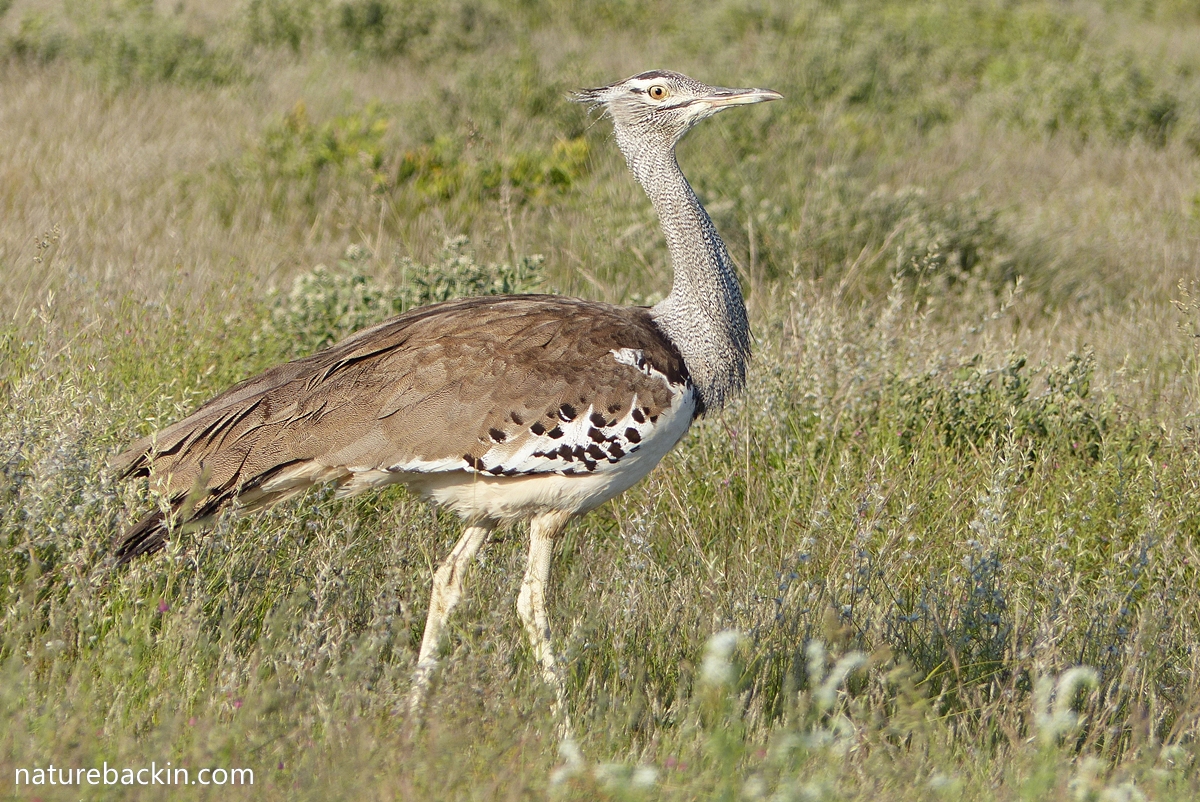
In this second post on terrestrial birds in southern Africa, I share my photos of the tall and stately kori bustards (Ardeotis kori) that inhabit some of our drier regions, where they can be seen walking majestically through open savanna and arid grasslands.
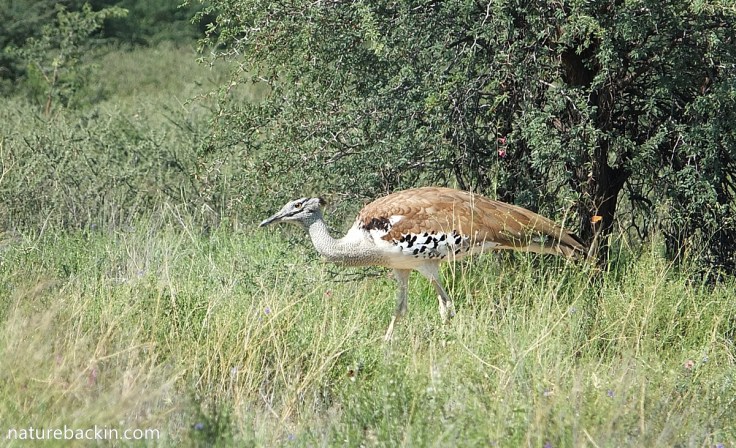
Described as being opportunistic omnivores, kori bustards walk sedately foraging as they go. They eat a variety of invertebrates, small reptiles, eggs and even nestling birds, and also plant material that forms an important part of their diet, including leaves, grass, flowers, roots and bulbs, seeds and berries. They are also known to eat wild melons and the gum of Vachellia (formerly Acacia) trees.
These photos were all taken from our vehicle while we were driving in game reserves in Botswana. When I say that all these photos are exceptional, I am not boasting. They are exceptional because nine times out of ten when we slowly approach kori bustards, even at quite a distance, being cautious birds they tend to veer off and walk away, so usually all we see are their slowly-but-surely retreating rear ends. These photos were taken on exceptional occasions when the birds did not immediately turn away.
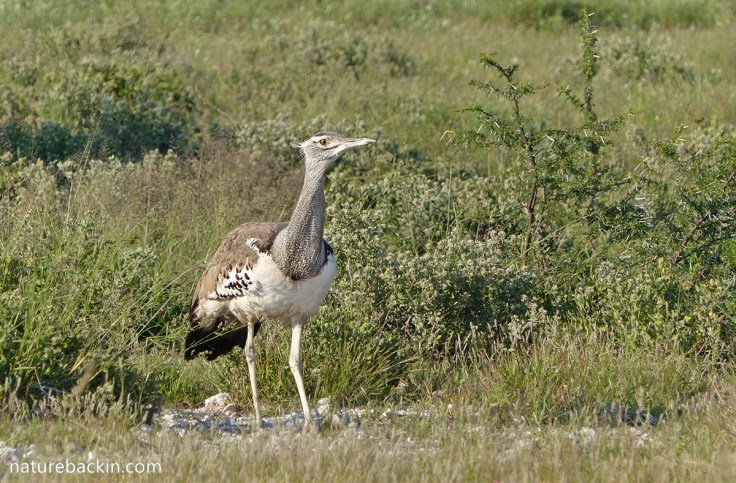
Kori bustards stand at about 1.5 m (5 ft) tall with the males being taller and heavier than the females.
The largest of the bustards and korhaans that occur in Africa, kori bustards are truly terrestrial in that not only do they forage on the ground but they also nest on the ground. Their feet, with three forward-pointing toes and no rear toe, are not adapted to perching or roosting in trees. At night they rest on the ground, remaining stationary in a standing or crouched position.
However, despite their terrestrial habits and large size and weight, kori bustards are capable of flight. They are the heaviest flying bird in Africa. Male kori bustards can range in weight from 11—19 kg (24—42 lbs) with females on average weighing about half that. They will likely run when alarmed rather than fly, but while running they can take to the air with heavy wing beats. They are also able to take-off from a standing position if they have to. Once airborne they are graceful fliers, flying with the legs folded and necks extended. They have an impressive wingspan up to 2.75 m (9 ft).
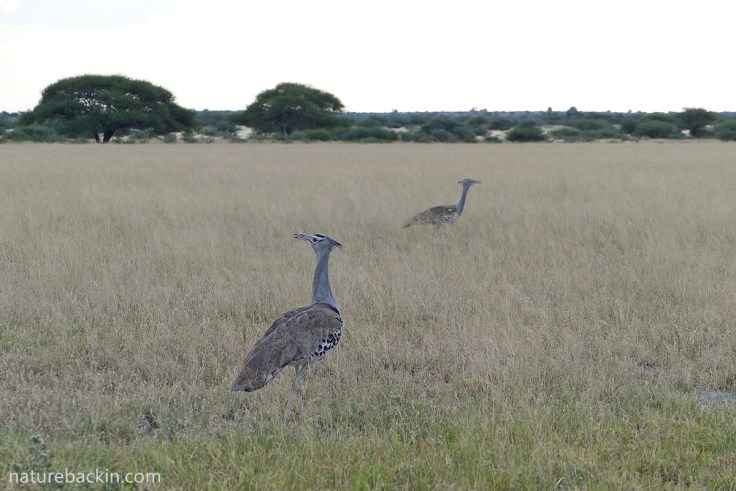
We have seen kori bustards foraging on their own or in loose associations with others. They do not form breeding pair bonds. In the breeding season, males display to compete with other males and to court the attention of females. A dominant male will mate with all the females that are attracted.
The female nests, incubates the eggs, broods and raises the young all on her own. The solitary nest is usually in a slight hollow or scrape in the ground, perhaps near protective vegetation, a mound or rock outcrop. Usually, one to two eggs are laid. Although the young are precocial they are initially fed by the mother for several weeks, and then they are able to forage while walking in her company. They (or more likely the sole surviving chick) may remain with the mother for many months, especially if she does not breed again the following year.
Unfortunately, the mortality rate of kori bustard chicks is high due to factors such as high predation rates and the ravages of environmental stress, for example during drought. Like many creatures in arid regions as the climate breaks down and temperatures are generally higher, kori bustards are less likely to breed successfully if at all under abnormally hot conditions.
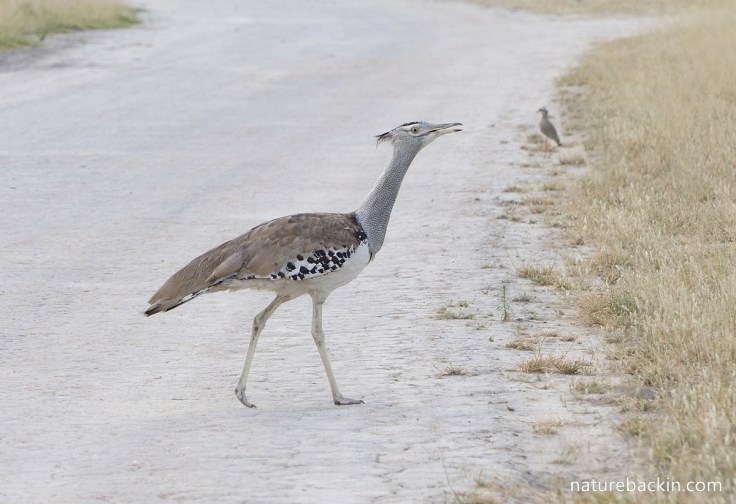
The above photo was taken of a kori bustard crossing a road in the Central Kalahari Game Reserve in Botswana. The bare ground enables one to see the three-toed feet (lacking a rear backward-facing toe) that are characteristic of birds that spend most of their time walking.
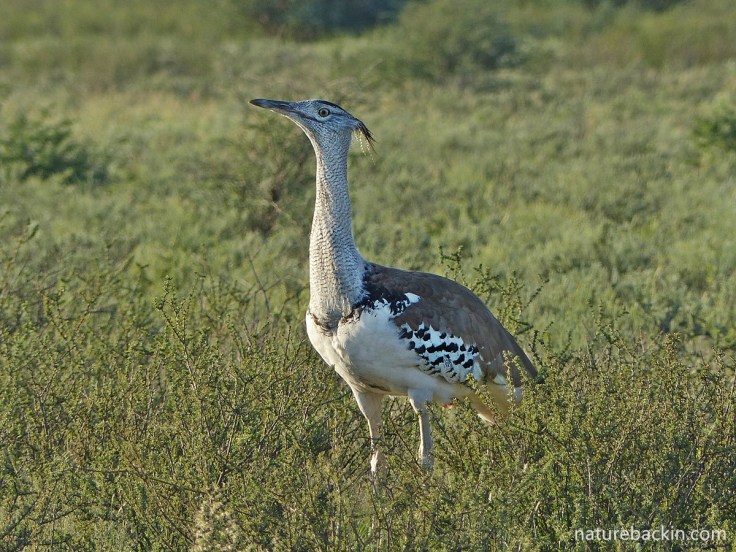
Kori bustards can look quite imposing with their erect posture, strong stabbing bill, penetrating eyes and especially the larger males with their more conspicuous crest. The markings on the feathers are very beautiful.
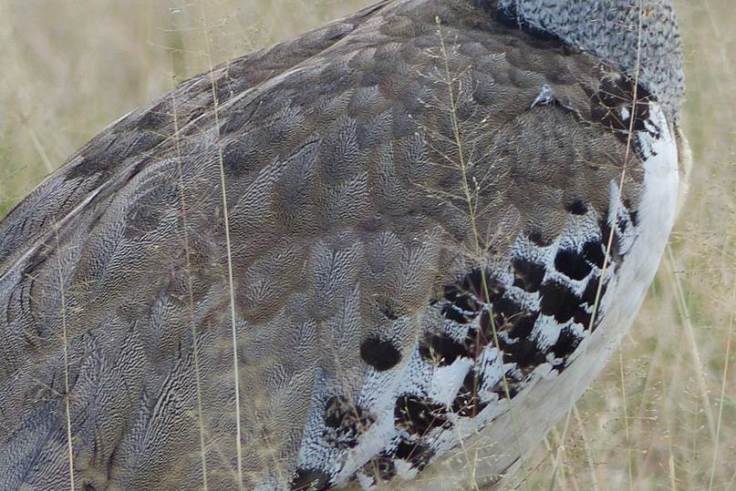
Each feather has fine barring or more distinctive black and white markings on the front edge of the wing.
Kori bustards occur only in Africa, in two distinct populations, each considered a separate subspecies. The more northerly population is in north-east Africa, occurring in South Sudan, Ethiopia and Somalia and further south to Tanzania. The southern subspecies occurs in southern Angola, Namibia, south-west Zambia, Zimbabwe, Botswana, and south into parts of South Africa.
Sadly, populations are declining over much of their range and kori bustards are classed as Near Threatened in the IUCN Red List assessment. Threats include habitat loss, bush encroachment, hunting, poisoning, the effects of climate change, and also many kori bustards are killed in collisions with power lines, which are an ever-increasing hazard as energy infrastructure expands. Even when lines are marked to improve visibility, these heavy birds with relatively poor eyesight are unable to change course to avoid collisions. Research into mitigating measures to reduce power line collisions is ongoing and the hope is to be able to address the planning and situating of new power line installations in kori bustard ranges.
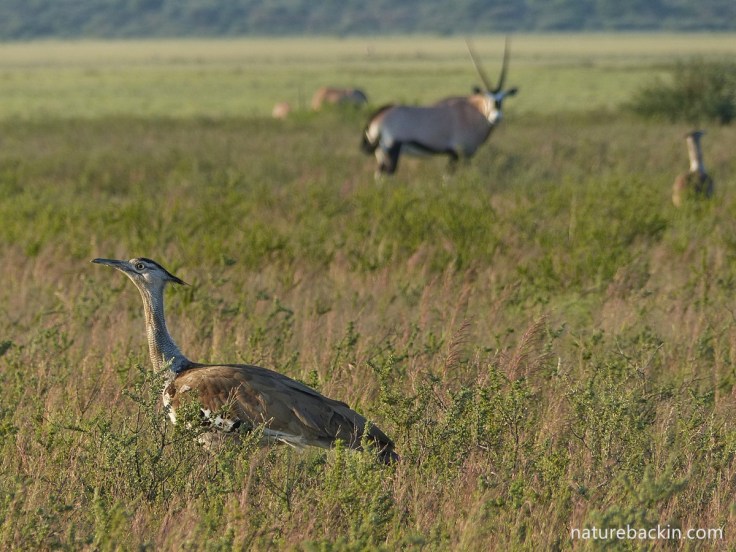
In nature conservation areas, Kori bustards are often seen foraging nearby or among other birds and animals, such as the gemsbok (oryx) seen in the background of the above photo taken at Mabuasehube Game Reserve in Botswana.
We saw an interesting interaction, recorded in the following photos, between an adult gemsbok (Oryx gazella) and her juvenile calf, and a kori bustard at the Central Kalahari Game Reserve in Botswana.
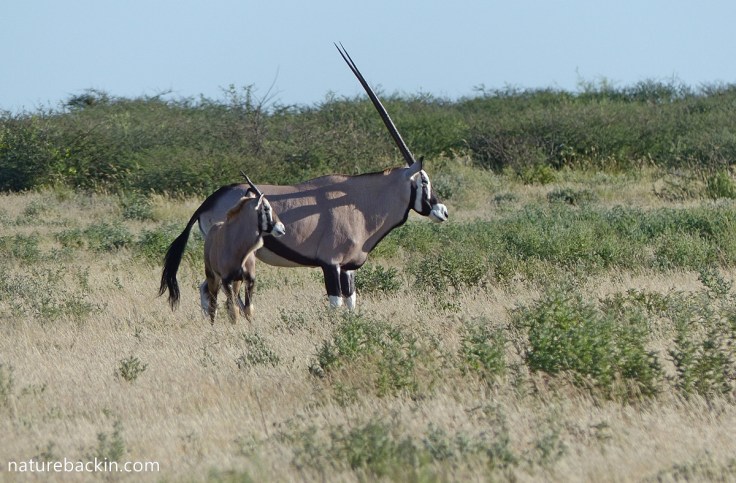
Initially we saw a gemsbok with her juvenile calf watching something quite intently.
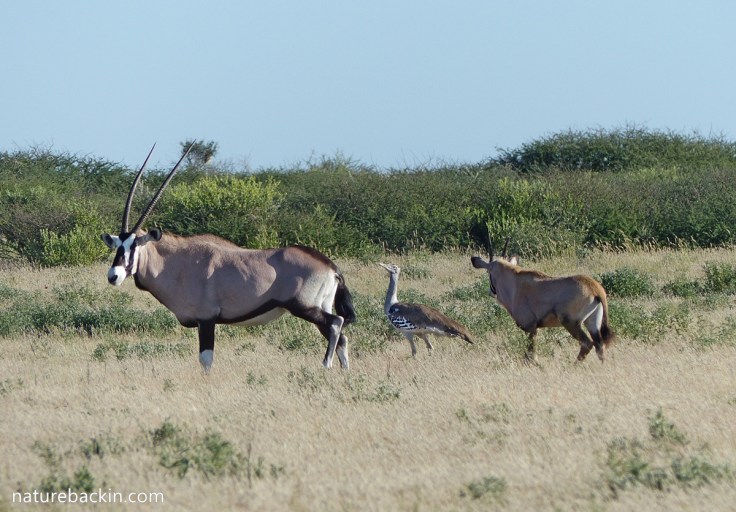
The pair turned away as a kori bustard walked past them, although the juvenile did show some interest in the passing bird. We took the kori bustard to be a male on account of his size.
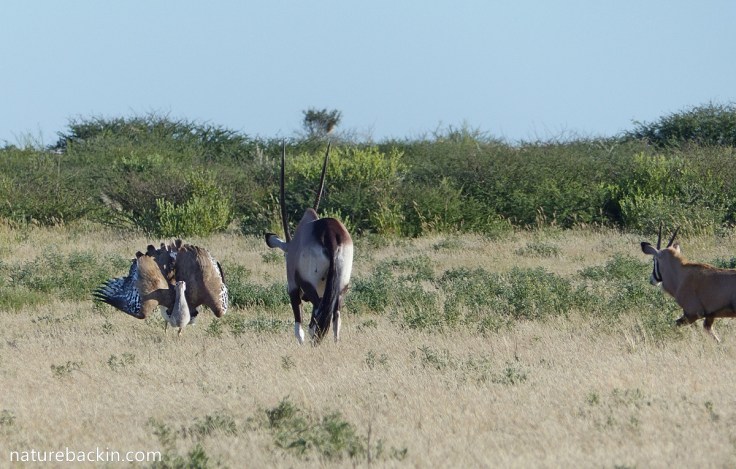
Then for some reason the kori bustard reacted with a threat display directed at the adult gemsbok, spreading its wings and fanning its tail to present a larger and threatening appearance. This aggressive posture is also referred to as a “shock display”. What precipitated this reaction from the kori bustard we didn’t know.
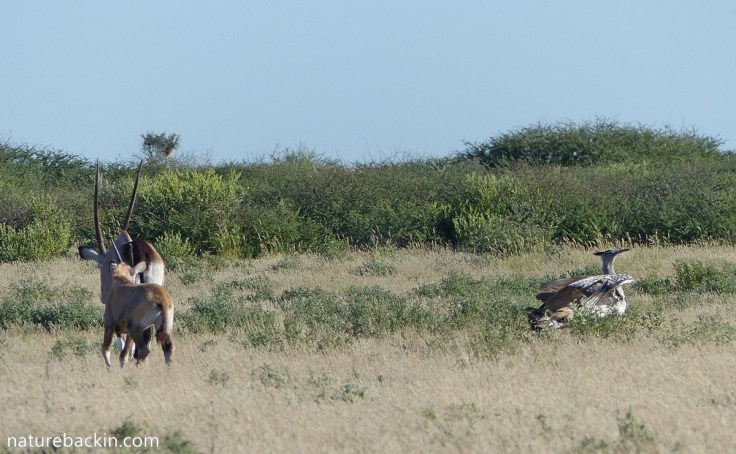
The juvenile gemsbok moved to be behind its mother and the kori bustard circled around with its wings still extended.
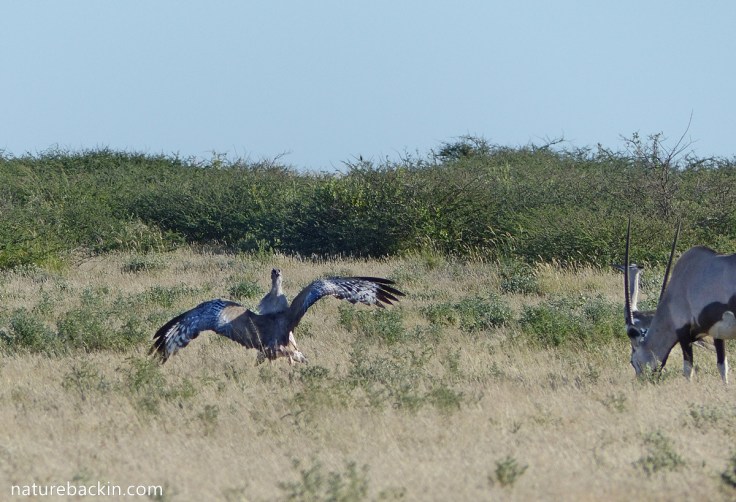
As the kori bustard turned with its back to us, we could see him still in threat display posture from behind as another kori bustard approached, just visible behind the gemsbok nibbling at some grass.
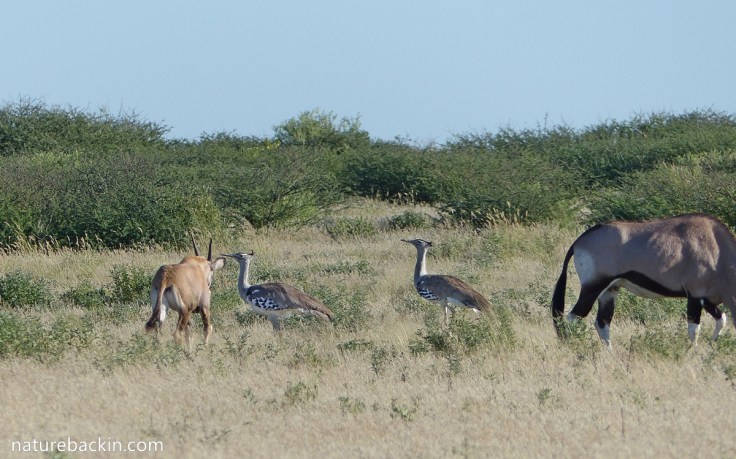
Then everything seemed to settle down with the juvenile gemsbok seemingly more intrigued rather than frightened off by the threat display. Possibly the second kori bustard is a female and we wondered if the gemsbok had unwittingly trespassed upon some kind of kori bustard courting behaviour. Meanwhile, the mother gemsbok slowly moved away while grazing.
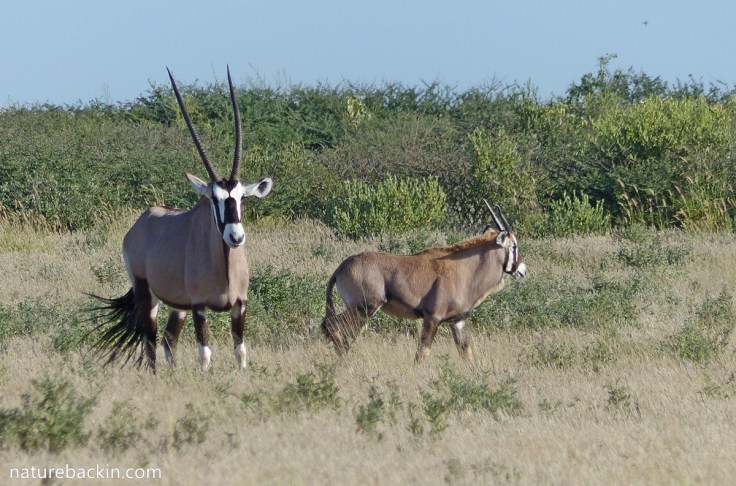
The kori bustards exited stage left, leaving the gemsboks to resume their morning activities in peace.
Another interspecies interaction involving kori bustards is commonly seen in Chobe National Park in Botswana. Carmine bee-eaters perch on the backs of kori bustards, benefitting from the larger birds stirring up insects while they forage, so that the carmine bee-eaters can then catch any disturbed insects that they might fancy. It is generally thought that the relationship between the kori bustards and the carmine bee-eaters is commensal as only the bee-eaters benefit although not to the detriment of the kori bustards. However, it is possible that the kori bustards benefit from the alert carmine bee-eaters helping detect threats and provide warning of potential predators.
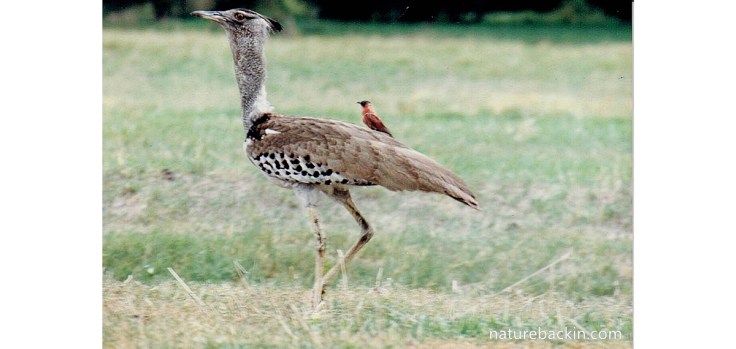
Unfortunately, the only photo I have of a carmine bee-eater perching on the back of a kori bustard is a scan of an older print photo that we took in the Chobe many years ago.
We have only seen a male kori bustard’s strutting breeding display, but to expand on what I said earlier, males use communal display sites, known as leks, to display competitively with other males to attract the attention of females. During these competitive displays, and sometimes also actual fights, one male may eventually achieve dominance and in the wake of his victory the other males leave.
Dominant males also perform courtship displays, strutting with their tails lifted and fanned, crests erect and their necks enlarged as they inflate their gular pouches concealed under their very fluffy neck feathers. Often while strutting they issue a loud, resonant and booming call that can be heard from afar. No interested female could fail to see and hear this impressive display.
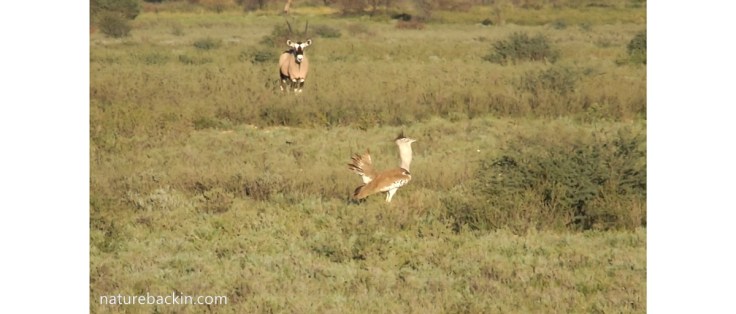
The only photo I have (above) of this strutting behaviour, is a still from a video – see the video clip below.
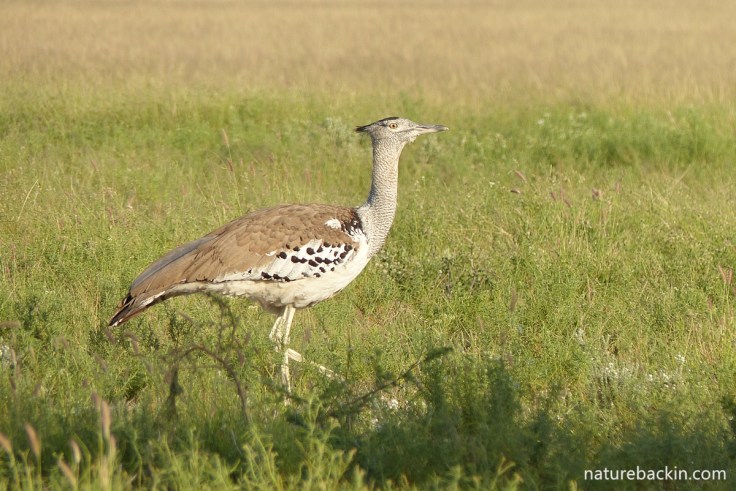
The kori bustard, even though it walks at a sedate pace, is constantly on high alert.
Population surveys are regularly conducted and various research initiatives and action plans are underway, but as noted in the report on the kori bustard in The 2025 Red Data Book of Birds of South Africa, Lesotho and Eswatini (Ehlers Smith, 2025) further proposed conservation measures include a focus on farmlands and rangelands outside of conservation areas, education of the public and increased collaboration with private landowners, taking further steps to eliminate hunting and persecution, and implementing measures to mitigate collisions with power lines, especially in known high-risk areas.
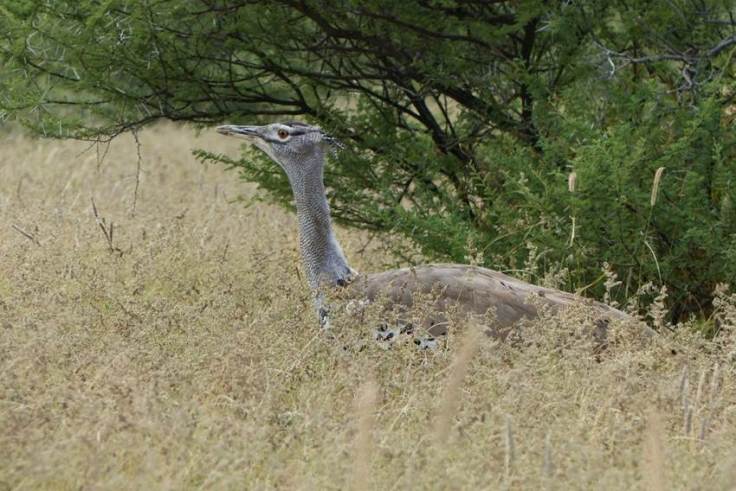
Kori Bustards are long-lived, and in captivity they have been recorded to live up to 26 years. Several captive breeding programmes were undertaken in the USA commencing in the 1990s in response to increasing concern for the survival of wild populations of kori bustards, with the thinking being that successful breeding and also behavioural observations could aid future conservation efforts. I have not found any recent updates on these projects.
A more recent international initiative, Bustards Without Borders (BWB), has been formed to work for the protection of bustards that collectively are a highly threatened group of terrestrial birds, with 60% of the total of 26 species classed as being threatened or near threatened with extinction. Various of these species occur in Africa, Asia, Europe or Australia. Of the total 26 species, 11 species (some referred to locally as korhaans) occur in southern Africa. (For a link to BWB’s first Programme of Work 2026-2028, see https://bustards-without-borders.org/program-of-work/).
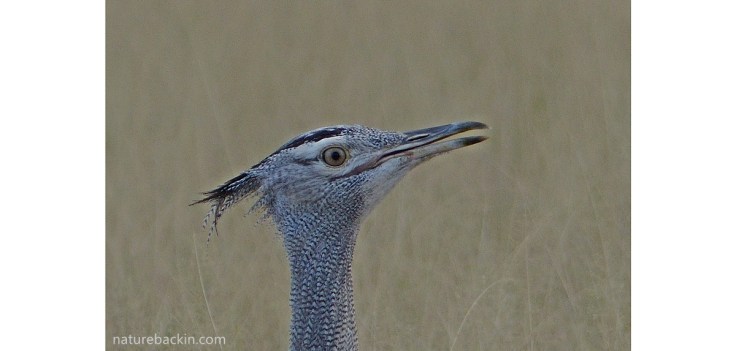
We have been privileged to see these splendid birds in the wild. As for the southern ground hornbill, the hope is that conservation efforts will enable the survival of the remarkable kori bustard.
Sources
🔖BirdLife International (2025). Species factsheet: Kori Bustard Ardeotis kori. Downloaded from https://datazone.birdlife.org/species/factsheet/kori-bustard-ardeotis-kori on 16/07/2026;
🔖Bustards Without Borders. https://bustards-without-borders.org/;
🔖Ehlers Smith, D.A. 2025. Kori Bustard. In: Lee ATK, Rose S, Banda S, Bezeng SB, Maphalala MI, Maphisa DH, Smit-Robinson H (eds), The 2025 Red Data Book of Birds of South Africa, Lesotho and Eswatini. Johannesburg, South Africa: BirdLife South Africa. Available at: https://www.birdlife.org.za/red-list/kori-bustard/;
🔖Lichtenberg, Elinor M., Hallager, Sara. 2008. A description of commonly observed behaviors for the kori bustard (Ardeotis kori). Journal of Ethology 26, 17–34. https://repository.si.edu/server/api/core/bitstreams/80d768e4-c37a-4902-b667-0744e044ce88/content;
🔖Tippet, Ryan. 2024. Kori Bustard (Ardeotis kori). Biodiversity & Development Institute. https://thebdi.org/2024/06/12/kori-bustard-ardeotis-kori/
Posted by Carol

Discover more from letting nature back in
Subscribe to get the latest posts sent to your email.


August 8, 2026 at 9:06 pm
A very impressive species and it’s amazing to think of something that heavy being able to take flight. We have one bustard in the UK (the great bustard) which was reintroduced after being hunted to extinction over a century ago.
LikeLiked by 1 person
August 9, 2026 at 10:01 am
Thanks for the info on the great bustard being reintroduced into the UK (I read that, at first at least, it has been reintroduced on Salisbury Plain). Reading more about them is of course depressing, but it is good that conservation efforts are trying to save the species.
It is amazing that such heavy birds can take off and fly.
LikeLiked by 1 person
August 7, 2026 at 6:07 pm
I remember seeing Bustards flying overhead when I traveled in Israel on a birding trip, but I didn’t realize they were so big. These remind me of our wild turkeys somehow.
LikeLiked by 1 person
August 9, 2026 at 9:23 am
Not all bustards are as large as the Kori. Do you know what species you saw in Israel?
LikeLiked by 1 person
August 9, 2026 at 12:30 pm
Good question! I will have to go back and look at my information from a few years ago to see the specific name of the bustards in Israel – or shall I say, flying over Israel.
LikeLike
August 10, 2026 at 11:43 am
I’m quite sure we saw the Houbara bustards over the Negev in Israel on a birding trip. Do you see them in your area?
LikeLiked by 1 person
August 13, 2026 at 6:43 pm
I gather that Hourbara bustards only occur in North Africa.
LikeLiked by 1 person
August 14, 2026 at 12:50 am
It was several years ago, but iI believe the birds we saw in the Negev might likely have been MacQueen’s bustards.
LikeLiked by 1 person
August 14, 2026 at 2:34 pm
I just looked up these bustards. Very interesting – thanks!
LikeLiked by 1 person
August 10, 2026 at 12:10 pm
Oh no – my error! Although we saw bustards, it was actually the migrating Honey Buzzards 5that we saw overhead!
LikeLiked by 1 person
August 13, 2026 at 6:45 pm
Seeing migrating Honey Buzzards must have been interesting. They migrate so far! We had one in our garden in KZN and I was staggered when I read how far they migrate.
LikeLiked by 1 person
August 13, 2026 at 11:44 pm
It was amazing.
LikeLiked by 1 person
July 28, 2026 at 2:25 pm
Ahh, I just love nature. Isn’t it therapeutic? Thank you for sharing these beautiful photographs and your knowledge. I especially enjoyed reading about the interaction with the gemsbok—it was fascinating to watch the story unfold. Posts like this are a lovely reminder of how much we can learn just by observing the natural world.
LikeLiked by 1 person
July 29, 2026 at 7:16 pm
Thank you Hayley. Quitely observing interactions in nature, no matter how small, can be utterly engrossing as well as therapeutic. The interaction with the gemsbok was fascinating – I wish I had more insight into what provoked that behaviour.
LikeLiked by 1 person
July 26, 2026 at 2:09 pm
I so enjoyed reading about these beautiful and interesting birds. Your photos are wonderful and gave an excellent idea of their appearance and behaviour.
LikeLiked by 1 person
July 27, 2026 at 1:08 pm
Thanks very much Christine. They are beautiful and impressive birds.
LikeLike
July 26, 2026 at 1:47 am
I am really enjoying this series. Here’s another bird I had not even heard of! Your photos and descriptions are so fascinating, and yet easy to understand. How imposing they look. I’m thinking that to see one flying might almost look like a small pterosaur?
LikeLiked by 1 person
July 27, 2026 at 1:13 pm
Hi Julie –
It is lovely to hear that you are enjoying this series. I am hoping to look at a bird species that is not endangered next time, as it can get too sobering to contemplate sometimes.
You are right, kori bustards do look rather like how I imagine a pterosaur might look in flight. Kori bustards do have something a bit prehistoric-looking about them!
LikeLiked by 1 person
July 23, 2026 at 2:22 pm
Before reading this, I did not even know that kori bustards existed. Thank you for telling us about these splendid, large birds. Fascinating
LikeLiked by 1 person
July 23, 2026 at 5:48 pm
Thanks Mariss – they are very splendid and impressive birds. I am happy to have introduced them to you.
LikeLiked by 1 person
July 23, 2026 at 1:24 pm
There is no doubt that these are all exceptional photographs – all of them! I loved seeing these birds during a trip through Botswana as well as in the Kruger National Park – never within a clear camera range for me though!
LikeLiked by 1 person
July 23, 2026 at 2:16 pm
Thanks very much Anne. These photos are misleading as typically these birds can be very elusive despite their large size! It is always wonderful to see them.
LikeLike
July 23, 2026 at 4:50 am
Great stuff Carol. A bird I’d never heard of, but that top photo got my attention! Also loved the interaction with the gemsboks, which also serves to illustrate the size of these birds. Loved the video too with the strutting behavior. It’s sad to hear how they’re struggling currently, but sadly that seems to be the norm for most species these days.
LikeLiked by 1 person
July 23, 2026 at 6:56 am
Hi Graham
I hadn’t thought about how having another species, gemsbok, in this case can provide a sense of scale even for larger creatures. I have provided a matchbox to give scale in photos of tiny critters, but its helpful to think about providing scale for larger animals too!
We were lucky to see that interaction and also the male strutting his stuff.
It is very sobering how many species are under increasing threat these days.
LikeLiked by 1 person
July 24, 2026 at 4:38 am
A bird that size is most impressive!
LikeLiked by 1 person
July 22, 2026 at 10:19 pm
Great post, Carol. A handsome bird, I enjoyed learning about it. I sincerely hope measures are taken to protect it from the endangerment it now faces.
LikeLiked by 1 person
July 23, 2026 at 6:51 am
Hi Eliza
Handsome is the word for these impressive birds.
It is interesting that conservation initiatives are extended beyond and outside the protected areas where a significant percentage of the birds still exist. Also hoping further protection measures can be implemented.
LikeLiked by 1 person
July 22, 2026 at 9:14 pm
Hi Carol,
Thank you for this detailed and well-illustrated account of your encounters with these remarkable birds. Your photos are wonderful and you must be so excited that the birds were willing to pose for you.
Let’s hope all the efforts to protect these vulnerable birds will be successful.
Best,
Tanja
LikeLiked by 1 person
July 23, 2026 at 6:47 am
Hi Tanja
Indeed they are remarkable birds, and seeing them is very special and especially when they feel safe enough not to retreat.
As for so many species, we can only hope that conservation measures help them survive.
Best to you too.
Carol
LikeLiked by 1 person
July 22, 2026 at 8:47 pm
Wow. What special experiences you had – and to get photos too! The future for these birds doesn’t look great however: everything seems stacked against them, despite concerted efforts from several quarters to change the odds. We can but hope …
LikeLiked by 1 person
July 23, 2026 at 6:43 am
Yes it was a lucky and special thing to witness and within camera range too! What you say about the future of these birds seems to be the sad situation they, as so many others, are facing. We used to see nature as a solace, but I sometimes think that these days it can be more of a sad challenge to contemplate given all the threats.
LikeLiked by 1 person
July 23, 2026 at 6:47 am
A depressing, but sadly true reflection.
LikeLiked by 1 person
July 23, 2026 at 6:58 am
I think the next terrestrial bird I feature should not be assessed as being under threat!
LikeLiked by 1 person
July 23, 2026 at 1:10 pm
Maybe. Gloom is so much in evidence, pehaps we all need a break!
LikeLiked by 1 person
July 23, 2026 at 2:14 pm
I am totally with you on that.
LikeLiked by 1 person