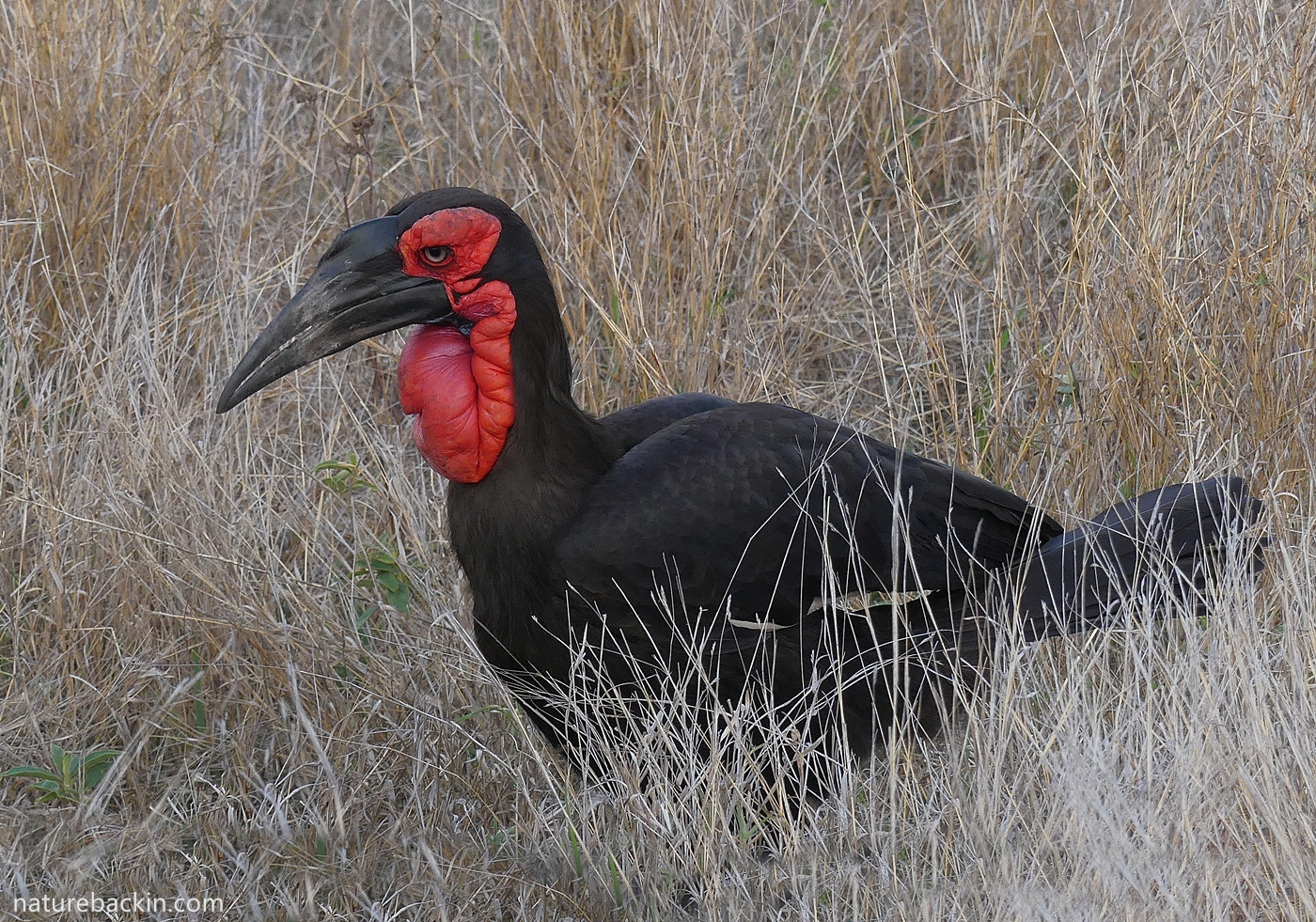
Here is the first in a series of posts on terrestrial birds, defined rather loosely as those species that spend most of their time foraging on the ground, rather than in trees or hunting on the wing. First up is the southern ground hornbill (Bucorvus leadbeateri).
I have seen wild ground hornbills in conservation areas in savannah and in open woodland, and even glimpsed them in fallow agricultural lands in the Midlands of KwaZulu-Natal.
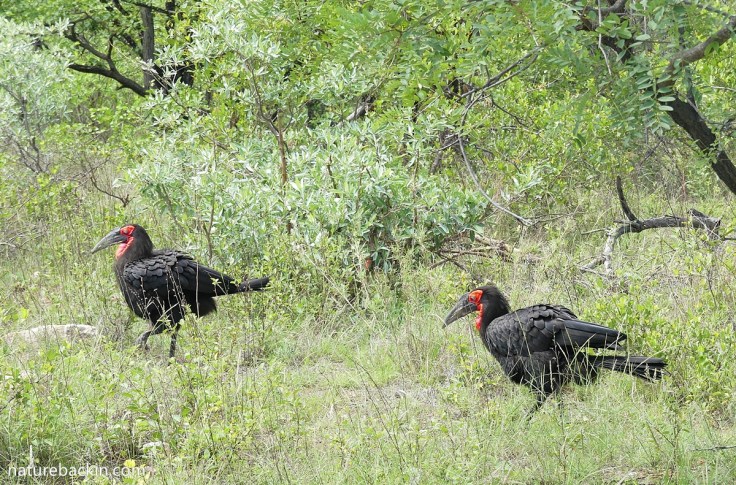
Most sightings have been of pairs or small family groups walking slowly and seemingly methodically, foraging for prey. The two in the photo above were part of a small group that we saw in Kruger National Park. As indicated by their common name, ground hornbills spend much of their time foraging on the ground. They have elaborately long eye lashes to protect their eyes from dust and vegetation.
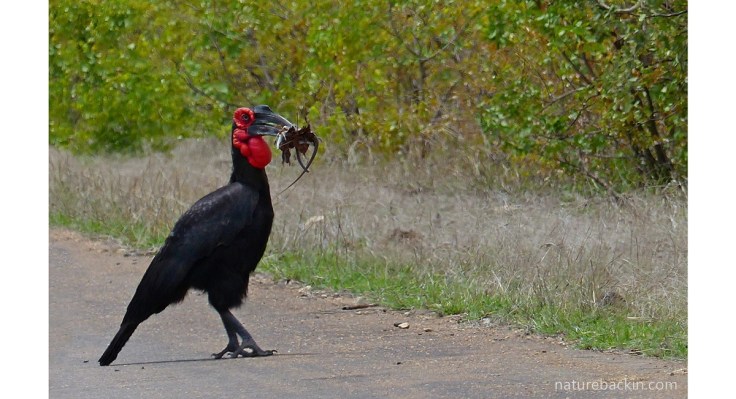
The large bill is a formidable and deft weapon for catching and subduing invertebrates as well as small reptiles, birds and even mammals if they can catch them. They are known to accumulate several prey items, as in the photo above, that they carry in the bill to improve their foraging efficiency. They will take the items to eat in the safety of a more secluded space or else take them to feed to the group’s breeding female and/or her chick.
Southern ground hornbills also eat carrion. Sadly, this practice frequently results in lead poisoning as the remains, including discarded offal, of animals that have been shot with lead bullets are contaminated with lead that can become fragmented throughout the body. Southern ground hornbills are particularly susceptible to lead poisoning. A coalition of organisations has formed a Lead Task Team to work towards reducing the poisioning of wildlife by lead and promoting the use of alternative ammunition that does not contain lead.
Another risk for scavengers, including southern ground hornbills, is consuming carcasses of animals and birds that have been deliberately poisoned as they are regarded as pests. For more on poisoning threats click on this link: https://ground-hornbill.org.za/mitigate/
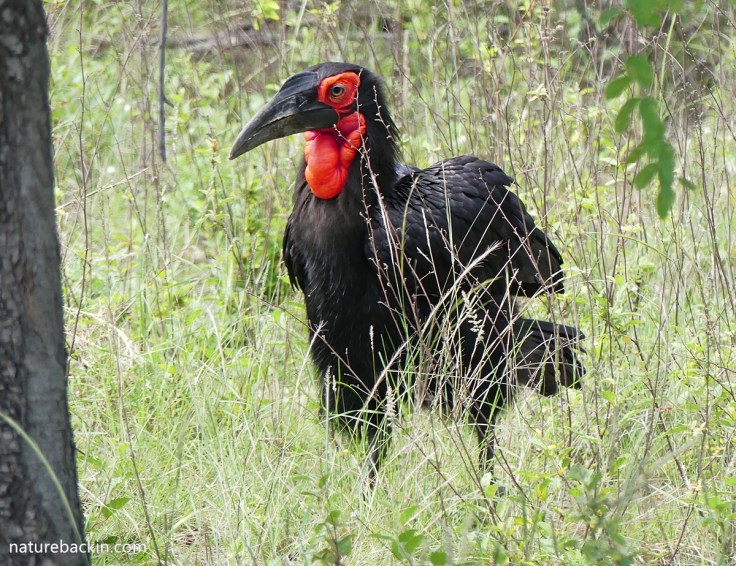
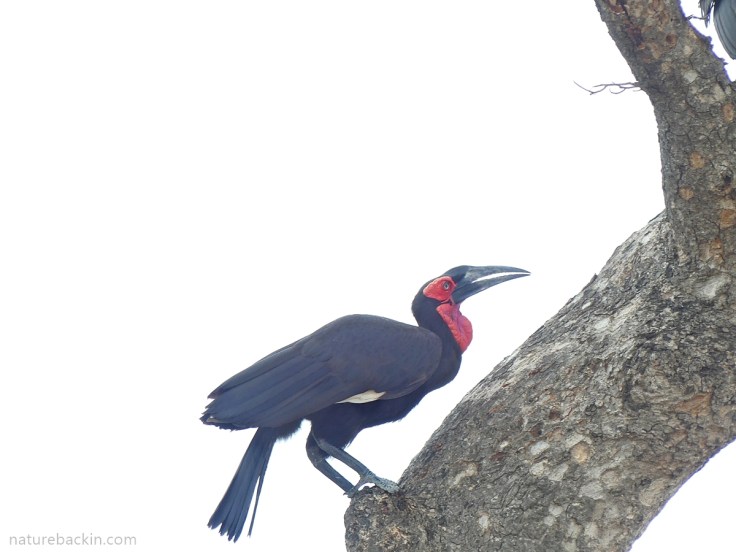
The large bill, including the casque, and the bare skin on the face and the bare loose skin at the throat, help with thermoregulation through heat dissipation in hot weather. By adjusting blood flow when in hot conditions, the birds are able to radiate heat from the bill and bare skin areas.
The loose skin (gular pouch) at the throat serves another function too; it is inflated to amplify the bird’s loud booming call that can be heard over long distances, up to several kilometres (miles) away. The calls help maintain contact between group members while foraging, and also advertise their territory. Pairs call at dusk and at dawn to proclaim their territory in a rhythmic duet. To hear and see a pair calling, see https://ground-hornbill.org.za/ground-hornbill-101/ and select “Sounds”. As can be seen in the video, the female can be distinguished by the purple patch at the throat, whereas the male’s throat is uniformly red.
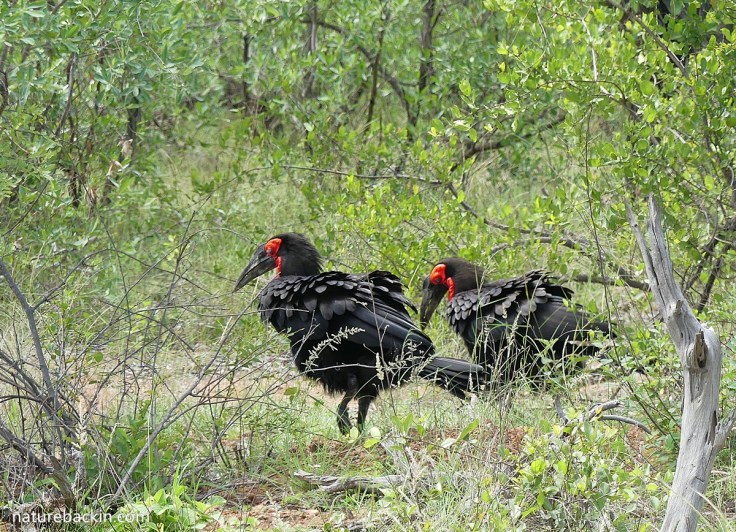
Although ground hornbills occur naturally in hot regions, they are nevertheless intolerant of prolonged high temperatures, and in addition to thermoregulating via the bill and the bare skin areas, they also may use other means to deal with the heat: they retreat to the shade, become less active, start panting, find perches off the ground and/or droop their wings to allow air to circulate around the body.
With climate change, temperatures are increasing in both summer and winter. Like many other birds and creatures in already hot regions, the increased temperatures make it difficult for them to remain active enough to forage for long-enough periods of time to find sufficient food, which in turn threatens attempts at breeding and breeding success. In winter, prey can be scarcer and there is less available shade, so needing to forage for longer with fewer opportunities to find shade is ever more stressful in generally hotter winters.
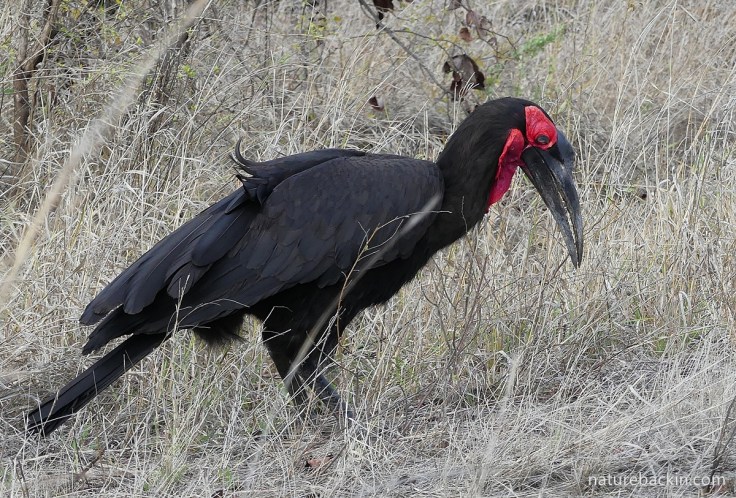
The largest species of hornbills worldwide, southern ground hornbills are approximately turkey-sized and may weigh anything from about 2–6.2 kg (4.4–13.6 lbs) with the males mostly being larger than the females. Although they forage by walking on the ground, they are capable of flying. Revealing their white covert and primary wing feathers while flying, and with a wingspan of 1.2–1.8 m (4–6 ft), they are impressive in flight.
Ground hornbills are long-lived, with life expectancy in the wild being 40–50 years, and up to 70 years in captivity. With such longevity, they reach sexual maturity only at 4–6 years, usually breeding for the first time when they are about 10 years old.
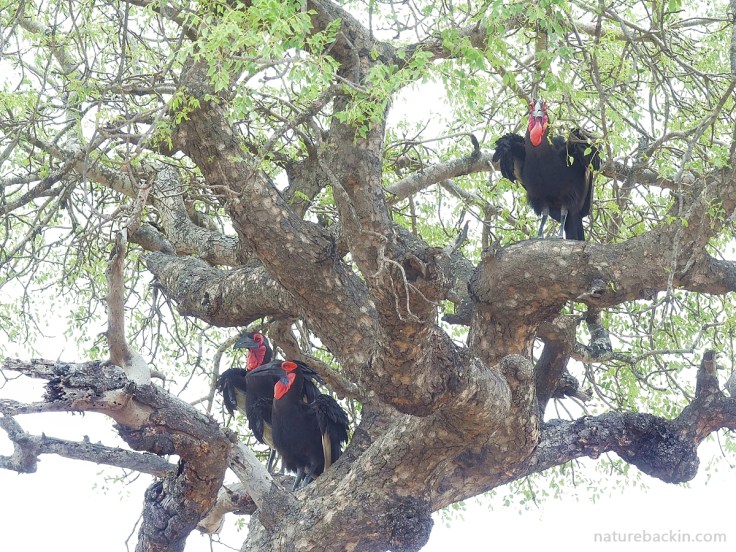
Although foraging exclusively on the ground, southern ground hornbills do roost and nest in trees. We saw a small family group in a large and solitary marula tree when we were on a visit to Kruger National Park in 2021. Ground hornbills are cooperative breeders living in small territorial family groups with one dominant breeding pair and a number of non-breeding helpers. In the above photo, the two on the left turned out to be the breeding pair. The adult on the left is one of the helpers, and not pictured is a fourth member of the group, an immature bird yet to gain its adult colouration.
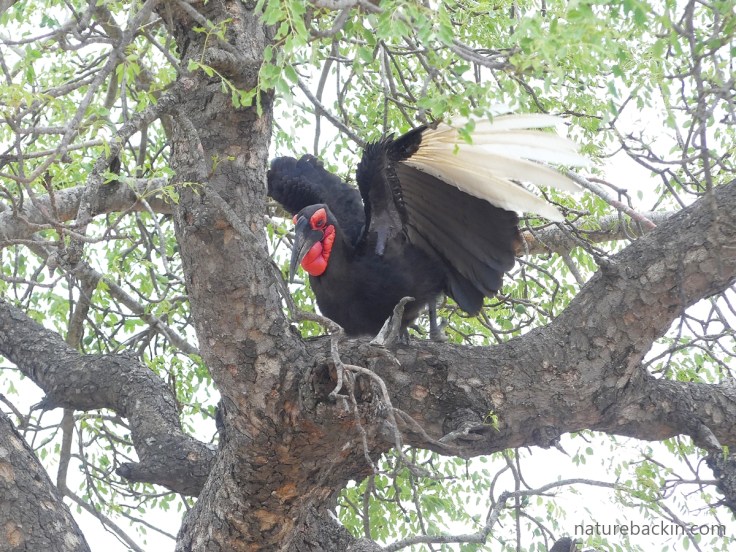
Up in the tree, the adult helper stretched his wings and showed off the white wing feathers that are normally concealed. Most of the helpers in a family group are males as the females disperse or are chased from a family group before they reach sexual maturity. They wander alone until they find a group to join up with. Males remain in the family group as helpers, even after reaching sexual maturity, with some individuals eventually dispersing to join other groups.
Despite living in cooperative groups, southern ground hornbills have a very slow breeding rate. Breeding attempts are affected by several factors, including environmental conditions and weather patterns, the body condition of the birds, and whether or not they have an available nest, meaning that several annual summer breeding seasons may pass without them breeding at all. According to the Mabula Ground Hornbill Project, the overall fledgling average is only one chick per group every nine years.
Southern ground hornbills nest in cavities in large trees, but may also find nesting sites on rock faces or earth banks. Unlike other hornbill species, the female is not sealed up in the nest, but she does incubate the eggs in the nest (over a period of 40 days) and mostly stays with the newly hatched chick/s for over a month. She does, however, leave the nest daily to join the others in the group and participate in territorial calling. The entire group contributes to bringing food to the nesting female and to the chick prior to it fledging.
Although ground hornbills typically lay two eggs several days apart, resulting in an older and younger chick, it is only the elder chick that is raised. The younger bird is thought to be a “spare” that will be raised if the first egg fails or the older chick does not survive. So, usually the younger chick ends up dying of starvation.
Classed as Endangered in South Africa and Namibia (and classed as Vulnerable in their range in central and eastern Africa), several projects actively intervene in the conservation of this species that is exposed to many threats. In response to the rapid decline in the numbers of ground hornbills in southern Africa, the Mabula Ground Hornbill Project, founded in 1999, works to protect and conserve the species. As part of their work in restoring ground hornbill populations, the project harvests the redundant second chick (if left in the nest it would perish from starvation) from the nests of wild southern ground hornbills. The chicks are hand reared at a rehabilitation centre. Each chick over time is carefully integrated into a group led by a wild breeding male/alpha male. For a description of this complex process click on this link: https://ground-hornbill.org.za/restore/
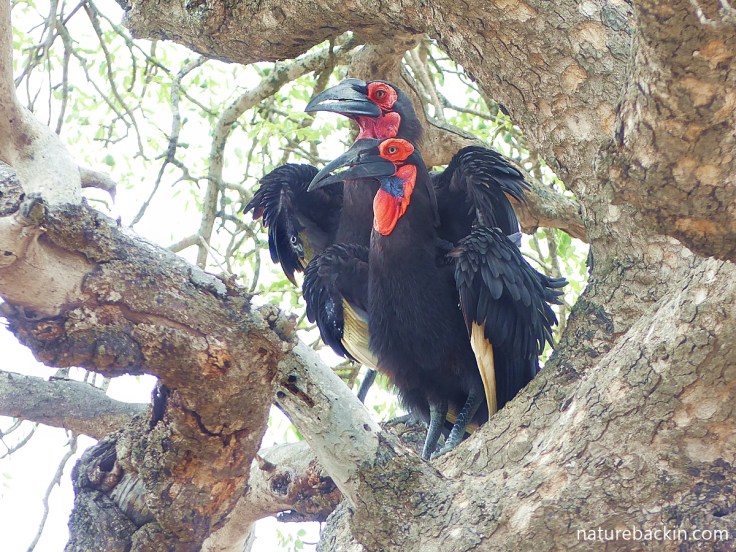
In the photo above the breeding pair are looking particularly regal perched in the marula tree just prior to mating. The female, in the foreground, can be distinguished by the purple patch of skin at her throat. I don’t know whether this tree in which they are perching will ultimately become their nesting tree.
Unfortunately, along with habitat destruction and other threats, naturally occurring nesting sites have become increasing rare. The APNR Southern Ground-Hornbill Project is a conservation project in the greater Kruger area. The Associated Private Nature Reserves (APNR) are five privately owned nature reserves on the western boundary of the Kruger National Park. A key focus of the project is the installation and monitoring of artificial nests, which have significantly contributed to more frequent breeding activity and improved breeding success. The project’s research and monitoring data contributes also to the work of the Mabula Ground Hornbill Project and the national strategy for conserving this species. For more information on the success of the artificial nests click on this link: https://www.apnrgroundhornbillproject.com/projects
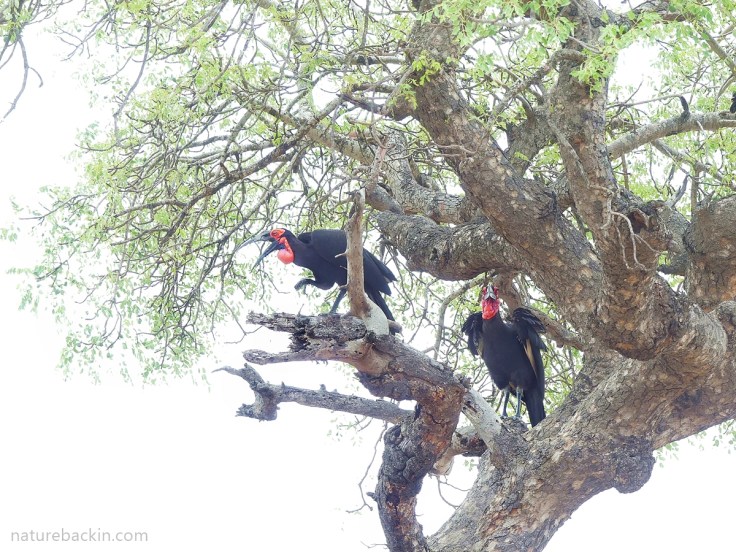
While we were watching, the female moved to an outer branch and called a few times before returning to the male.
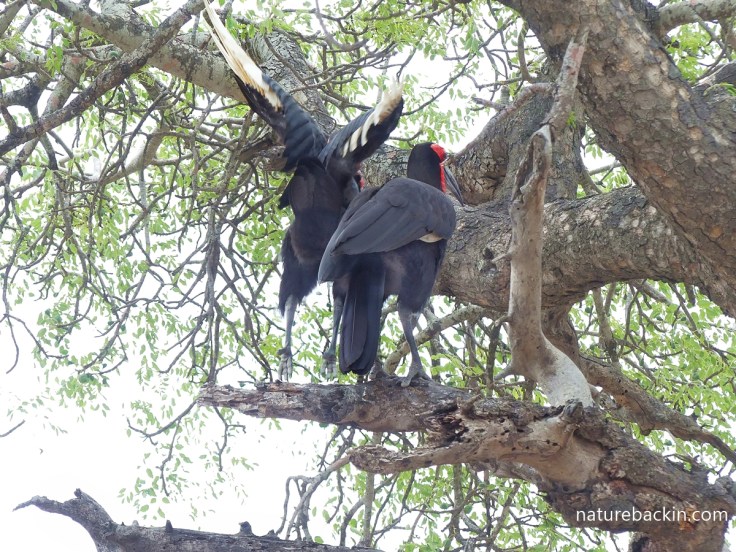
Both birds then hopped up onto a higher branch.
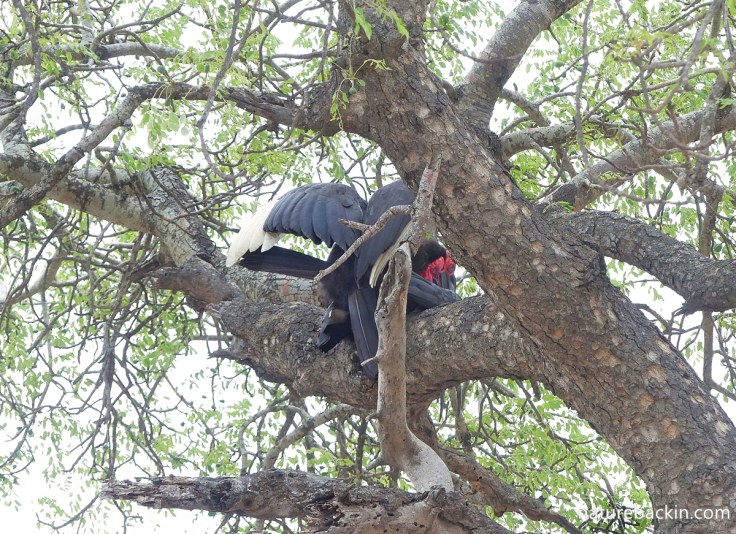
The pair then mated while high up in the tree. We only had a limited view of them as they were partially concealed by branches.
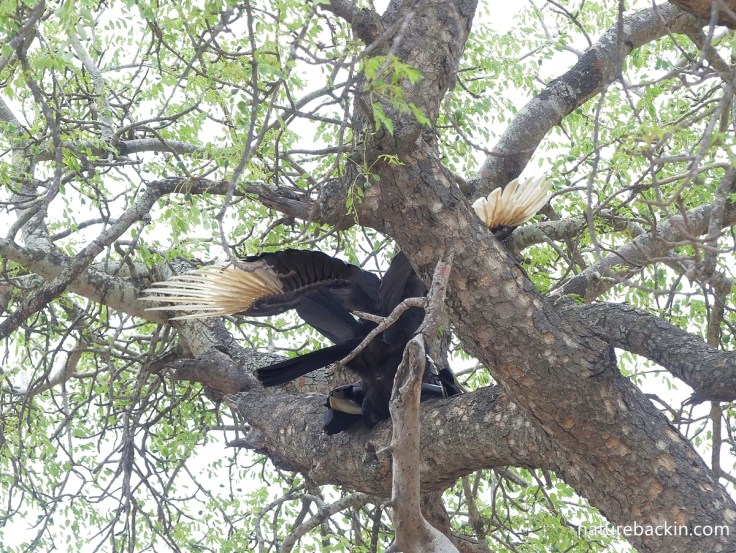
At one point the female tipped forward at a dangerous angle but the pair managed not to fall out of the tree.
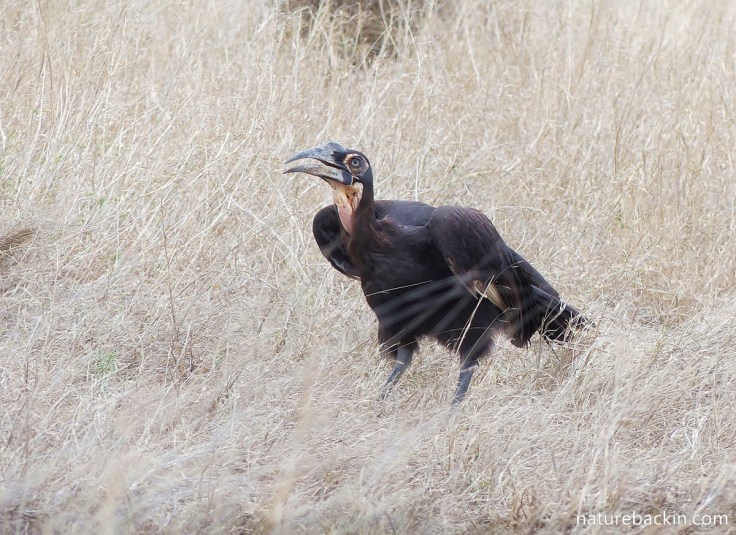
Meanwhile the juvenile on the ground below the tree watched the mating pair, most likely his parents, with what looked to be a disconsolate air. We rather fancifully imagined that he was having a premonition of his losing his current favoured “baby” status, and maturing into the status of helper to the group and to the breeding pair and any ensuing offspring.
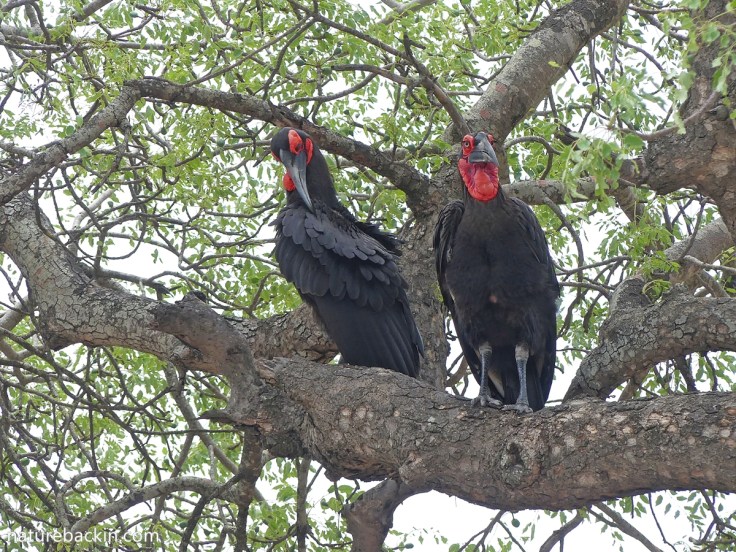
After mating the pair remained together and indulged in a bit of preening. After a few minutes the juvenile flew up into the tree just below them, and the other adult male remained in his perch higher up in the tree.
This was a very special sighting of this iconic species. It is sobering to know that the numbers of these birds have declined rapidly in the face of threats that include habitat loss, poisoning, electrocution on power lines, deliberate persecution and climate breakdown. At the same time, it is heartening to know of the active conservation projects that work to mitigate these threats. For more about these projects see the links in the sources listed below.
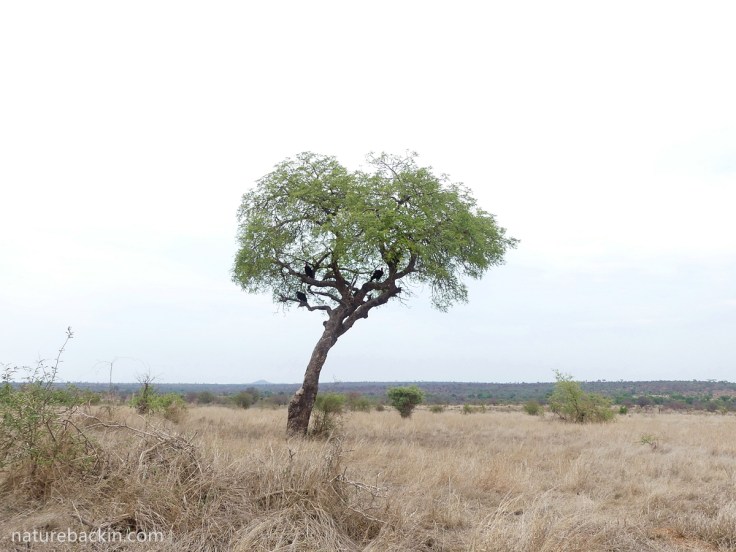
When driving away, after an engrossing time watching this hornbill family, we stopped to look back at the roosting tree that was not far from the road. All four birds were perched high up in the branches. Let’s hope that they had breeding success after the mating we witnessed, and that the descendants of this family continue to survive despite the many threats and challenges. By now, if he has survived, the juvenile would be about ten years old and of breeding age, possibly having dispersed to a new group and attaining breeding status.
Sources:
🔖Africa Geographic. 2022. Southern ground hornbill: Africa’s rara avis. https://africageographic.com/stories/southern-ground-hornbill-africas-rara-avis/#:~:text=It%20is%20the%20voice%20of,Africa’s%20most%20iconic%20bird%20species.
🔖APNR Southern Ground-Hornbill Project. 2025. https://www.apnrgroundhornbillproject.com/
🔖BirdLife International. 2025. Species factsheet: Southern Ground-hornbill Bucorvus leadbeateri. https://datazone.birdlife.org/species/factsheet/southern-ground-hornbill-bucorvus-leadbeateri
🔖Janse van Vuuren, Andries & Kemp, Lucy & McKechnie, Andrew. 2020. The beak and unfeathered skin as heat radiators in the Southern Ground‐hornbill. Journal of Avian Biology. 51 (6). DOI:10.1111/jav.02457
🔖Mabula Ground Hornbill Project. 2024. https://ground-hornbill.org.za/what-we-do/
Posted by Carol

Discover more from letting nature back in
Subscribe to get the latest posts sent to your email.


July 16, 2026 at 2:58 pm
I so very much enjoyed this thorough look at the Southern Ground Hornbills, Carol. I love this bird. I saw it a few times in eastern Africa over a decade ago. They didn’t stay around long so my observations were not as in-depth as yours was, so I was really glad when I saw the title of your post because I knew I would finally get a few more beautiful moments with them. I really appreciated the link to their sounds, that video was fantastic. When I saw them, I heard a sort of blowing-into-a-coke-bottle sound from them, which I did hear faintly in the background of the video. The project sounds wonderful and I was glad to see their website and hear about their great works. It’s especially noteworthy that they raise the “spare” chick. Great narrative and photos, Carol, and much appreciated.
LikeLiked by 1 person
July 16, 2026 at 6:42 pm
Hi Jet, that is great that you saw ground hornbills on your visit to eastern Africa.
The video of the pair duetting is really interesting.
The conservation projects seem to be yielding significant successes, not least raising the “spare” chick.
Thanks so much for visiting and commenting.
Best from Carol
LikeLiked by 1 person
July 15, 2026 at 2:45 pm
Hi Carol
Would it be possible for me to include the link to this article (and future ones on other terrestrial birds) in the Inkwazi Birdclub newsletter, of which I am the editor?
I have attached our July newsletter to help you decide!
Regards Lesley Jeffrey
LikeLiked by 1 person
July 16, 2026 at 6:38 pm
Hi Lesley, that would be fine to include a link to this post (and the future ones) in the Inkwazi Birdclub newsletter. Thanks for asking.
(By the way, I don’t find your July newsletter attached, perhaps because this is via a comment.)
With best wishes
Carol
LikeLike
July 17, 2026 at 7:01 am
.Hi Carol
Thanks for your permission, I’m sure our readers will enjoy your posts as much as I do.
I think you’re right about the attachment being missing is likely due to it being in a comment. If you would like to see an example of the newsletter, please send me an email address I can use instead.
Regards Lesley
LikeLiked by 1 person
July 22, 2026 at 2:58 pm
Hi Lesley – my email is dcbramm at gmail dot com.
Thank you!
LikeLike
July 14, 2026 at 4:10 pm
So wonderful bird 🕊️
LikeLiked by 1 person
July 14, 2026 at 6:57 pm
Indeed, they really are wonderful birds. Thanks for visiting.
LikeLiked by 1 person
July 15, 2026 at 11:53 am
💐
LikeLike
July 13, 2026 at 9:00 pm
Oh wow! What an amazing bird! I’ve not seen one before.
LikeLiked by 1 person
July 14, 2026 at 6:52 pm
Thanks for visiting. Yes indeed – I find them amazing every time I see them – they are somewhat larger than life!
LikeLike
July 13, 2026 at 10:13 am
Carol, what a fascinating essay, thank you! I saw these birds a number of times on my visits to Kruger but knew nothing about them beyond their name, size and colouring. Only when I learn more about a given species do I truly begin to understand the intricacy and marvels of nature. Your closing words echoed my thoughts as I read – to hear of the many threats to these birds is discomfitting, but perhaps there is hope in the projects underway.
LikeLiked by 1 person
July 13, 2026 at 7:17 pm
Hi Sandra – I am glad you saw these amazing birds on your visits to Kruger. Indeed the threats to so many species are distressing, but it is heartening that there are conservation projects that are having a measure of success in assisting in the survival of the ground hornbills in South Africa.
LikeLiked by 1 person
July 12, 2026 at 8:56 pm
What a truly magnificent bird, and one that I don’t recall seeing on my trips to Africa. I hope the conservation efforts are successful.
Lead shot is in the process of being banned in the UK but slowly, with a phasing out period.
LikeLiked by 1 person
July 13, 2026 at 7:11 pm
Thanks Adele – they are very impressive birds and let’s hope they can be saved.
That is good to know that lead shot is the process of being phased out in the UK.
LikeLike
July 10, 2026 at 6:33 pm
Hi Carol,
Thank you for sharing photos and descriptions of your very special observations. I saw the northern (Abyssinian) relatives of these hornbills at our local zoo only a few days ago, but that was obviously a very different experience from yours, seeing these impressive birds in their natural habitat.
I also find it heartening to know that there are people who care enough about ensuring the survival of certain creatures, they spare no effort in trying to undo all the damage of centuries. Let’s hope they will be successful.
Best wishes for you and the hornbills,
Tanja
LikeLiked by 1 person
July 13, 2026 at 7:09 pm
Hi Tanja – thanks for reading my post on these amazing birds. What a coincidence that you recently saw some Abyssinian hornbills at your local zoo.
We can only hope that the conservation efforts save these birds from extinction.
Thanks for your good wishes.
Best to you too
Carol
LikeLiked by 1 person
July 4, 2026 at 11:14 am
Thank you, Carol, for this fascinating account. I was especially pleased that the redundant chicks were being rescued from starvation! There were many of these remarkable birds at Thula Thula when Barbara and I were there and we so enjoyed their noisy presence.
LikeLiked by 1 person
July 4, 2026 at 3:21 pm
Hi Christine, I agree that harvesting the second chick is good also for the welfare of the chicks saved from starvation, in addition to helping the survival of the species. Hearing a group of hornbills calling is an unforgetable experience.
LikeLike
July 4, 2026 at 4:35 am
A remarkable bird Carol, and great information about it. It’s sad they’re struggling to survive, like so many other creatures. Hopefully, the support projects will help.
LikeLiked by 1 person
July 4, 2026 at 3:18 pm
Thanks Graham. They are very impressive. It is sad that so many threats stack up against them. Perhaps the conservation projects will enable them to survive – at least in some of the conservation areas.
LikeLiked by 1 person
July 3, 2026 at 4:19 pm
I love seeing Ground Hornbills! Your photographs of them in a tree has really piqued my interest for I have not seen them do this before!
LikeLiked by 1 person
July 4, 2026 at 3:14 pm
I have seen them flying up to perch on branches of dead trees, but nothing like this activity high up in the lone marula tree. It is always very special to see them.
LikeLiked by 1 person
July 3, 2026 at 11:51 am
A fascinating post about these beautiful ground hornbills, Carol! What a special encounter! Seeing that lone tree in the distance at the end provides such a distinct perspective. Thank you for sharing.
LikeLiked by 1 person
July 3, 2026 at 1:57 pm
Thanks Carol, and yes it was special to see that family group in that lone marula tree. I am glad we stopped to look back to take the final photo that gives it better context.
LikeLiked by 1 person
July 3, 2026 at 3:36 pm
I didn’t mention that I also clicked on the link and heard the hornbill’s incredible sounds! Amazing.
LikeLiked by 1 person
July 4, 2026 at 3:12 pm
The call is incredible. I have read that the way the sound carries, it can sound even louder at a distance.
LikeLiked by 1 person
July 3, 2026 at 12:28 am
My goodness that is an extraordinary bird, and your photos are amazing. The strong colors felt a bit frightening to me at first, but in the “portraits” you captured they looked truly regal.
Oh, the sound they make! It reminded me of a conversation between a very low flute and an answering hollow drum. Fascinating!
It’s always sad to hear that so many birds and animals are struggling to survive in these troubled times. I hope your beautiful article is also published elsewhere, so more people can learn about and appreciate them.
Best,
Julie
LikeLiked by 1 person
July 3, 2026 at 1:55 pm
Hi Julie – I agree these birds can look rather intimidating, but despite that formidable bill there is even something rather endearing about them!
Your description of the call is poetic and apt, and in contrast to Margaret saying the call can sound like a spoof musical instrument!
It is sad and troubling that so many creatures are on the edge of survival in these troubled times. I admire the scientists and conservationists doing the hard yards in their efforts to save and conserve our wildlife and habitats.
Best from Carol
LikeLiked by 1 person
July 2, 2026 at 9:59 pm
Fascinating post, Carol. Such an interesting bird, its look and call make me think of its dinosaur ancestors. Imagine a colony of them calling out!
LikeLiked by 1 person
July 3, 2026 at 1:42 pm
Thanks Eliza. They are remarkable birds. I had not thought of the connection to dinosaurs until you mentioned it!
LikeLiked by 1 person
July 2, 2026 at 6:40 pm
What an extraordinary and utterly fascinating bird. That call! My husband thought I was playing a spoof musical instrument on my laptop when he heard it! The odds seem sadly stacked against it, so I hope the feeding threats it contends with can be protected by strong legal means, and that it develops strategies to help it to flourish despite the difficulties pesented by climate change. Thanks for this engrossing account!
LikeLiked by 1 person
July 3, 2026 at 1:28 pm
Hi Margaret, they do have a weird call and a spoof musical instrument is a great description!
They are very fascinating birds. When I was a child, I was particularly smitten by their glamorous long eyelashes.
It is sad and troubling that their future is so uncertain in these times of climate change and other threats. Kudos to those working so hard to protect and save them.
LikeLiked by 1 person
July 3, 2026 at 7:36 pm
May they succeed. And .. I’ve never seen a bird with eyelashes!
LikeLiked by 1 person
July 4, 2026 at 3:16 pm
I once noticed feathering resembling eyelashes on a brownhooded kingfisher that I saw one close by, but nothing to compare to the ground hornbill’s lashes!
LikeLiked by 1 person
July 5, 2026 at 6:42 am
I suppose ground-foraging in relatively large birds exposes them to dust, pollen, seeds etc.
LikeLiked by 1 person
July 7, 2026 at 2:38 pm
Yes, it is thought that the eyelashes serve as protection for the eyes from dust etc.
LikeLiked by 1 person