Spurfowls, like francolins, are part of the pheasant family. Their name comes from the tarsal (leg) spurs that are especially evident in the males. All 23 species of spurfowls are endemic to the African continent, with 6 species occurring in southern Africa.
Previously, spurfowls and francolins were lumped together and were generally referred to as francolins. In the early 2000s, as more genetic and behavioural characteristics became known, ornithologists decided that it made sense to split spurfowls (now in the genus Pternistis) from the smaller francolins.
Spurfowls are more prone to sit tight or else run rather than fly when alarmed, and they perch in branches off the ground at night, whereas true francolins are more likely to take flight when startled and most francolin species rest on the ground. The crested francolin that featured in the previous post, confusingly, shares some characteristics associated with spurfowls, but is an exception among the southern African francolins.
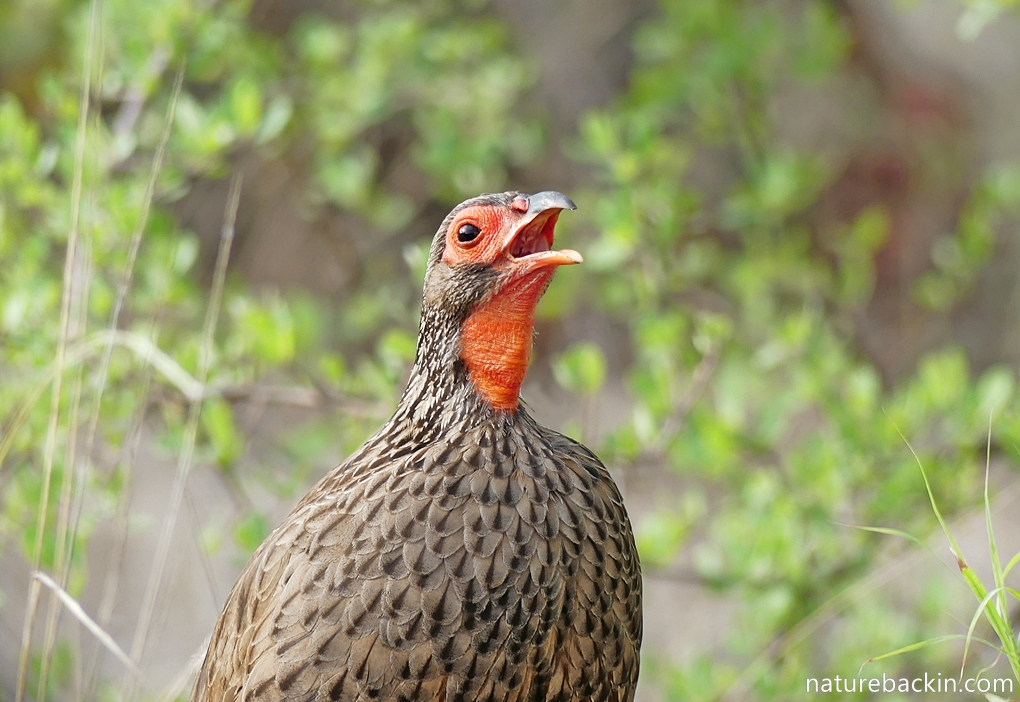
Loud grating calls are characteristic of spurfowls, compared to the softer and less harsh calls of the true francolins. The header photo shows a Swainson’s spurfowl calling its repetitive harsh crowing sound early one morning.
Swainson’s spurfowl
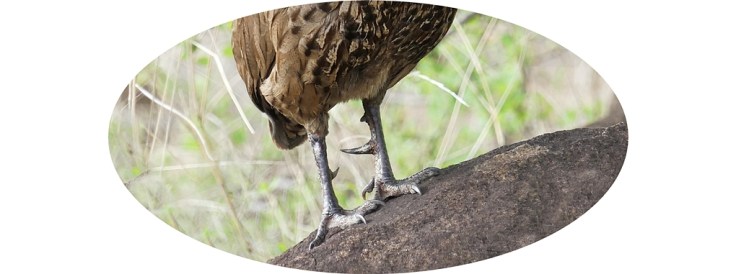
The long backward-facing leg spurs of a Swainson’s spurfowl are visible in the above photo. The spurs are used in courtship fights and as a defence against predators. The spurs wear down as a bird ages. Females often do not have leg spurs, and if they do the spurs are very much smaller than in the males.
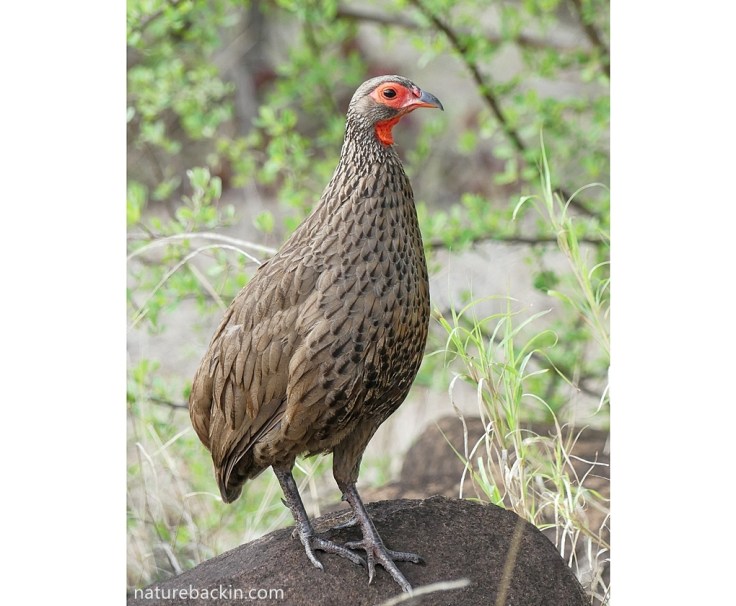
The easiest way to distinguish the Swainson’s spurfowl from other spurfowls is the combination of red face and throat with the black legs. The above photo of a Swainson’s spurfowl (Pternistis swainsonii) was taken in the Kruger National Park.
.
Red-necked spurfowl
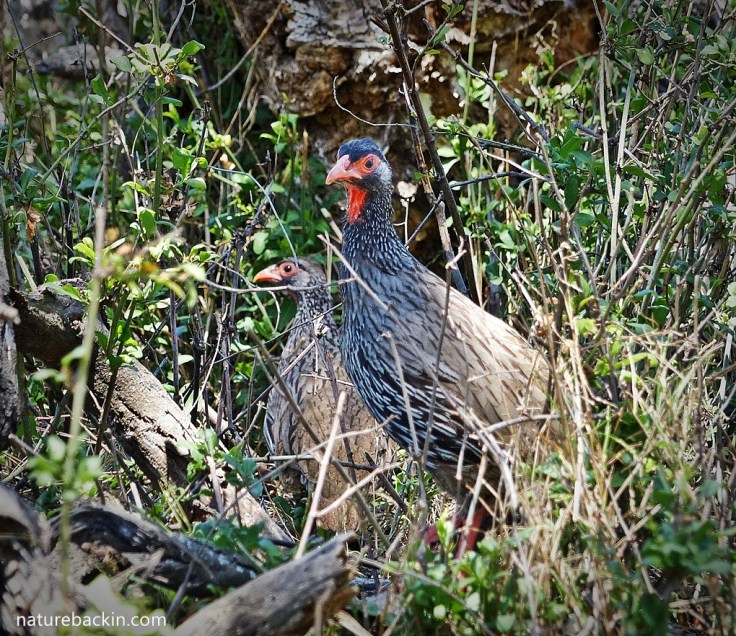
By contrast, the red-necked spurfowl has red legs (that are partially concealed in this photo). Red-necked spurfowls (Pternistis afer) are generally wary and prefer deep cover, as demonstrated by this pair photographed in the Baviaanskloof, whereas Swainson’s spurfowls prefer grasslands or open savannah.
.
The range of the red-necked spurfowl extends northwards into parts of central Africa, whereas the Swainson’s spurfowl is confined more to southern Africa, as far north as Zambia. Both species are absent from the Western Cape, but their ranges overlap in the inland regions of eastern South Africa where they occupy distinct habitats
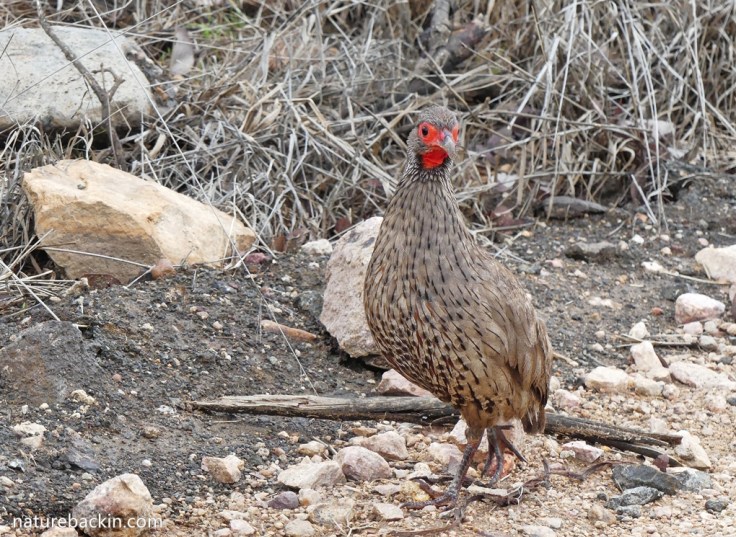
This Swainson’s spurfowl, in the above photo, we saw walking rather jauntily beside the road in Kruger National Park, where it is not unusual to see spurfowls foraging along the road sides. Spurfowls generally are omnivorous feeders, feeding mostly on plant material, including roots, bulbs, small fruits, shoots, seeds and grain, supplemented in the summer by a variety of invertebrates.
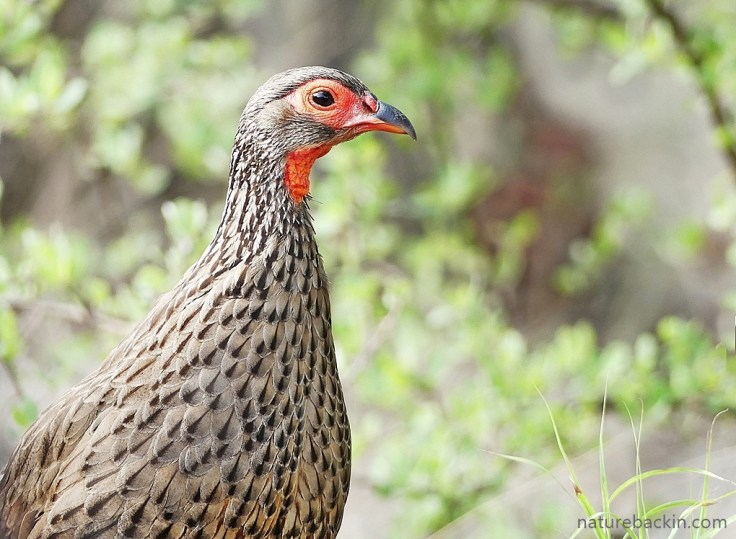
In addition to the eye-catchingly red bare skin on the face and throat, the Swainson’s spurfowl is indeed a bird of fine feathers.
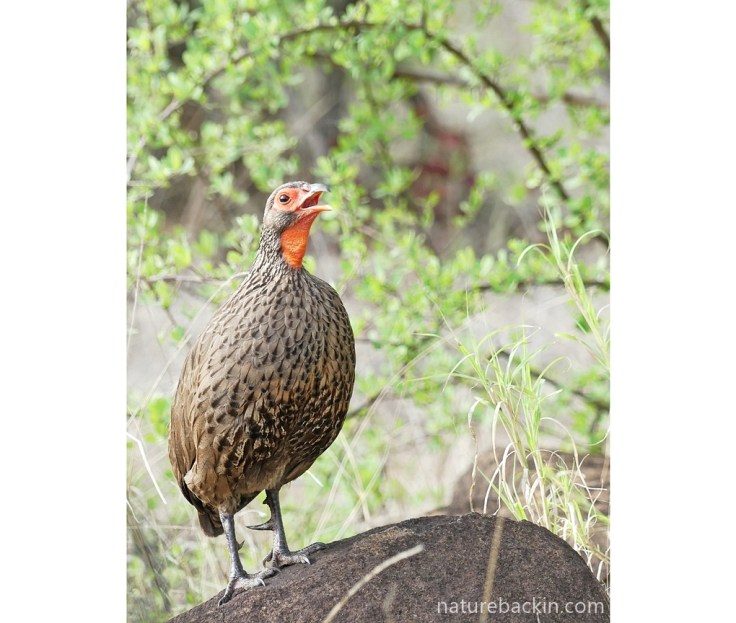
This male Swainson’s francolin has found a slightly elevated place from which to call. Like other spurfowls species, they call most often at dawn and dusk. To listen to recordings of the calls of southern African spurfowls and francolins click here.
.
Red-billed Spurfowl
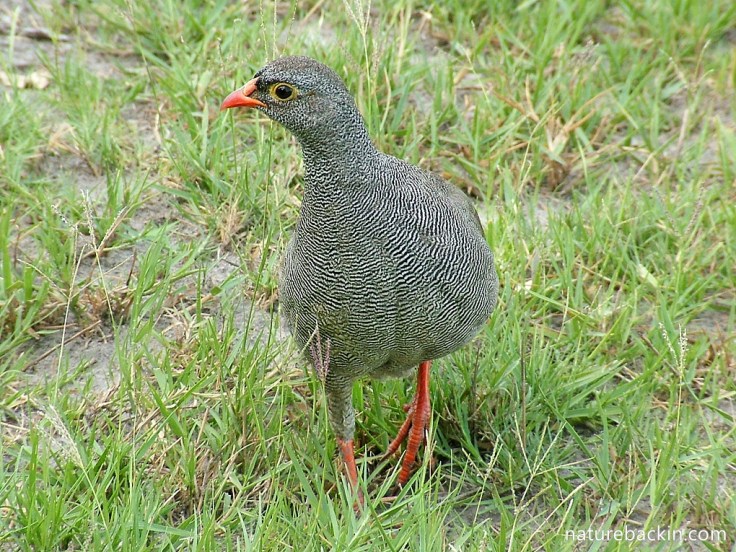
On our visits to nature parks in Botswana, it became evident that red-billed spurfowls (Pternistis adspersus) like to hang around campsites. Perhaps the presence of human campers offers some protection from predators. Also, they may opportunistically pick up discarded scraps of food. I grew up knowing these birds as francolins (before they were renamed spurfowls), and so any bird making itself at home around our campsite we inevitably referred to as Frank.
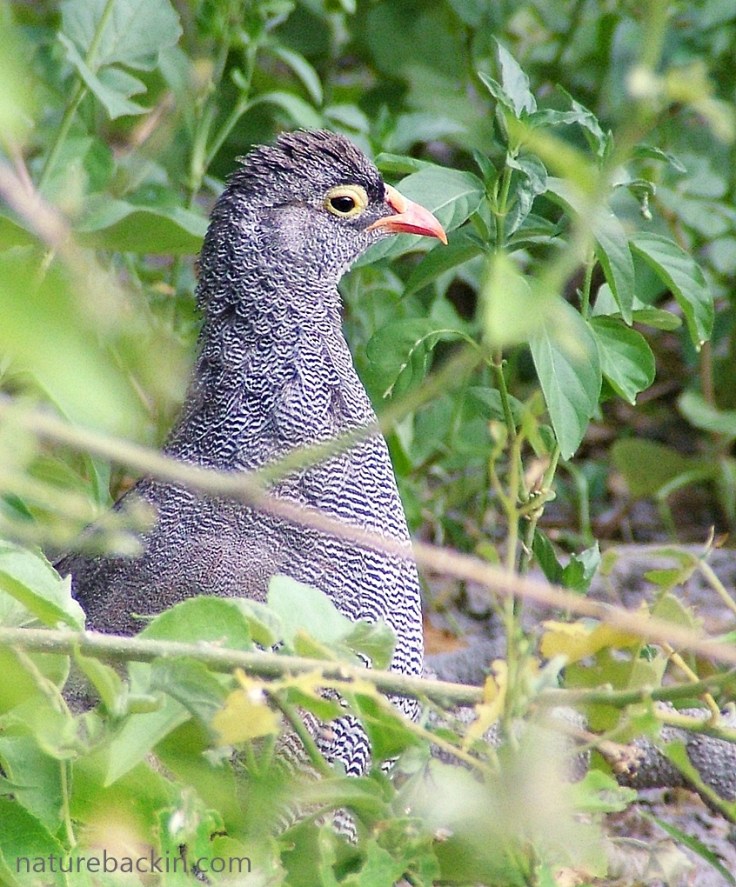
The red-billed spurfowl is the only spurfowl in the region to feature yellow eye-rings. Its red bill and red legs are also conspicuous and its plumage is finely barred.
Red-billed spurfowls inhabit drier country and occur in northern Namibia, parts of Angola, Botswana, Zambia and Zimbabwe and in a small northern central area of South Africa.
.
Of the six species of southern African spurfowl, the only species that I do not include in this post is the Hartlaub’s spurfowl (Pternistis hartlaubi) that also occurs in drier country, specifically in Namibia and southern Angola.
Natal spurfowl
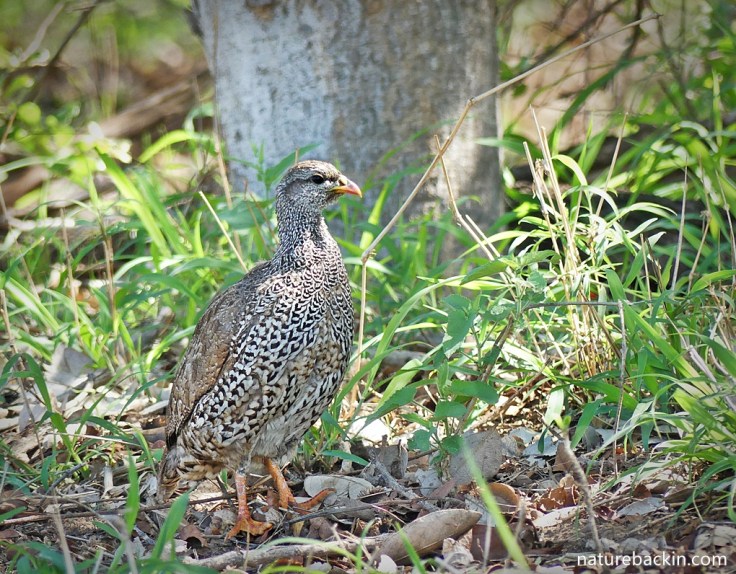
The Natal spurfowl (Pternistis natalensis) occurs in the eastern regions of southern Africa extending as far north as south eastern Zambia. Unlike several other species of spurfowl, it does not have any bare skin on the head or face.
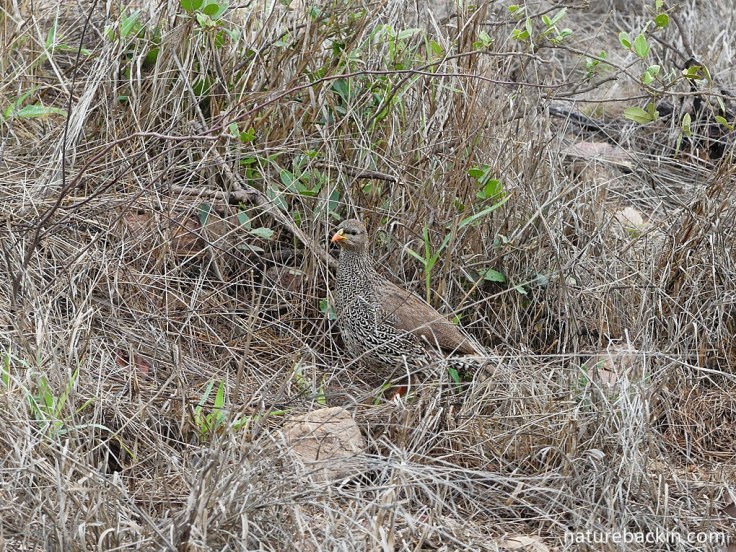
Natal spurfowls thrive in a variety of habitats with a mix of open ground and dense vegetation that provides adequate cover, such as in woodland, savannah and coastal forest. They are often found close to water or water courses. Their highly patterned plumage provides excellent camouflage.
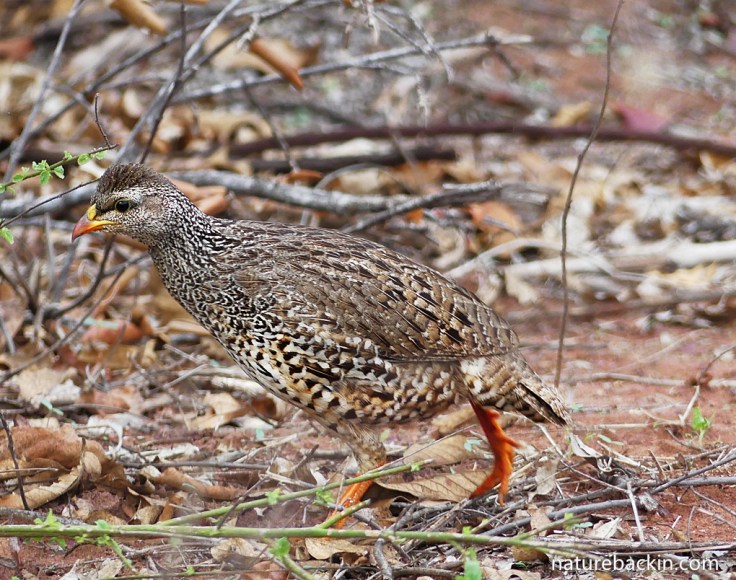
The Natal spurfowl has a distinctive yellow and red-orange bill and orange legs. Like other spurfowls it is a ground forager with an omnivorous diet. They form monogamous breeding pairs and move around in pairs or small family groups.
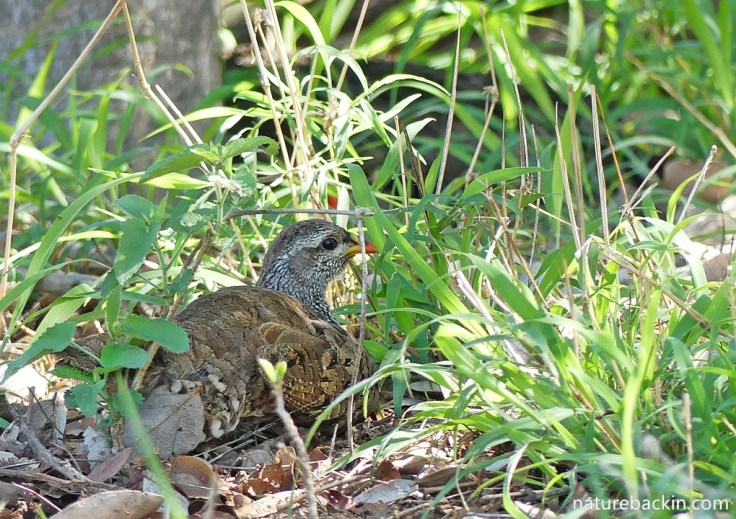
We thought that this bird (above), seen in Kruger National Park, was resting in the shade and avoiding the hot sunshine rather than that it was sitting on a nest, although they are ground nesters. Their nests are little more than a lined scrape on the ground. Natal spurfowls are mostly quite shy birds, retreating to cover when they see a perceived threat.
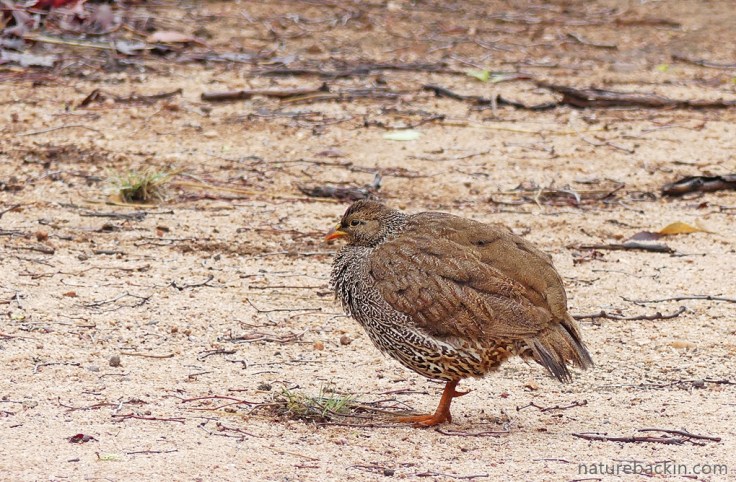
Rather than sheltering from the heat, this rather subdued-looking Natal spurfowl is fluffed up to keep warm on a cool and damp morning at Kruger National Park.
Cape spurfowl
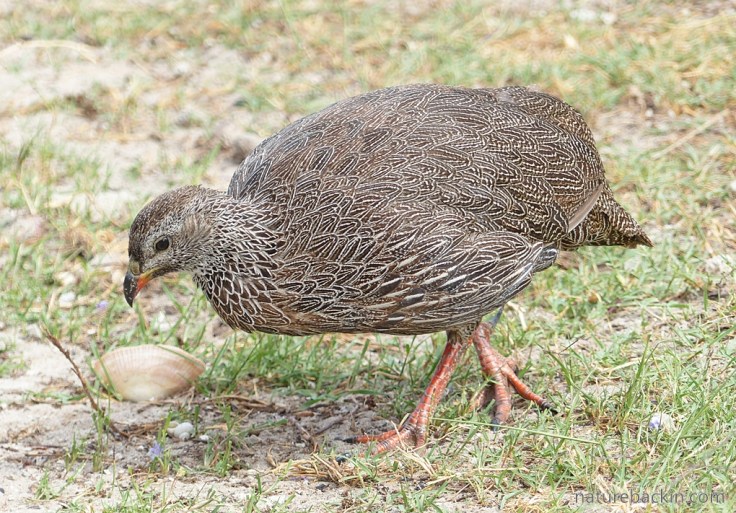
The Cape spurfowl (Pternistis capensis) is the largest of the spurfowls in southern Africa. It is endemic to the Western Cape into the Eastern Cape and southern Namibia. In many parts of the Western Cape, it has adapted well to areas of human habitation and can even be found in the suburbs, such as this one (above) foraging in a suburban garden. They are also adapted to fynbos, strandveld, renosterveld, farms and fields and riverine scrub.
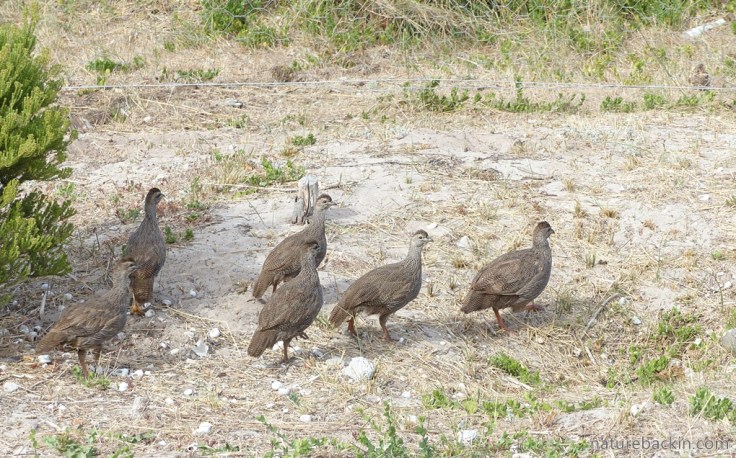
Typically, spurfowls move around in pairs or small family groups. In the above photo, a family of Cape spurfowls is making its way through a backyard in a greenbelt suburb in the Overberg in the Western Cape.
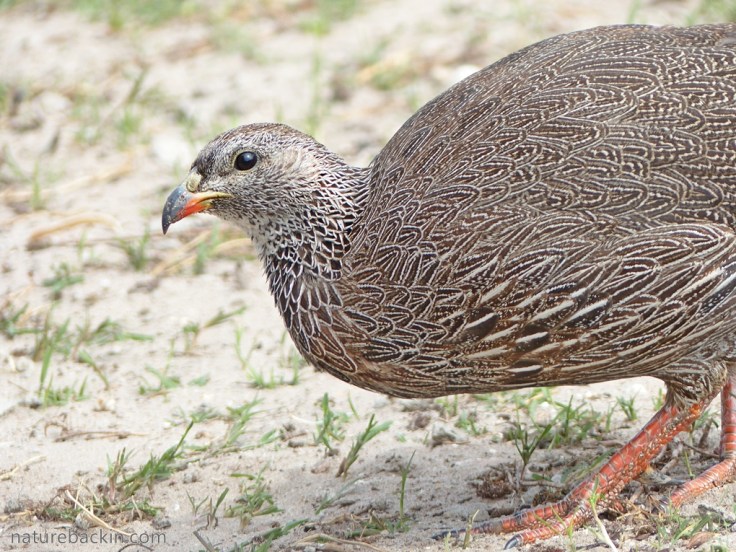
Like the Natal spurfowl, the Cape spurfowl does not have bare skin on the face or throat. Their plumage is marked in fine detail, giving the appearance of each feather being separately defined.
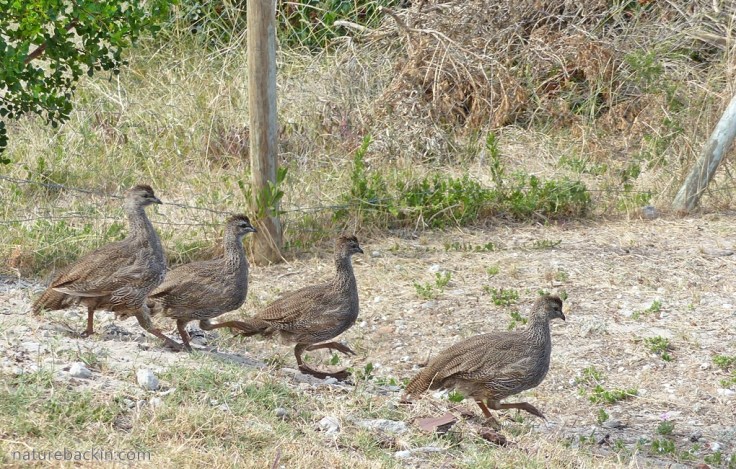
When startled this group of Cape spurfowls started running rather than taking to the wing, behaviour typical of spurfowls in general. Spurfowls can sprint at an astonishing rate when they feel the need.
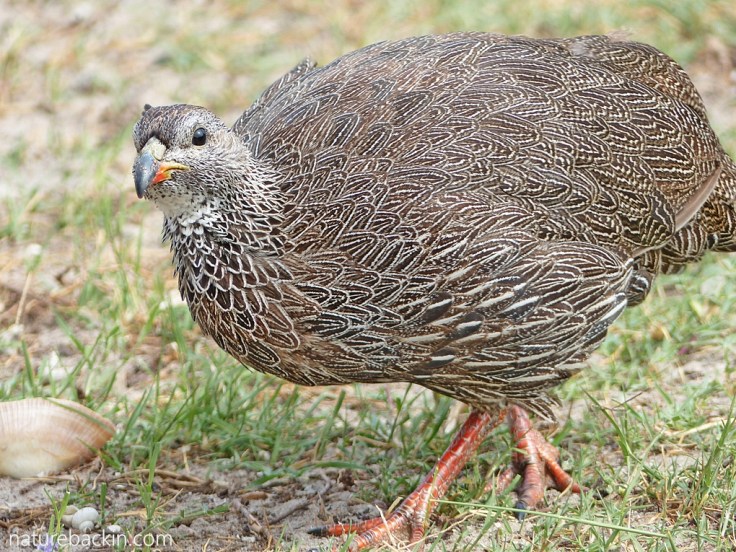
The species that the Cape spurfowl most resembles is the slightly smaller Natal spurfowl, but their ranges do not overlap. The Cape spurfowl’s range does overlap with the red-necked spurfowl, but the species are easy to tell apart as the Cape spurfowl does not have the red throat, bare facial skin or the red bill of the red-necked spurfowl.
Although they are not immune to threats that include habitat loss, hunting pressure and wildfires, happily, all six species of spurfowl that occur in southern Africa have the conservation status of Least Concern.
Sources:
🔖Iziko Museums of South Africa. [n.d.] Family: Phasianidae (partridges, francolins, spurfowls and quail). Biodiversity Explorer: The web of life in southern Africa https://www.biodiversityexplorer.info/birds/phasianidae/index.htm 🔖Labuscagne, Lize. [n.d.] Cape Spurfowl. South African National Biodiversity Institute (SANBI). https://www.sanbi.org/animal-of-the-week/cape-spurfowl/ 🔖Little, Rob. 2020. Elevating gamebirds: New francolin and spurfowl taxonomy. African Birdlife. March/April, pp. 50-53. https://science.uct.ac.za/sites/default/files/content_migration/science_uct_ac_za/925/files/AB08%25283%252950-53.pdf 🔖Peacock, Faansie/Firefinch App. [n.d.] Alarm Clocks of the Bush (Spurfowl and Francolin Calls). https://faansiepeacock.com/francolins/
Posted by Carol

Discover more from letting nature back in
Subscribe to get the latest posts sent to your email.


September 17, 2026 at 11:28 am
I so enjoyed your most informative post and the wonderful photos. As you point out there are rather tame appearing spurfowl in the Western Cape and it was good to learn so much about these neighbours!
LikeLiked by 1 person
September 17, 2026 at 7:37 pm
Thanks Christine – I enjoyed putting this post together and comparing the different spurfowls. I continue to be surprised whenever I see Cape spurfowls calmly going about their business in suburban areas.
LikeLike
September 16, 2026 at 9:12 pm
I so enjoyed this post. The patterns on the feathers are incredible! The red-billed spurfowl actually made me a bit dizzy trying to figure out the pattern. 😉 Your portraits are lovely, and seem to show personality. (What is the red-billed spurfowl eyeing us with that yellow “eye makeup” thinking, I wonder? ) It seems funny to me that all of the birds plumage blends in so well with the brown environment around them, but then their feet and beaks are so brightly colored.
Thanks again for posting this.
Wishing you the best possible warm weather season, as I head into fall and winter up here.
Cheers,
Julie
LikeLiked by 1 person
September 17, 2026 at 7:35 pm
Hi Julie – thanks for your interesting observations. I agree that spurfowls do exude personality, and quite quirky too at times. The patterning on the plumage is amazing and intricate. Yes, the red faces and legs are surprising given the cryptic colouring of the plumage. Thinking about it, I suppose the legs can be concealed and the head turned away from any threats.
Yes, we are enjoying spring but I feel some trepidation re the forecast very hot and very dry summer.
I hope that your autumn (fall) is lovely and the winter does not bring anything too extreme.
Best from SA, Carol
LikeLike
September 19, 2026 at 1:32 am
I am so hoping for you that you have a more temperate summer. Here in Massachusetts, although I know some snow is needed, I’m hoping for a milder winter that involves less ice and snow shoveling.
Best from Massachusetts,
Julie
❄️ ⛄️
LikeLiked by 1 person
September 11, 2026 at 4:36 pm
What a lovely post. All these have a clearly close relationship with our own pheasants (not of course a native species here, but ridiculously omni-present because of the practice of bringing in hundreds of thousands of eggs over from – often the Netherlands – every year to raise so the birds can be shot in shooting season). While none of the calls you highlight is particularly beautiful, they’re better then the ‘clockwork’ calls of our pheasants here: https://www.youtube.com/watch?v=XhAfDXTEaUQ. As others have said, the examples you show here have lovely markings when you get up close enough.
LikeLiked by 1 person
September 14, 2026 at 6:04 am
Your imported pheasants are very beautiful. Their colour, markings and long tails are quite dramatic. Thanks for the link to the video. Interesting to hear their call.
LikeLiked by 1 person
September 14, 2026 at 7:46 am
Beautiful, but dim. And a menace. Their numbers upset the balance of things. For instance, they adore most caterpillars. Butterflies beware!
LikeLiked by 1 person
September 11, 2026 at 7:57 am
I have loved reading this post and admire your beautiful photographs! Spurfowl are among my favourite terrestrial birds and so I enjoy the opportunity to look closely at the differences between them in this post. I agree that they are very attractive birds and well worth a closer look!
LikeLiked by 1 person
September 11, 2026 at 10:47 am
Hi Anne – I am so pleased you also enjoy seeing spurfowls and being able to compare several species in this post. The intricate patterning on their plumage is remarkable. They also project quite a lot of personality!
LikeLike
September 12, 2026 at 12:37 pm
I agree with you 🙂
LikeLiked by 1 person
September 11, 2026 at 6:40 am
I have seen so many spurfowl duing my wanderings in the Cape. They are certainly much bigger than in KwaZulu-Natal.
LikeLiked by 1 person
September 11, 2026 at 10:36 am
I was surprised when we first moved here to see them so numerous and tame in some of the suburban areas!
LikeLike
September 11, 2026 at 5:02 am
Very interesting Carol. They have beautiful markings. I have to say that If they are louder and harsher than francolins, they must be very loud indeed. The francolins have a very piercing call!
LikeLiked by 1 person
September 11, 2026 at 6:19 am
Hi Graham, indeed they are loud, and repetitive! Don’t need an alarm clock in the morning if spurfowls are in calling mode!
LikeLiked by 1 person
September 12, 2026 at 4:52 am
I try and discourage the francolins and roosters from getting too comfortable near the house!
LikeLiked by 1 person
September 10, 2026 at 6:25 pm
Hi Carol, I enjoyed learning about the different types of Spurfowl. Your terrific photos show the interesting markings and patterns in their feathers. I’m glad that these birds aren’t endangered. Thanks for putting this post together. 🙂
LikeLiked by 1 person
September 11, 2026 at 6:17 am
Thanks Jane. From afar they plumage looks quite nondescript, but closer up their markings are beautiful. Putting this post together, I was surprised to find I have photos of 5 of the 6 southern African spurfowls.
LikeLiked by 1 person
September 10, 2026 at 5:57 pm
Terrific post, Carol. Spurfowl have beautiful feather detailing and if not for the red faces on some, they would be tough to spot. They sound well-adapted to their environment, both human and wild.
LikeLiked by 1 person
September 11, 2026 at 6:13 am
Thanks Eliza. From a distance they may look a bit drab (apart from those with red faces) but closer up their markings are gorgeous. When calling though they are impossible to miss!
LikeLiked by 1 person