
Although they are predominantly brown, there is nothing drab about crested francolins plumage. Their intricately patterned plumage serves to provide effective camouflage for these terrestrial birds. They are named for the dark crest on the head, but as that is only occasionally raised the most noticeable feature is the broad white eyestripe.
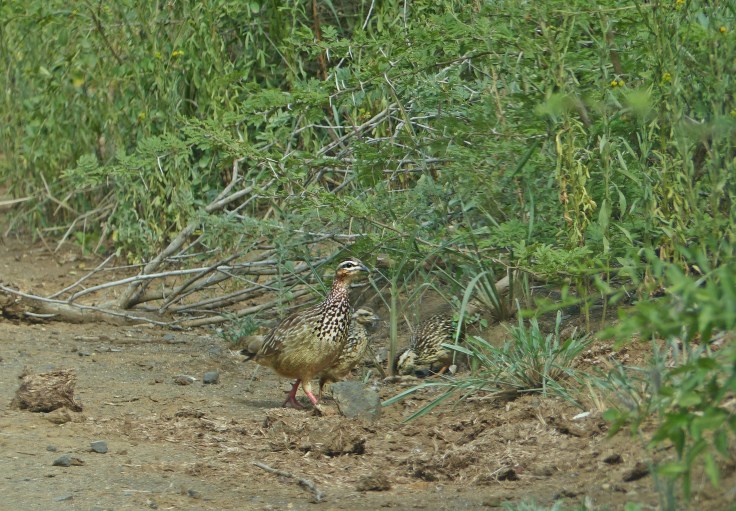
I have mostly seen crested francolins (Ortygornis sephaena) in small family groups, comprising a breeding pair and their young. In the photo above, part of such a group is scratching and pecking for insects in a pile of dung (probably elephant dung) next to the road in Hluhluwe–Imfolozi Park in Kwa-Zulu Natal, which is at the most southerly part of their range in South Africa.
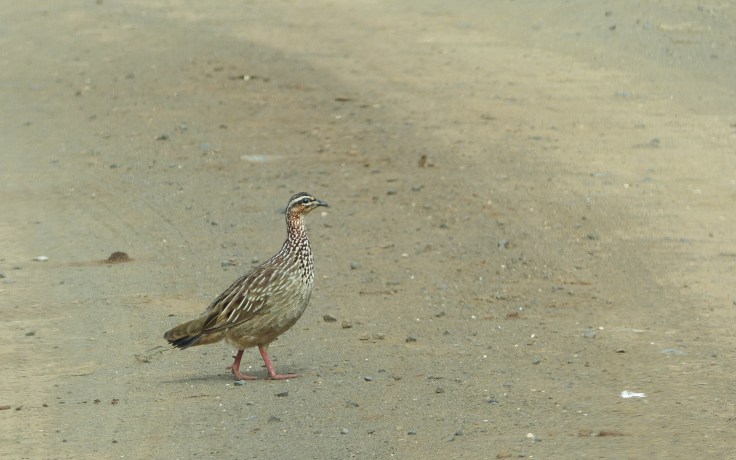
We have sometimes seen them crossing the road while walking at a sedate pace, such as the one in the photo above (photo taken through the windscreen), or else scurrying across the road to the safety of concealing vegetation on the verge. Some descriptions of crested francolins compare them to chickens or bantams, partly because of their size and also because they have a habit of cocking their tails, and also, I guess, they are like chickens because they too cross the road to get to the other side!
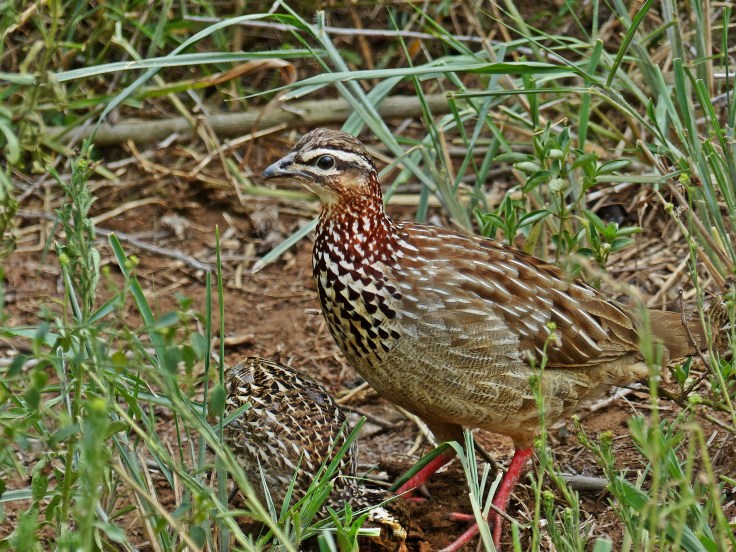
This crested francolin paused next to the road with a small family group long enough for me to take this photo showing the bold chevron pattern on the chest, and the red legs that are more typical of spurfowls. One other thing that crested francolins have in common with spurfowls is that they roost at night in trees or shrubs, whereas most francolins will remain on the ground even at night.
Being terrestrial birds, crested francolins forage on the ground not only for invertebrates (mostly insects), but they also eat plant material, especially in the winter months, that includes shoots, leaves, seeds, fruits and berries as well as corms and bulbs. They use their strong legs and feet to dig and scratch to uncover food items as they forage.
Although terrestrial they can fly, typically taking to the air when startled, usually at the last moment with a sudden burst of wing beats and a loud screech.
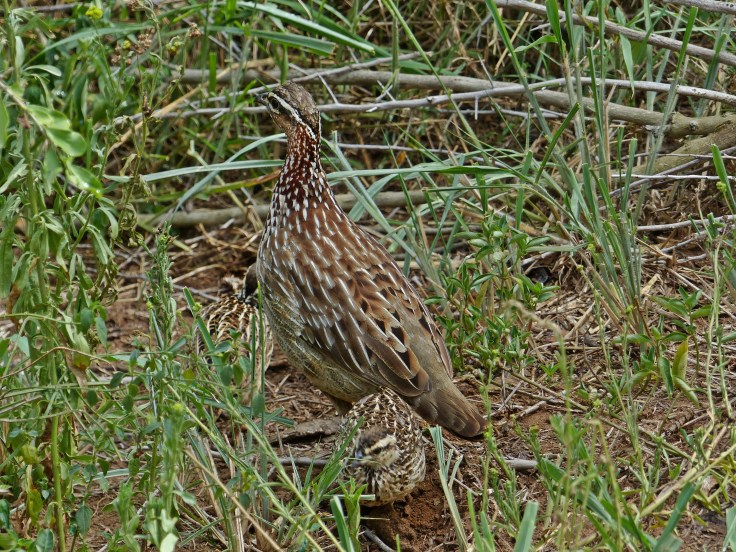
If one slows one’s vehicle to take a closer look, more often than not, the birds will duck into the vegetation on the side of the road and rapidly disappear from view, as this francolin with chicks is about to do. The chicks are precocial and area able to leave the nest about 2 hours after hatching. They are looked after by both parents.
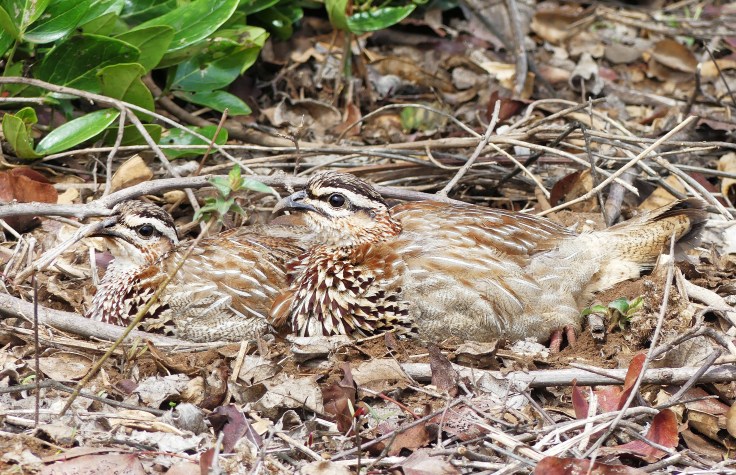
When encountering crested francolins in nature reserves in KwaZulu-Natal we had mostly seen them walking or foraging in family groups near the road. So, on a visit to Kruger National Park, we were charmed to see this pair companionably nestled together in a comfy spot while they indulged in a bit of dust bathing.
Crested francolins form monogamous pairs during the breeding season, which is October to March in South Africa. Preferring scrubby savanna and open woodlands, crested francolins hide their nests on the ground in the cover of surrounding vegetation. The actual nest is a scrape in the ground lined with grass and leaves. The 3-7 eggs in a clutch are incubated for about three weeks by the female.
Crested francolins occur only in Africa, down the eastern side from Ethiopia in the north and southwards to Zululand in South Africa, extending further west in southern Africa through Zimbabwe to northern Namibia. Given its large range and that it survives in a diversity of habitats, from open woodland to shrubby grassland, I am happy to report that the International Union for Conservation of Nature (IUCN) assessment of the status of the crested francolin is listed as Least Concern.
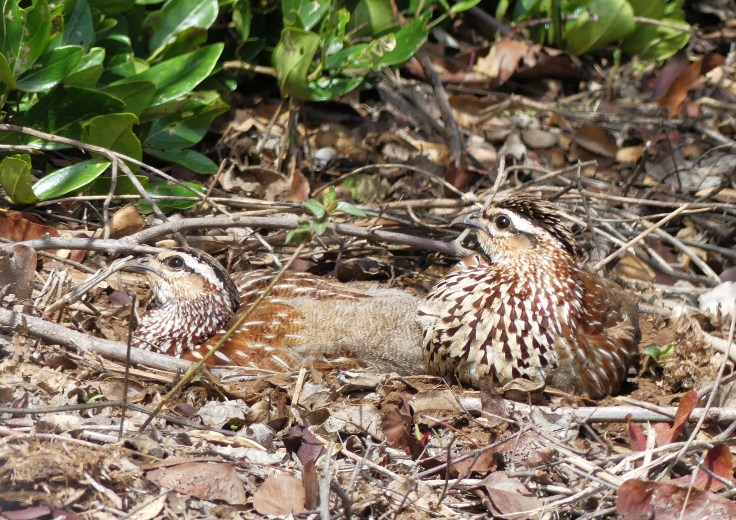
Even while ostensibly relaxing the pair were regularly cocking their heads to keep an eye on the sky above. No wonder, as the main predators of crested francolins are several species of raptor.
Francolins and spurfowls (more about spurfowls in my forthcoming next post) are known for their loud territorial calls. Bird expert Faansie Peacock (his real name!) describes them as the alarm clocks of the bush. Click here and scroll down to the image of a crested francolin to hear a recording of their call.
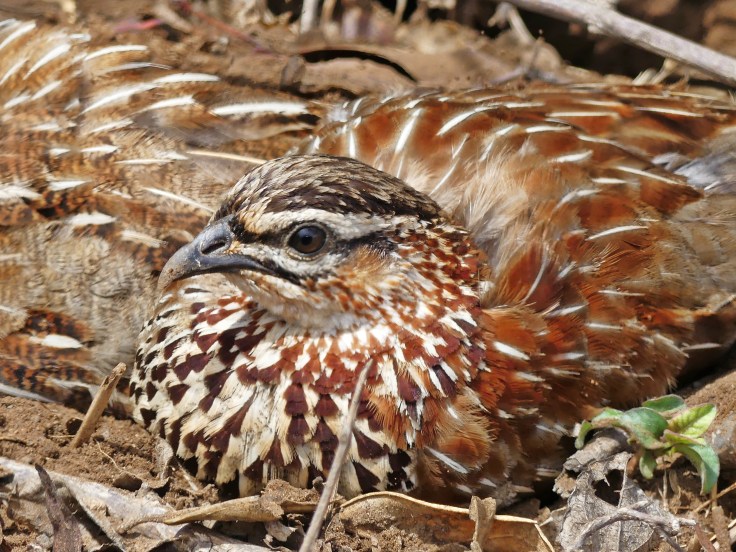
I end this post with a short video of the pair of crested francolins engaged in dust bathing, a process that they seem to really enjoy.
Sources:
🔖BirdLife International. 2016. Ortygornis sephaena. The IUCN Red List of Threatened Species 2016: e.T22678752A92787092. https://dx.doi.org/10.2305/IUCN.UK.2016-3.RLTS.T22678752A92787092.en. Accessed on 05 August 2026.🔖Robertson, Hamish. [n.d.] Dendroperdix sephaena (Crested francolin). Biodiversity Explorer: The web of life in southern Africa. https://www.biodiversityexplorer.info/birds/phasianidae/dendroperdix_sephaena.htm🔖Bath, Barry. 2022. What is the Difference between Francolins and Spurfowls? July 7, Londolozi Blog. https://blog.londolozi.com/2022/07/07/what-is-the-difference-between-francolins-and-spurfowls/🔖Peacock, Faansie/Firefinch App. [n.d.] Alarm Clocks of the Bush (Spurfowl and Francolin Calls). https://faansiepeacock.com/francolins/
Posted by Carol

Discover more from letting nature back in
Subscribe to get the latest posts sent to your email.


August 8, 2026 at 8:58 pm
Thank you for this interesting tour of a bird with a rather subtle beauty. They remind me a bit of European quails.
LikeLiked by 1 person
August 9, 2026 at 9:41 am
Yes their beauty is subtle. They do have similarities to quails.
LikeLiked by 1 person
August 8, 2026 at 4:57 am
Lovely birds and quite like the francolins here, especially in the volume of their calls! Love the video too.
LikeLiked by 1 person
August 9, 2026 at 9:39 am
Yes they can be very noisy! That sunbathing pair are very endearing.
LikeLiked by 1 person
August 7, 2026 at 6:11 pm
Another great post, Carol! I was curious if there are New World birds that are related to this crested francolin, as they remind me of some kind of Bird of ours. Birds of the World tell me that they are distantly related to quails, and I realized that that’s why they looked familiar.
LikeLiked by 1 person
August 9, 2026 at 9:39 am
Yes, quails, partridges, francolins, spurfowls, pheasants etc! Quails and francolins do have similarities. I have been reading a bit about adjustments in naming as taxonomies have been adjusted. It’s complicated! But then it is a huge family …
LikeLiked by 1 person
August 9, 2026 at 12:29 pm
There seem to be more and more changes in the naming of birds these days due to continually increasing information about them.
LikeLike
August 7, 2026 at 2:20 pm
Thank you for this. The patterning on the bird’s chest is striking
LikeLiked by 1 person
August 7, 2026 at 2:49 pm
Possible inspiration for a fabric art piece, I cant help wondering!
LikeLiked by 1 person
August 8, 2026 at 7:32 am
You read my mind
LikeLiked by 1 person
August 9, 2026 at 9:12 am
😊
LikeLike
August 7, 2026 at 1:44 pm
These remind me a lot of our female pheasants (not that they’re native to us of course, but they’re very omni-present). What a delightful video, and an encouraging account of how they’re holding their own. May it continue that way!
LikeLiked by 1 person
August 7, 2026 at 2:19 pm
I was going to say something about the francolins also being gamebirds, but then I saw that defining gamebirds opens up a bunch of complexities that I decided to avoid (I nearly said duck – in fact some definitions include ducks as gamebirds!). It is a relief to feature a species that is not in dire straits. As you say, may it continue that way!
LikeLike
August 7, 2026 at 5:16 pm
Oooh, I didn’t know that ‘gamebirds’ was complicated! But hooray for the lack of Dire Straits!
LikeLiked by 1 person
August 9, 2026 at 9:21 am
I felt a bit of overwhelm when I read an article that included ostriches and emus as gamebirds!
LikeLiked by 1 person
August 9, 2026 at 12:59 pm
Well, that’s a sentence you couldn’t write here!
LikeLiked by 1 person
August 11, 2026 at 7:17 am
True! 😄
LikeLiked by 1 person
August 7, 2026 at 11:12 am
Another delightfully interesting post and your photographs are superb! The red-necked spurfowl are most common here in the Eastern Cape and we see them often in Addo.
LikeLiked by 1 person
August 7, 2026 at 2:16 pm
Thanks Anne. There is something rather charming about these little francolins. I am planning on featuring spurfowls in my next post, possibly also including red-necked spurfowls. Lovely to see them often in Addo.
LikeLiked by 1 person
August 7, 2026 at 5:52 am
Hello Carol,
I agree, Francolins are very beautiful birds, including the lovely details of their feathers. I’m happy they are doing well, and thank you for sharing your beautiful images and video. Hope all is well.
Greetings from Japan,
Takami
LikeLiked by 1 person
August 7, 2026 at 2:14 pm
Hi Takami
It is good to hear from you. I am glad to hear that you also enjoy the lovely feather details of these brownish birds. Often it is colour that attracts admiration from us humans, but the intricacy of the patterns is indeed lovely.
We are doing fine here thanks, and I hope that you are too.
Best from South Africa
Carol
LikeLiked by 1 person
August 7, 2026 at 12:35 am
These are lovely birds, and I really enjoyed how they disappear with their camouflage. The chevrons on are their chests are very striking. Funny that they have such loud calls, as they look just like the sweetest chicken-like birds that you could almost pick up and hold. 😉
Hope all is well,
Julie
LikeLiked by 1 person
August 7, 2026 at 2:12 pm
It is almost contradictory that their cryptic colouring camouflages them so well and then they advertise themselves by calling so raucously – but I am being flippant! I also think they have a sweet demeanour, especially the dust-bathing pair.
All is fine here thanks. We had a little rain yesterday after an exceptionally dry July. Hoping for more! Hope all is well with you too.
Best
Carol
LikeLiked by 1 person
August 7, 2026 at 12:02 am
Beautifully plumed birds, they do remind me of chickens. So glad that their numbers are stable, something to cheer about! 👍🏼
LikeLiked by 1 person
August 7, 2026 at 2:09 pm
They are beautifully marked and are quite chickenish! It is good to know that they are not a threatened species.
LikeLike
August 6, 2026 at 10:03 pm
Wonderful photos and video, Carol, thank you for sharing. I find your francolins very attractive. Color in birds is beautiful, but so are feather details shown in some of your images.
It’s nice to know that some birds are still doing ok. May it stay that way.
Best wishes,
Tanja
LikeLiked by 1 person
August 7, 2026 at 2:08 pm
Thanks Tanja. The intricate patterning adds to their attractiveness, and their demeanour can be quite charming – though they can be raucous when calling!
It is nice to know they are not threatened and indeed, may it stay that way.
Best from SA
Carol
LikeLiked by 1 person