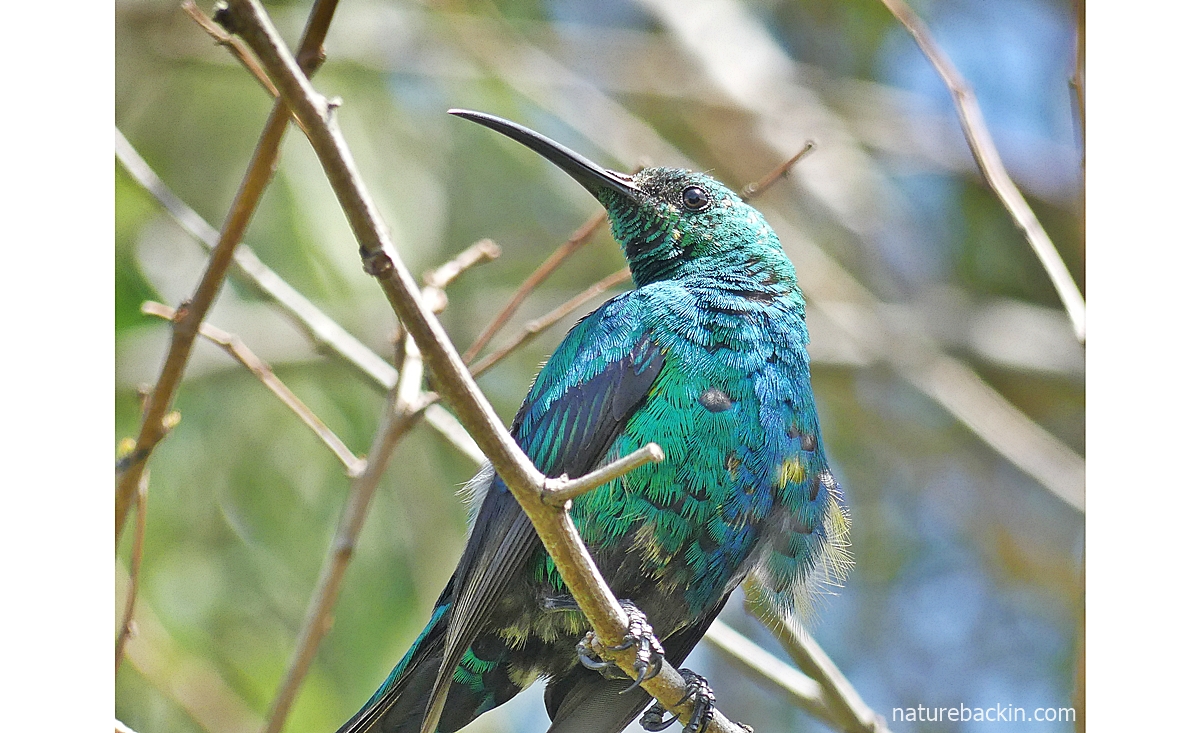
Visiting birds such as malachite sunbirds bring their own festive features to the garden in the year-end summer holidays. There will be no snow lying round about, no blazing Yule before us, or halls decked with boughs of holly. But oblivious of all that, the birds are donned in gay apparel. Fa la la la la and all that 🎶

What could be more festive than a male malachite sunbird (Nectarinia famosa) in his breeding plumage?

Flaunting those fine feathers!

A male malachite sunbird in eclipse (transitional) plumage, photographed in January last year.
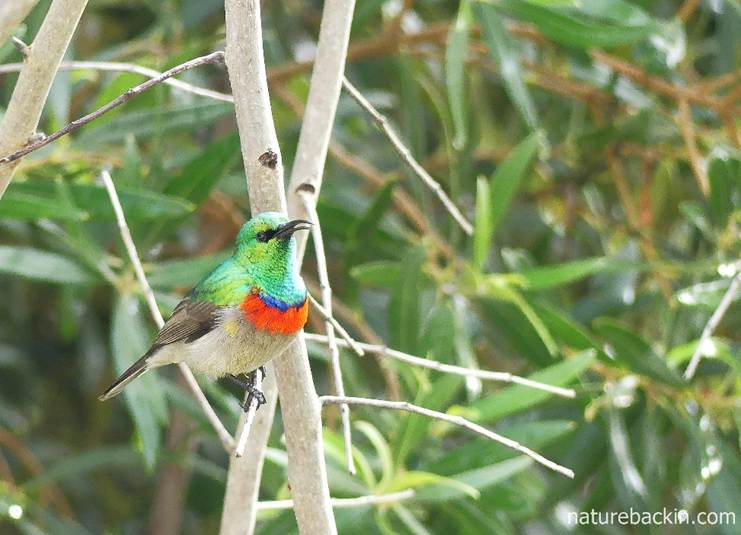
Although smaller in size than the malachite, the southern double-collared sunbird (Cinnyris chalybeus) is nevertheless a flamboyant presence.

A male southern double-collared sunbird looking less flamboyant and slightly weird in eclipse plumage, in October this year.
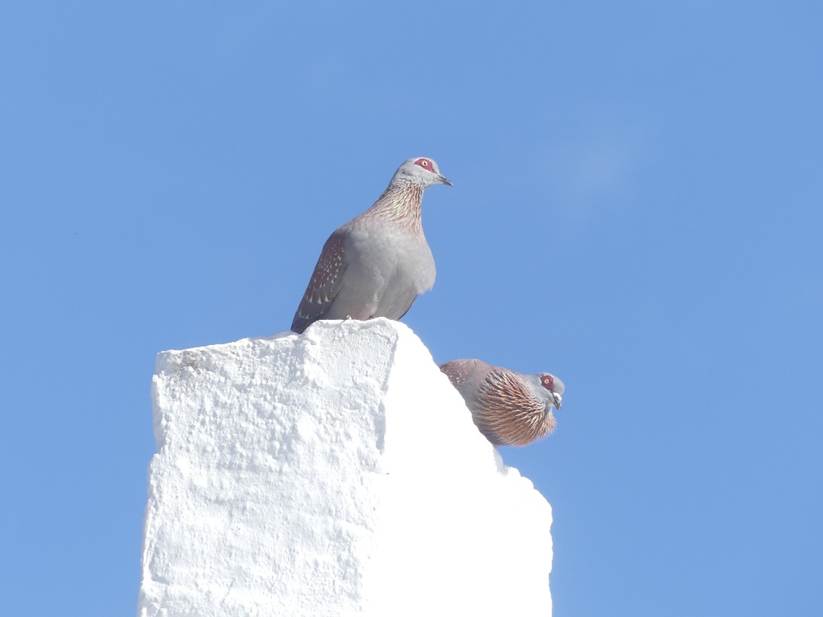
Decorative, although in another colour palette, is this pair of speckled pigeons (Columba guinea).
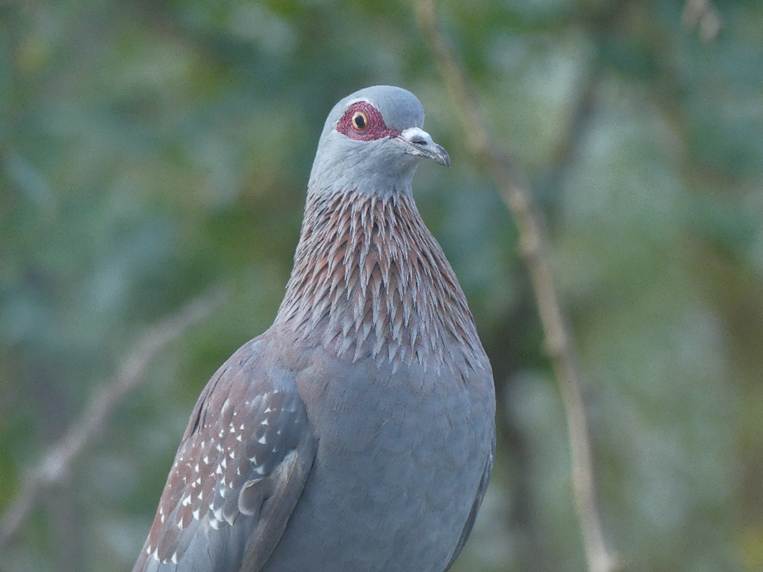
With feathers both fine and festive, the speckled pigeon (also known as the African rock pigeon) can register a regal presence.
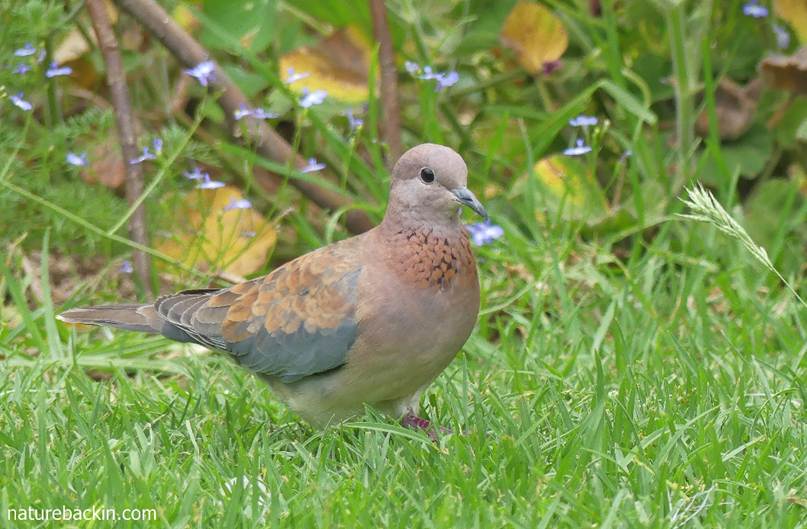
The nuanced colours of the laughing dove (Spilopelia senegalensis) are more festive than one might expect.

The opposite of nuanced is the plumage (including the crest even when held flattened as in the above photo) of the African hoopoe (Upupa africana).

Definitely dapper and despite its sombre colour, this Cape bulbul’s (Pycnonotus capensis) white eye-ring and yellow vent are decorative features.
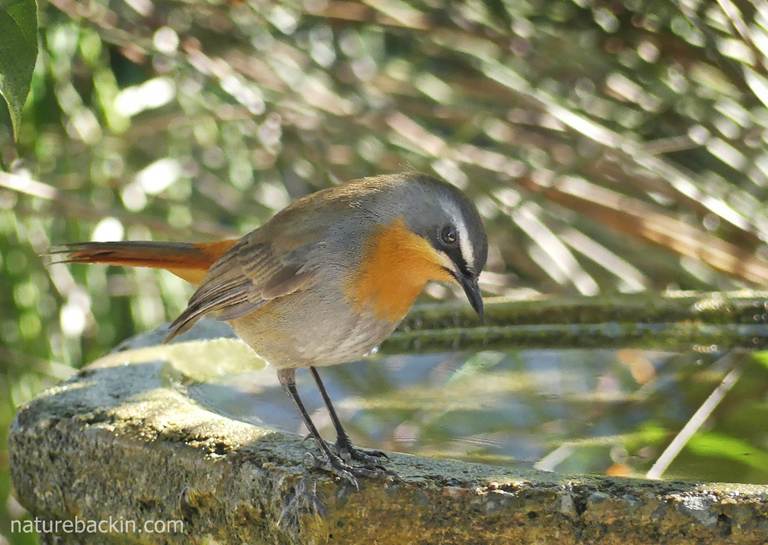
Superficially reminiscent of the European robin of British Christmas card fame (Erithacus rubecula) is the Cape robin-chat (Cossypha caffra), this one apparently deep in thought while perched on the rim of a birdbath in our garden.

A bully canary, also known as a brimstone canary, (Crithagra sulphurata), looking slightly diffident while drinking at a birdbath.
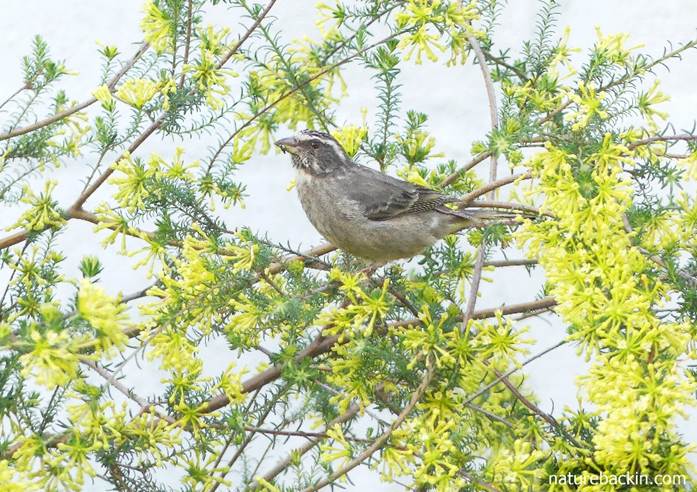
Looking festive while eating flowers of the Gnidia squarrosa, is the canary-like streaky-headed seedeater (Crithagra gularis).

Also visiting the Gnidia shrub (with round pods of the balloon milkweed (Gomphocarpus physocarpus) visible in the background) is a female Cape weaver (Ploceus capensis).
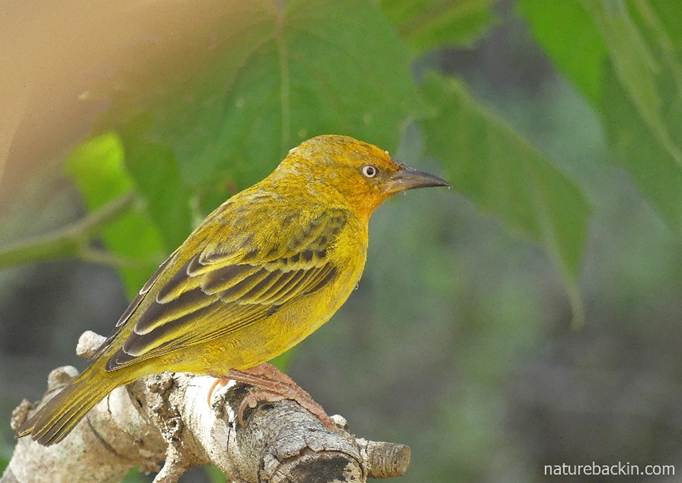
Washed a stronger orange-yellow colour than the female, the male Cape Weaver has pale eyes in contrast to the brown eyes of the female.

Often overlooked in quiet contrast to the bright red of the male southern red bishop (Euplectes orix) in crimson breeding plumage, the non-breeding male or female bishop bird has a festively yellow eyebrow and attractive streaking on the breast. A common waxbill can be seen in the background.

A male southern red bishop, just starting to transition to breeding plumage.

This southern red bishop is nearly there in attaining full and festive breeding plumage.
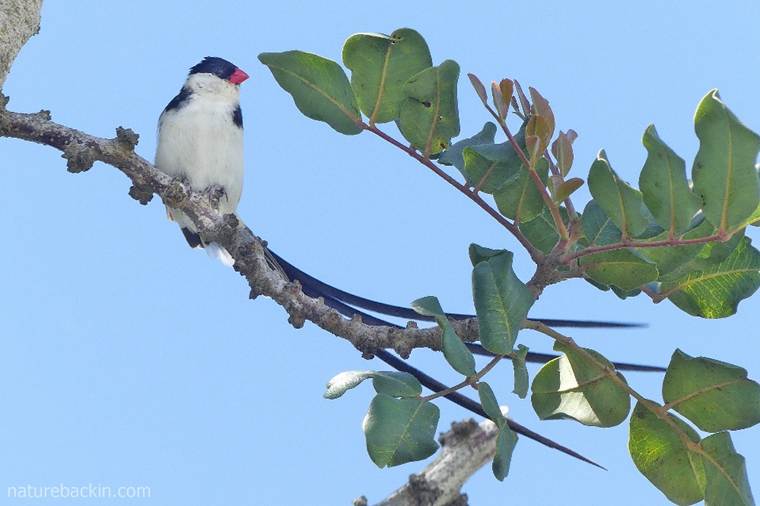
No collection of fine and festive feathers in our summer garden would be complete without including the pin-tailed whydah (Vidua macroura) that featured in this recent post.

Another bird with more nuanced coloration is the Cape sparrow (Passer melanurus)—here a female looks rather fetching at the bird feeder.

And the male Cape sparrow is always decorative, whatever time of the season.

Posted by Carol
Discover more from letting nature back in
Subscribe to get the latest posts sent to your email.


January 11, 2026 at 2:50 pm
Wow, this was such a treat, Carol, for this birder. The birds in your backyard are what some of us travel across the world to see. I enjoyed each one, the weavers, sparrows, bishops, waxbill, seedeaters and more, but it was the sunbirds that completely dazzled me. Oh and what a treasure to see the African hoopoe…I love them. Fantastic to see them! Then just as you’re closing the show–the male pin-tailed whydah and his elegant long tail. Super gallery here, thanks for sharing your backyard.
LikeLiked by 1 person
January 14, 2026 at 2:49 pm
Thanks Jet. It is a different perspective to realise that our garden birds are sought after by keen birders from far afield – not that I ever take them for granted! They are all so special, though yes, the sunbirds are the most dazzling of all, and the hoopoe so showy!
We have wild fires raging in our region, some have been and currently are close to our village. Stressful times. The firefighting crews and coordination have been and continue to be outstanding and heroic.
LikeLiked by 1 person
January 15, 2026 at 2:22 pm
Dear Carol, I know too well the stress and anxiety of nearby raging wildfires. I hold you and your community of residents, birds and animals, and firefighters in my heart. We hope for the winds to die….
LikeLiked by 1 person
February 15, 2026 at 1:09 pm
Thanks very much Jet. I apologise I have taken so long to respond. Those fires have been contained and since then we had a cut-off low causing a lot of rain!
I intend posting about the fires today.
Sending best wishes.
LikeLiked by 1 person
January 10, 2026 at 9:17 pm
Unbelievable selection of birds! What a joy to peruse!
LikeLiked by 1 person
January 11, 2026 at 2:22 pm
Thanks Julie – you also have a wonderful array of bird visitors where you are!
LikeLiked by 1 person
January 8, 2026 at 8:35 pm
Hi Carol, You’ve captured such fine shots of these stunning birds. Their colors and markings are so beautiful. I wish I had your skills in identifying birds! I’m a bit late in my holiday wishes – hope you have many more nature moments in 2026!
LikeLike
January 5, 2026 at 1:37 pm
Carol, I’ve been playing catch-up – a quick run through of your previous two posts, to admire the flora and fauna and the landscape, and a much slower meander through this one. What festive beauties you have shown us! I often think that even the most “drab” of birds is actually very beautiful if there is an opportunity to study the intricate shades and patterns of their plumage. You have certainly demonstrated that here. The quieter species claiming their spot alongside their more flamboyant fellows.
Happy New Year, Carol. I hope, despite the challenges around the world both near and far, you continue to enjoy the glories of nature at home and further afield. And continue to share them with us!
LikeLiked by 1 person
January 7, 2026 at 3:00 pm
Hi Sandra – yes the less flamboyantly coloured plumages can be most decorative, if not festive!
Thanks for your good wishes for the New Year, and I send best wishes to you. I hope you have a rewarding year, despite the the challenges, near and far, as you say.
I intend to continue blogging, and hope to become a bit more regular in posting this year!
LikeLiked by 1 person
December 31, 2025 at 11:30 am
Thank you for sharing this festive collection of beauties, Carol! I hope you are experiencing a joyous holiday season!
LikeLiked by 1 person
December 30, 2025 at 6:18 pm
Festive indeed. Thank you for this photographic line-up.
I agree that there is nothing quite like the bright flashing feathers of sunbirds in breeding plumage
LikeLiked by 1 person
December 23, 2025 at 2:21 pm
This collection of birds is definitely doing it best to be cheerful for Christmas. Lovely.I hope you have a good Christmas too!
LikeLiked by 1 person
December 26, 2025 at 1:16 pm
Hi Margaret – Thank you. In many ways we all need to be doing our best to be cheerful these days, unfortunately!
I hope your Christmas has been festive too. And with very best wishes for the New Year ahead.
LikeLiked by 1 person
December 26, 2025 at 3:34 pm
Thank you, and to you too. Though too much seems to be out of our control ….
LikeLiked by 1 person
December 23, 2025 at 4:39 am
Lovely collection of birds and so colorful too. Hope you have a great holiday season.
LikeLiked by 1 person
December 23, 2025 at 10:29 am
Thanks Graham. Even the less brilliantly coloured birds, turn out to be quite colourful on a second look! I hope you have an enjoyable break too.
LikeLiked by 1 person
December 22, 2025 at 7:34 pm
Very handsome birds, excellent photos, and I love the names of most of them! 🙂
Happy Holidays, Carol!
LikeLiked by 1 person
December 23, 2025 at 10:28 am
Thanks Eliza, and Happy Holidays to you too! 🎄
LikeLiked by 1 person
December 22, 2025 at 3:12 pm
It has been a delight looking through your photographs of familar birds. What a fun theme you have chosen for them too. We have a pair of African hoopoes nesting in a hole above our front door – which we cannot use because of the agressiveness of the white-rumped swifts that are nesting just above the door!
LikeLiked by 1 person
December 23, 2025 at 10:27 am
Hi Anne – your front door has a lot to offer, including seclusion thanks to the swifts! Lovely to have hoopoes nesting above the door too.
The only nest we have seen recently in our garden is used by red-eyed doves. They recently fledged two youngsters, their second brood this season. Originally the nest, in our lemon tree, was built by sparrows, but was not ever used by them.
LikeLike
December 24, 2025 at 2:48 pm
I have been enjoying the awareness of several nests in our garden (cannot always see them) and will be sad to leave our garden behind when we finally downsize during the course of 2026. What a wrench that will be, although I shall embrace new opportunities to see different birds in a different environment.
LikeLiked by 1 person
December 26, 2025 at 1:19 pm
Oh my gosh, Anne. I feel for your, having been through a fairly recent move and downsize myself. I still miss our former garden, but on balance it has been a good move, and it so much easier to have a more manageable space.
As you say, there will be new opportunities to embrace. I hope your find a suitable and satisfying new place to move to. With very best wishes.
LikeLiked by 1 person