Two outings in September exposed us to an array of spring flowers spiced with a sprinkling of birds seen on farm roads and nature reserves in the Overstrand area of the Overberg in the Western Cape.
This post covers the first outing, walking in the Phillipskop Mountain Reserve where we saw a dazzling array of spring flowers. Here is a small selection of some that I photographed. (See also a previous post about an April walk featuring flowers and rock-climbing baboons at Phillipskop here.)
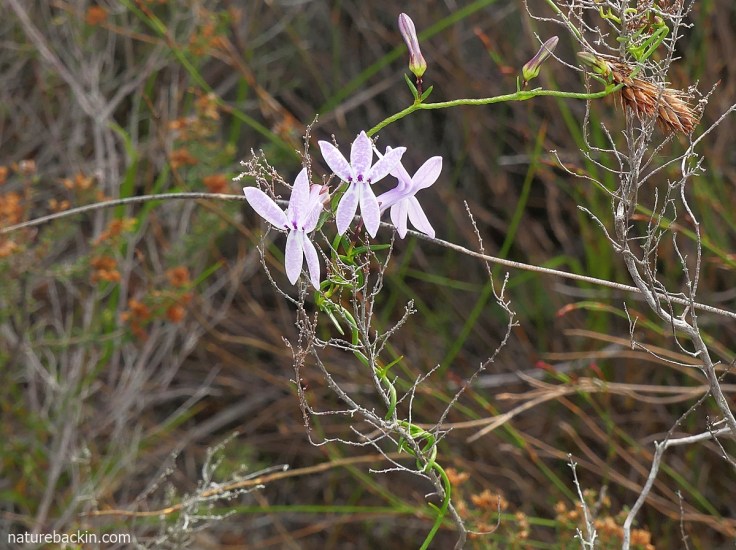
A delicate creeper that twines around low-growing shrups is Cyphia volubilis. Its common name bokkie baroe derives from a Khoikhoi name (variant spellings include baroe/baroo/barou/barup) for the tuberous plants in the Cyphia genus. The edible tubers were once an important food source in the Western Cape. The plant becomes dormant in the dry months of summer but sprouts quickly in response to the winter rains and flowers in the spring.
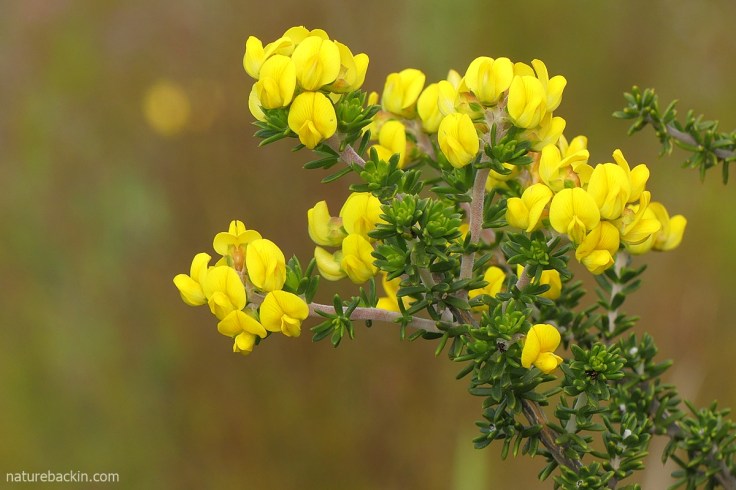
Honeybush Cape gorse (Aspalathus callosa) is a member of the pea family. Despite its common name, it is not the honeybush plant that produces honeybush tea (which is harvested from several species of Cyclopia). Neither is it a type of gorse. Aspalathus species got the name “Cape gorse” as they superficially resemble “English gorse”. Endemic to South Africa, there are over 270 species of Aspalathus, with the vast majority occurring only in the Cape Floristic Kingdom with many confined to very specific localities. Due to this specificity some species have become extinct or are threatened or endangered. Commercially grown rooibos tea (Aspalathus linearis) – not to be confused with honeybush tea – is a famous member of this genus.
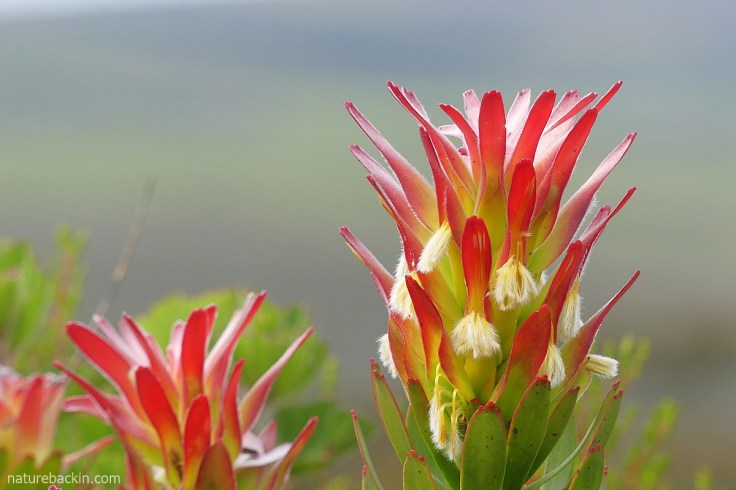
Common pagoda (Mimetes cucullatus) is one of the 14 members of the Mimetes genus (a member of the protea family), all of which are endemic to the Western Cape. The common pagoda is the only species in the genus that is a “resprouter” – it survives fires by resprouting from a large, woody, underground rootstock. All the others are “reseeders”. The prominent red leaves partly enclose the white tufts of small flowers that hang down in small groups from the cowl-shaped red leaves, as can be seen in the photo. The flowers are pollinated by sunbirds and sugarbirds.
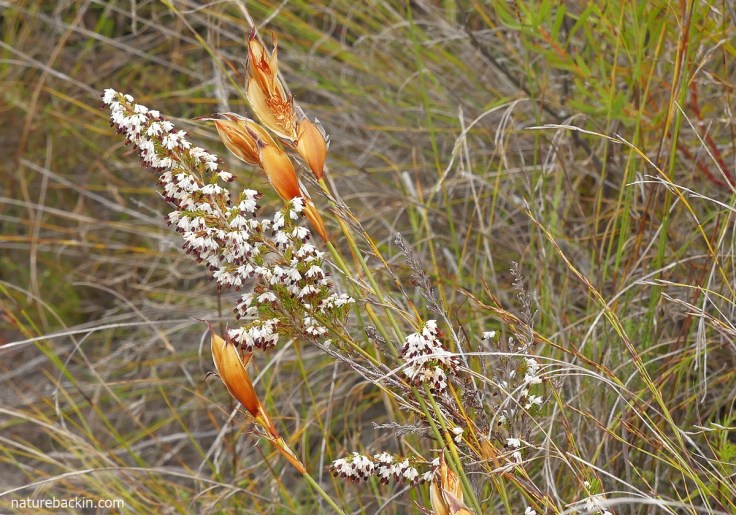
Growing abundantly and obvious to the eye when in flower, the heath Erica imbricata lights up the vegetation. It is easy to see why it is known as the salt-and-pepper heath; the calyx and petals (corollas) are white and the protruding anthers are brown. In the photo above, a flowering branch of this Erica is seen in the company of flowering stems of one of the restios (Cape reeds). Along with the protea family, erica and restio species are characteristic of fynbos shrublands.
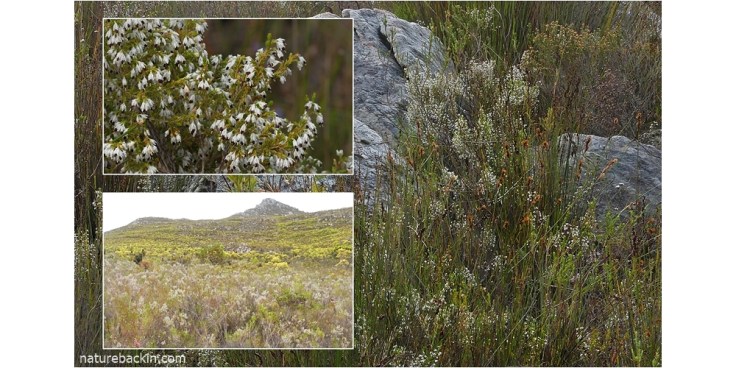
The salt-and-pepper heath (Erica imbricata) flowers mostly from June to December. It really brightens the fynbos as seen in the above photos taken at Phillipskop Mountain Reserve. There are over 800 species of Erica that occur in Europe, the Middle East and Africa, and of these, almost 700 species are endemic to South Africa, with the greatest concentration of species being in the Cape Floristic Region.
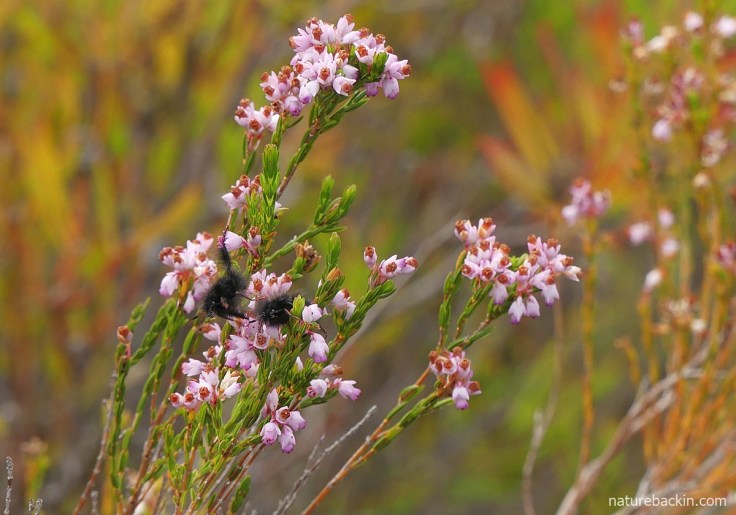
Another erica that is in flower in the springtime, is the dark-tipped erica (Erica corifolia). Initially the flowers (corollas) and the calyx and bracts of each flower are pink, but the flowers themselves soon turn brown. However, the plant retains its colour as the calyx and bracts remain pink for a long time. This plant in the above photo is being visited by shaggy monkey beetles in the genus Anisonyx – most likely Anisonyx ursus, also known as the beary monkey beetle. Monkey beetles have very long hind legs, fancied to resemble the long arms of monkeys, hence the common name. Almost half of the world’s monkey beetle species are found in South Africa – over 1040 species in 51 genera. Most of these species occur in the Fynbos and Succulent Karoo Biomes where they are important pollinators.
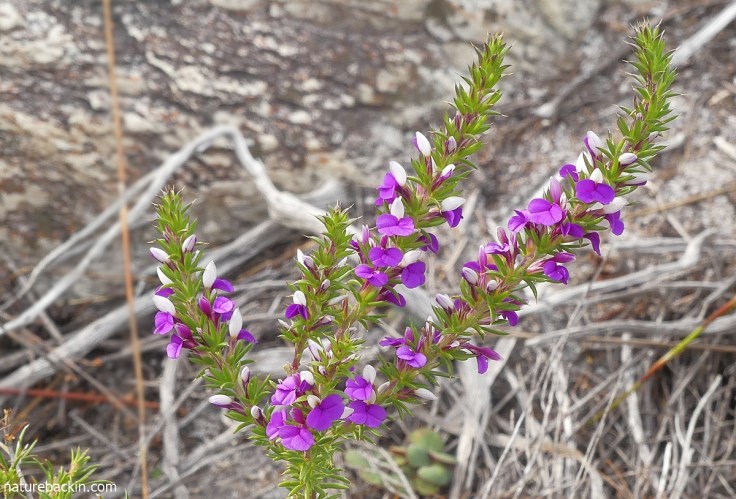
Prickly purple gorse (Muraltia heisteria) is another shrubby plant endemic to the Western Cape. As is the case for the genus known as “Cape gorse” (Aspalathus), the common name is misleading as it is not really a gorse – Muraltias are members of the milkwort (Polygalaceae) family. Its growth forms are very variable and the flowers may be purple, pink and white, pink only and sometimes only white. Interestingly, it has been shown to self-pollinate.
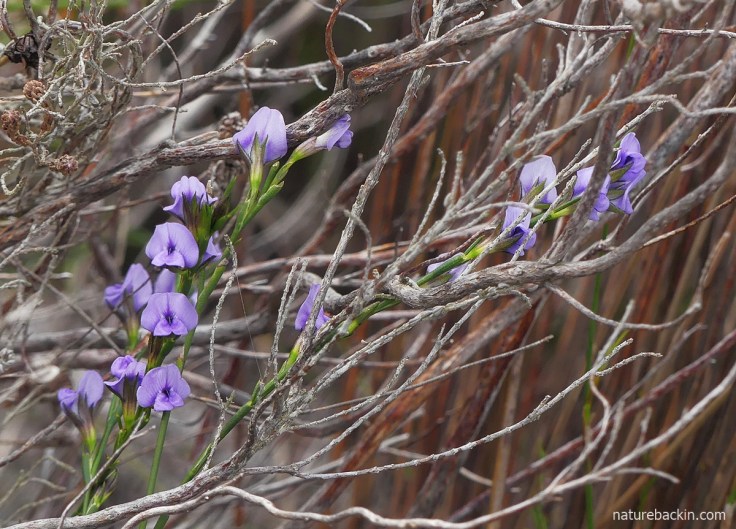
The fine fountainbush (Psoralea restioides) is a pretty rush-like perennial plant in the legume family (Fabaceae). It is endemic to the Western Cape and occurs mostly in mountainous or coastal regions. The flowers may be blue or purple. Its needle-like leaves help it to conserve moisture and it copes well in dry conditions. The common name for the genus, fountainbush, reflects the fact that these plants often grow along streams or in damp areas, but in the hot dry summers even areas that may be marshy in winter can become parched. Seed pods mature in late summer. The seeds are adapted to germinate after fire or heat.
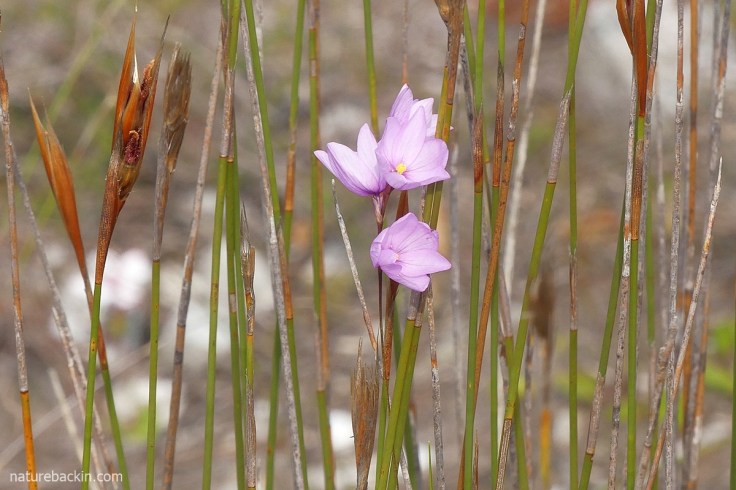
The pink-to-mauve flowers of the Ixia micrandra, in the company of reed-like restios in the above photo, are attached to slender wiry stems that have the ability to bend in the wind. Ixia are tuberous perennials. The common name, kalossie, is derived from the Afrikaans word, kalotjie, “originally a skull-cap but applied to the headdress worn by Malay slaves in early Cape Town, which the flowers were thought to resemble” (Manning (2018, 2nd ed.), p. 110)
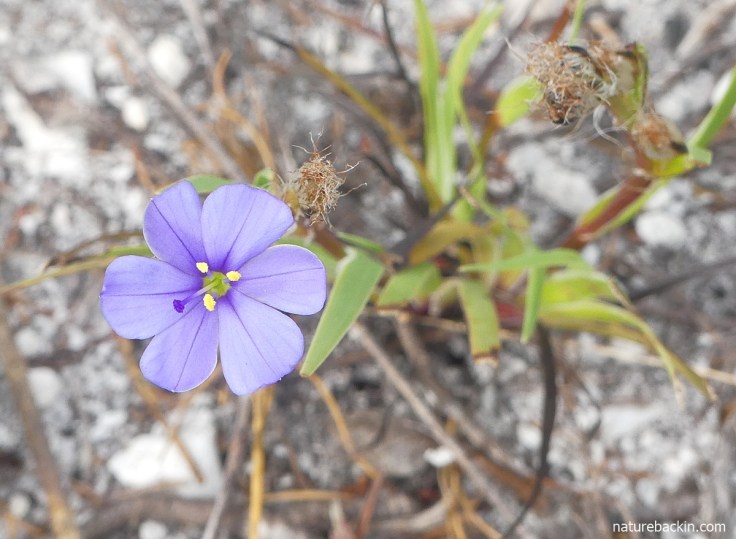
Yet another plant endemic to the Western Cape, the African Cape blue (Aristea Africana) is a perennial rhizomatous plant that occurs on sandy flats and mountain slopes. The word Aristea derives from arista, meaning an ear of corn, and refers to the leaves resembling the leaves of maize (corn) plants.
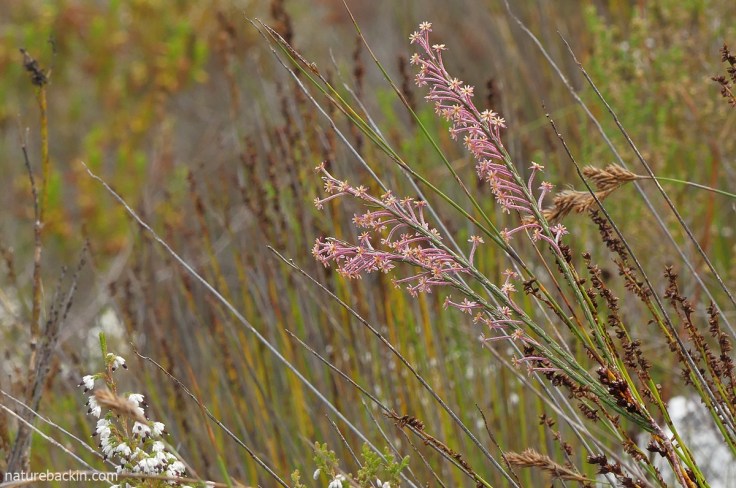
Common names for this genus (Struthiola) include featherhead, Capespray and gonna. The word “gonna” is a corruption of the Khoisan name for some species in this family. This particular species, Struthiola ciliata, is an erect shrub that can grow as tall as 1.5 m (about 5 feet). The small flowers may be white, pink or reddish and are unscented during the day but become scented at dusk and into the night. They are moth pollinated. What appear to be the flower’s outer petals are actually lobes of the calyx, with 8 flower petals contained within these and the yellow stamens visible in the tube of the flower.
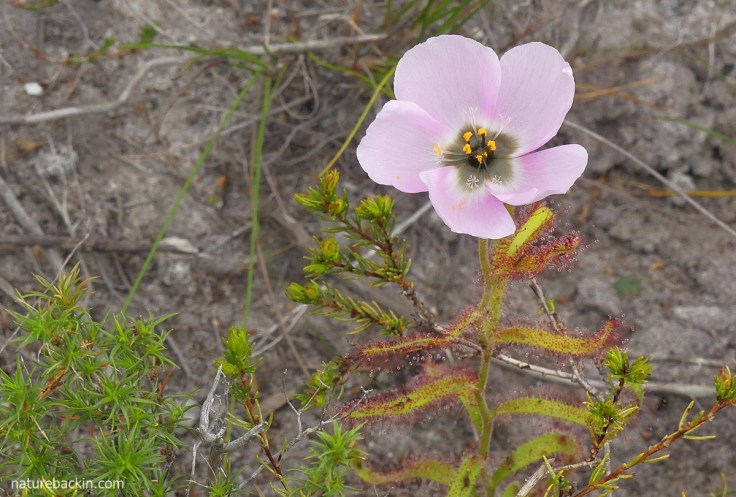
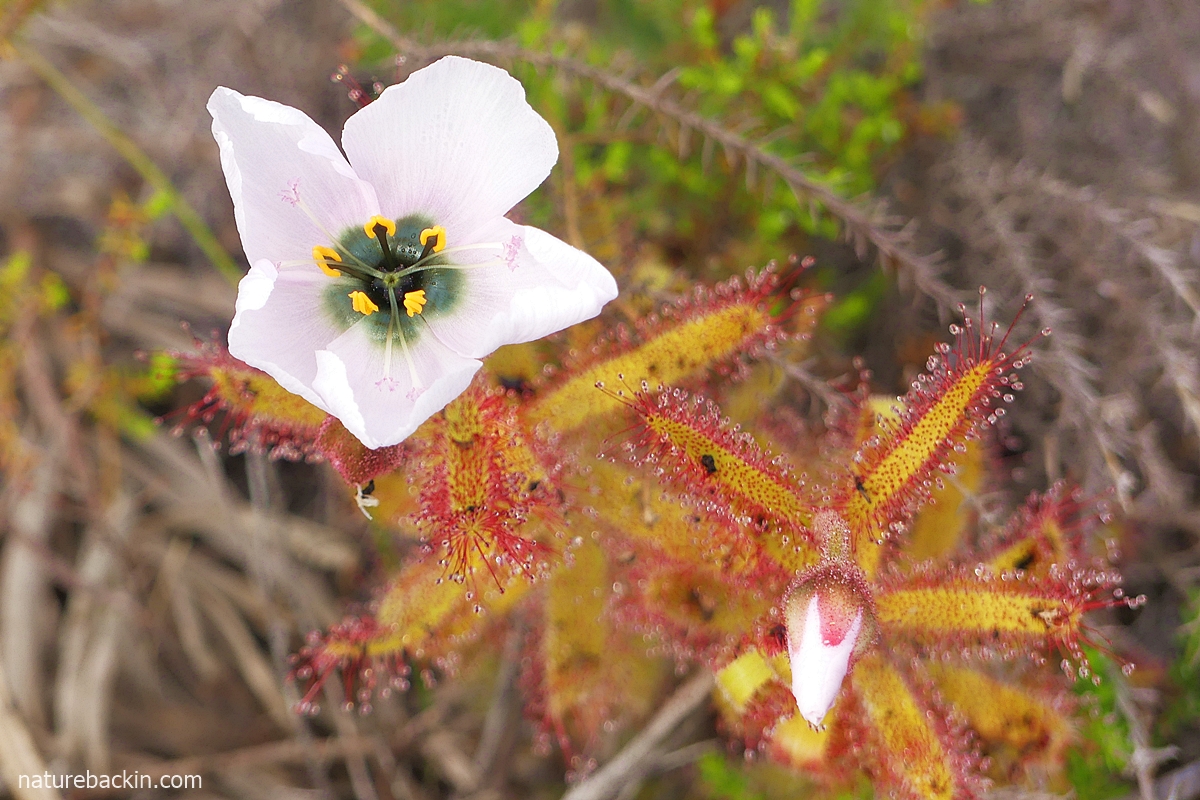
I was captivated by the poppy-flowered sundew (Drosera cistiflora). The large flowers (3–5 cm in diameter) and the sticky leaves covered with glandular hairs or tentacles each tipped with a drop of moisture are unusual and attractive. The droplets can be seen in the above photo as well as in the header photo. Drosera means dewy, and refers to the leaf glands that look dewy.
Luckily, I was only metaphorically captivated, whereas insects may be literally captivated as Drosera are carnivorous plants. The sticky, gluey droplets trap insects that approach too closely. Once an insect is caught the leaf produces more dew and neighbouring tentacles are stimulated to bend towards the victim, further entrapping it. The sticky fluid contains a weak acid and enzymes that digest the soft parts of the prey, enabling the leaves to absorb nutrients directly from the bodies of trapped insects – consequently Drosera can survive even in extremely nutrient poor soils. The form and flower colours of Drosera cistiflora are variable across its range. Flowers are most commonly pink or white, but purple, red or yellow flowers occur in some regions.
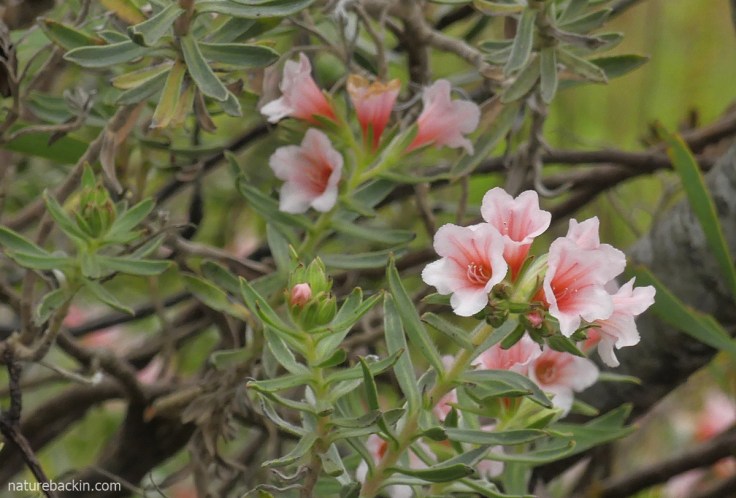
Lobostemons are members of the Forget-me-not family, and collectively are referred to as “agtdaegeneesbos” – literally “eight-day health bush”, referring to the healing qualities of these plants, mostly particularly Lobostemon fruticosus, that have antiseptic properties. Substances made from the leaves were used traditionally to treat wounds and other skin ailments. Pictured above is Lobostemon curvifolius (known as pink geneesbos or large-flower health bush) in flower at Phillipskop Mountain Reserve. It flowers during spring and the early months of summer, producing showy trumpet-shaped flowers that are pollinated by bees. This species is endemic to the south western region of the Western Cape.
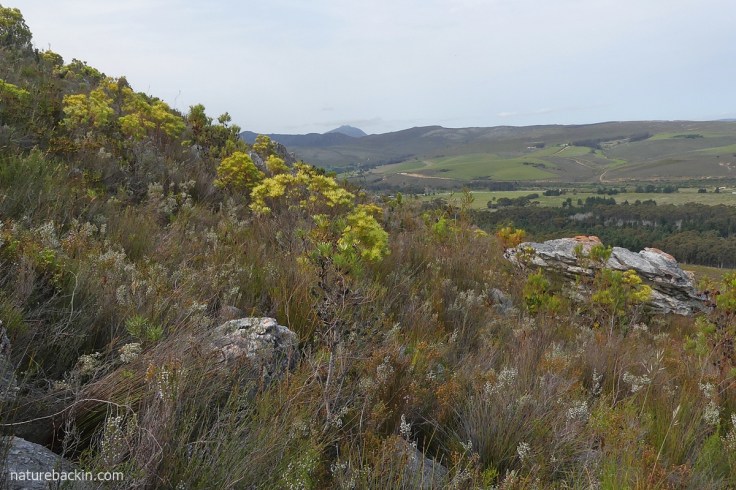
The above photograph was taken during our walk at Phillipskop Mountain Reserve. The splashes of yellow in the vegetation are sickleleaf conebushes (Leucadendron xanthoconus). The mountain slope drops down to the Klein River valley. On the opposite ridge on the horizon in the photograph, is the privately owned Sugarbird Nature Reserve. Our visit there will be the subject of the next post.
But before I sign off on this post, below is a photo taken from the Sugarbird Nature Reserve towards where the above photo was taken from.
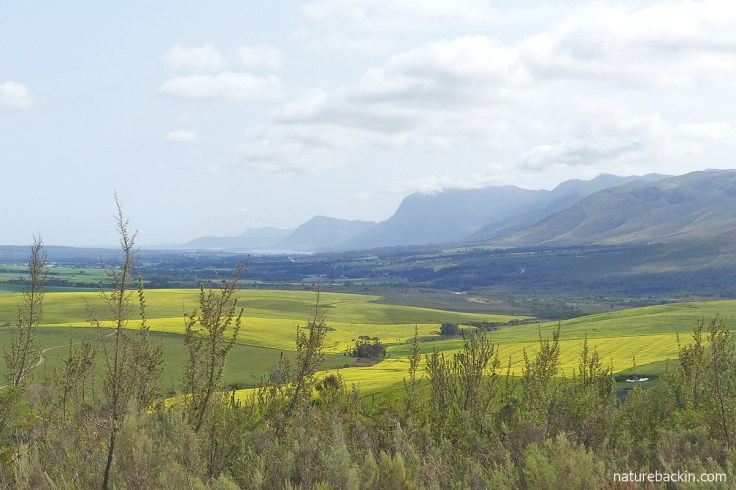
The Klein River Mountains, including Philipskop Mountain Reserve, are visible on the righthand side. Just visible in the distance is the Klein River Lagoon. The distant cluster of buildings on the far left of the photo are part of Stanford village. The yellow in the fields is canola just coming into flower. The darker area with trees is the part of the valley through which the Klein River flows down to the lagoon, which is on the shoreline of the South Atlantic Ocean just east of Hermanus.
Sources:
Websites:
Phillipskop Mountain Reserve. https://www.phillipskop.co.za/articles/flora/;
PlantZAfrica. South African National Biodiversity Institute (SANBI). https://pza.sanbi.org/
Books:
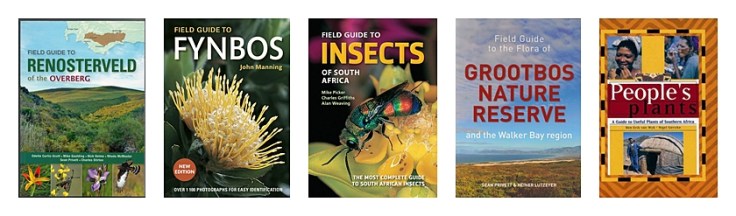
🔖Curtis-Scott, Odette. et al. 2020. Field Guide to Renosterveld of the Overberg. Cape Town: Struik Nature; 🔖Manning, John. 2018 (2nd ed.) Field Guide to Fynbos. Cape Town: Struik Nature; 🔖Picker, Mike, Charles Griffiths & Alan Weaving. 2019. Field Guide to Insects of South Africa. Cape Town: Struik Nature; 🔖Privett, Sean & Heiner Lutzeyer. 2010. Field Guide to the Flora of Grootbos Nature Reserve and the Walker Bay Region. [Hermanus]: Grootbos Foundation; 🔖Van Wyk, Ben-Erik & Nigel Gericke. 2007. People’s Plants: A Guide to Useful Plants of Southern Africa. Pretoria: Briza.
Posted by Carol
Discover more from letting nature back in
Subscribe to get the latest posts sent to your email.


November 29, 2025 at 3:30 pm
Wow, I just wrote a really nice comment and it didn’t go through. I will try again. Thanks so very much, Carol, for sharing this fascinating visit to Africa’s Western Cape and the Phillipskop Mountain Reserve. I really enjoyed your descriptions and photos of all the interesting wildflowers, but was especially intrigued by the one you liked, the carnivorous poppy-flowered sundew. Cool bees and beautiful landscapes.
LikeLiked by 2 people
December 9, 2025 at 1:59 pm
Hi Jet – it is most frustrating when comments disappear like that. Thanks for taking the time to write another comment! We do live in a beautiful area. Phillipskop is a ten-minute drive from our house. We are enjoying seeing and learning about the Cape Flora. The carnivorous poppy-flowered sundew is especially intriguing.
LikeLiked by 1 person
November 21, 2025 at 10:21 am
What a beautiful bouquet. Thank you for sharing your photographs and knowledge of these flowers. I am tickled by some of the common names
LikeLiked by 2 people
November 24, 2025 at 6:31 pm
Thanks Mariss. I also enjoyed some of the common names 😊
LikeLiked by 2 people
November 19, 2025 at 4:20 pm
Beautiful 😍
LikeLiked by 2 people
November 24, 2025 at 6:31 pm
Thank you!
LikeLiked by 1 person
November 25, 2025 at 3:58 pm
Welcome hi visit my you tube channel
LikeLike
November 18, 2025 at 6:28 pm
WOW whza`t an interesting plant life
The Fab Four of Cley:-) 🙂 🙂 🙂
LikeLiked by 2 people
November 19, 2025 at 6:20 am
The Cape Floristic Kingdom is a treasure trove!
LikeLiked by 1 person
November 13, 2025 at 7:49 am
Such interesting plant life, often the-same-but-different from many species we have here.
LikeLiked by 1 person
November 16, 2025 at 12:43 pm
Yes, the overlaps and similarities can be interesting.
LikeLiked by 1 person
November 12, 2025 at 11:33 am
What a wonderfully rich post, Carol. Despite my living not far from this area there were so many plants that I haven’t seen before. Your rich, careful descriptions are a delight!
LikeLiked by 2 people
November 12, 2025 at 6:40 pm
Thanks so much Christine. The diversity of plants here never ceases to astonish!
LikeLike
November 12, 2025 at 4:53 am
Lovely selection of your native plants and very informative as always. I confess I do like a good carnivorous plant. They’re bizarre and wonderful in my book.
LikeLiked by 2 people
November 12, 2025 at 6:39 pm
Thanks Graham. Carnivorous plants truly are bizarre. Perhaps can be used as inspiration for a Halloween costume?
LikeLiked by 1 person
November 13, 2025 at 4:11 am
If I did anything for Halloween I’d think about it!
LikeLiked by 1 person
November 16, 2025 at 12:43 pm
😂 Luckily Halloween is not really a thing here.
LikeLiked by 1 person
November 12, 2025 at 4:46 am
Your excellent post has given me a joyful start to my day: beautiful photographs and interesting information that is easy to digest. You have moved to a new world of biodiversity and by embracing it are enlightening us all!
LikeLiked by 2 people
November 12, 2025 at 6:36 pm
Thanks for your lovely comment Anne. It truly is a new world here! I am happy to share as I learn and enjoy along the way.
LikeLiked by 1 person
November 12, 2025 at 12:34 am
Ooh, I love getting to see flowers that are totally new to me. Thanks for posting!
In the “It’s a small world” department: I often think of you as I am practicing my Celtic harp. I learn via online videos and zooms. My main teacher teachers from South Africa. 😉
LikeLiked by 2 people
November 12, 2025 at 6:31 pm
It has been nice to share some of the wildflowers we saw this past springtime.
I am really impressed that you are playing Celtic harp in addition to ukulele. Interesting that your main teacher is from SA. I have just listened to some Celtic harp online. It has such a beautiful tone.
LikeLiked by 1 person
November 11, 2025 at 9:37 pm
So many beautiful and unusual wildflowers! Excellent post, Carol. 👏🏼 👍🏼
LikeLiked by 2 people
November 12, 2025 at 6:25 pm
Thanks Eliza. The Cape Floristic Kingdom really is a place of riches.
LikeLiked by 1 person