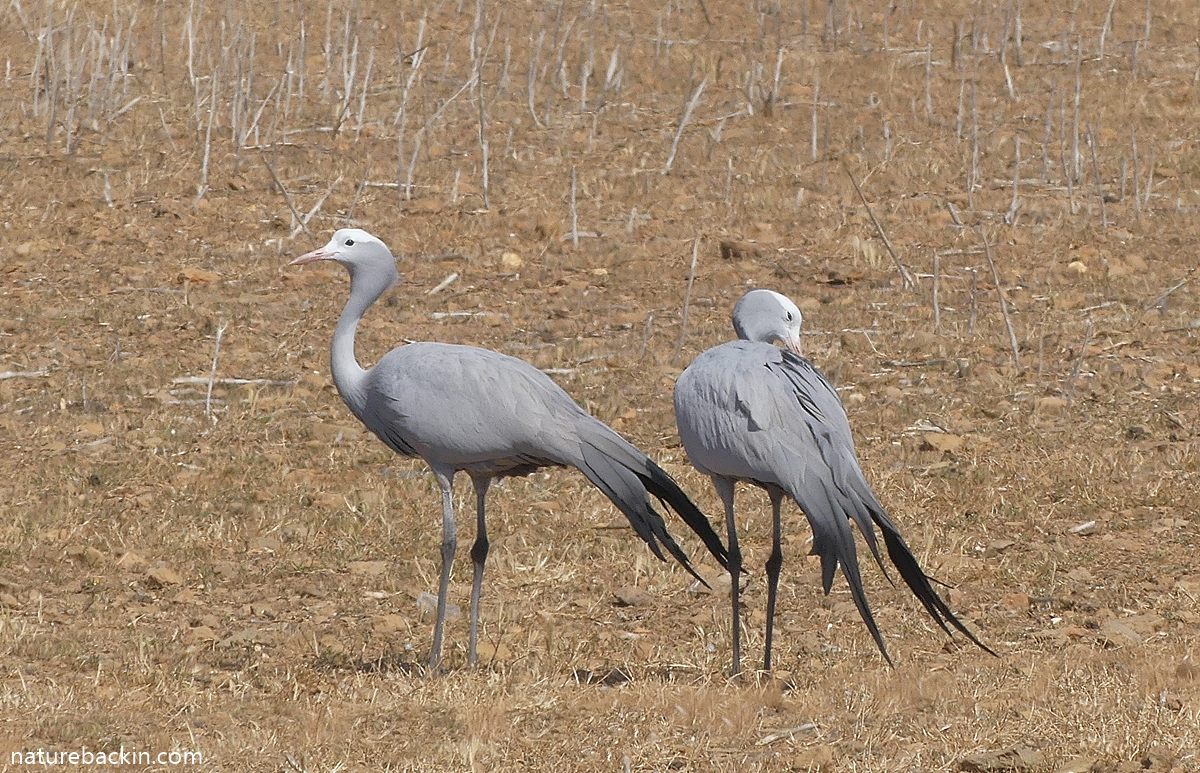
The blue crane is South Africa’s national bird. It is a strikingly beautiful and statuesque bird, standing at up to 1.2 m (4 ft) in height. We are lucky enough to see them flying over our house from time to time, their distinctive calls drawing our attention. But it was only when driving through freshly harvested wheat fields that I had an opportunity to photograph blue cranes as they congregated in large groups.
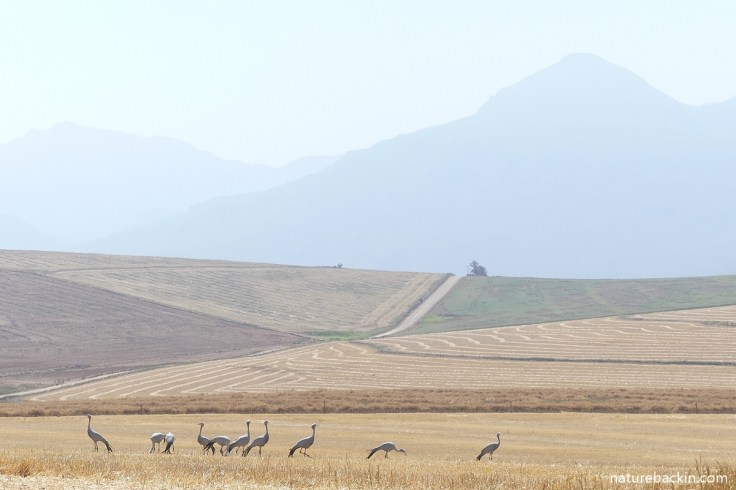
Ten blue cranes that were part of a widespread congregation numbering over 70 birds foraging on recently harvested grain fields in the Overberg in October last year. Blue cranes are omnivores, eating sedges and grasses, small bulbs, roots, seedlings and seeds and a variety of small creatures from worms to frogs, insects and even small mammals
Endemic to southern Africa, historically, blue cranes (Anthropoides paradiseus) occurred mainly in the grassland biome in eastern regions of the country. Sadly, populations in these regions have drastically declined since the 1970s, with the main factors being poisoning on agricultural lands (blue cranes can cause crop damage to young seedlings), and the loss of habitat as natural grasslands were largely eradicated and replaced, for example by commercial tree plantations. However, where grasslands remain, populations of blue cranes continue to exist in their former “stronghold”.
In the Overberg and Swartland regions in the Western Cape, vast areas of natural fynbos and renosterveld were replaced by wheatfields. Blue cranes expanded their range into these agricultural lands. Although numbers increased sufficiently for these regions to become one of the three most important regions for significant populations of blue cranes, more recent assessments indicate that numbers have been declining in the Overberg since 2011. Alarmingly, recent counts suggest that the population of blue cranes in the Overberg has declined by 44% between 2011 and 2025. (See https://bluecrane.org.za/blue-cranes-uplisted-to-vulnerable-a-wake-up-call-for-the-overberg/.)
Climate change with hotter, drier and longer summers can have a detrimental effect on the breeding success of blue cranes. Plus, climate change is causing changes in agricultural practices, for example a reduction in wheat cultivation, which is impacting on the survival rates of birds in this region. Other threats to blue cranes include collisions with power infrastructure, entanglement with fences and accidental poisoning through the use of poisoned bait to protect crops from other animals, such as rodents and wild geese. (See https://bluecrane.org.za/blue-cranes-uplisted-to-vulnerable-a-wake-up-call-for-the-overberg/.)
The Overberg Crane Group, established in the 1990s due to the high number of Blue Crane poisonings, currently works in partnership with the Endangered Wildlife Trust, and with CapeNature (the Western Cape’s conservation authority) to combat the misuse of agrochemicals so that wildlife poisoning is limited. (For more information see https://bluecrane.org.za/threats/.)
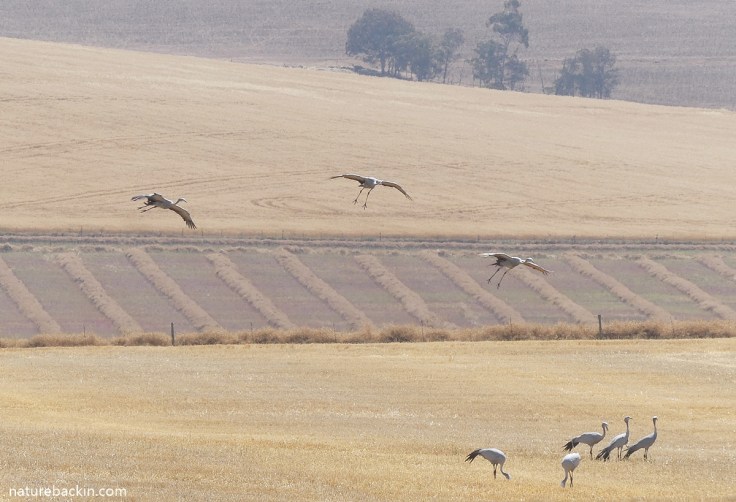
Three blue cranes coming into land to join the others foraging in the stubble of the wheatfields
The third area with significant populations of blue cranes is the central Karoo region of South Africa where the species has adapted to the pasture land-use system. Populations here may be more stable than in the eastern grassland regions or in the Western Cape. Blue cranes also occur in very small numbers in parts of the Eastern Cape. For a range map see here.
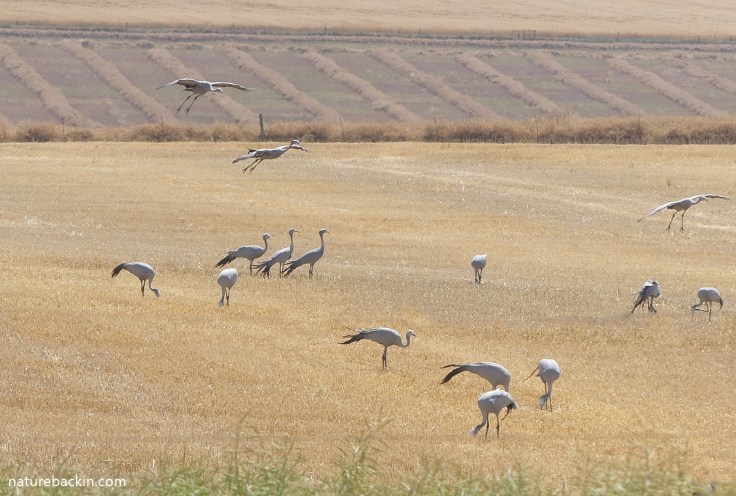
The same three birds as in the previous photo steadying just before landing
In the International Union for Conservation of Nature (IUCN) Red List of Threatened Species and the Regional Red Data Book of Birds of South Africa, Lesotho and Eswatini 2025, blue cranes are categorised as Vulnerable. Nationally, the blue crane population fell by half in the last quarter of the 20th century. According to Birdlife’s website named DataZone, blue crane population estimates that were published in 2007 estimated a minimum of 25 520 individual birds in the total population, with just over 12 000 in the Western Cape, just under 10 000 in the central Karoo and only 2 600 in the eastern grasslands.
More recent surveys have suggested that the populations may be higher than those that were estimated in 2007, but these numbers are rough and uncertain. Estimated numbers for the total population is between 25 000 and 46 000, equating to around 17 000 to 30 000 mature individuals.
A small disconnected population in northern Namibia has declined to being very small, down to only 33 individual birds in 2019. (For more information on blue crane population trends see https://datazone.birdlife.org/species/factsheet/blue-crane-anthropoides-paradiseus#Population)
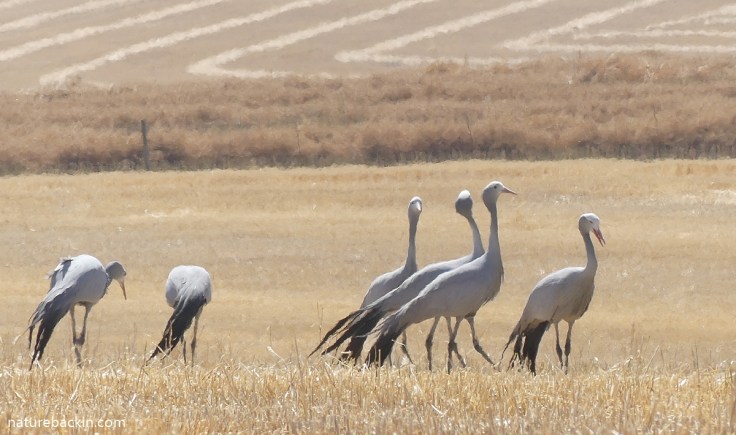
Zooming in for a closer look creates a painterly almost watercolour effect. The decorative train of long and darker plumes are not tail feathers, but are trailing tertial wing feathers. The wingspan of adult blue cranes is 180–210 cm (70–83 inches)
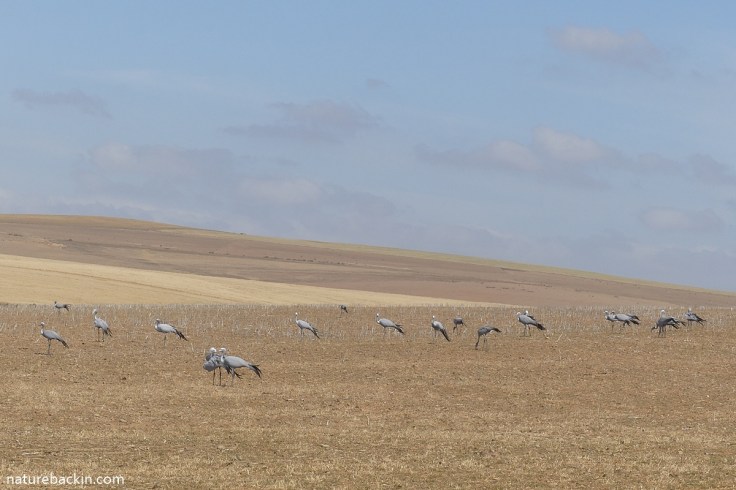
A group that forms part of another large congregation of non-breeding blue cranes foraging on recently harvested wheatfields in early summer
Breeding pairs disperse from large groups during the breeding season (in spring and summer) with pairs returning to their own breeding territory. In winter, breeding pairs with juvenile offspring leave their breeding territory and join with other groups forming large flocks. Adult birds in a breeding pair form a lifelong bond and remain together throughout the year, even when joining large sociable flocks. Like other species of cranes, blue crane pairs perform a courtship display or dance during the breeding season.
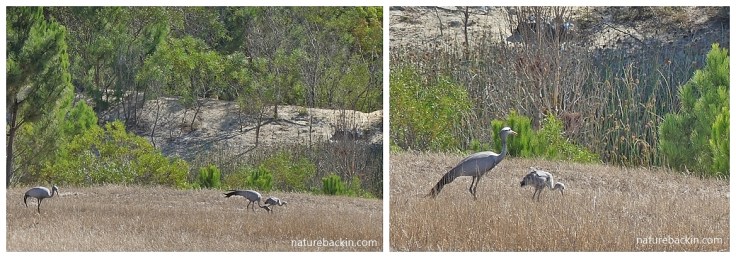
The above are the only photos I have of a breeding pair with a juvenile offspring. We saw this family in a block of unburnt farmland after the recent fires in the Overstrand
Blue cranes usually lay two eggs and the parents take turns incubating the eggs. Nests are often little more than a scrape on the ground—with a few stones or sticks scraped together, and nesting sites may be in secluded grassland or fallow agricultural land or, where available, in shallow wetlands—where a pad of vegetation is used to nest on. The chicks are very vulnerable to many threats and mortality rates are high despite the parents being very protective. Youngsters are able to fly when they are 3 to 5 months old.
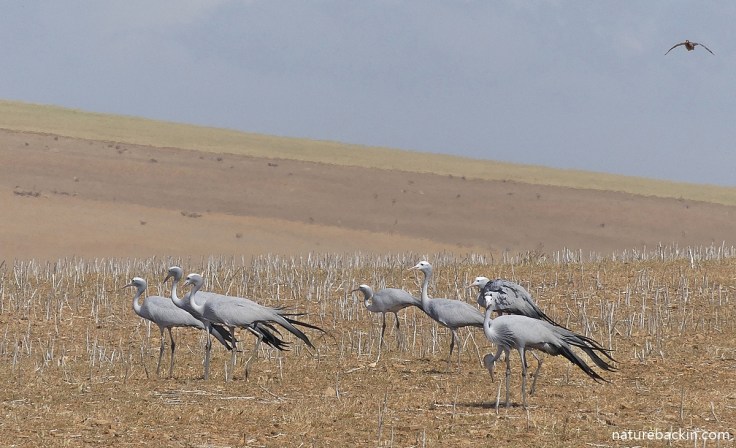
Blue cranes showing off their trailing wing feathers that are rippling in the breeze. Note the appearance of a duck flying into the frame in the top righthand corner!
Even while foraging the blue cranes are quite vocal. Their calls carry long distances especially when they call in flight. For recordings of blue cranes calling, see https://xeno-canto.org/species/Grus-paradisea. (This site has not yet updated the genus name from Grus to Anthropoides.)
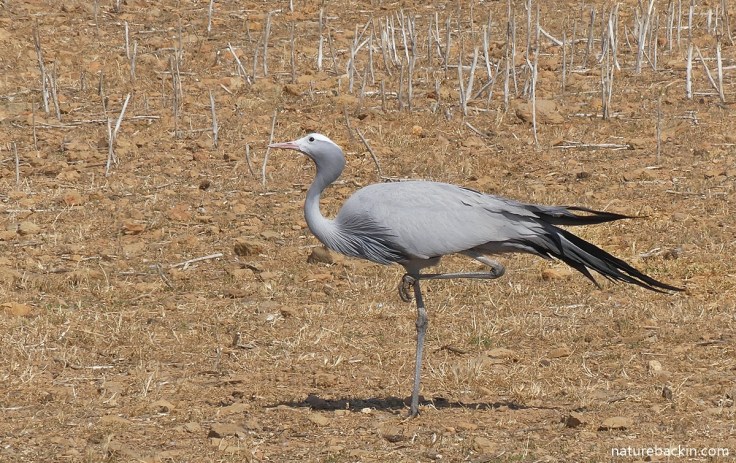
While high-stepping this blue crane displays not only the trailing wing feathers but the distinctive white cap and the ruffle of feathers at the base of the neck onto the chest
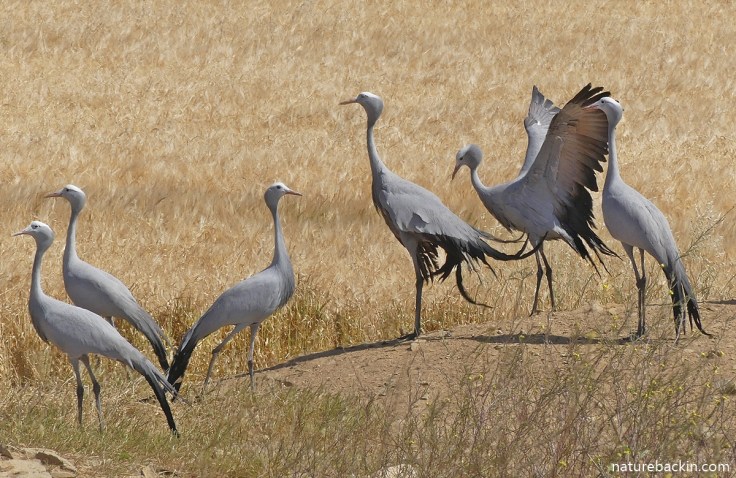
Another rather painterly impression of blue cranes just before they took flight from their vantage point on relatively high ground
Three species of crane occur in South Africa. In addition to the blue crane (Anthropoides paradiseus), the other two species are the wattled crane (Grus carunculate), which is categorised as Vulnerable, and the grey crowned crane (Balearica regulorum regulorum), which is categorized as Endangered.
To find out more and how you can help, here’s how to contact some of the crane conservation groups that work to protect species of cranes:
- Overberg Crane Group https://bluecrane.org.za/
- KZN Crane Foundation https://kzncranefoundation.org.za/
- Endangered Wildlife Trust. African Crane Conservation Programme https://ewt.org/cranes/
- International Crane Foundation https://savingcranes.org/south-africa/
For more on South African cranes, see my post from 2018 on the courtship dance of the endangered grey crowned crane.
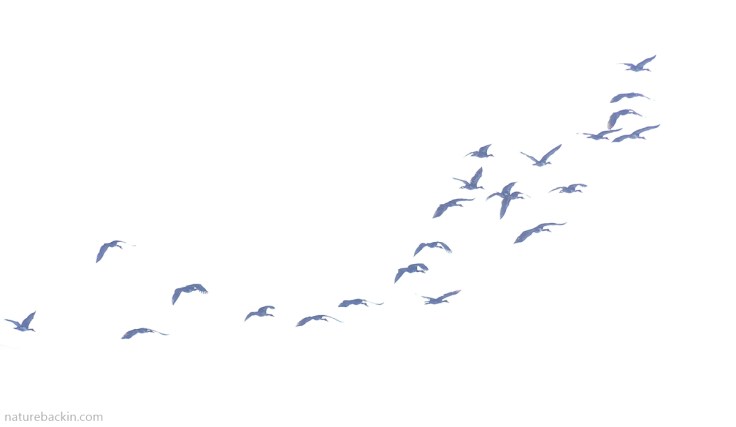
A rather impressionistic shot of a skein of blue cranes flying over our house one evening
Sources:
BirdLife International (2021). Species factsheet: Blue Crane Anthropoides paradiseus. Downloaded from https://datazone.birdlife.org/species/factsheet/blue-crane-anthropoides-paradiseus on 27/02/2026
International Crane Foundation. 2026. Blue cranes. https://savingcranes.org/species/blue-crane/
Jobe, Sizwe. 2026. Blue Crane. South African National Biodiversity Institute (SANBI). https://www.sanbi.org/gardens/hantam/information/blue-crane/
KZN Crane Foundation. 2026. Blue Crane – South Africa’s National Bird. https://kzncranefoundation.org.za/about-cranes/blue-crane-south-africa/
KZN Crane Foundation. 2026. Cranes of the World. https://kzncranefoundation.org.za/cranes-of-the-world/#:~:text=Anthropoides%20has%20one%20entirely%20African,Africa%20as%20a%20wintering%20migrant
Posted by Carol

Discover more from letting nature back in
Subscribe to get the latest posts sent to your email.


February 28, 2026 at 6:25 pm
Painterly is a great descriptor of these statuesque birds. Striking and graceful. I enjoyed learning about the blue cranes, Carol. I hope the efforts to increase their numbers bear fruit.
LikeLike
February 28, 2026 at 5:25 pm
What fabulous photos! And I hope that conservation efforts bear fruit, as it seems a wonderful bird to have as a national symbol. Its call sounds a little querulous? Perhaps I didn’t have the sound up high enough as you say it carries a fair distance! Great post!
LikeLike
February 28, 2026 at 4:08 pm
What a wonderful sighting (and photographs) of the Blue Cranes! I get very excited when I see them in the Addo Elephant National Park and even more so when I occasionally come across them not far from where we live.
LikeLike