Although the males are unmistakable and conspicuous in the breeding season, initially I didn’t recognize the first non-breeding pin-tailed whydahs I saw in our Western Cape garden.
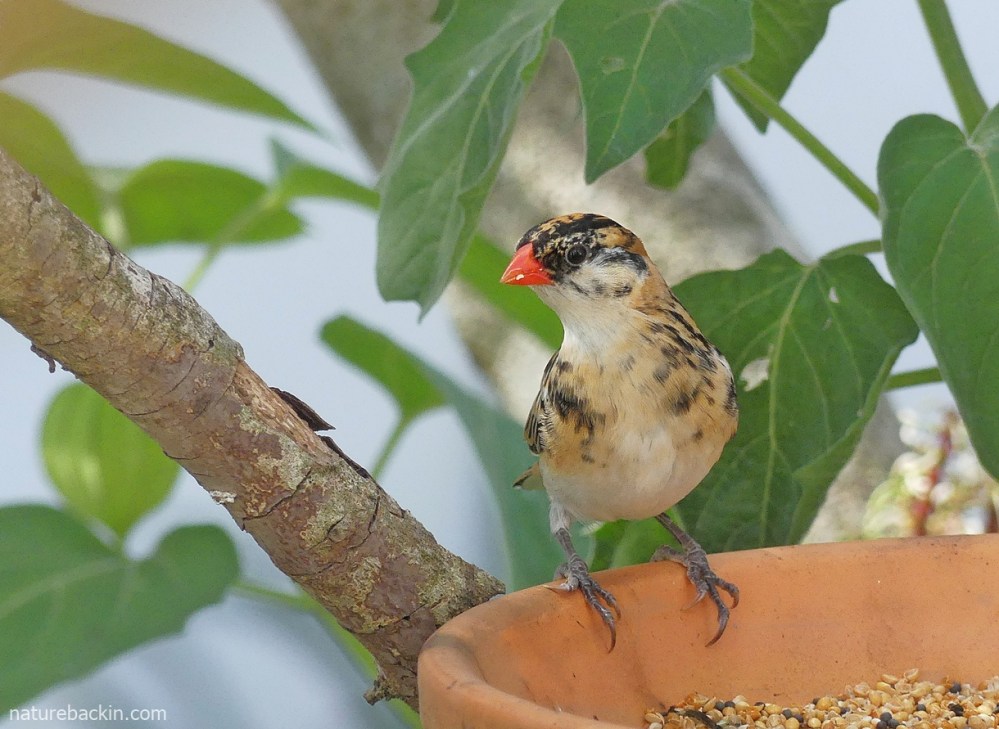
A pin-tailed whydah in non-breeding plumage at a feeder in our garden in April this year
In the breeding season, the female pin-tailed whydahs (Vidua macroura) have largely black bills, so I found their non-breeding-season red (or reddish) bills surprising. The adult males have red bills throughout the year. When not breeding the males no longer carry the long and distinctive black tail feathers of the breeding season, and their plumage – showing more buffy colours including on the underparts – is the same as the plumage of the non-breeding adult females.
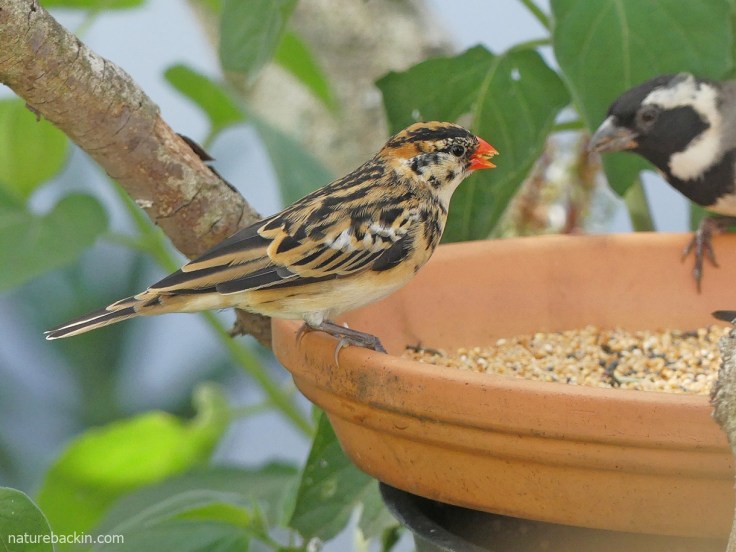
The non-breeding plumage of the pin-tailed whydahs, often described as drab, is actually surprisingly striking and made even more so by the bright red bill. This adult pin-tailed whydah at our bird feeder could be a male or a female. (That is a male Cape sparrow in the background.)
Pin-tailed whydahs are small birds weighing only about 15 g (half an ounce). But they are not short on attitude, especially in the breeding season when the males are an outsize presence in terms of their in-flight breeding displays and their often-pugnacious behaviour towards other birds.
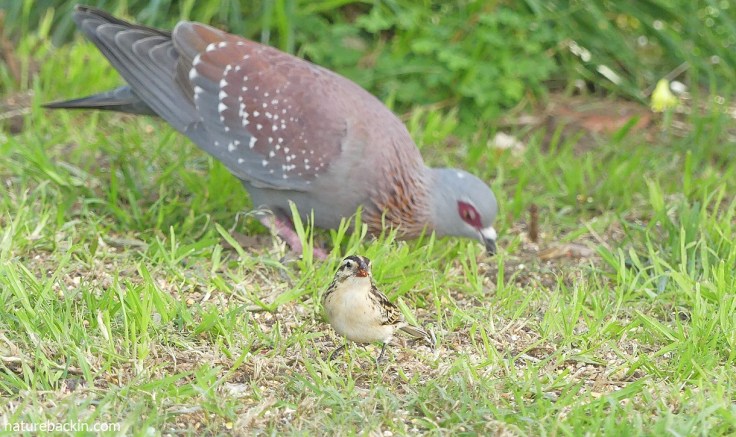
A relatively tiny female pin-tailed whydah in the breeding season – sporting a mostly black bill, pale underside and distinctive crown stripe and eyebrows. Feeding on the ground behind her is the much larger speckled pigeon (Columba guinea) that weighs around 345 g (12 oz.)
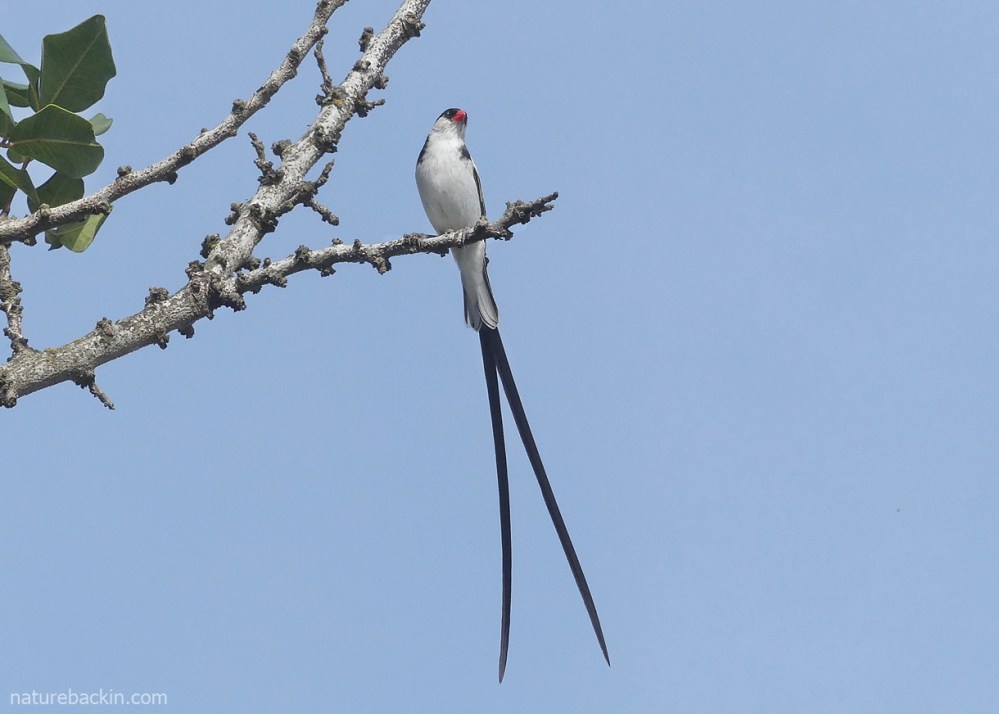
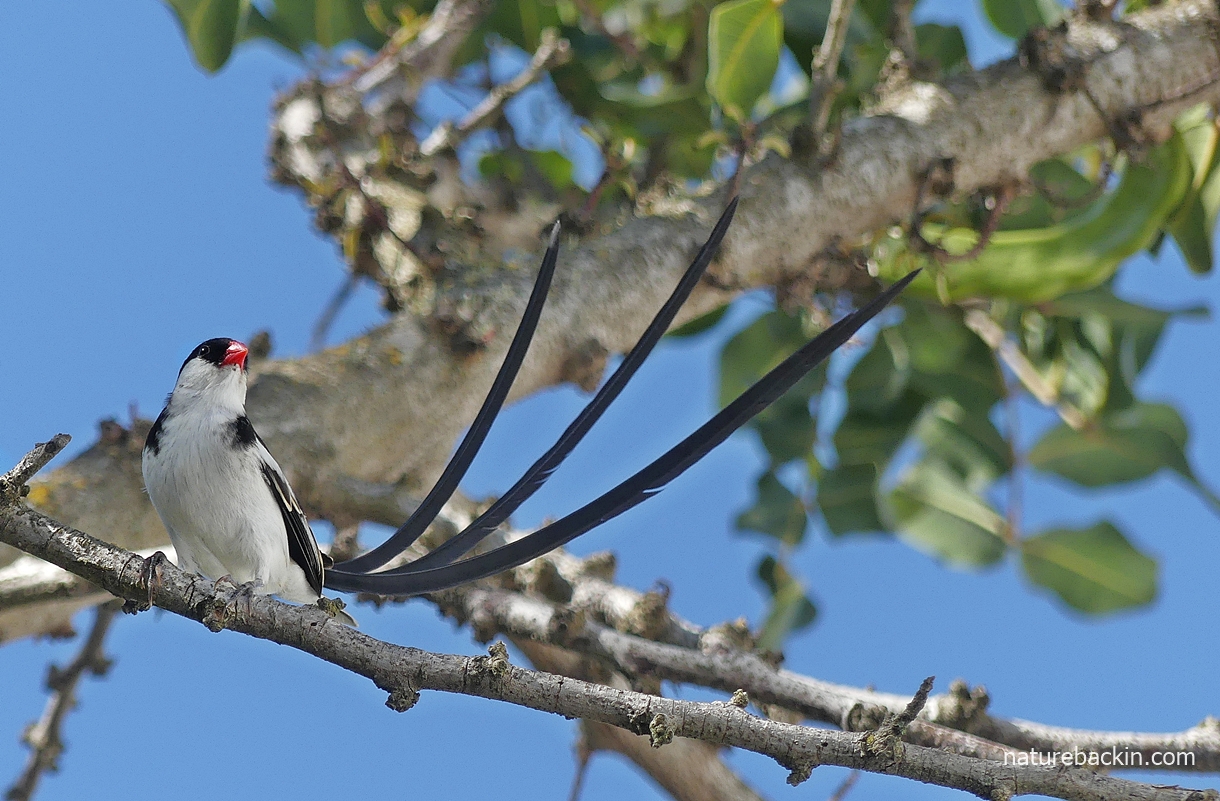
And above, perching in the carob tree in our garden, is a male pin-tailed whydah in his breeding plumage with showy white underparts and long tail feathers
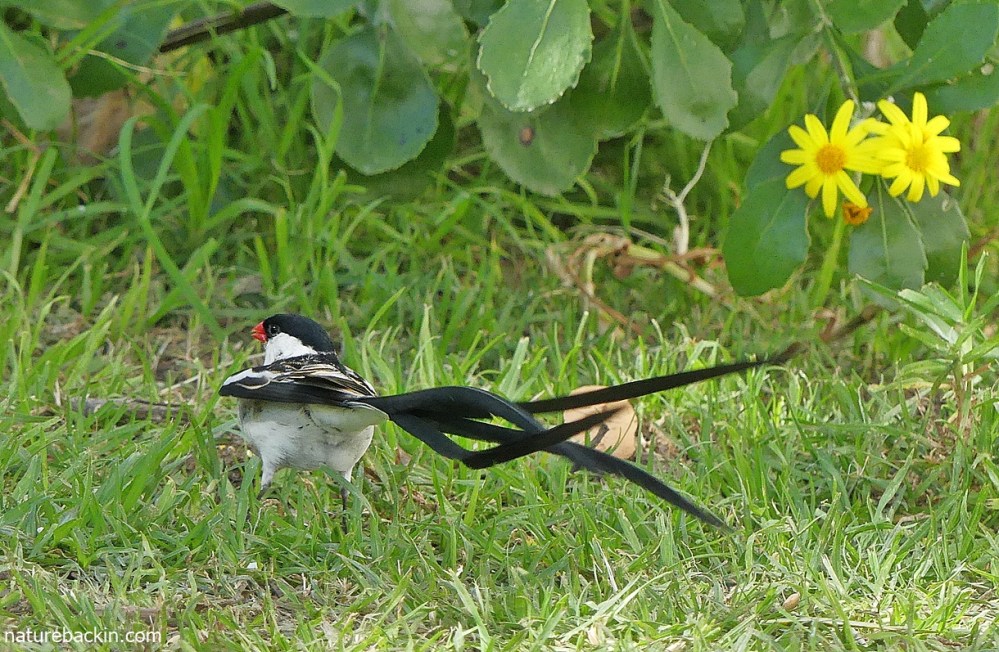
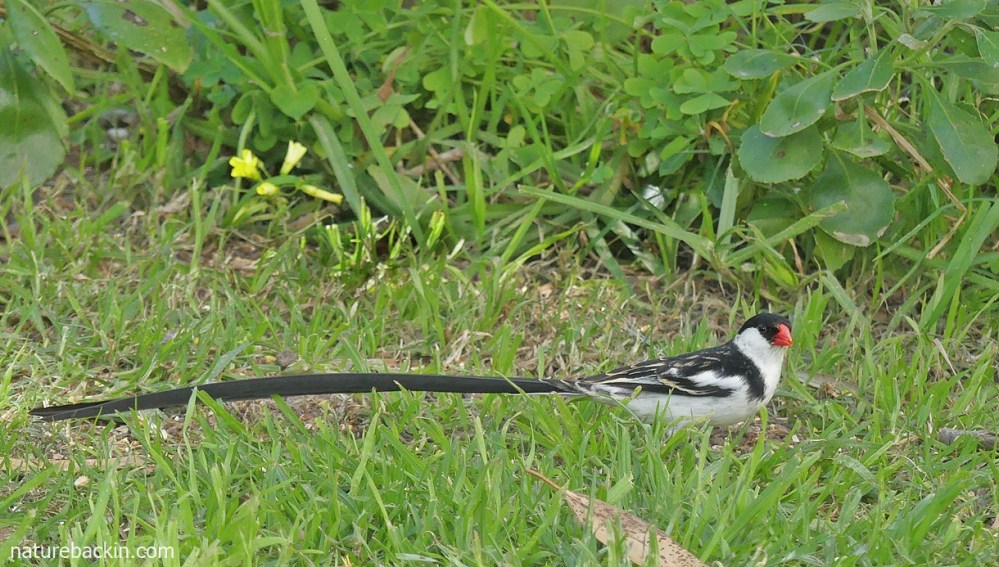
A male pin-tailed whydah foraging on the ground below our bird feeder. His long tail feathers are being buffeted by the wind
In the peak of the breeding season, male pin-tailed whydahs seem to live an exhausting life. Not only are they almost constantly chirping, but they frequently perform flight displays showing off their tails to potential mates, while at the same time chasing off other males and, when feeding, also birds of other species.
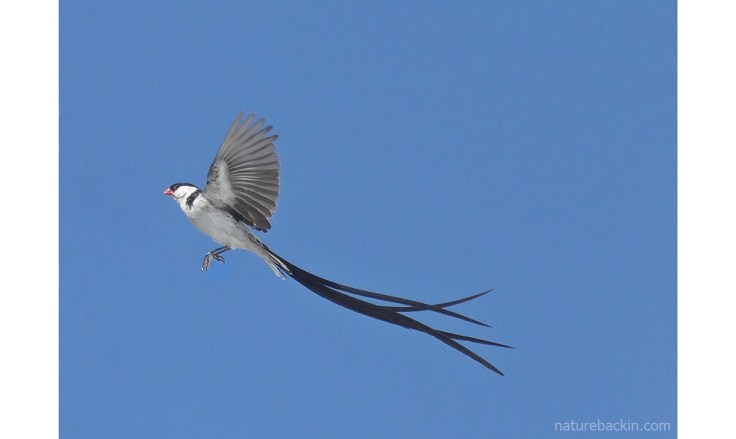
With their long tail feathers trailing behind them, male pin-tailed whydahs in breeding plumage are spectacular in flight
Over the past two or three weeks the male pin-tailed whydah visiting our garden has ratcheted up his flight activities. Occasionally I have seen a second male, but after a short chase, only one remains.
There are a few breeding females also visiting the neighbourhood and our garden, and the male has a peculiar flight display to attract the attention of an interested female. He chirps loudly while hanging almost hovering above her in the air, his feet unfolded before him while he kind of flounces up and down in flight causing his tail to swirl up and down behind him.
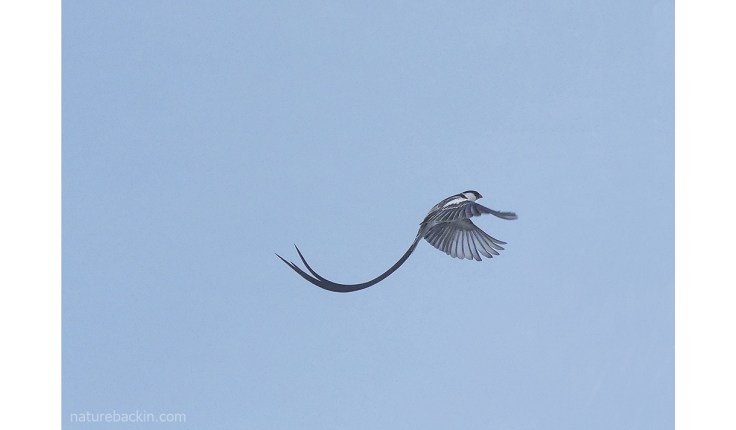
Because of intervening vegetation, I was not able to get a photo of the whydah in his courtship flight displays, but this photo shows how the tail can bend and flair when the bird is in a more undulating flight
As if the courtship flight displays are not exhausting enough, for about two weeks, the male pin-tailed whydah also flew repetitively at our upstairs bedroom window, tapping his reflection on the glass pane with his bill, perhaps perceiving his reflection as a rival male. Mercifully he did not tap hard enough to do himself damage, but it was energetic and tiring. Although currently he is still around and courting females, to our relief for the last few days he has stopped taking an interest in the reflection.
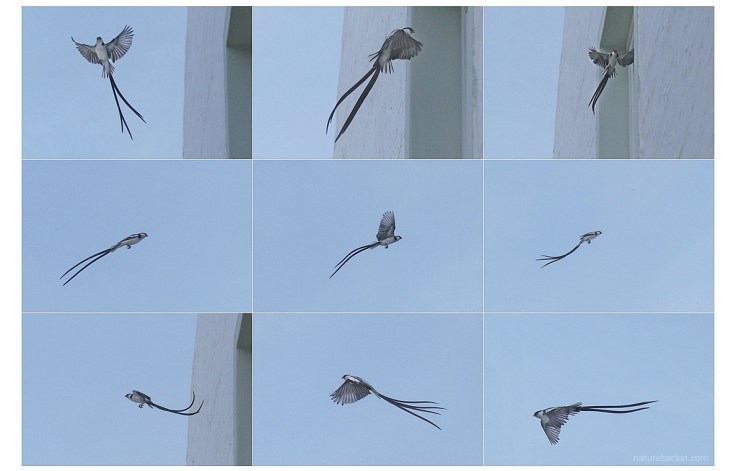
Here are some shots I snapped on a recent afternoon of the male pin-tailed whydah flying back and forth from attacking his reflection in the window
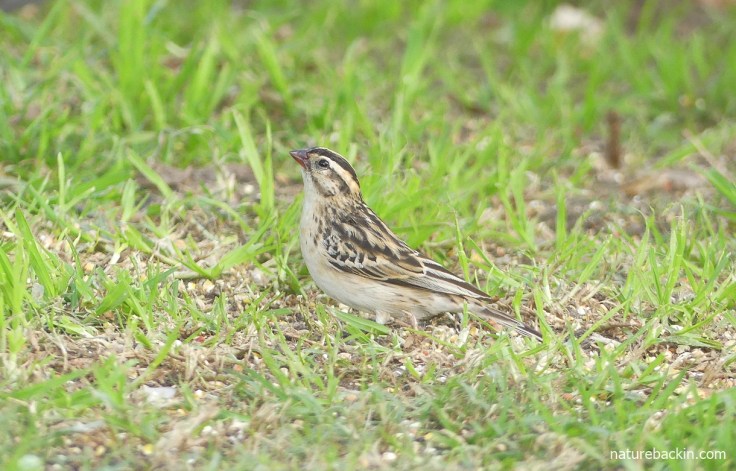
While foraging for fallen seeds this female pin-tailed whydah was interested enough in the flight antics of the male to stop feeding and look up to watch him. Her breeding colours – the nearly black bill and the stripes on her head – are clearly visible
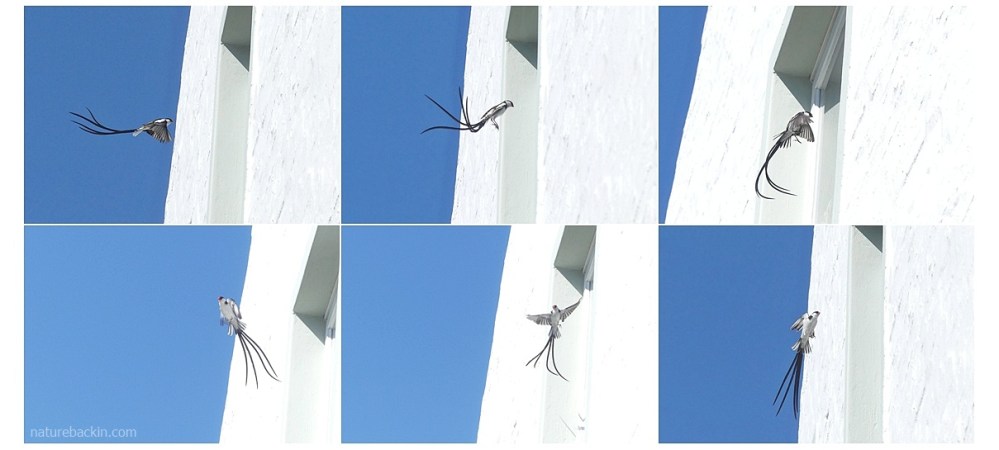
In bright morning sunshine, here are more photos of the acrobatic antics of the male pin-tailed whydah attracted to attack his reflection in the window
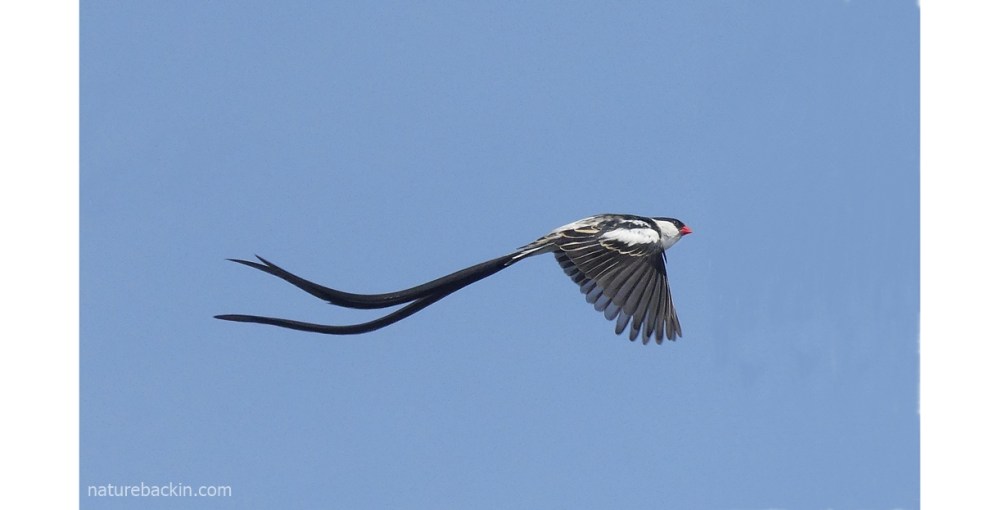
Male pin-tailed whydah in flight
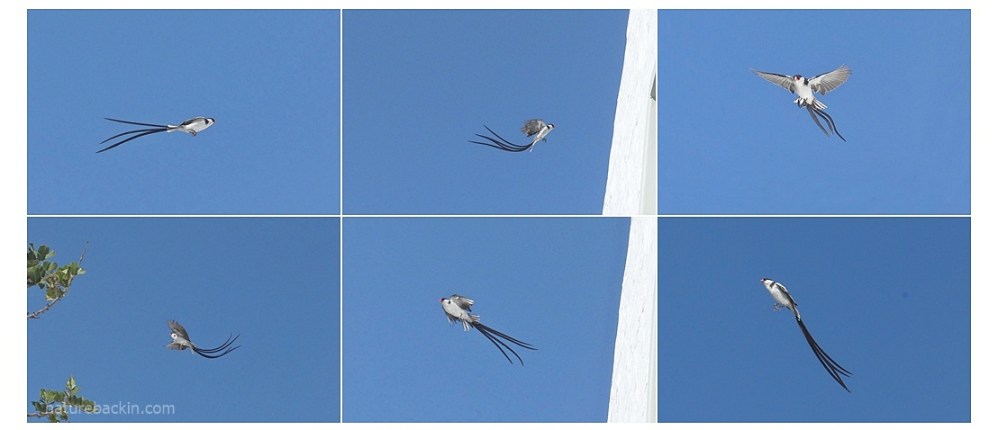
Pin-tailed whydah aerial acrobatics

A rare moment of rest for the male pin-tailed whydah as he perches in our carob tree, as he seemingly also takes a break from the weight of those long tail feathers that are curved over a branch
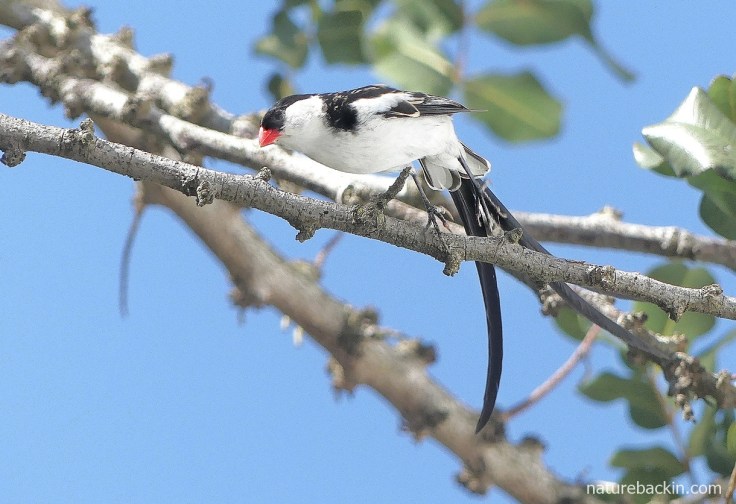
But here he goes again – the pin-tailed whydah launching himself off his perch and back into action to attract the attention of a female
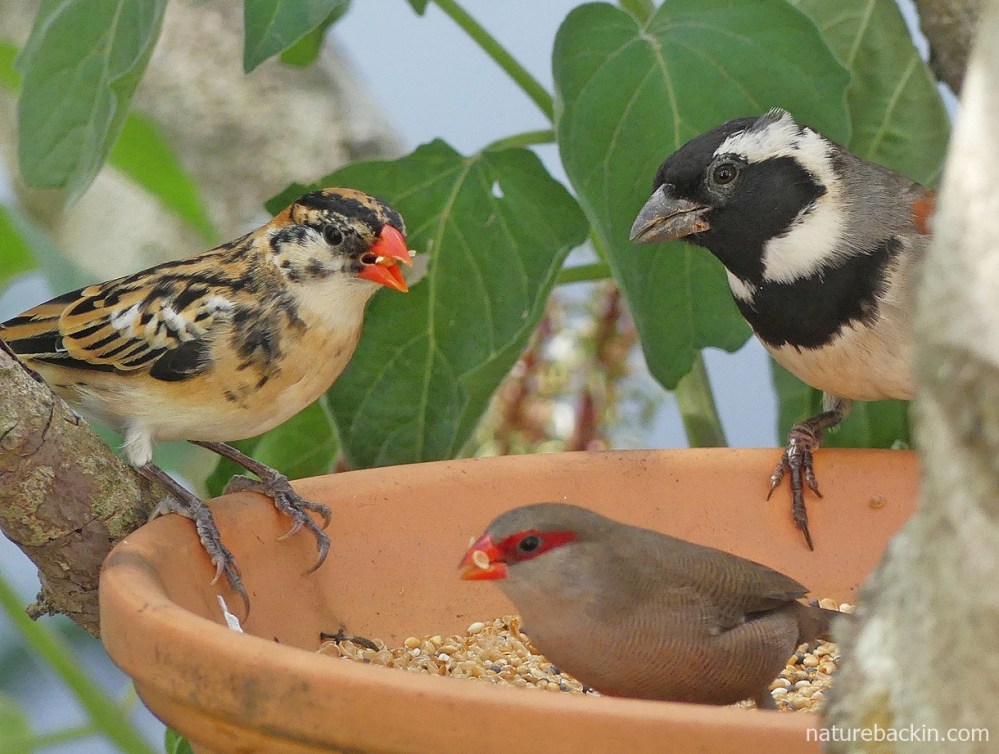
Back in the non-breeding season in April, a pin-tailed whydah was at the bird feeder in the company of a male Cape sparrow (on the right) and a common waxbill in the foreground
Interestingly, pin-tailed whydahs, like other whydahs and indigobirds (all in the Viduidae family along with the cuckoo finch), are brood parasites, that is they don’t make their own nests or raise their own young, but they lay their eggs in the nests of other species to be raised by them. Unlike cuckoos and honeyguides, whydahs do not routinely destroy or evict the eggs or chicks of the host species. Like many brood parasites, whydahs have only one or a few favoured host species.
The primary host species of the pin-tailed whydah is the common waxbill (Estrilda astrild). These birds, with an average weight of only 8 g (just over quarter of an ounce), are even tinier than the pin-tailed whydahs.
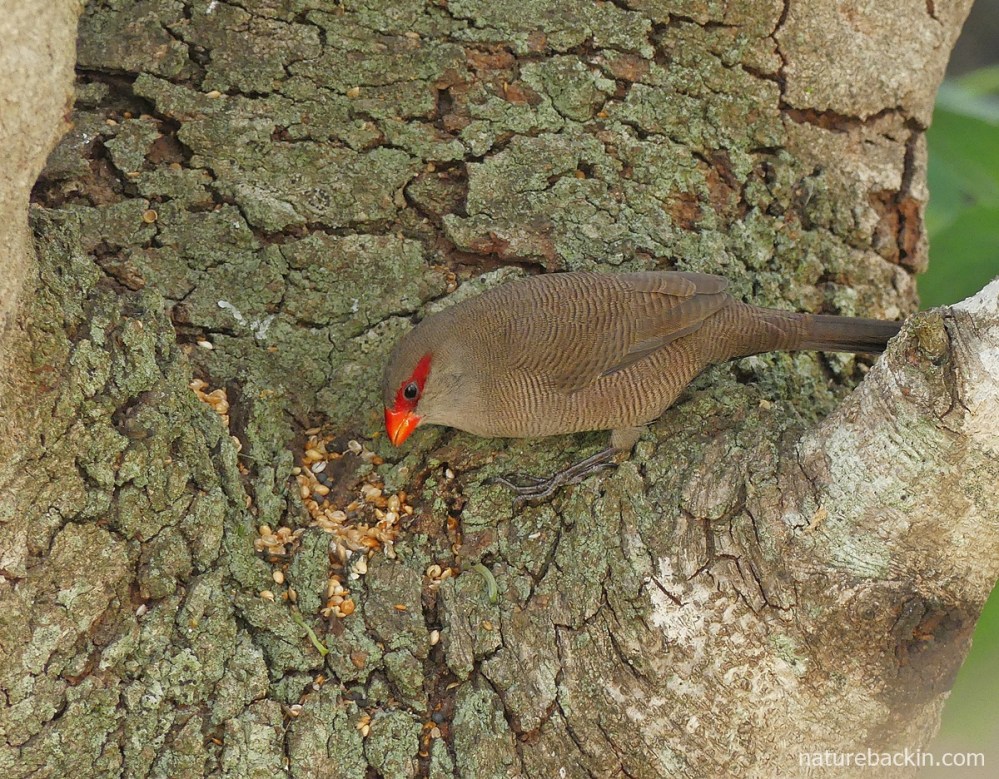
A common waxbill finding seed fallen from the bird feeder on the trunk of the carob tree in our garden
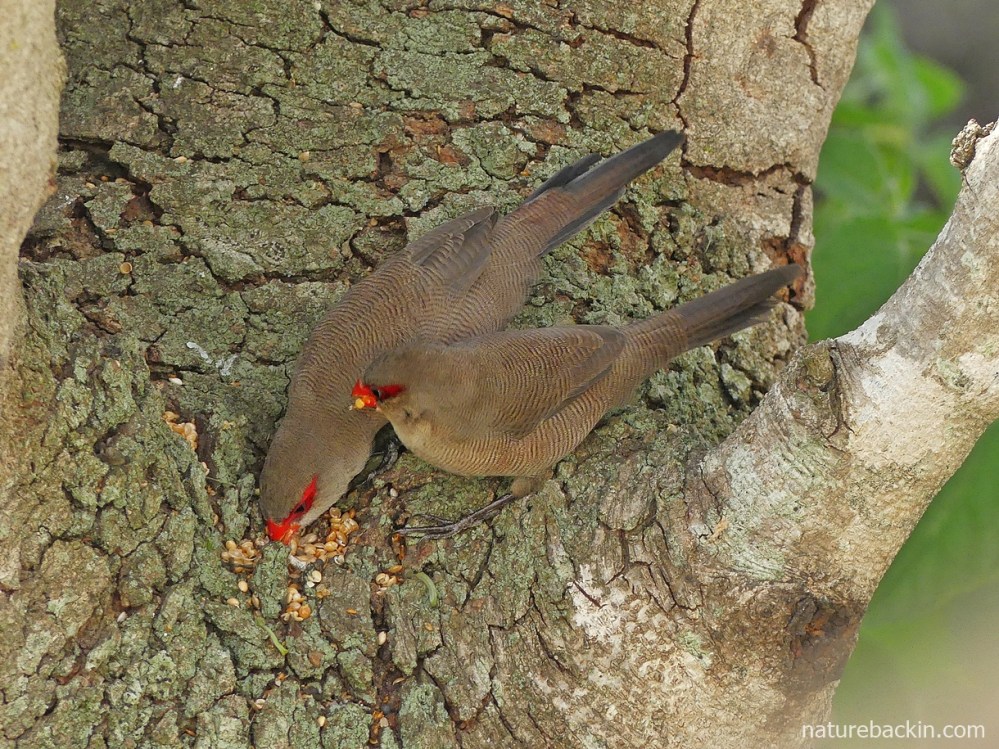
Common waxbills are often together as pairs or in small groups. Males and females are very similar
Pin-tailed whydahs and common waxbills are both popular species in the captive bird market. Escapees from the exotic pet trade have led to both species taking up residence in some regions with suitable habitat far from their native sub-Saharan Africa.
In the case of pin-tailed whydahs, they have become established in many off-shore African islands, in parts of Spain and Portugal, and in the Americas in Puerto Rico and in southern California. They have been introduced to other regions, such as in Hawaii, but are yet to become successfully established there. In addition to appropriate habitat, they also need appropriate host species.
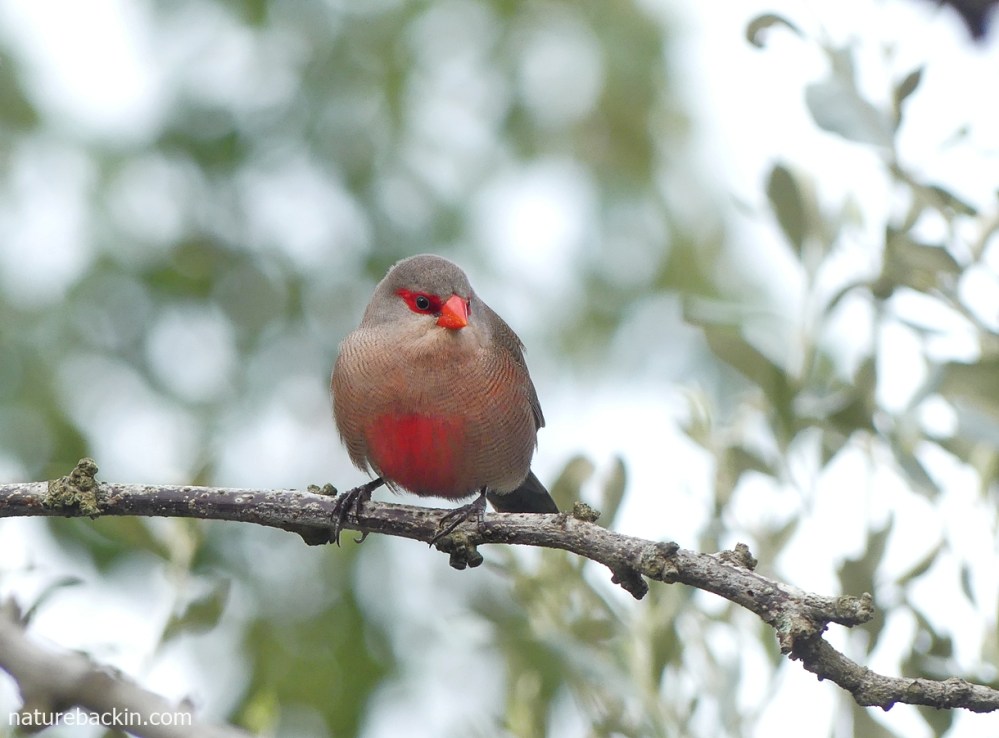
A common waxbill visiting our garden. The reddish patch on the belly is often more obvious in males though it may vary depending on the individual
In some regions where pin-tailed whydahs have been introduced, they have found hosts in other introduced species. For example, in Puerto Rico they parasitize mostly exotic orange-cheeked waxbills, and in southern California they parasitize an introduced Asian species of munia, the scaly-breasted munia.
Of the nine species of whydah in Africa, four occur in Southern Africa. Of these four, two parasitize only one host species each – the long-tailed paradise whydah (Vidua paradisaea) parasitizes the green-winged pytilia (Pytilia melba), and the broad-tailed paradise whydah (Vidua obtusa) the orange-winged pytilia (Pytilia afra). Although the shaft-tailed whydah (Vidua regia) mainly uses the violet-eared waxbill (Granatina granatina) as its host species, it occasionally also uses the black-faced waxbill (Brunhilda erythronotos) or the blue waxbill (Uraeginthus angolensis). In these three whydah species the adults mimic the calls of the host-species that they use, serving to ensure that the same host species is used in succeeding generations.
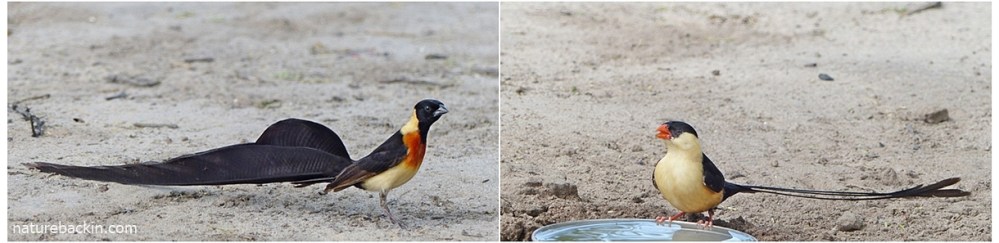
The long-tailed paradise whydah (Vidua paradisaea) (left above) and the shaft-tailed whydah (Vidua regia) (above right). I photographed both these birds in the Central Kalahari Game Reserve some years ago
Pin-tailed whydahs, however, are able to use several species as host species and they do not mimic the calls of any of the host species. Although the common waxbill is their primary host species, in southern Africa they have also been recorded parasitizing the bronze mannikin, orange-breasted waxbill, red-billed firefinch, swee waxbill, neddicky and tawny-flanked prinia. As they do not mimic the calls of their hosts they are not so locked-in to selecting only one host species.
This ability to switch hosts improves the chances of the pin-tailed whydah becoming established outside of its native range. As mentioned, in southern California it uses the scaly-breasted munia as a host. Munias are of the same family as the bronze mannikin, one of its historical host species in Africa.
There is a fear that introduced pin-tailed whydahs could switch to parasitizing other finch-like species that are native to their adopted region. As these novel species will have no coevolutionary history with the brood parasites, they are likely to be more seriously impacted.
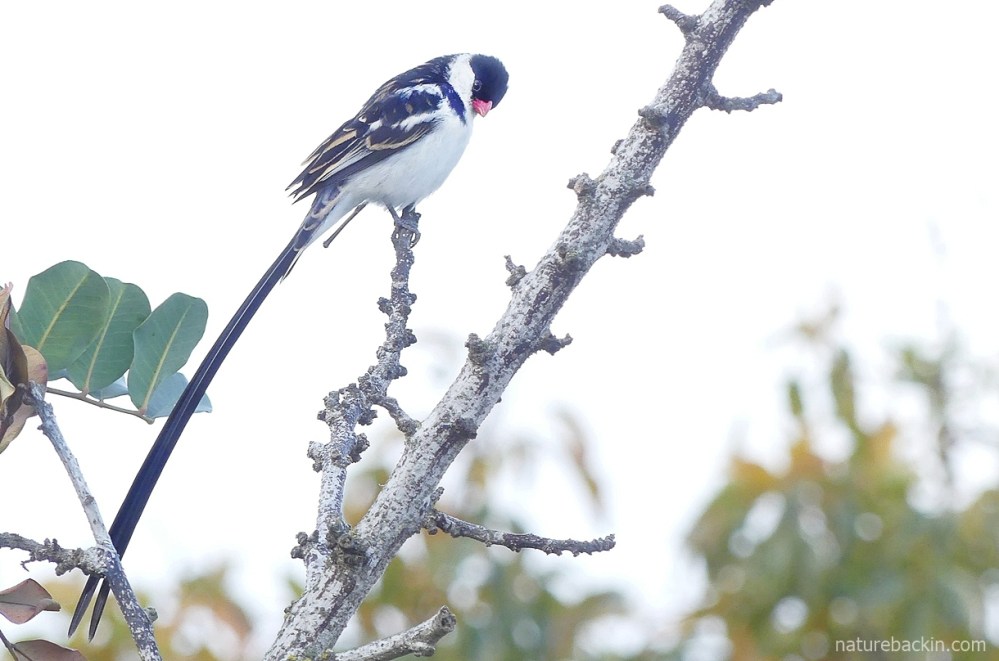
Confidently surveying his territory in our garden, the pin-tailed whydah is a big presence despite his small size
In the Western Cape, pin-tailed whydahs breed mostly from August to November, peaking in September and October. In the eastern parts of South Africa nesting is later in the summer, November to April, and in Zimbabwe from November to March.
Female pin-tailed whydahs may range widely to find nests of hosts. Sometimes her visits to host nests are accompanied by a male. She usually lays 1 to 2 eggs, but sometimes up to 5, per visit. Occasionally she may remove and eat an egg from the host’s already existing clutch. The hosts do their best to remain vigilant to defend their nests from the whydahs.
The pin-tailed whydah chicks are slightly larger than the chicks of the host species. They have similar mouth patterns when gaping for food and they mimic the waxbills swaying behaviour as they solicit food from the parents. The waxbills end up raising the pin-tailed whydah chicks alongside their own chicks. A week after fledging, surviving whydah chicks will disperse from the host family group to join whydah flocks.

Sources:
Crystal-Ornelas, Robert; Lockwood, Julie L.; Cassey, Phillip & Hauber, Mark E. 2017. The establishment threat of the obligate brood-parasitic Pin-tailed Whydah (Vidua macroura) in North America and the Antilles, The Condor: Ornithological Applications, Vol 119, Issue 3; 1 August 2017, pp.449–458, https://doi.org/10.1650/CONDOR-16-150.1;
Daniel, Karis. 2022. Pin-tailed Whydah (Vidua macroura). Biodiversity and Development Institute (BDI). https://thebdi.org › 2022 › 03 › 04 › pin-tailed-whydah-vidua-macroura;
Roberts VII Multimedia Birds of Southern Africa: PC Edition. 1997-2016 Southern African Birding. (This programme no longer has online support.)
Posted by Carol

Discover more from letting nature back in
Subscribe to get the latest posts sent to your email.


October 23, 2025 at 7:38 pm
Oh Carol, this was such a dazzling bonanza of pin-tailed whydah photos–truly heavenly. As a birder studying the African birds in the field guide, I dreamt about seeing just one of these when the male was sporting the long tail. I never did, so this fantastic series of photos completes that dream. Really interesting and informative, too. Thanks so much.
LikeLiked by 1 person
October 26, 2025 at 11:31 am
Hi Jet – thanks very much. Too bad you didn’t see a male whydah in breeding plumage, but such is the nature of birding I guess. You can be lucky most of the time, but not all of the time!
So I am happy our garden-visiting whydahs turned up and I was able to get some photos. I am just sorry I couldn’t get any photos of the breeding display, but he kept disappearing from view behind branches or shrubbery.
The whydahs are still very active in our garden, but the male has not returned to his window reflection. He must have figured something out!
LikeLiked by 1 person
October 3, 2025 at 8:57 am
So interesting, Carol, thank you! A great little bird. I too, am curious to know how the male acquires his display feathers. Do you see them growing longer over a period leading up to the breeding season? The photo of the resting male with his tail feathers wound around the tree also interests me. Am I right to assume he hasn’t the control over them to make that happen deliberately? Although they are all around us, there’s always so much more to learn about birds.
LikeLiked by 1 person
October 3, 2025 at 3:20 pm
Hi Sandra, yes they are great little birds!
As I replied in a comment to Carol, the birds have a pre-nuptial moult (when breeding plumage is acquired and grows-in over time) and a post-nuptial moult. Hormonal changes, including testosterone in the males, are associated with the moults and other breeding behaviours and characteristics.
Yes, if being observant, one can see the birds transitioning from non-breeding to breeding plumage, including seeing the breeding tail feathers growing longer.
The birds can manipulate their tail feathers by flicking their bodies, but as far as I have observed they don’t seem to have control over these breeding feathers they way they have control over their normal tails.
The tail feathers draped over the branch was probably not something the bird deliberately achieved, but it happened that way as he moved around.
I was perhaps being a bit whimsical saying he was taking a break from the weight of the tail feathers 😊
LikeLiked by 1 person
October 4, 2025 at 9:29 am
Thank you, Carol. Nature is so complex. And so remarkable!
LikeLiked by 1 person
October 2, 2025 at 12:50 pm
What a fascinating and highly informative post about these beautiful birds, Carol! I’m trying to imagine how the males transform from non-breeding breeding and back again… Do you see their tails growing a little by little and then receding gradually?
Seeing them in flight is amazing and I love the shots of them sitting on a branch with their tails resting. Spectacular photos of them and of all their bird neighbors! In comparison to the others, the whydahs seem very small – how much do they weigh?.
LikeLiked by 1 person
October 3, 2025 at 3:08 pm
Thanks Carol. As far as I know, their breeding plumage comes and goes with each moult. To over-simplify complex processes, for the males, increased testosterone levels are triggered before the pre-nuptial moult when breeding plumage is acquired, and as testosterone declines at the end of the breeding season a second moult results in the non-breeding plumage. It certainly is a fascinating process.
Yes, one sees male birds in eclipse or transformational plumage as they acquire their breeding colours and the males’ breeding tail feathers grow longer.
Whydahs are very small and weigh 15 g (about half an ounce).
LikeLiked by 2 people
October 9, 2025 at 12:10 pm
Thank you so much for this very informative reply, Carol! I learn so much from your posts!
LikeLiked by 1 person
September 30, 2025 at 11:53 am
What a fascinating bird, this is a great post, Carol. Whydahs are striking birds with interesting behaviors. I had a recent experience with a parasitic chick.fledging in the yard. I noticed the parent bird was much smaller than the fledge, a wildlife expert explained why. Aren’t birds amazing creatures?
LikeLiked by 1 person
September 30, 2025 at 2:53 pm
Thanks Laura. They are very striking and interesting to watch. Even though not actively parenting, brood parasitic birds seem to have an exhausting lifestyle.
I can see that having a larger size than the host chicks and even parents can be advantageous. One can’t but help feeling sorry for host parents feeding the relatively enormous parasitic chicks!
LikeLiked by 1 person
September 30, 2025 at 9:52 am
I’m so pleased you have focused on the pin-tailed whydah 🙂 At the moment we have up to four males visiting our garden – all with tails of varying lengths. As you can imagine, the one with the longest tail is dominant. Several females have also been visiting. I think the other males will be forced to find their own territories before long.
LikeLiked by 1 person
September 30, 2025 at 2:46 pm
Four males is quite a competition!
We had a second male with a shorter tail visiting briefly today. The main man is still busy courting and defending his turf.
I read that the displays and deterrence from dominant male whydahs can stop lesser males from acquiring breeding colours after moulting – so rivalry can be nipped in the bud!
LikeLike
October 1, 2025 at 5:09 am
This is fascinating to learn. I must keep a closer watch on our lot 🙂
LikeLiked by 1 person
September 30, 2025 at 4:40 am
Fascinating information Carol. It’s quite the show the male puts on but, as you say, a lack of parental duties possibly makes it easier. We have the waxbills here and it would probably not be good if the whydahs reached these shores.
LikeLiked by 1 person
September 30, 2025 at 2:38 pm
Thanks Graham – they are very flamboyant and quite a presence to have around.
Let’s hope caged birds aren’t released in Hawaii as there is a risk they could establish themselves, although I gather that a previous small population of free whydahs on one of the Hawaiian islands died out.
LikeLiked by 1 person
October 1, 2025 at 6:13 am
Interesting. I didn’t know they’d made it here.
LikeLiked by 1 person
September 30, 2025 at 12:20 am
Great post, Carol. A handsome bird with some interesting traits!
LikeLiked by 1 person
September 30, 2025 at 2:27 pm
Thank Eliza. Definitely handsome and interesting 😊
LikeLike
September 29, 2025 at 9:02 pm
Well. How fascinating. This little bird has plenty of attitude. No wonder you’ve spent so much time observing. And with no parental duties, they have a fine old time. I wonder if it’s worth looking out for them in northern Spain, where my daughter lives? I’m sure I haven’t seen any there so far.
LikeLiked by 1 person
September 29, 2025 at 9:18 pm
Perhaps its the absence of parental duties that give the males enough energy to do all that flying around displaying! I am not at all sure how widespread they may or may not be in Spain. But worth keeping a look out next time you visit.
LikeLiked by 1 person
September 30, 2025 at 7:02 am
We can try!
LikeLiked by 1 person