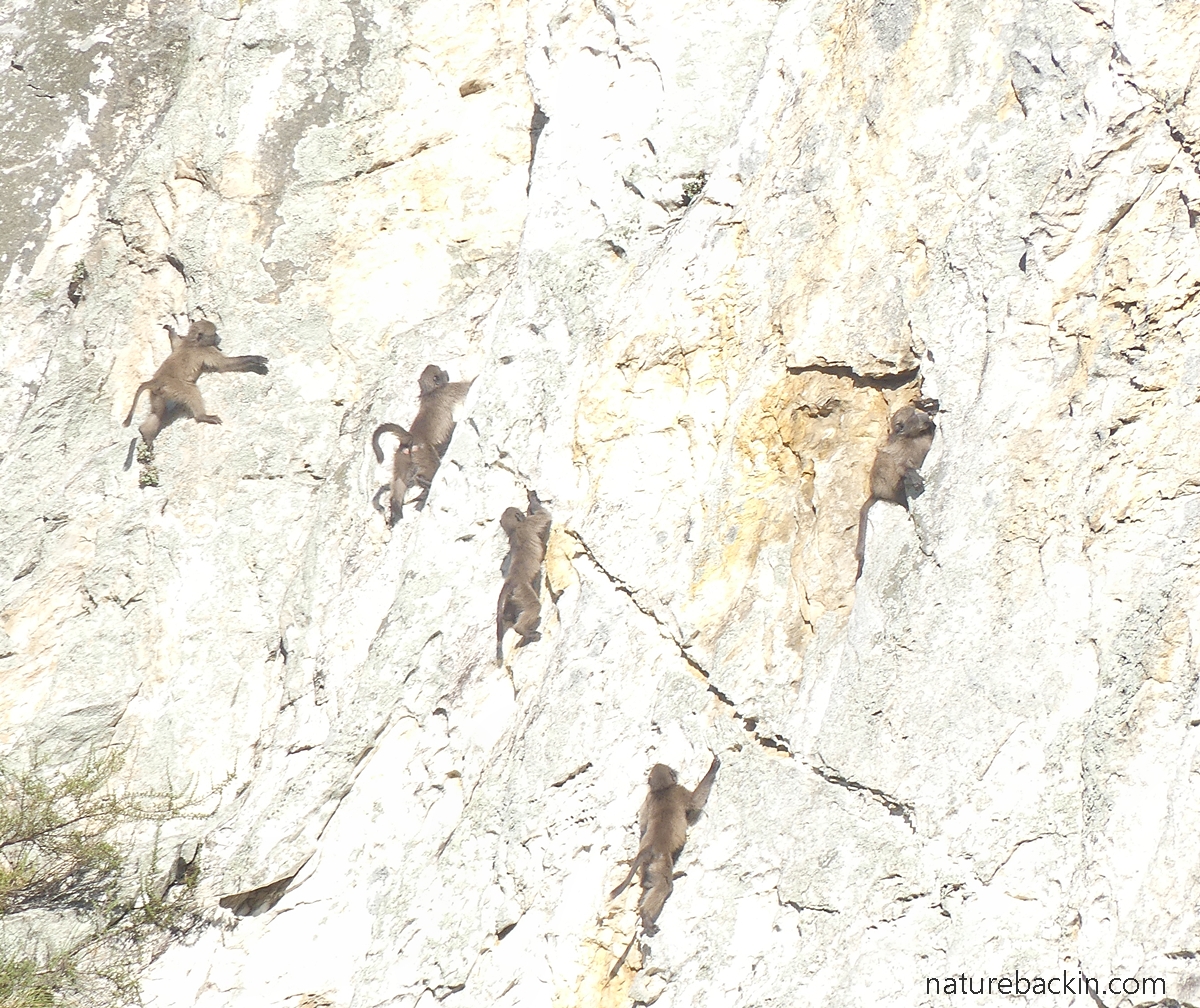
One morning in April we went walking in the Phillipskop Mountain Reserve, which is not far from Stanford in the Overberg. A highlight turned out to be watching chacma baboons climbing a rock face after they emerged from a large cave.
On the slopes of the Klein River Mountains in the Western Cape, the privately-owned Phillipskop Mountain Reserve, 246ha (608 acres) in size, offers self-catering accommodation, guided walks, and access to hiking trails for residents and Friends of Phillipskop.
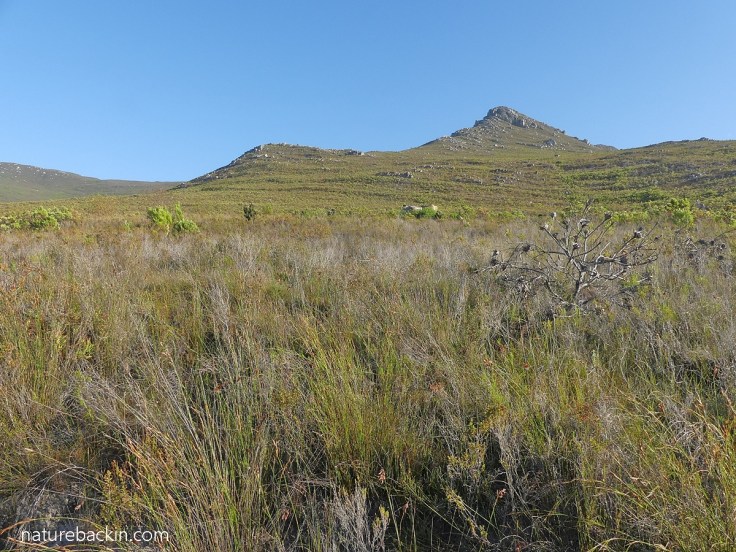
Phillipskop is the right-hand peak on the skyline. This photo was taken on our April walk in early autumn and ahead of the winter rains
As noted on the Phillipskop Mountain Reserve website, “the Klein River Mountains are made up of hard quartzitic rock of the Table Mountain Group (often called Table Mountain Sandstone)”. The highest peaks and steepest cliffs of the Cape Fold Mountains are formed by the hard and erosion resistant Table Mountain sandstone. Soil derived from this sandstone is acidic and nutrient poor. Mountain and lowland fynbos is associated with such soils. More specifically, the fynbos at Phillipskop is “acid sand proteoid fynbos”.
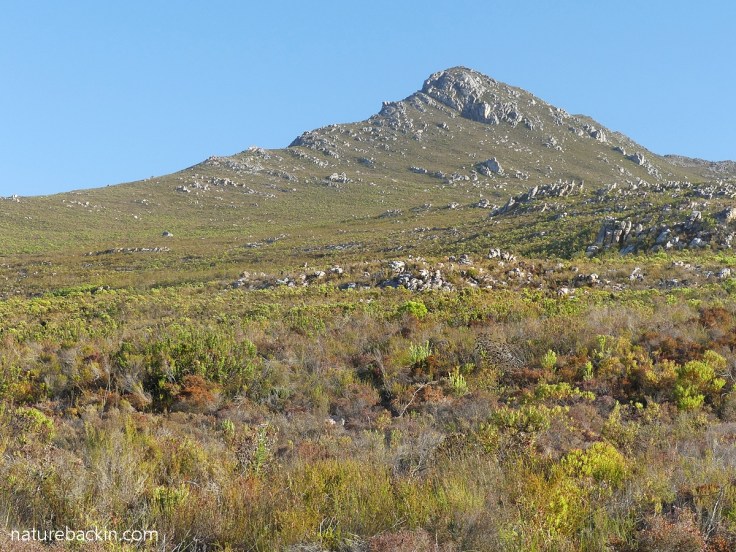
A closer look at the peak named Phillipskop, which is 487 metres high. The fynbos vegetation significantly features members of the Protea and Restio families and species from the Erica genus
We started our walk sometime before 9 am. The sun was still fairly low in the sky but the light grew harsher as we walked. We followed a track that diverted into a path that turns up towards the mountain as it ascends more or less parallel to a mountain stream. We had decided to walk up to a small waterfall where the stream falls over the lip of a small cliff.
As we walked, we paused to observe the plants and take in the view that got wider as we went higher.
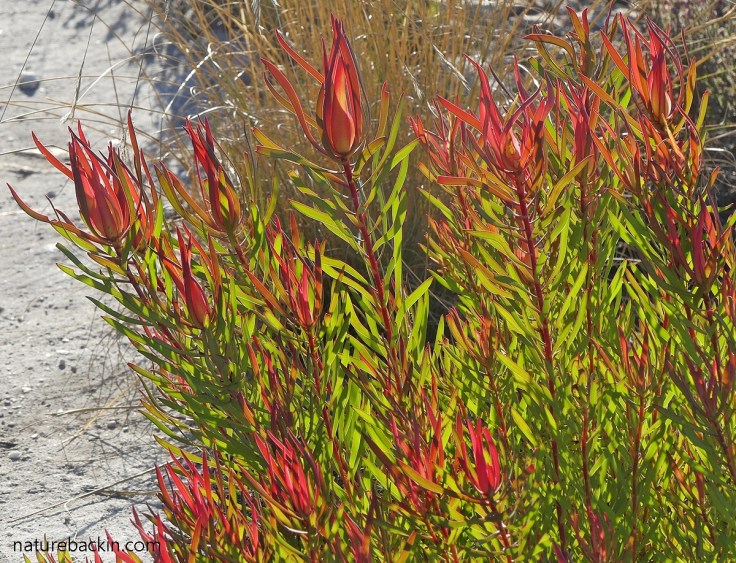
A common sunshine conebush (Leucadendron salignum), growing by the side of the track, is backlit in the morning light. Conebushes are members of the Protea (Proteaceae) family
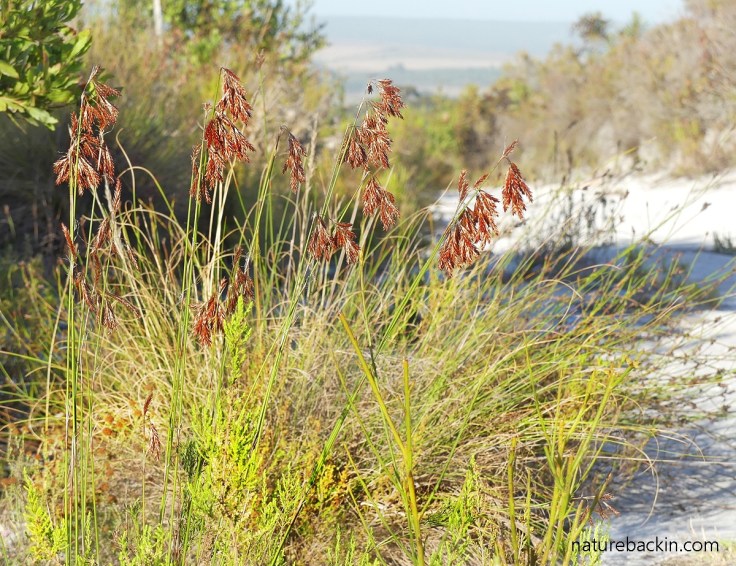
A species of Restio, a member of the grass-like plants in the family Restionaceae, also referred to as Cape reeds
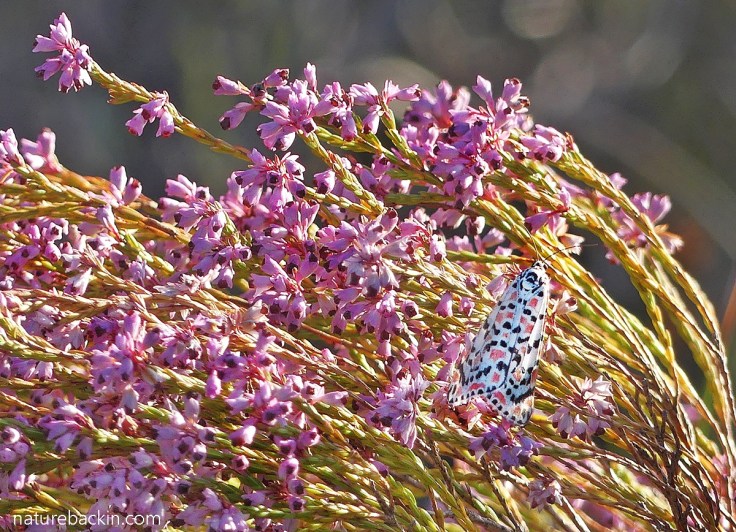
A day-flying moth, a crimson-speckled footman (Utetheisa pulchella), visiting a species of Erica (Ericaceae – Cape heather) that is in flower. As might be expected from its conspicuous warning colouration, the moth is toxic and unpalatable to birds
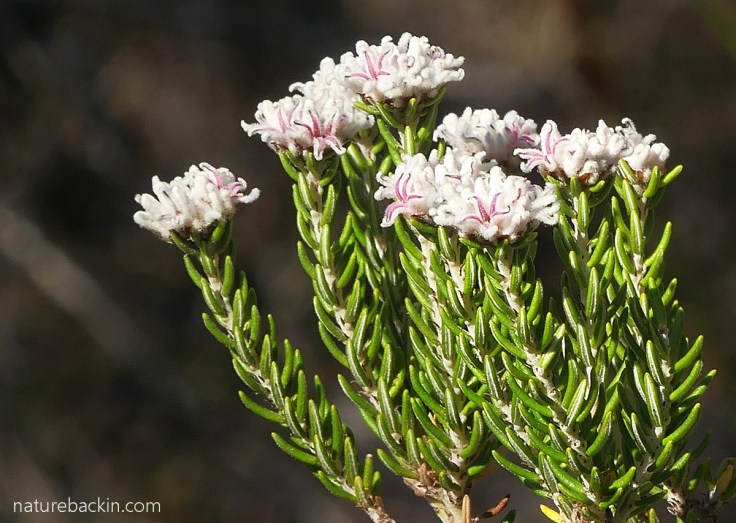
The interesting flowers of Trichocephalus stipularis, known as dogface due to the fact that when fruiting the fruits assembled at the end of the stalks are said, rather fancifully, to resemble the face of a dog. The flowerheads are white and woolly. The long pink sepals of the individual flowers that are open are visible, but the tiny flower petals are hidden deep within
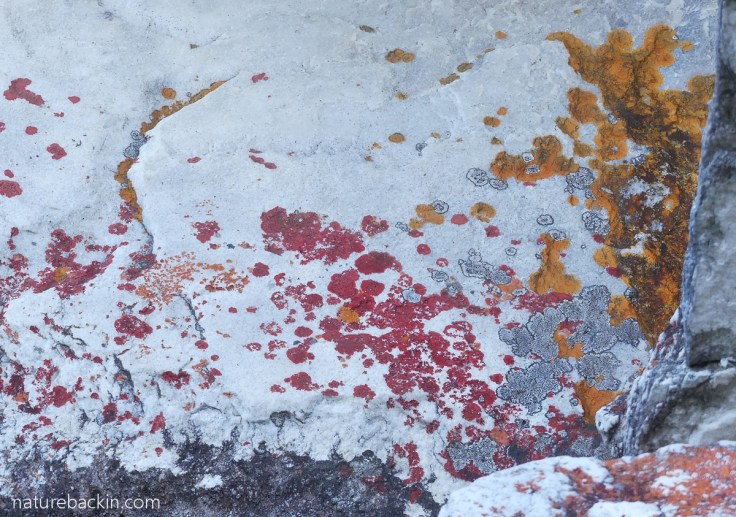
Vividly coloured lichen growing on some large slabs of rock next to the path
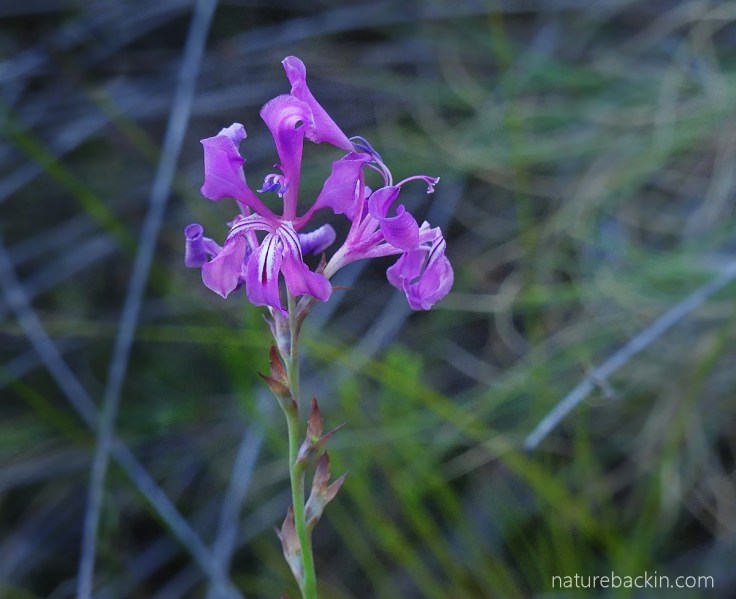
As the rocky path ascended it became shaded by the adjacent high bank or cliff on the other side of the stream. As we approached the waterfall, we saw a Tritoniopsis lata, a member of the Iridaceae family. It is sometimes referred to as a snake flower
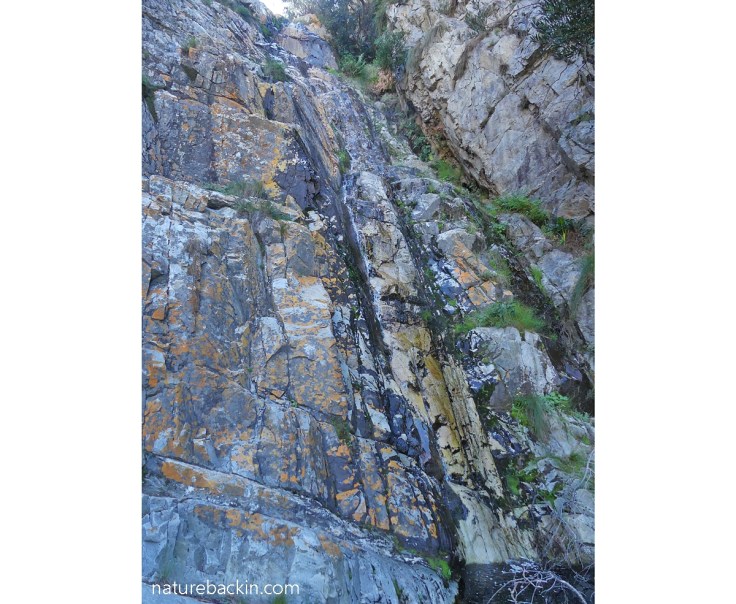
We descended a short way from the main path to the bottom of the small waterfall that was flowing down a high rock face. Obviously, the falls are much fuller than this after decent rains
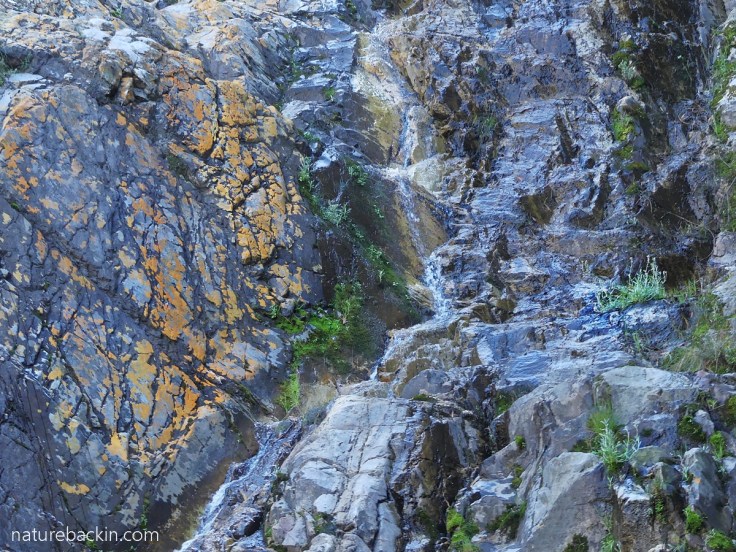
The water angles down the rock face in small cascades. Small plants and mosses grow in the spray zone, and lichens decorate the rock faces
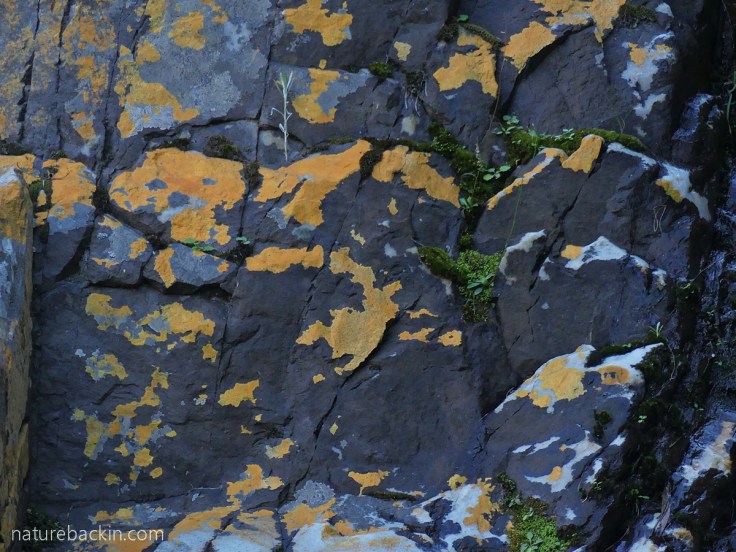
The lichen and moss form a bold abstract on the dark rock face
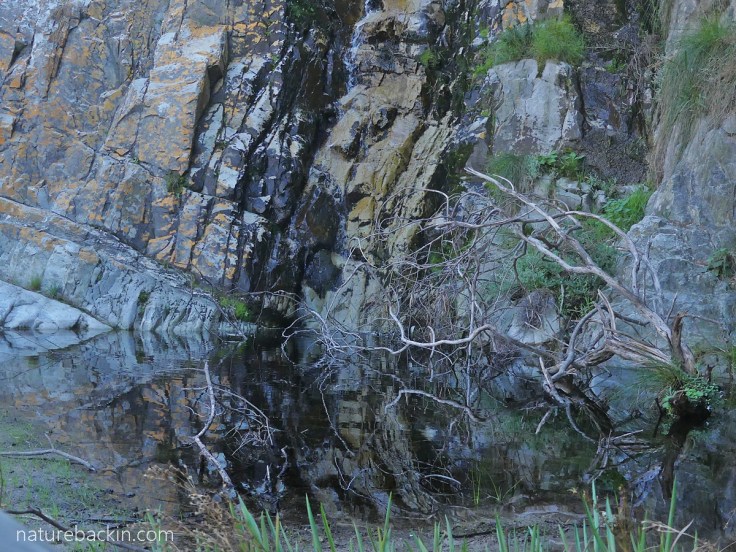
The moving water falls into a tranquil pool where a gracefully arched dead tree is reflected. Despite the coolness in the shade of the cliff we decided to pause here and have a snack and drink the coffee we had brought in a flask
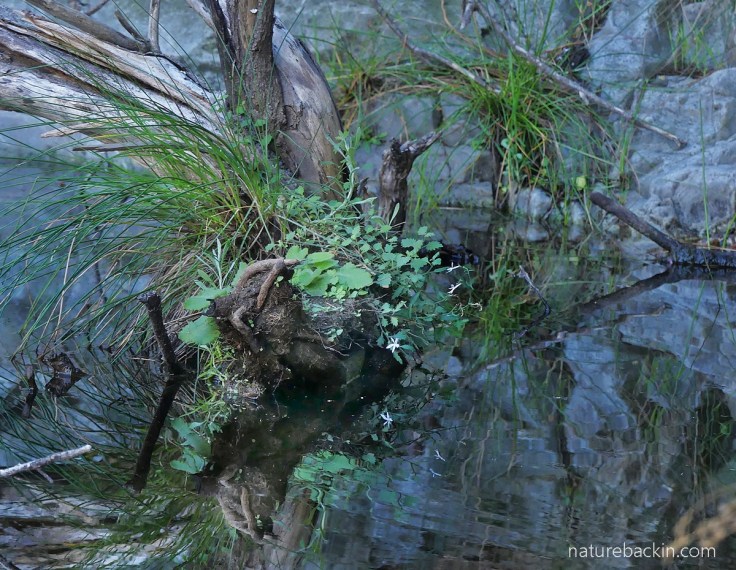
While drinking our coffee we admired the small still life composed by the plants growing at the base of the dead tree
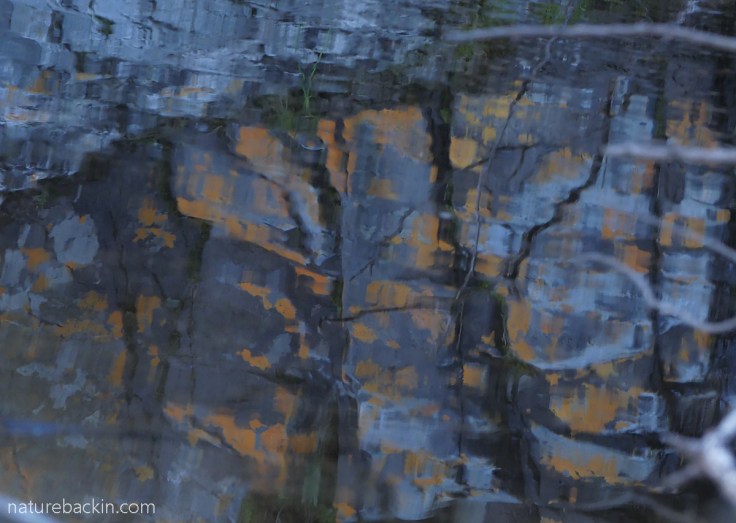
The lichen looked more subdued when reflected in the pool at the bottom of the waterfall
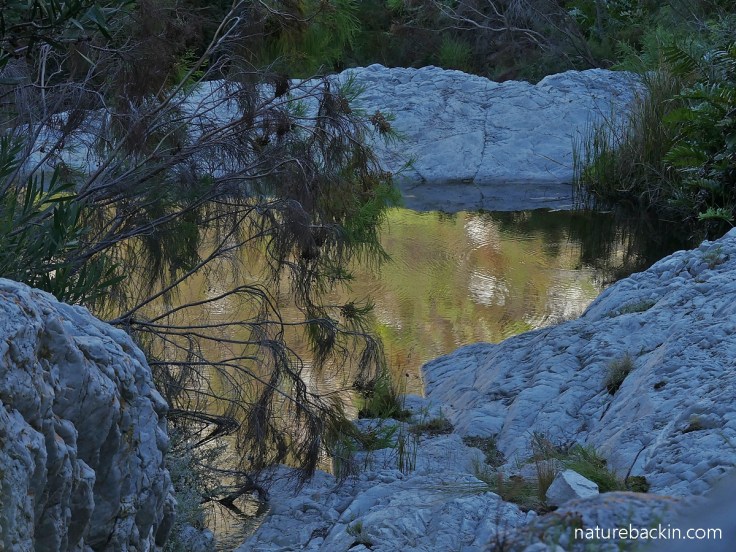
Looking down over a few smaller cascades that flow downstream from where we were sitting, the water forms a larger pool that reflected the sunshine on the opposite grassy slope
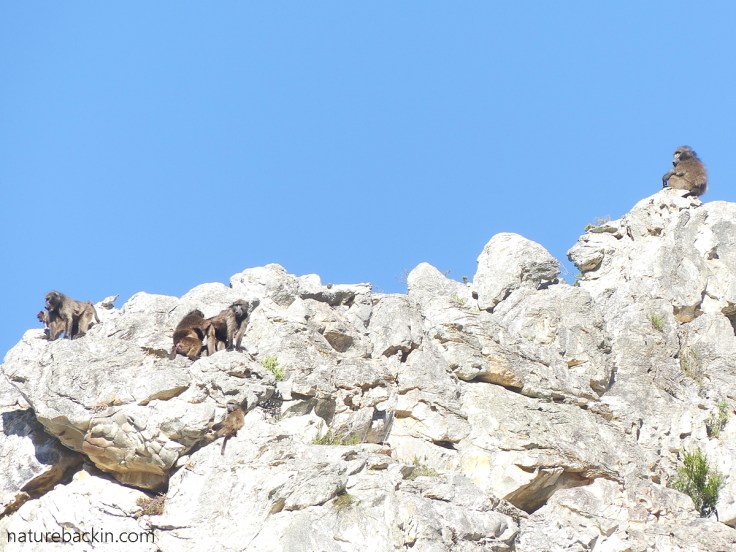
As we were walking and approaching the waterfall we had seen some chacma baboons (Papio ursinus) enjoying the sunshine on the high ridge on the opposite side of the valley
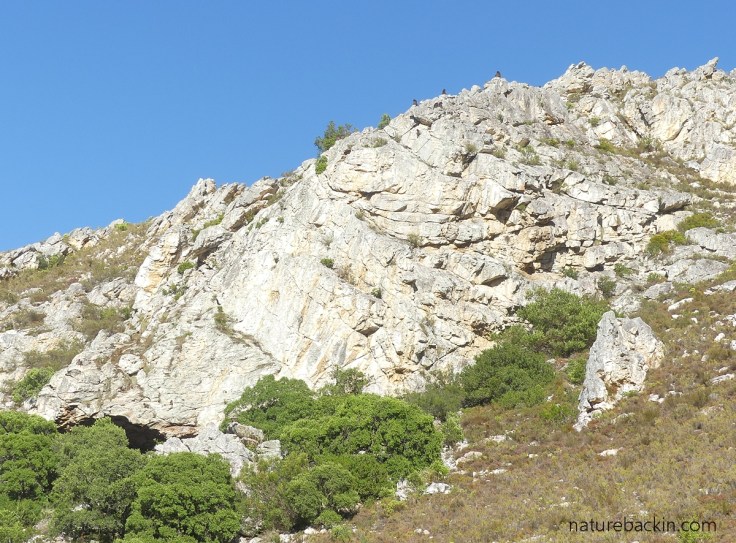
While sitting comfortably near the bottom of the waterfall, we had a good view of the rock face. Baboons can be seen high up on the horizon. At the bottom on the left, the black shady area is the opening to a large cave. As we watched, more baboons emerged from the cave and started to climb the rock face that is almost sheer in large sections
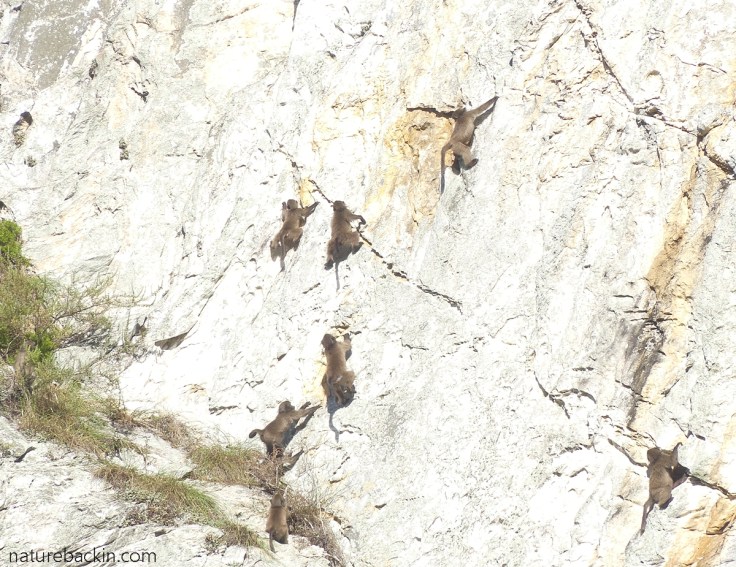
Pushing my zoom lens a bit further than is wise and braving the harsh sunlight, I photographed the climbing baboons. We were struck by the fact that they used similar techniques to human rock climbers, but without ropes and gear of course
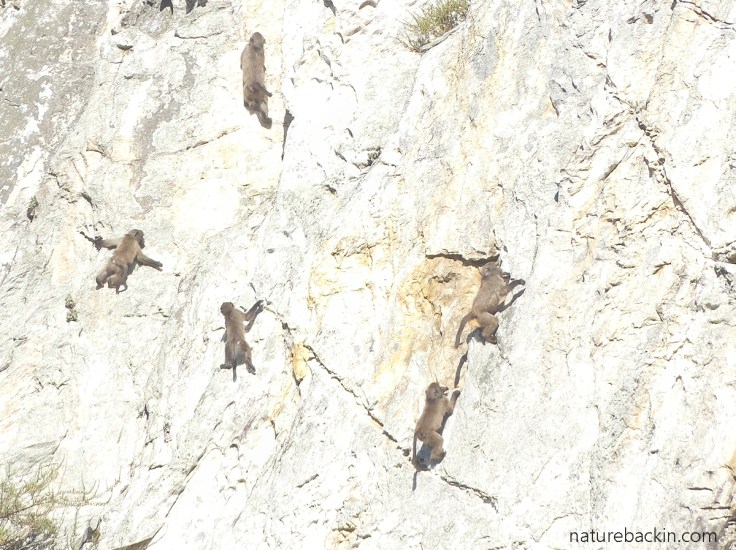
They reach for hand holds and brace themselves with their feet much as human rock climbers do
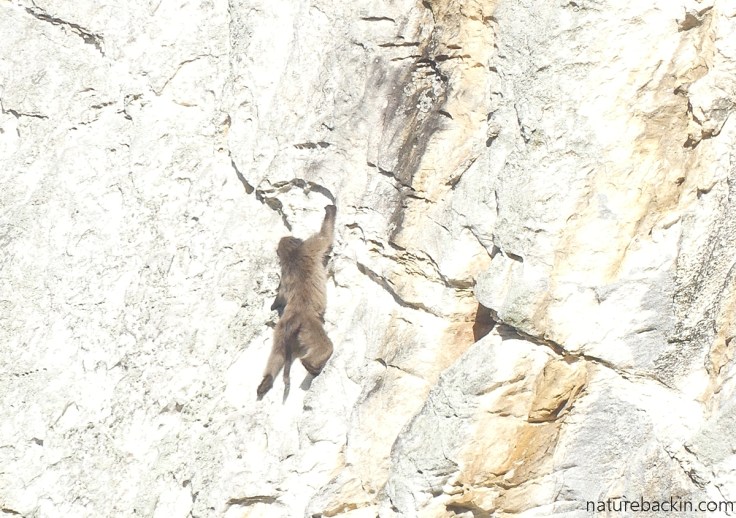
Look at the skilled technique of this seasoned climber
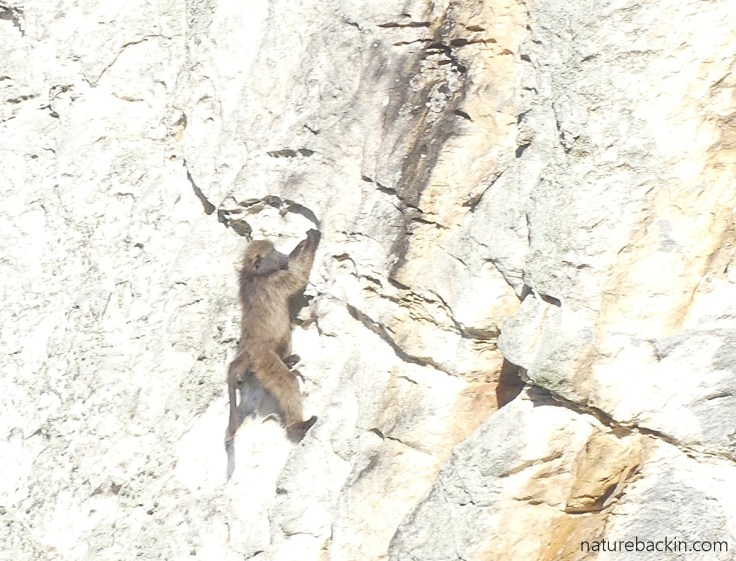
The baboon paused as he sought out the next handhold
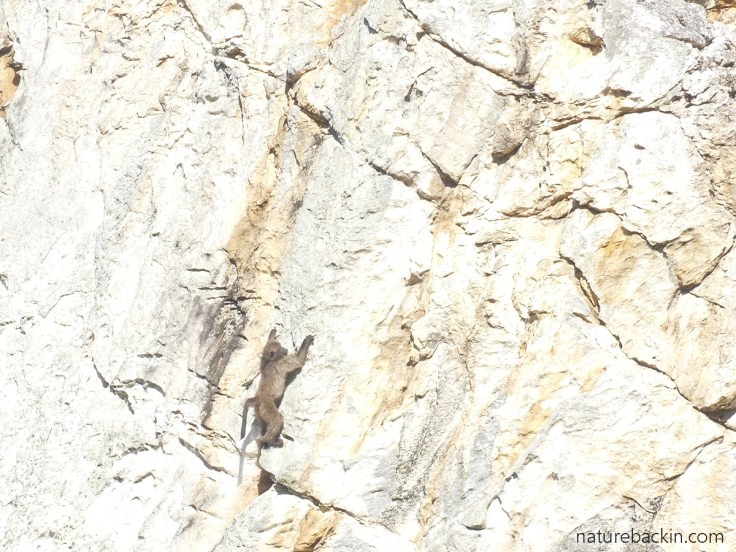
There was no rush as each baboon one-by-one carefully navigated their way to the top, taking advantage of cracks and small ledges on the rock face to use as handholds and footrests as they went
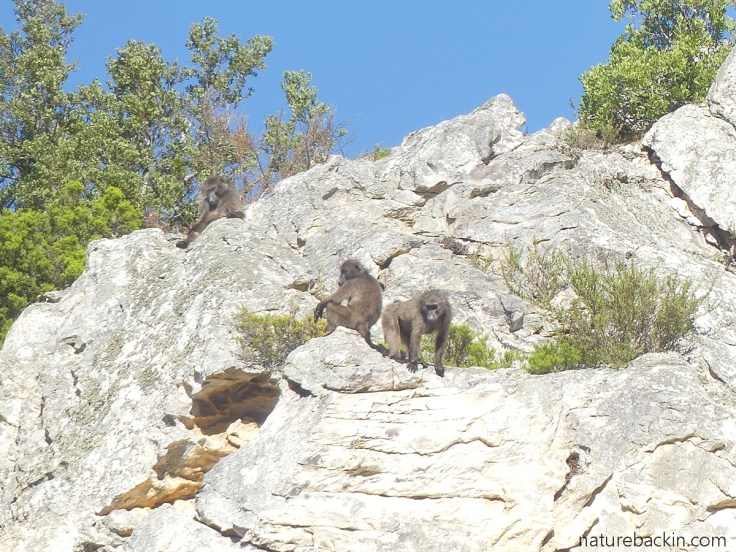
Some of the baboons at the top took a keen interest in watching the progress of those still climbing
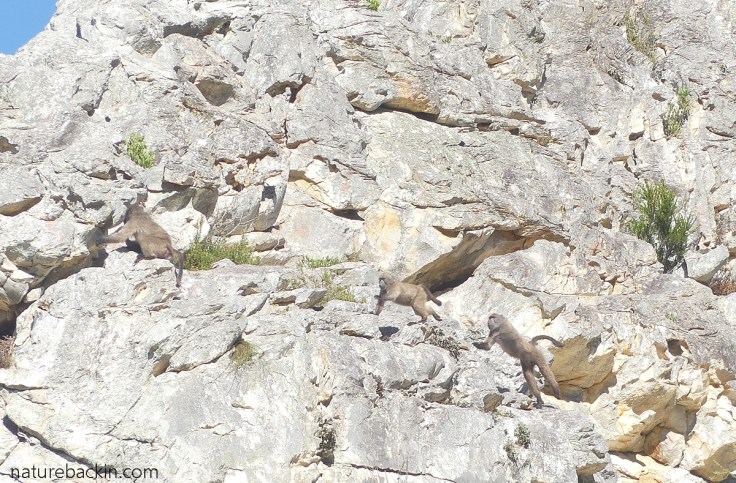
Once they got up to safer terrain, two baboons let off steam in a bout of running and chasing. I have not seen human rock climbers do that, though they may let out a few whoops of joy/relief when they reach the top! The baboon on the left paused to do a spot of foraging en route
After having been thoroughly entranced by watching the baboons’ climbing skill, we left our damp and shady spot to emerge into the sunshine and carefully pick our way back down the steep rocky path in marked contrast to the baboons’ athleticism.
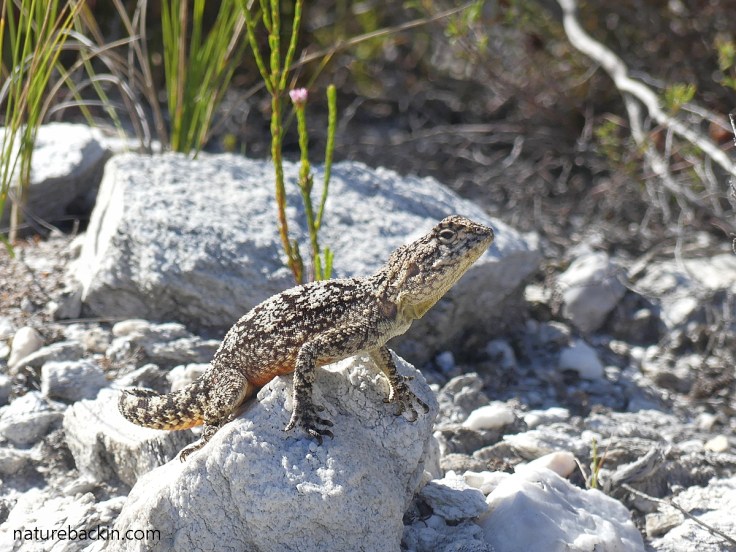
As we retraced our steps, nearly at the end of our walk we saw a southern rock agama (Agama Atra) sunning itself in very bright sunshine on a rock on the edge of the path
And to finish this post, just to explain my long break from blogging was largely due to injuring my arm and not being able to drive the mouse and edit the photos. The arm is functioning fine now.
Posted by Carol

Discover more from letting nature back in
Subscribe to get the latest posts sent to your email.


July 5, 2025 at 12:29 pm
Welcome back and thank you for a rivetting article. Your photographs and descriptions make magic of your walk at Phillipskop. The account of the climbing baboons had me spellbound. It must have been fascinating to watch them move up the mountain. I am glad that your zoom lens and your skill made it possible to share the experience
LikeLiked by 1 person
June 30, 2025 at 8:00 pm
I’m so glad to hear your arm is healing well, Carol. We are fortunate that you were able to create this fascinating post. Looks like an incredible place to visit, and you illustrated your narrative with such diverse wonders of nature. Beautiful photos and wonderful commentary!
Did you anticipate seeing the baboons or was that a surprise when they emerged from the cave?!
LikeLiked by 1 person
June 30, 2025 at 8:17 pm
Thanks very much Carol. It is a lovely place to walk, and its only 10 minutes by car from where we live.
We know there are baboons resident in the area, but we did not expect to see them emerging from the cave. We don’t know if this is a regular overnighting place for them, of if they move around from night to night to better avoid predators. There are wild leopards in the area.
LikeLiked by 1 person
June 30, 2025 at 9:12 pm
So interesting! And so remote from our southeast Florida world. 🌍
LikeLiked by 1 person
June 28, 2025 at 8:48 am
I was thinking about you only yesterday, and lo – a post appreared! And a lovely post too, as always. Such fascinating flora and fauna you’ve shown us. But those baboons are just wonderful. (My son went climbing for the first time a few days ago and is suffering the after effeccts of using muscles differently. He needs a lesson from the baboons!)
I’m very glad to hear that you’re ok now, Carol. It sounds like a nasty injury.
LikeLiked by 1 person
June 28, 2025 at 7:29 pm
Thanks very much Sandra. Rock climbing and mountaineering fascinate me, though only from a distance! I can imagine your son discovering muscles he did know he had. I am always astounded at how strong the fingers of climbers need to be.
Indeed the baboons were very good at reading the rock face as they went and adept at finding handholds.
LikeLiked by 1 person
June 28, 2025 at 7:46 am
Poor you! Yes, I had been wondering about you and hoping all was OK. I’m glad you were recovered enough to do this walk. Interest at every step, but the highlight HAS to be those doughty baboons. What skill!
LikeLiked by 1 person
June 28, 2025 at 7:25 pm
Thanks very much Margaret. In fact we did that walk back in April before the issue with my arm. I did want to post about the baboons climbing though, even though belatedly, as it was so remarkable to see their skill and determination.
LikeLiked by 1 person
June 28, 2025 at 6:32 am
So great to hear from you! Thank you for an awesome post 😊
LikeLiked by 1 person
June 28, 2025 at 7:24 pm
Lovely to hear from you Marica, and thank you. We will be keeping a lookout for baboons climbing on future walks.
LikeLike
June 28, 2025 at 4:47 am
Glad to hear you feeling better. Hope the arm injury wasn’t too awful. That’s a beautiful area and I love all the detailed photos, but the baboons are the icing on the cake. They’re better climbers than me, that’s for sure!
LikeLiked by 1 person
June 28, 2025 at 7:22 pm
Thanks Graham. It is a beautiful area. It is interesting being in mountains at low altitude as they are so near to the coast, compared to the inland mountains we were familiar with in KZN. The slow determination of the climbing baboons was remarkable.
LikeLiked by 1 person
June 29, 2025 at 5:46 am
I wonder if they use the same route each day?
LikeLiked by 1 person
June 29, 2025 at 6:42 pm
I was wondering that too – also how often they overnight in the cave.
LikeLiked by 1 person
June 27, 2025 at 9:44 pm
I would not have thought baboons would climb like that. I’m sure they’re strong, but apparently pretty brave too. The objective must have been worth the falling risk!
LikeLiked by 1 person
June 28, 2025 at 7:20 pm
We were also amazed to see them climbing like that. As there are easier alternative routes to the top (though longer), it is interesting that they take the precipitous route. We did see one take a tumble – but luckily only about 4 or 5 metres before landing on a ledge, seemingly unhurt. He then resumed the climb, which was extra brave!
LikeLiked by 1 person
June 27, 2025 at 9:40 pm
Glad you are back and well – we missed you! We are going to Namaqualand in August for the flowers – your newsletter set a great example.
LikeLiked by 1 person
June 28, 2025 at 7:12 pm
Thanks very much Colin. Have a wonderful time in flower-filled Namaqualand in August.
LikeLike
June 27, 2025 at 8:16 pm
My goodness, what a nice surprise. I have missed your posts, Carol so it is nice to see you back. The arm injury sounds nasty… to have kept you away for this long.
Glad you’re not quite so ‘armless.
Looking at the images of the Baboons reminded me of the opening scene of Mission impossible 2. ( Tom Cruise free climbing an almost vertical rock face).
Again… Nice to have you back.
😊
LikeLiked by 1 person
June 28, 2025 at 7:11 pm
Thanks so much Ark. I am glad to be back.
I was thinking of Alex Honnold in “Free Solo”, but Tom Cruise also fits the bill!
LikeLiked by 1 person