Of the 270 naturally occurring species of pelargoniums in the world, about 219 species occur in South Africa. Of these, I focus here on just two – and one hybrid – that grow in our garden. And a true geranium also makes an appearance. Be it the leaves, the flowers or the seeds, pelargoniums are always interesting to photograph.

Above are flowers of the rose-scented or coast pelargonium (pelargonium capitatum) growing in our garden. It grows naturally in coastal areas near to us in the Overberg, and in fact in coastal regions from the west to the east of South Africa, including on sand dunes and low hillsides.
The flowers are relatively understated and lack the strong scent of the leaves and stems, but they still attract the attention of insects, including butterflies.
The butterfly that I regularly see visiting the plant in our garden in the early summer months, is a geranium bronze butterfly. It is most likely the common geranium bronze (Cacyreus marshalli), a small butterfly with a wingspan of 15–27 mm (0.5–1 inch). There is a chance that I also see the similar but less common Dickson’s geranium bronze (Cacyreus dicksoni), which also occurs in this area.
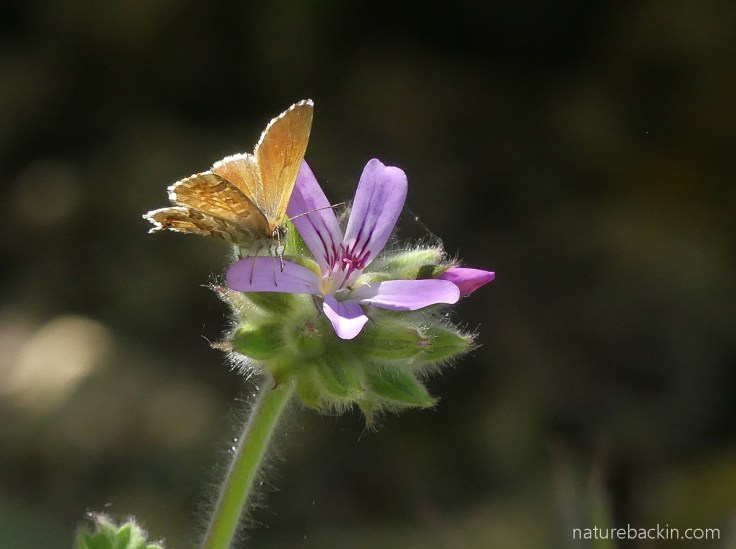
I had assumed that the butterflies were visiting the flowers to feed on nectar, but I have since learned that pelargoniums (rather than true geraniums) are host plants for the larvae of geranium bronze butterflies. So, the butterflies are visiting not to nectar, but to lay their eggs on the flowers and stems as their larvae feed exclusively on pelargonium plants.
The common geranium bronze butterfly (Cacyreus marshalli) is native to southern Africa, but unfortunately it was inadvertently introduced into Europe via the trade in pelargoniums. It is (or was in 2022) the only non-native butterfly species recorded among 482 European species (Rocchia et al., 2022).

Through ongoing trade in non-native pelargoniums that are used as much-prized ornamentals, the common geranium bronze butterflies are spreading through warmer regions in Europe. With no natural predators in Europe, the larvae do significant damage to ornamentals in nurseries and gardens. The larvae bore into the stems of the host plant, which they eat from the inside, causing the stems to weaken and blacken. In South Africa it is thought that their presence is limited by the presence of natural predators or parasitoids, and consequently damage to plants is limited too.
The increasing presence in parts of Europe of common geranium bronzes could become a threat to native biodiversity with the possibility of the butterfly being further naturalised if it adapts to wild geranium species as hosts.
These butterflies thrive in warmer temperatures and so far, their spread is contained by the colder temperatures at higher elevations, for example in Alpine regions in Italy. But, there is a fear that as climate change leads to higher temperatures, common geranium bronzes may then be able to survive in Alpine areas, posing a threat to less adaptable native species of butterfly and to wild plants in the Geranium family (Geraniaceae), even at higher altitudes.
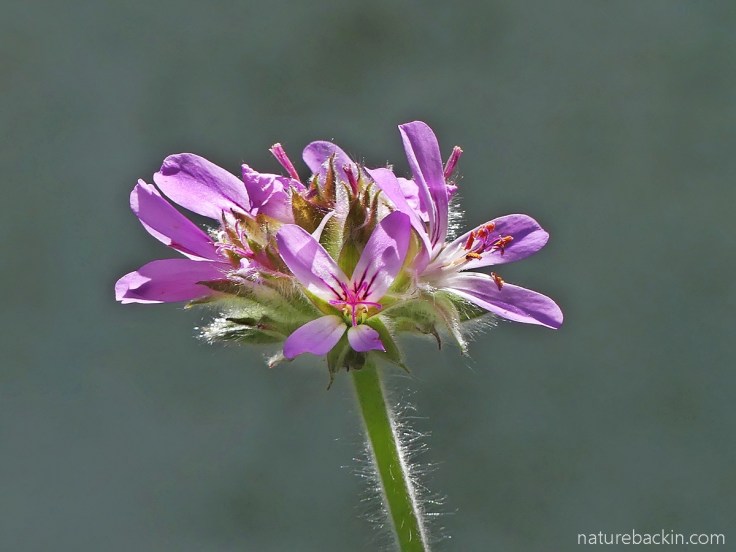
The rose-scented pelargonium (Pelargonium capitatum) has many cultivars and hybrids. In addition to being grown as an ornamental plant, it – like other species of scented pelargoniums – is also cultivated for its oil of geranium, which is used in perfumes and cosmetics.
The scented leaves can be used as a skin softener by rubbing them on calluses and hard skin on the hands and feet. The leaves can also be used in bath water to help soothe skin rashes. Traditionally a tea made from the leaves was used to treat digestive, kidney and bladder ailments.

As the flower fades, the beak-like fruits or seed capsules emerge. The name Pelargonium derives from the Greek pelargós, meaning ‘stork’, because the seeds look like a stork’s beak.

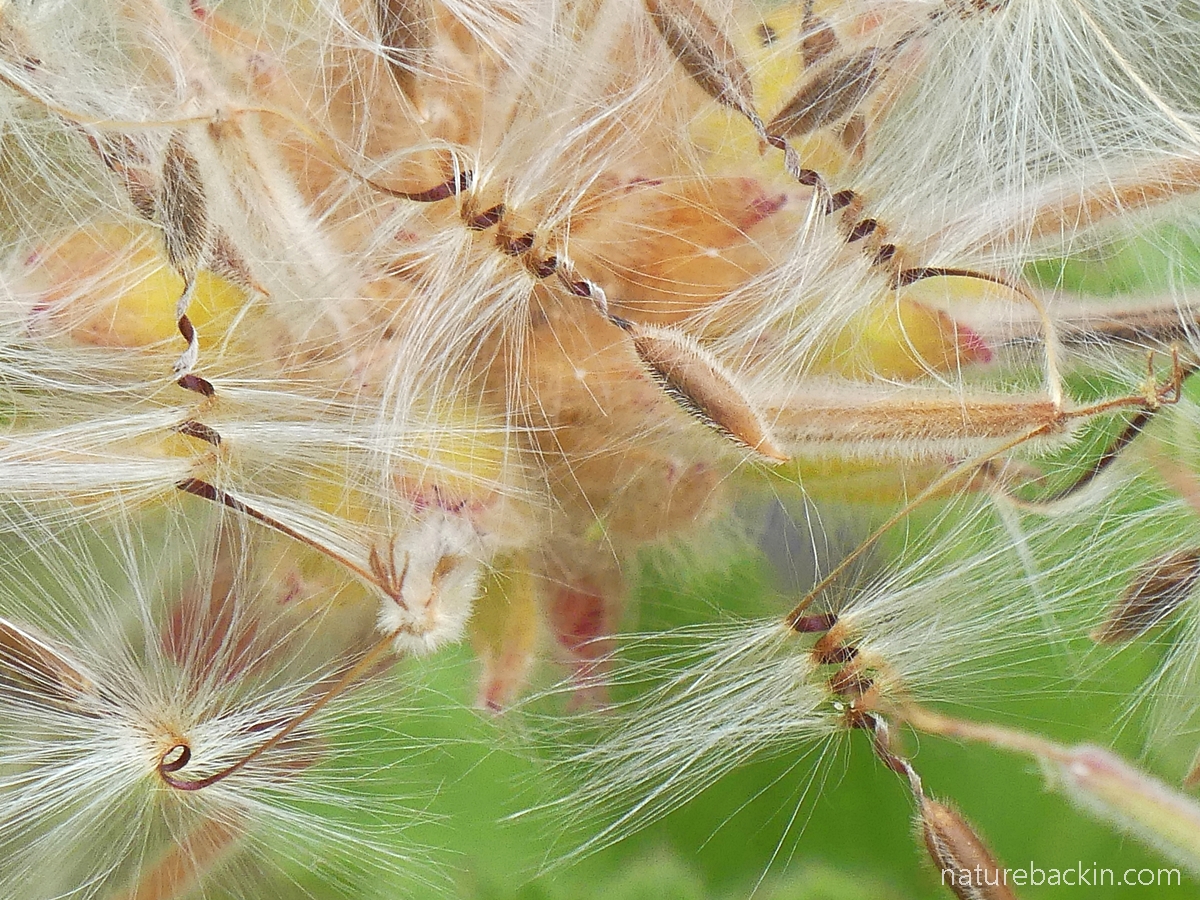
As the fruits ripen, they gradually split releasing elongated seeds that are attached via a spirally stem to a fluffy ‘tail’.
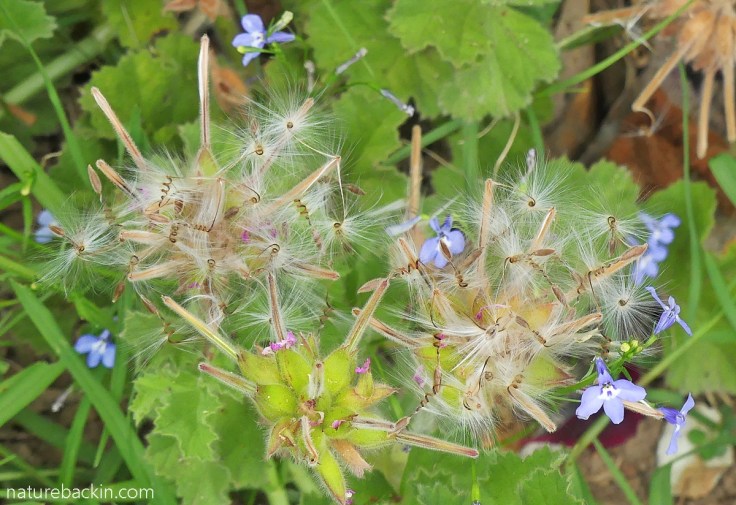
The above photo is of the seedy remains of two flowerheads showing the elongated seeds attached by spirals to the fluffy tail-like structures. The small blue flowers are a species of wild lobelias that have arrived in our garden as very welcome ‘volunteers’.
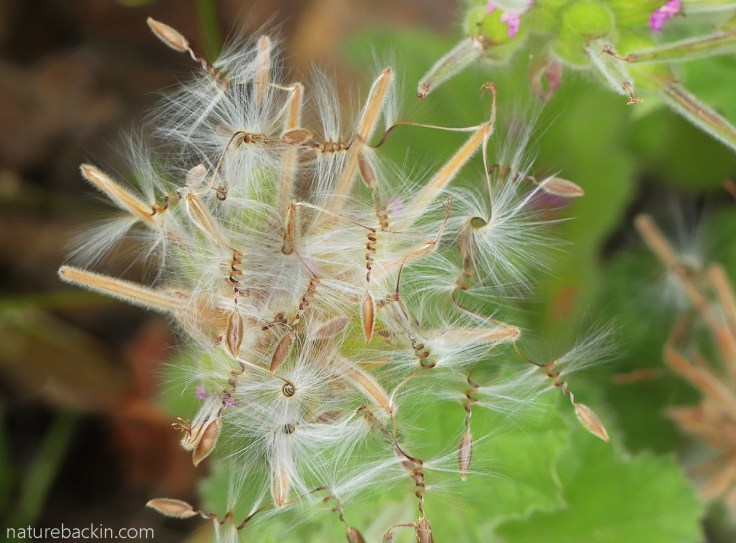
When the seeds of the rose-scented pelargonium eventually detach from the beak-like fruit, they can float off through the air, and after falling to the ground the spiral stem can effectively corkscrew the seed into the ground as the fluffy tail is turned by the wind.

Above (and in the header photo) is a close-up of the elongated seed and the spiral or ‘corkscrew’ structure with the fluffy tail.
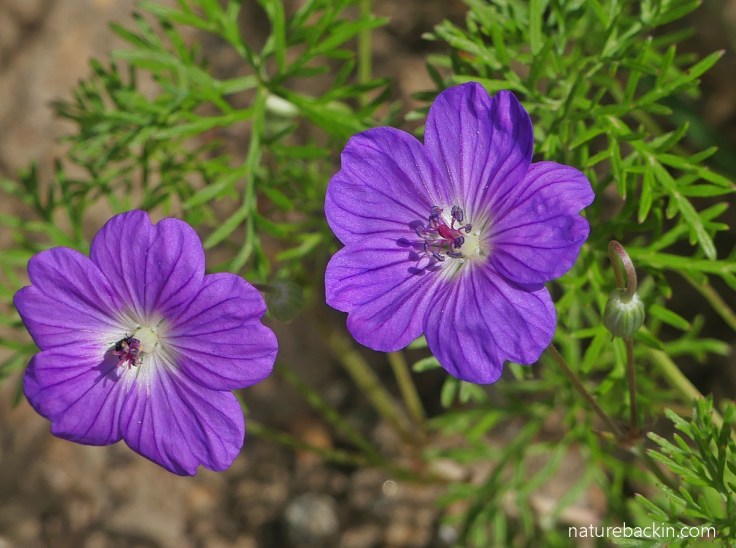
The only true geranium in our garden, as opposed to a pelargonium, is the low-growing Geranium incanum with its lovely open purple-coloured flowers (above). Known as the carpet geranium, it is useful in the garden as a pleasing groundcover. It occurs naturally as a low scrambler in sandy or stony grounds in coastal regions of the southwestern and eastern parts of South Africa.
The name ‘geranium’ comes from the Greek géranos, which refers to a crane, as the seed capsule resembles the beak of that bird. Originally, pelargoniums were not distinguished from geraniums, which perhaps explains why pelargoniums are often referred to as geraniums. But there are sufficient differences that pelargoniums have been split from geraniums into a separate genus. Naming the beak-shaped fruit of the pelargonium after the stork, was a way of differentiating it from the geranium, which is named after the crane, though in fact their structures are very similar.
One of the most obvious differences between the two genera is that geranium flowers are radially symmetrical (5 petals of similar size and shape) and pelargonium flowers are asymmetrical, with 2 upper petals different in size and shape to 3 lower petals, although that characteristic has been bred out in some hybrid species.

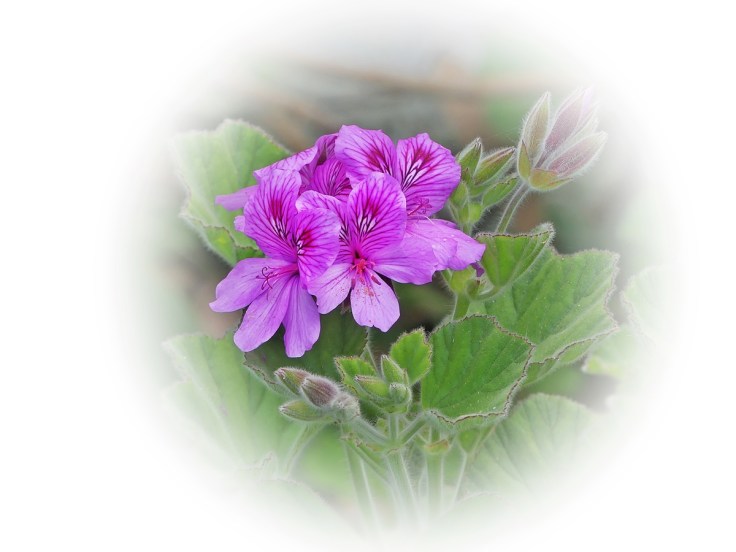
The showy Perlargonium cucullatum is known as the hooded-leaf pelargonium or wild malva and it makes a fine display in our garden in early summer. It can also be found growing wild and abundantly in the southwestern Cape. For more on this species see an earlier post of mine, Pelargoniums wild and domesticated

The species part of the name of this plant derives from the Latin word cucullatus, meaning a cape or cowl, reflecting the cup-shaped leaves. The attractive leaves produce a sweet smell when crushed, and they are used in a traditional medicine for coughs and chest congestion.

When bearing pollen, the stamens of the flowers are an unexpected orange in colour.

The rather hairy and deep purpley-magenta casing or calyx of the fruiting capsules almost matching the colour of the veins on the flower petals.

I photographed a large cabbage white butterfly (Pieris brassicae) visiting a flower of the Pelargonium cucullatum to feed on nectar. Pelargoniums are not a host plant of the larvae of this species of butterfly. In our garden the caterpillars feed mostly on nasturtium plants. Large cabbage whites are not indigenous to South Africa. I intend posting about these potentially invasive butterflies in the near future.
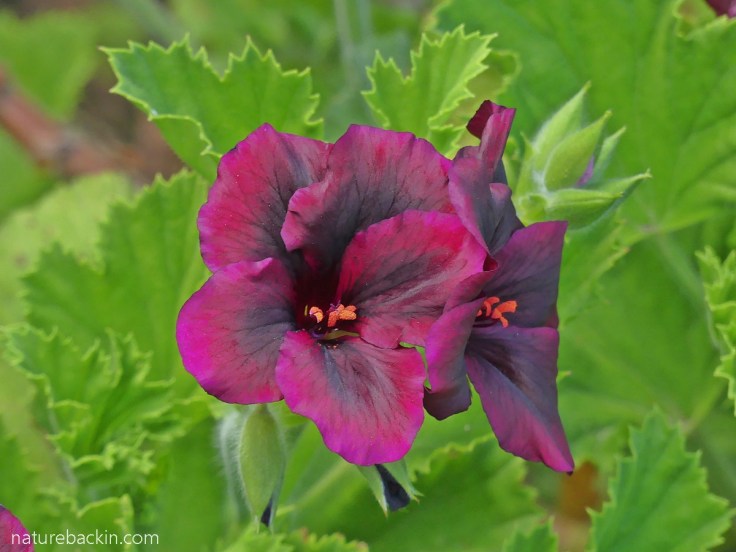
Last summer I was given some pelargonium cuttings that I planted in our garden. One of them turned out to be this hybrid species of regal pelargonium with wine-coloured flowers (above). I gather that regal pelargoniums (known as Martha Washington in North America if I understand correctly) originate from hybridising Pelargonium cucullatum and Pelargonium grandiflorum, which are both native to the Western Cape in South Africa. Coincidentally, this regal pelargonium in our garden grows right next to one of its parent plants, the Pelargonium cucullatum.
Sources:
Adams, Trevor. 2005. Pelargonium capitatum. PlantZAfrica. South African National Biodiversity Institute (SANBI). https://pza.sanbi.org/pelargonium-capitatum
Favilli, Leonardo & Manganelli, Giuseppe. 2006. Life history of Cacyreus marshalli, a South African species recently introduced into Italy (Lepidoptera Lycaenidae). https://www.researchgate.net/publication/342439329_Life_history_of_Cacyreus_marshalli_a_South_African_species_recently_introduced_into_Italy_Lepidoptera_Lycaenidae
May, Liesl. 2000. Pelargonium cucullatum. PlantZAfrica. South African National Biodiversity Institute (SANBI). https://pza.sanbi.org/pelargonium-cucullatum
Rocchia E, Luppi M, Paradiso F, Ghidotti S, Martelli F, Cerrato C, Viterbi R, Bonelli S. 2022. Distribution Drivers of the Alien Butterfly Geranium Bronze (Cacyreus marshalli) in an Alpine Protected Area and Indications for an Effective Management. Biology (Basel). Apr 7;11(4):563. doi: 10.3390/biology11040563. https://pmc.ncbi.nlm.nih.gov/articles/PMC9027867/
Posted by Carol
Discover more from letting nature back in
Subscribe to get the latest posts sent to your email.


February 8, 2025 at 1:33 pm
Nice post, Carol, and interesting that you touched on biosecurity matters. Britain and Europe still act like they’ve missed the memo on this, certainly compared to Australia where even getting off the plane with muddy shoes will lead to questions at airport security. Year after year, we allow invasive non-native species to hop a lift on products or nursery plants and cause massive damage. The worst example at present is the ash dieback fungus, which was reputedly imported to the UK through infected seedlings from Europe, and put 80 million wild trees at risk. It boggles the mind.
LikeLiked by 1 person
February 10, 2025 at 8:31 pm
Thanks Adele.
That ash dieback fungus is quite literally devastating. Mind boggling as you say.
It must be almost impossible to protect against the spread of such pathogens unless one is on a discrete island(s) – such as the UK – or a discrete continent. But even then the level of vigilance would need to be intense and sustained, and I imagine that awareness my come only after the fact.
LikeLiked by 1 person
February 15, 2025 at 1:16 pm
Yes, there are always going to be some organisms that cannot be kept out (the spread of covid showed that too well). However, we are also taking unacceptable risks. Ash dieback was known on the continent for years and yet we kept importing saplings. It is slightly controversial if that was the only method of entry, but it’s beyond doubt that it contributed – it was first identified here in imported ash in a plant nursery, sadly only after many of that batch had already been planted out.
In addition, we’ve let non-native spiders in on bananas, continue to use cherry laurel as garden hedging despite how frequently it escapes, and some people deliberately turn non-native reptiles and amphibians loose for one reason or another. We could do a lot better.
LikeLiked by 1 person
February 7, 2025 at 1:37 pm
Ugh, wordpress just lost my comment and I forgot to copy it. Let’s see what I can remember! I had never occurred to me to wonder why geraniums are called cranesbills. And the corkscrew seedheads – what a wonder nature is. Another fascinating article, Carol, thank you. (And no, that’s not how I wrote originally!)
LikeLiked by 1 person
February 10, 2025 at 8:13 pm
Hi Sandra – this is so weird, I was just revisiting my site and noticed that my reply to your comment has got lost, or at least is not there!
I replied by commiserating re your lost comment and then find the same happened to my reply. Is that not odd?
Thanks for going to all the trouble of sending a replacement comment. Indeed those corkscrew structures on the pelargonium seeds are amazing.
LikeLiked by 1 person
February 11, 2025 at 9:56 am
That is very strange, Carol! We’ve managed eventually though!
LikeLiked by 1 person
February 11, 2025 at 7:16 pm
Yes we did! 🙂
LikeLiked by 1 person
February 7, 2025 at 1:31 pm
That wine coloured pelargonium looks stunning! So much beauty around you. Thank you for sharing with us too!
LikeLiked by 1 person
February 7, 2025 at 7:56 pm
Yes the colour of that pelargonium is almost incredible. I enjoyed looking at these plants with more attention and sharing what I found. 🙂
LikeLike
February 7, 2025 at 12:13 pm
Another fascinating and informative post with stunning photographs. I learnt a lot. Thank you
LikeLiked by 2 people
February 7, 2025 at 7:49 pm
Thanks Mariss. They are lovely plants to have around, though they are looking a bit sad currently in the heat of the dry summer.
LikeLiked by 1 person
February 6, 2025 at 9:44 am
What an interesting post, Carol, on these special plants which do so well in our region. I found it most enlightening and thoroughly enjoyed your marvellous pix!
LikeLiked by 1 person
February 6, 2025 at 7:59 pm
Thanks Christine – even though they are so familiar, they remain such special plants. We are lucky to live in their home territory!
LikeLike
February 6, 2025 at 7:54 am
I thoroughly enjoyed your wonderful photographs and the detailed information, Carol – thank you very much!
I also had lots of fun reading your previous two posts (the 2nd Tankwa installment and that about the beautiful Bateleur)!
LikeLiked by 1 person
February 6, 2025 at 7:28 pm
Hi Dries – thanks so much for finding the time to look at my blog and also for making the time to comment. I am happy to hear that you enjoyed these posts. I did enjoy exploring more about the seemingly humble yet extraordinary pelargonium!
LikeLike
February 6, 2025 at 7:21 am
This is absolutely fascinating, Carol! You have inspired me to take a much closer look at the indigenous pelargoniums growing in my garden. Your photography is always a joy to see!
LikeLiked by 1 person
February 6, 2025 at 7:14 pm
Thanks Anne. I wonder if you will find geranium bronze butterflies also visiting your pelargoniums during the early summer months (when they seem commonest here).
LikeLike
February 7, 2025 at 4:51 am
I will keep an eye on them 🙂
LikeLiked by 1 person
February 6, 2025 at 4:56 am
Fascinating information and fabulous photos, Carol. Too bad about the butterfly becoming a problem in Europe. The wrong thing in the wrong place can be a disaster.
LikeLiked by 1 person
February 6, 2025 at 7:13 pm
Thanks so much Graham. I was rather surprised by such a small butterfly being such a big problem when out of place!
LikeLiked by 1 person
February 7, 2025 at 4:41 am
I can send you a fire ant if you’d like, to see a small creature being a big problem!
LikeLiked by 1 person
February 7, 2025 at 7:42 pm
Ooh – I have just looked up the little fire ant. Very tiny yet an enormous problem as you say. It is often noted that the most dangerous creature in Africa is the mosquito. So I shouldn’t be surprised when a small butterfly is harmful!
LikeLiked by 1 person
February 8, 2025 at 5:04 am
They have apparently made it to this corner of the island, but I have yet to encounter one. Long may that continue!
LikeLiked by 1 person
February 10, 2025 at 8:15 pm
Indeed – I hope you don’t ever encounter them.
LikeLiked by 1 person
February 6, 2025 at 1:16 am
Wonderful photos and post, Carol. I love those corkscrew seed heads. I have a rose geranium that I’ve always dead headed, but I think I shall leave a few to go to seed just to see that interesting form.
LikeLiked by 1 person
February 6, 2025 at 7:12 pm
Thanks so much Eliza. I agree about those corkscrew structures. Are pelargoniums annuals where you are, or do you bring them indoors to see them through the winter?
I hope you are rewarded with some fluffy seed heads next time they flower!
LikeLike
February 6, 2025 at 10:55 pm
Thanks, Carol. Yes, my pelargoniums spend summer on the porch and are brought inside in the fall to spend the winter in my sunroom. Their blooms cheer me through the winter. 🙂
LikeLiked by 1 person
February 5, 2025 at 9:12 pm
This was so interesting. Perhaps because we have these plants in abundance too. I didn’t realise that butterflies in the wrong place can be a threat to biodiversity. This one looks like a battle that has been lost. Your garden must be a wonder to behold!
LikeLiked by 2 people
February 6, 2025 at 7:10 pm
It is remarkable how pelargoniums are so treasured as ornamental plants in so many places. They can be so comforting especially when potted.
Yes, indeed re the butterflies when in the wrong place.
Our garden is actually quite dry currently and the pelargonium flowering period is over – we are still trying to adapt to dry ‘Mediterranean-climate’ summers.
LikeLiked by 1 person
February 7, 2025 at 7:41 pm
It’s still going to be a while before you truly are integrated into your new climate I guess.
LikeLiked by 1 person
February 7, 2025 at 8:03 pm
I am a slow adapter on that score! Seems so odd not to have rain in what I think of as the growing season.
LikeLiked by 1 person
February 5, 2025 at 8:55 pm
Hi Carol, I thoroughly enjoyed this post. What an interesting flower in all its stages and your photography is fantastic. I especially love your close-ups of the wispy seed pods. Beautiful! Thanks for sharing your research and photos. 🙂
LikeLiked by 2 people
February 6, 2025 at 7:02 pm
Thanks so much for your kind comment Jane. Its amazing when even a familiar plant can be interesting when looked at more closely! The seed structures never cease to surprise me 😊
LikeLike