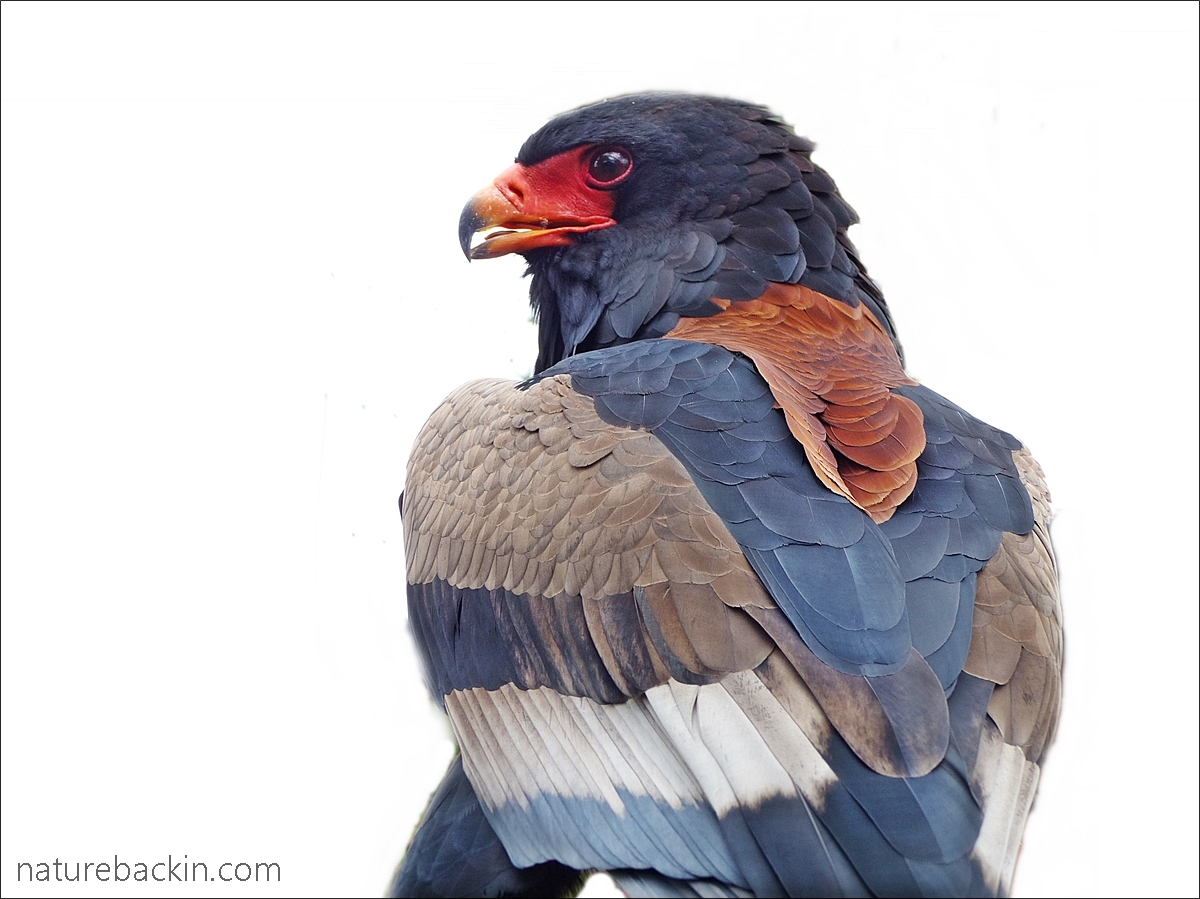
In the nick of time before 2024 draws to a close, lets celebrate BirdLife South Africa’s Bird of the Year, the gorgeous eagle known as the bateleur. By championing an individual species each year, BirdLife South Africa hopes that the year-long information campaigns highlight the conservation importance of each named species and of South Africa’s amazing birdlife more generally. The bateleur is listed as an endangered species and so it needs all the help it can get.
Bateleurs (Terathopius ecaudatus) are medium-sized eagles and are more closely related to snake eagles than to true eagles and they also have a genetic link to vultures. Bateleurs are the only species in the genus; Terathopius refers to the bird’s marvellous or pretty face, and ecaudatus means “without a tail” as their tails are so short. With progressive moults into adult plumage the tail gets shorter still and so is especially short in adult birds, so much so that when in flight, the feet extend beyond the end of the tail. (See the stunning photo here of a bateleur in flight).
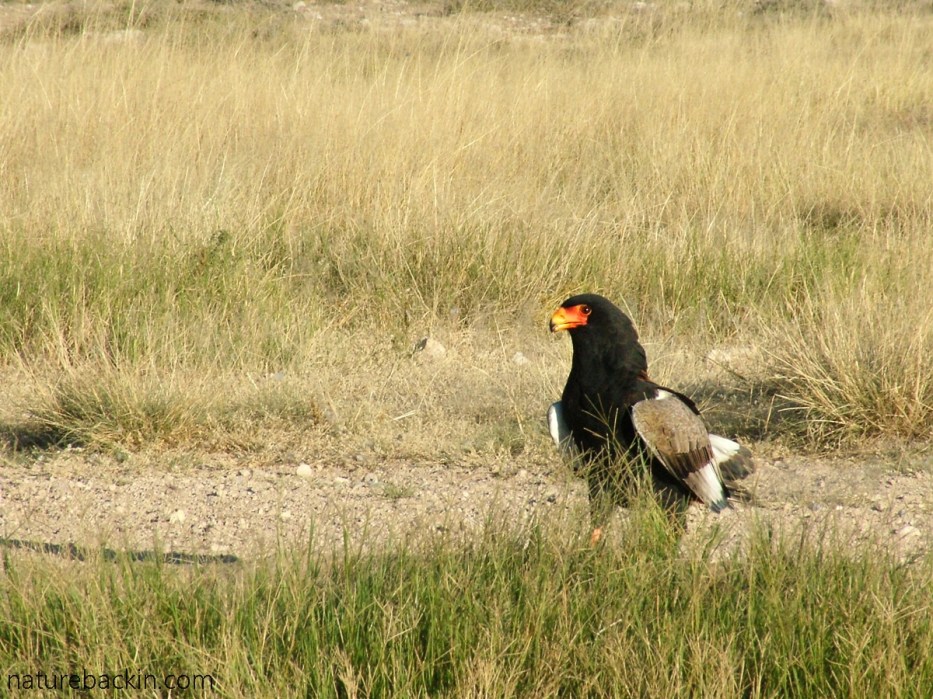
An adult female bateleur that I photographed near a small artificial watering point in the Mabuasehube Game Reserve in Botswana in the Kgalagadi Transfrontier Park
Bateleurs occur in most sub-Saharan African countries, except in the tropical rain forests of west and central Africa, and there may be a small population in the Arabian Peninsula. On occasion, vagrants may be seen outside the main parts of their range.
In South Africa, the range of bateleurs has contracted significantly over the past 100 years or so. Historically they occurred widely, even as far south as the southern Cape Province (Simmons), but bateleurs have been eradicated from most of their former range and now they only occur in protected areas. North of the Gariep/Orange River on the western side of the country they occur in protected areas such as the Kgalagadi Transfrontier Park, and northwards into Botswana. They also occur in the Kruger National Park and in the northern KwaZulu-Natal conservation areas of Hluhluwe-iMfolozi Park and iSimangaliso Wetland Park.
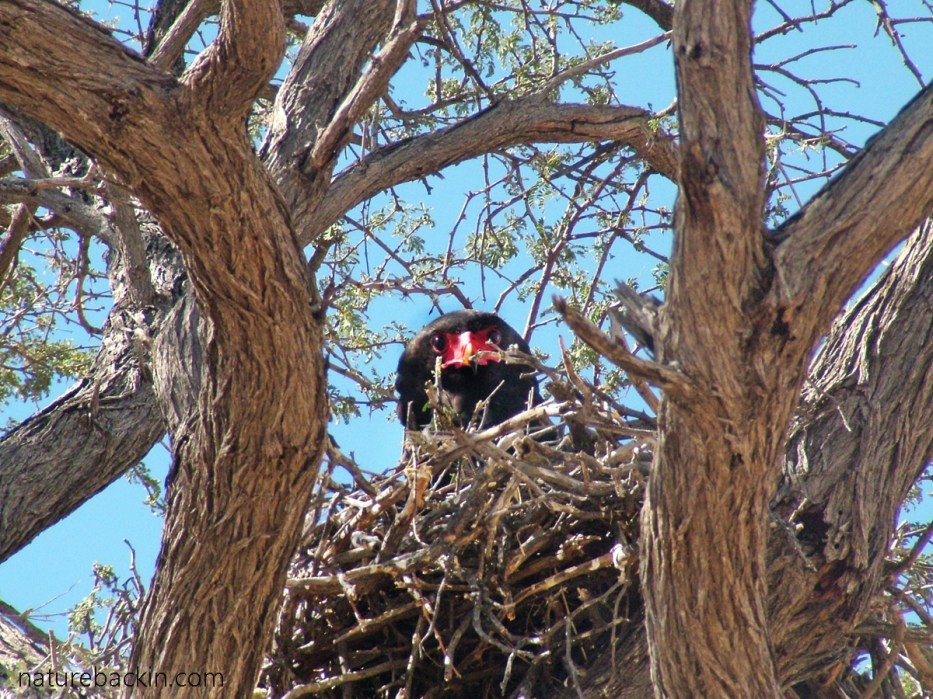
A bateleur peeping at us from its nest that is built in the fork of a tree that leans over a dirt road in the Mabuasehube Game Reserve in Botswana. We paused briefly below the nest and I took this photo through the windscreen before we slowly drove away
I have since learnt that bateleurs often abandon their nests if disturbed by human activity. With suitable trees being at a premium, perhaps the tree in the photo above was selected as a nesting site despite being over a road, or it was selected before the game reserve became more frequently visited. But then I see that the Wikipedia entry cites three sources that indicate that bateleurs may favour building nests near paths or roads! Bateleurs form lifelong monogamous pair bonds that extend over multiple breeding seasons and a pair will often go back to the same nesting site each year. Males and females share in the incubation of the single egg laid in each annual breeding season, and they share in the feeding and the raising of the chick.
Bateleurs prefer open woodlands and savannahs so long as there are trees suitable for nesting sites. They avoid dense forest, higher altitudes and deserts. In more arid regions such as in Namibia, they occur where there are tall woodlands near drainage lines or ephemeral rivers.
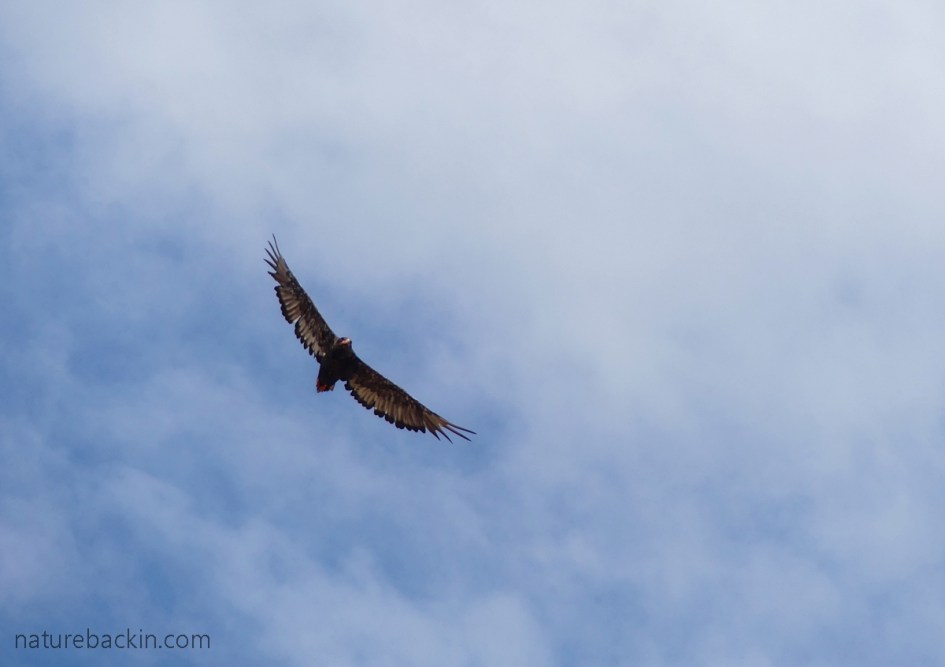
The silhouette of a bateleur in flight – the bowed wings are long relative to the length of the body and short tail. This female has nearly acquired full adult plumage colours. The reddish legs and feet don’t yet quite extend beyond the end of the tail, but after the next moult into adulthood the tail will be even shorter. Bateleurs spend up to 8 hours a day looking for food in a soaring low-altitude flight, though less so on overcast days
The common name “bateleur” was given to the bird by the French explorer, naturalist, collector and ornithologist François Levaillant (1753-1824). In French, the word means street entertainer, or more specifically acrobat, tumbler or tight-rope walker. It is thought this name was given on account of the bird’s sometimes acrobatic manoeuvres in flight or perhaps because it of its characteristic rocking motion of tilting from side to side when soaring, that could be thought similar to the rocking balancing motions of a tight-rope walker. Some flight embellishments or manoeuvres are part of ritualised nuptial aerial displays and also territorial displays, but as they also occur in juveniles, some flight embellishments may simply be in reaction to the presence of other bateleurs flying in the vicinity.
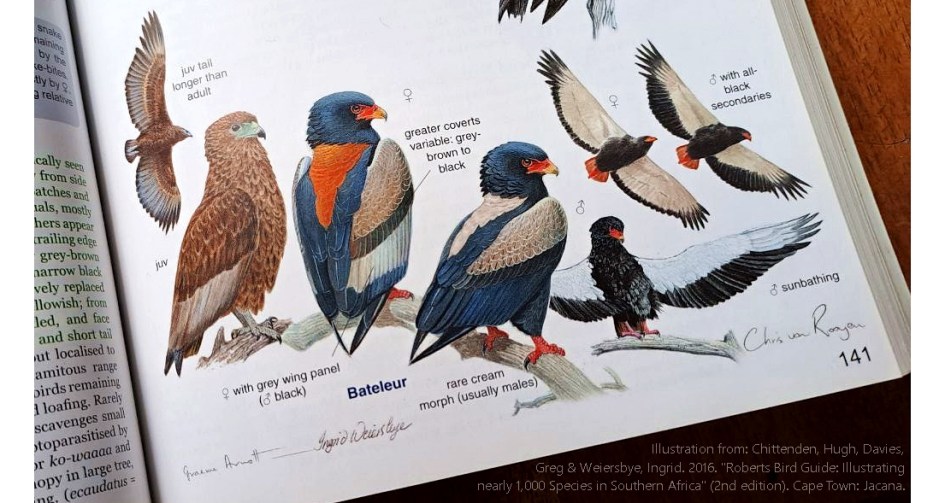
Even with online bird apps available, I still find my print Roberts Bird Guide useful. The illustrations for the bateleur (p.141) show the colour difference between the male and female adults, both when perched with folded wings and when in flight. The brown juvenile is also depicted, and an adult with wings spread as it “sunbathes” is also illustrated
Bateleurs are proficient diurnal hunters as well as sharp-eyed scavengers, often being the first species to show up at even small carcasses or carrion. They forage in flight and hunt and scavenge a variety of prey. Immature birds rely more on scavenging than adults who become more proficient at hunting, with small mammals being favoured prey, though birds and some reptiles are also hunted, and at times invertebrates are also taken.
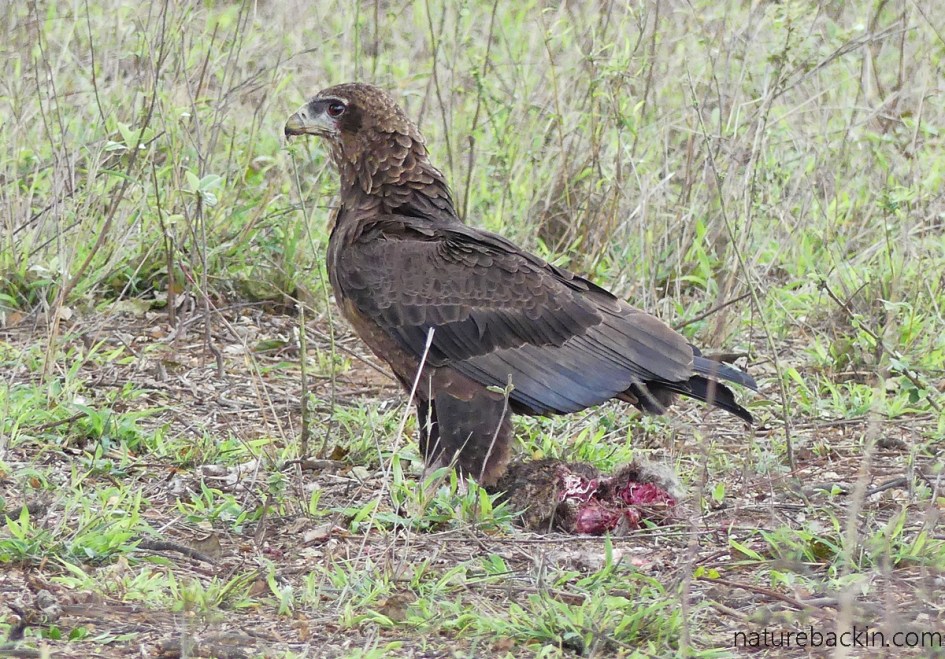
An immature bateleur standing tall showing its distinctive large and cowled head, short legs and short tail. It is standing next to the remains of a small mammal carcass it has been eating. This bird has undergone at least one moult and is darker in colour than the paler brown of a juvenile. The wing tips are extending beyond the tail. The tail gets progressively shorter with each moult. It takes 7– 8 years to acquire full adult plumage, which is the age at which bateleurs reach sexual maturity. This photo was taken in Kruger National Park
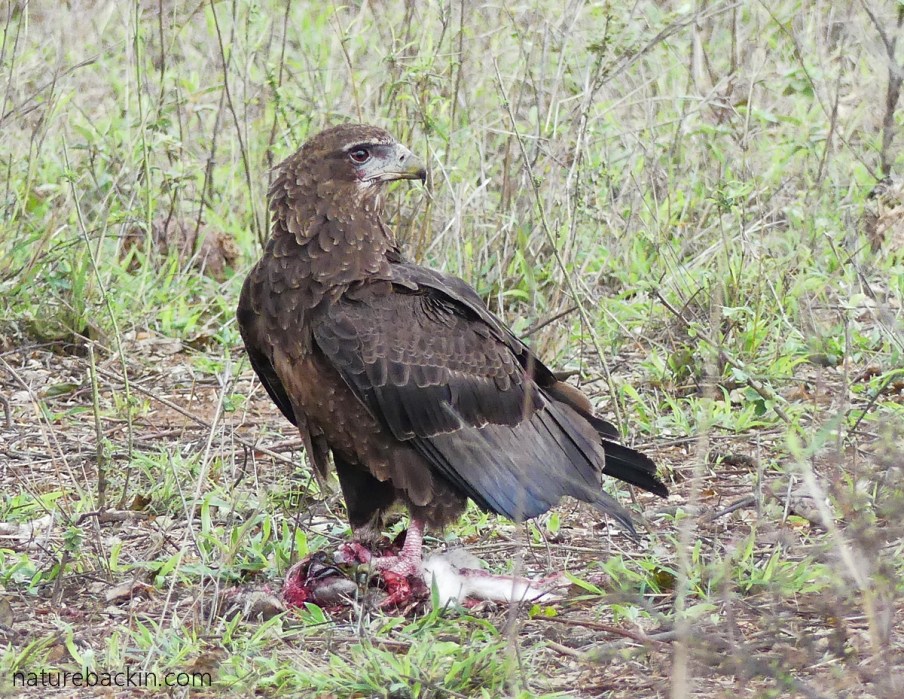
It is not clear whether this bateleur hunted for itself what was possibly a hare. Initially, we saw a large brown eagle eating the carcass. It flew away and almost immediately the bateleur arrived to claim the carcass. As mentioned, immature bateleurs scavenge more than adults, but they are still capable of hunting. It is also known that bateleurs are frequently kleptoparasitised by tawny eagles – in other words, tawny eagles often nick the prey of bateleurs. We do not know which or indeed if either of these birds originally hunted the prey, or if both of them were scavenging successively from a found carcass
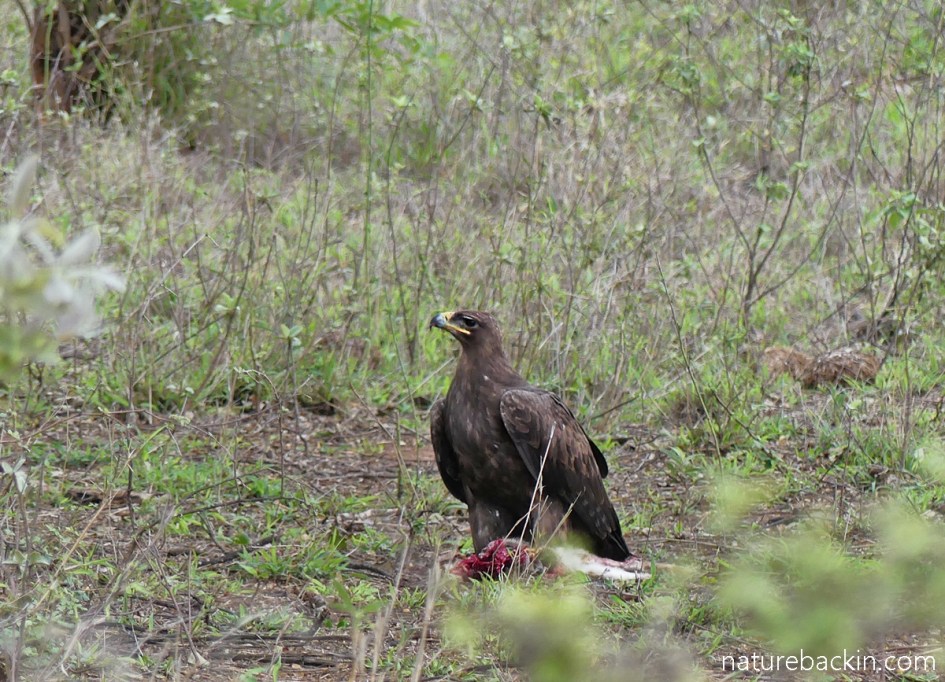
Above is the large brown eagle that we first saw with the prey animal. It could be a tawny eagle with the less common dark brown coloration, or it could be a steppe eagle. (The length of the gape is supposed to help distinguish between the two species, with the gape extending further below the eye in the steppe eagle, but I am not certain which it is from this photo.) It is interesting to compare the shape and profile of this eagle, with its smaller head relative to its body, to the shape of the bateleur
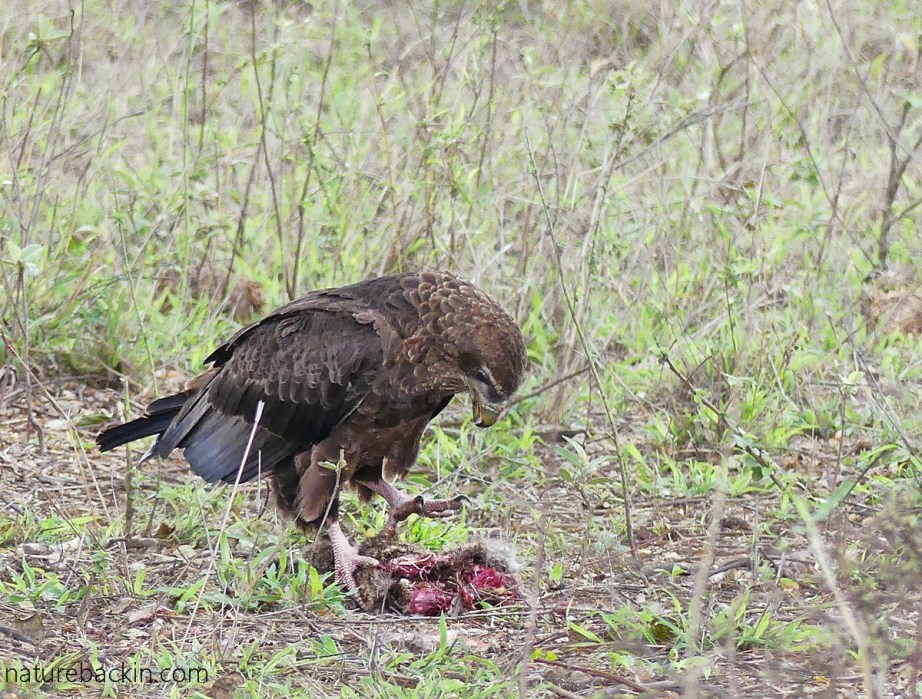
The bateleur grasping at the carcass as it prepares to tear off more bits to eat, showing its relatively short legs and robust feet with rough, tough skin, as is typical of snake eagles
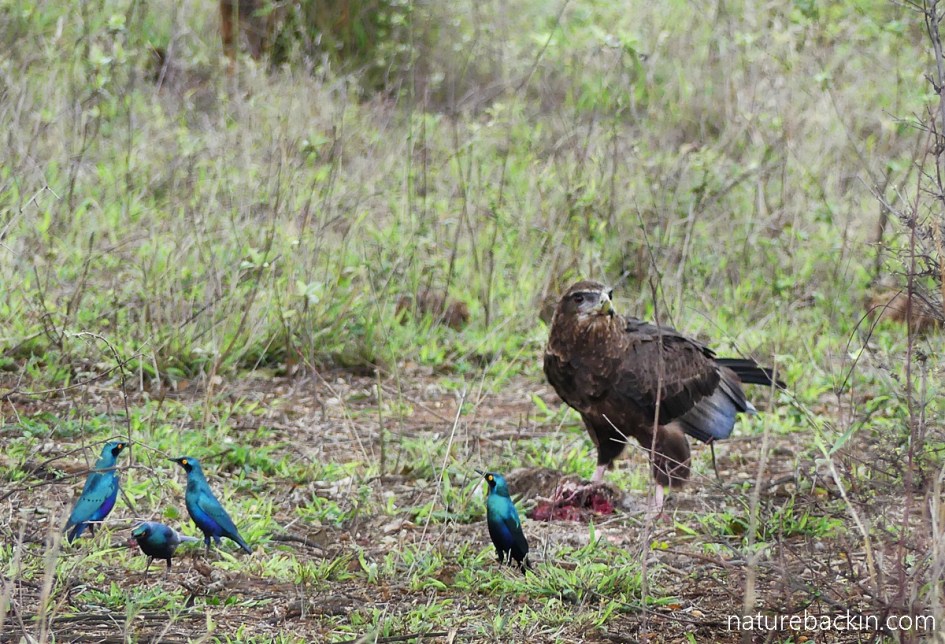
The bateleur tearing at the carcass attracted the attention of several glossy starlings that were evidently hoping for morsels. While we there they did not venture too close
The only photos I have of a bateleur pair together were taken of a captive pair at the African Raptor Centre (https://africanraptor.co.za/) that is near Pietermaritzburg. Due to land invasions, the Centre relocated this year, from its previous premises to the Tala Collection Game Reserve also near Pietermaritzburg.
The pair, named Portia and Dartanian, are from different areas in Mpumalanga and each were brought to the centre after having been found injured and unable to fly. Although their lives were saved at the sanctuary, their injuries were such that they are not able to be rehabilitated for release back into the wild.
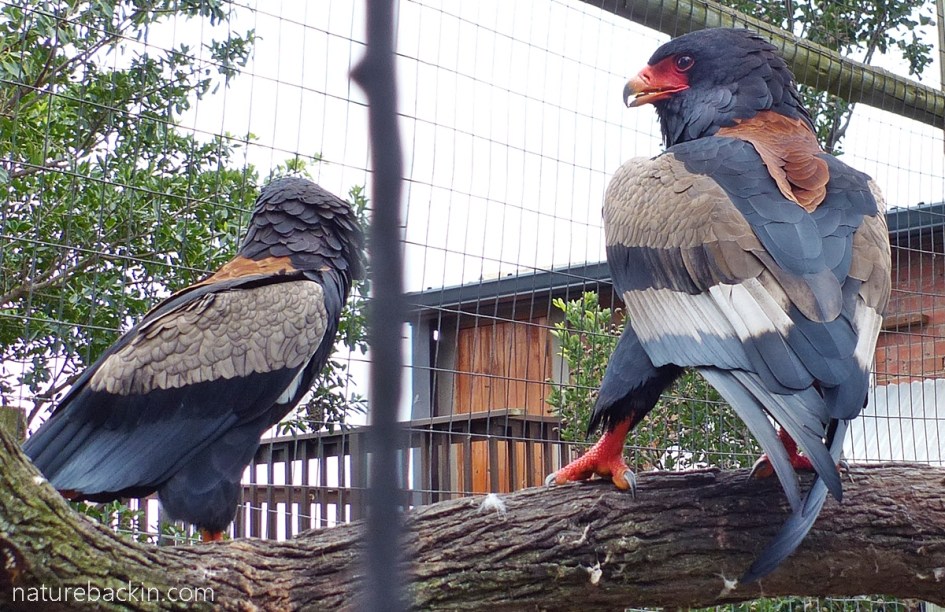
The breeding pair of bateleurs at the African Raptor Centre that provides rehabilitation and/or sanctuary to rescued raptors. In the photo above the male is on the left and the female (typically slightly larger) is on the right. The folded wings can be seen to extend way beyond the short tail
In captivity these two birds have become a breeding pair and have successfully bred, and to my knowledge at least two chicks have been born in captivity. Bateleurs lay a single egg. In the wild, both parents incubate the egg, and both contribute equally to brooding and feeding the chick. The chick develops slowly and first stands and engages in wing flapping at about 5 weeks. At about 6 weeks, it is able to feed itself when small prey is brought to the nest by the parent birds. It fledges only after 3 to 4 months, and returns to the nest after its first flights. It continues to return to the nest for about 3 months after its first flight and may remain dependent on its parents for as long as 4 months after fledging.
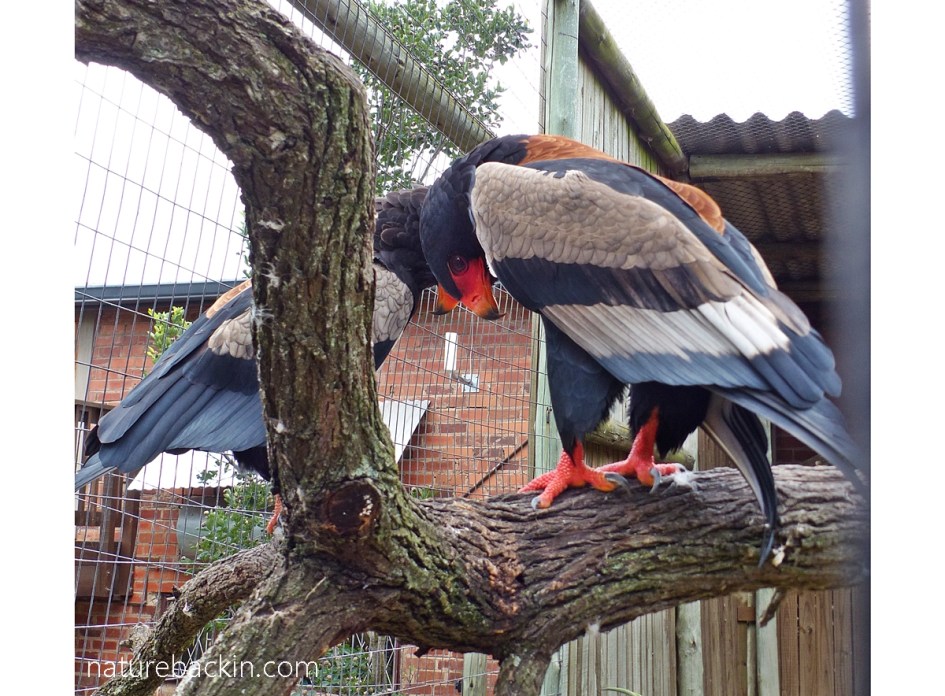
The pair engaged in a kind of bowing behaviour. Breeding pairs have a very close bond and in the wild often engage in behaviours such as allopreening that serve to strengthen their bond
With the breeding age of bateleurs only commencing at the age of 8 years, the fact that pairs only lay one egg per season, and that the development time from nesting to post-fledge requires investment from the parents for an exceptionally long time, being 8 to 9 months, the reproductive rate of bateleurs is very low. Rick Watson, who researched bateleurs in the Kruger National Park during the 1980s, found that bateleurs raise 0.47 young per pair per year. To be successful at maintaining population levels, breeding adults need to live a long a time. Even small declines in adult survival can be catastrophic for population levels.
After achieving independence, immature birds are driven out of the territory when the breeding season arrives, but they tend to return outside of the breeding/nesting season. Adopting a necessarily nomadic lifestyle, bateleurs, particularly immature birds, leave the relative safety of conservation areas. In a study in the Kruger National Park, recovered juveniles were found to have wandered between 30 to 285 km (18 to 177 miles). In this wandering, the eagles fly into adjacent stock-farming lands, where they become vulnerable to poisoning due to scavenging from baited carcasses that have been set out by farmers to target potential livestock predators, such as jackals.
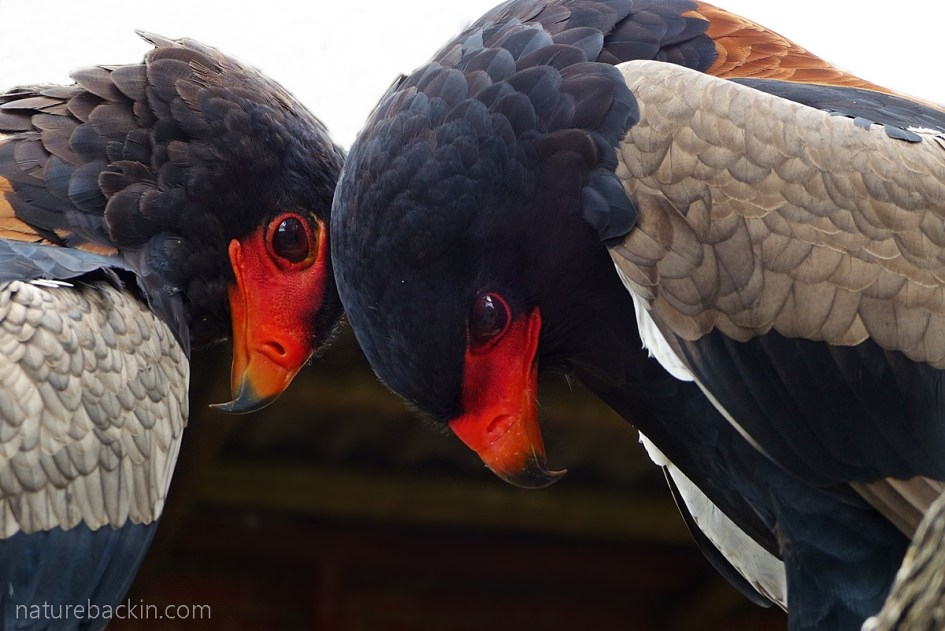
We spent time observing the pairs’ bonding behaviour during a quiet time at the sanctuary when no other visitors were around
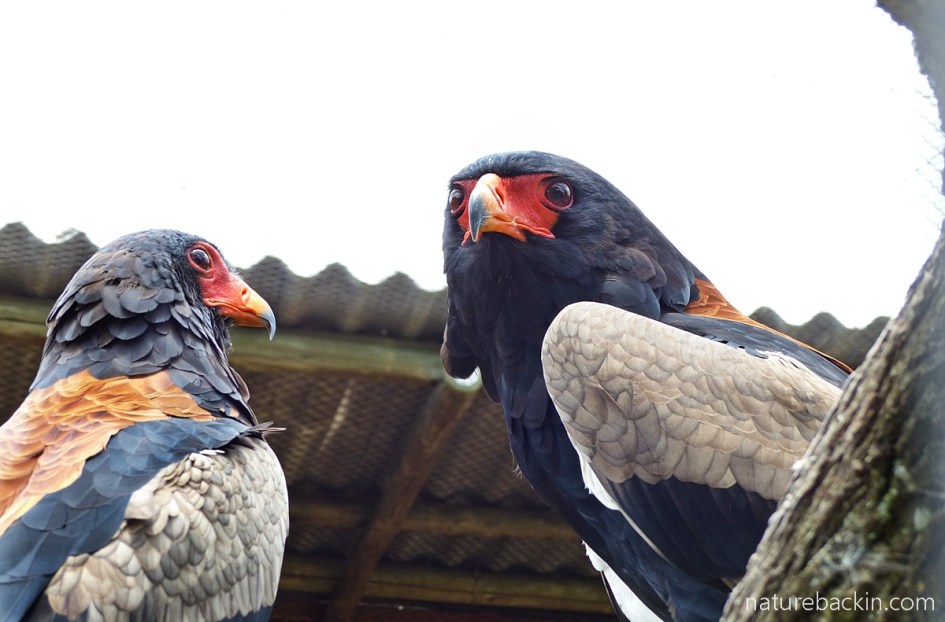
The beauty of the bateleur eagles is breathtaking as can be seen in this captive pair at the African Raptor Centre
It is tragic and shocking that in South Africa, according to BirdLife South Africa, bateleurs have had “an estimated population reduction of over 50% over the past three generations (40 years), leaving a regional population size of less than 1000 mature individuals” (https://www.birdlife.org.za/bird-of-the-year-2024/). In addition to extensive loss of habitat due to urbanisation, intensive agriculture and climate change, the tendency of bataleurs to scavenge has led to deaths of bateleurs over the last 100 years or so as a result of scavenging from poisoned carcasses, as has already been mentioned. Other causes of bateleur deaths include disturbances near nesting sites resulting in abandonment of chicks, individuals being killed when they fly into powerline cables, drown in farm reservoirs or are hit by motor vehicles when scavenging road kills. Illegal harvesting of birds for the traditional medicine trade is also a problem. In addition, the use of pesticides may also be contributing to the decline in bateleur numbers
In BirdLife International’s 2020 assessment, the status of bateleurs across their ranges in Africa was up-listed from Vulnerable to Endangered. According to the IUCN Red List of Threatened Species, threats facing bateleurs are summarised as follows:
Putative reasons for declines vary, but include poisoned baits, pesticides, trapping for international trade, nest disturbance from spreading human settlements, and increased intensification and degradation of agricultural land (Ferguson-Lees and Christie 2001, N. Baker in litt. 2005, S. Thomsett in litt. 2005). The major cause of the decline seems to be almost entirely poisoning by a few large-scale commercial farmers, but poisoning is also a problem in tribal small-stock farming communities. (https://www.iucnredlist.org/species/22695289/174413323)
Simmons writes that there is “virtually unanimous agreement” that the decrease in bateleurs is “owing to indiscrimate poisoning by livestock farmers, observing that on their own “pesticides in eggs and habitat destruction are unlikely to have reduced the range of the Bateleur” to the drastic extent that has occurred.
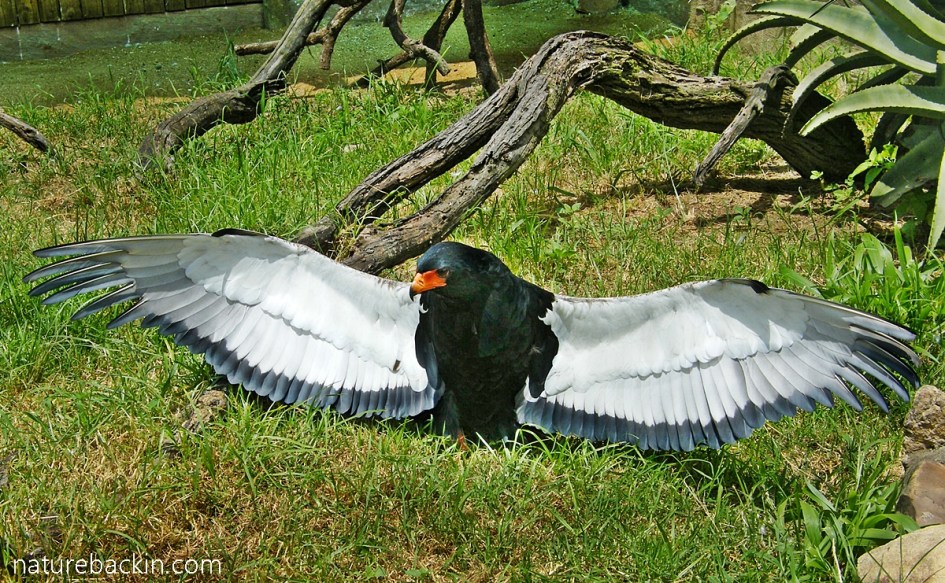
Even in captivity, this female bateleur demonstrates the sunbathing stance with wings spread that is typical of bateleurs
It is thought that bateleurs indulge in this type of sunbathing for thermoregulation purposes and/or to warm oils in the skin and feathers. The bird then spreads the warmed oils by preening so as to maintain the health of the feathers.
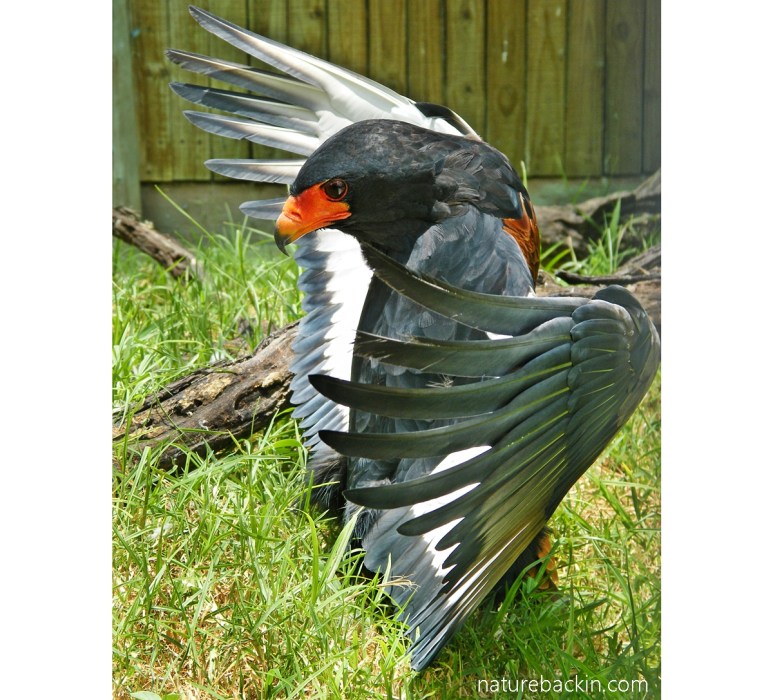
The sunbathing bateleur with wings spread viewed from the side
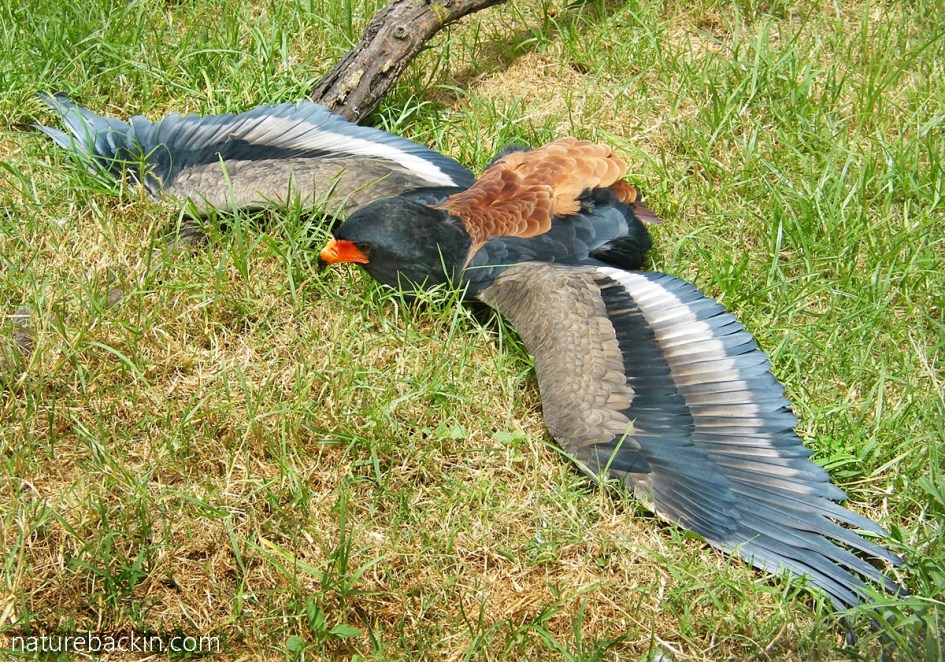
After sunning her front, the bird flopped forward onto her belly and, keeping her wings spread, she continued sunbathing. The impressive wingspan of about 1.8 metres (6 feet) can be appreciated as the bird lies on the ground, especially in contrast to her short body and almost non-existent tail
It is thought that this flopped-forward on the ground behaviour is adopted by bateleurs for the purposes of anting, that is allowing ants to crawl over the body to collect bits of skin and debris in the feathers. The theory is that when a bird is covered in ants it ruffles its feathers causing the ants to release formic acid in self-defence, which has the effect of ridding the birds of parasites! However, the bird we witnessed, albeit a captive bird, seemed merely to be extending her sunbathing behaviour.
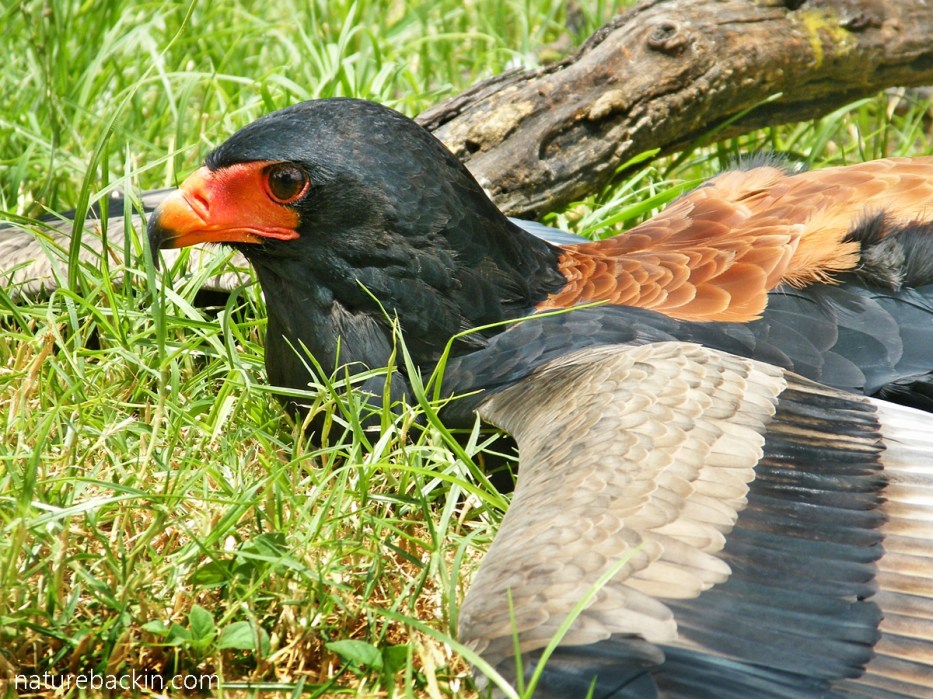
A close-up of the female bateleur sunbathing
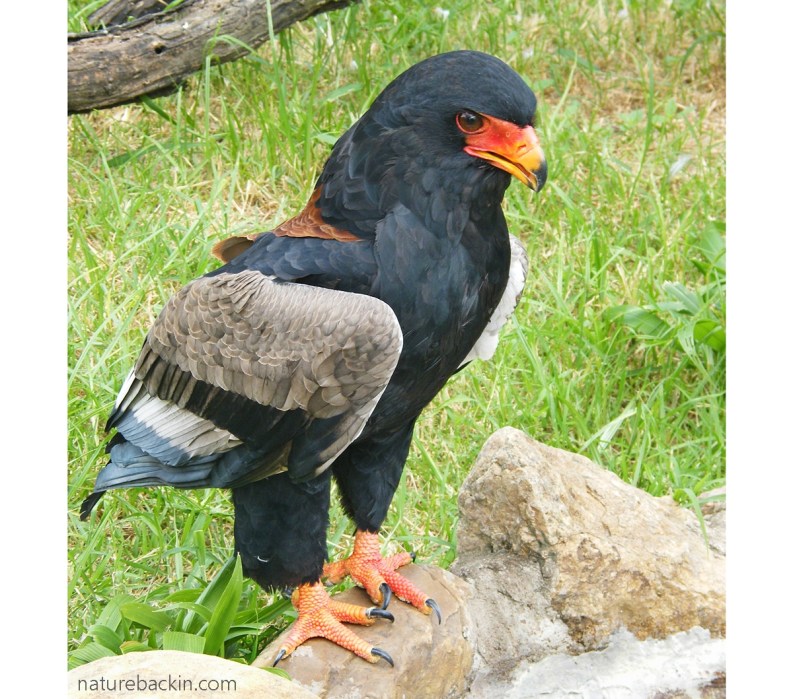
After only a few minutes of sunbathing, the bateleur was up and approached the birdbath in the enclosure. Bateleurs in the wild are known to spend a lot of time at water holes, often standing for long periods in the water, sometimes with wings outspread
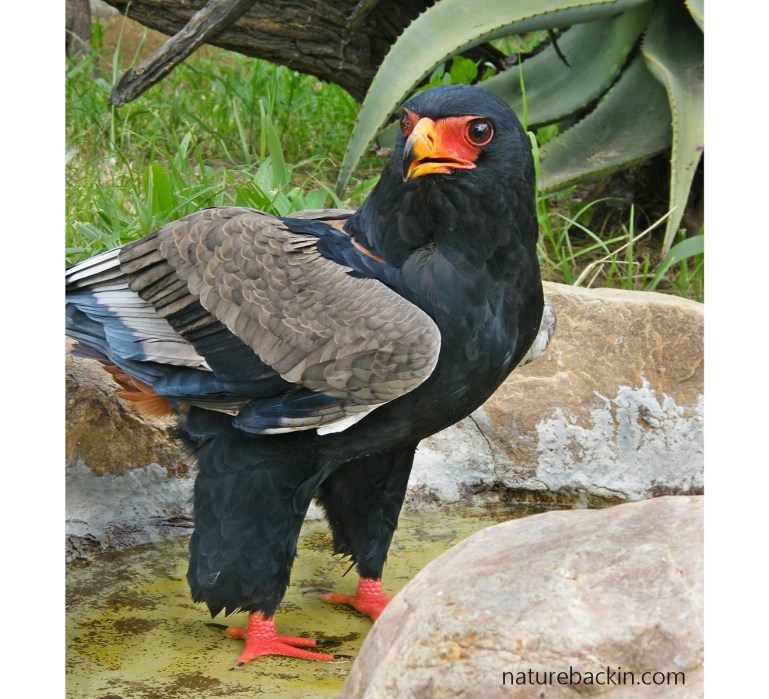
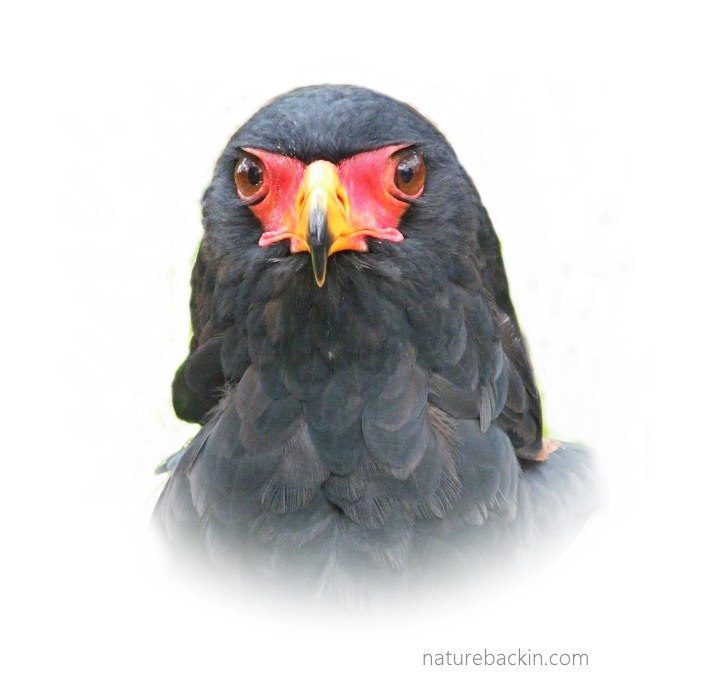
The bateleur stepped into the water of the bird bath to drink. In this photo the bare red facial skin and the red skin of the feet look especially vivid. Her stance in this photo conveys something of the power of these birds
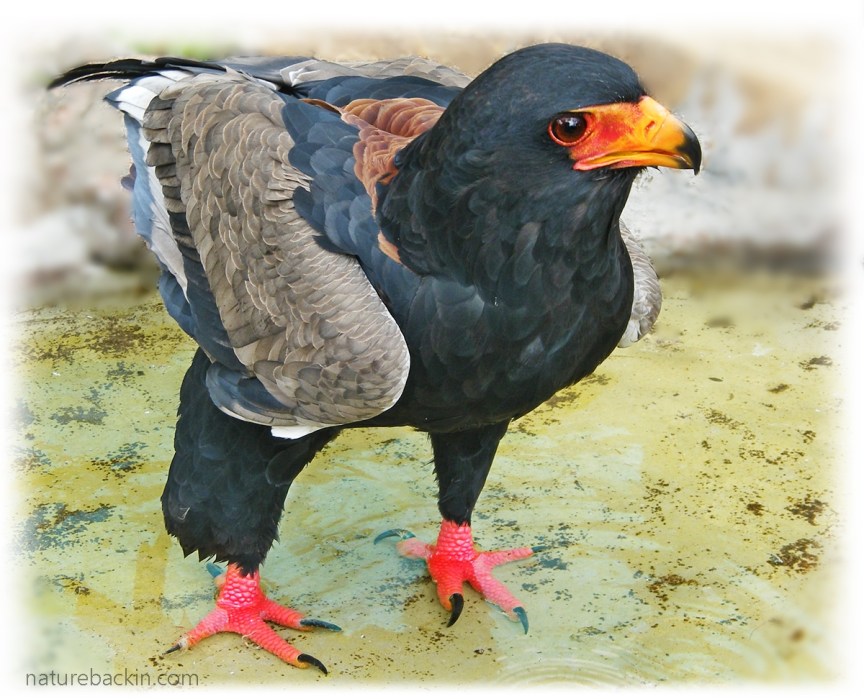
And here she is still standing in the water while drinking
I wish I could strike a more optimistic note on the future of the bateleur eagles. BirdLife South Africa reports that the Bird of Prey Working Group of the Endangered Wildlife Trust has been active with an awareness and education programme for land-owners and stock farmers in Northern Cape, which has been successful in reducing the number of poisoning incidents, citing personal communication with AJ Botha. Such initiatives have the potential to benefit not only bateleurs but other eagles too as well as vultures.
The Endangered Wildlife Trust has also embarked on a research programme where individual bateleurs are tagged with GPS trackers, enabling conservationists to better understand the range covered by individuals bateleurs, especially important as immature bateleurs are known to roam widely over several hundred kilometres from where they were born and raised.
P.P.S. Positive Postscript
Going forward I hope to end each post by logging something positive. We all need to be able to acknowledge the hopeful in these times.
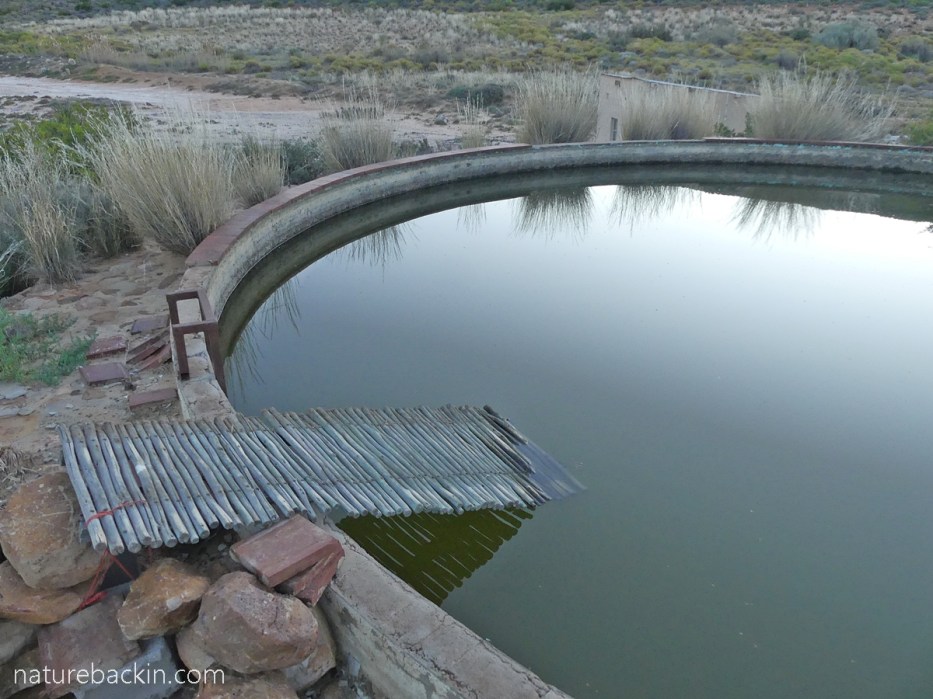
Above is a photo of a farm reservoir with a ramp extending into the water, which would enable birds and other creatures that are unfortunate enough to fall into the water to find a way out. It is not unusual for raptors to drown in farm reservoirs
Kudos to Hartnekskloof Guest Farm in the Tankwa Karoo for providing (even if the original intention was for something else?) an escape route in their farm reservoir. Hopefully, other owners of reservoirs do the same. (For more on Hartnekskloof Guest Farm see https://www.pressreader.com/south-africa/go-karoo-test/20240901/283386247201497)
Wishing all readers and blogging friends hope, health and happiness in 2025
Sources:
African Raptor Centre. https://africanraptor.co.za/
BirdLife South Africa. [n.d.] Introducing the Bateleur: Bird of the Year 2024. https://www.birdlife.org.za/bird-of-the-year-2024/
BirdLife International. 2020. Bateleur Terathopius ecaudatus. The IUCN Red List of Threatened Species. Version 2024-2https://www.iucnredlist.org/species/22695289/174413323
Chittenden, Hugh, Davies, Greg & Weiersbye, Ingrid. 2016. Roberts Bird Guide: Illustrating nearly 1,000 Species in Southern Africa (2nd edition). Cape Town: Jacana.
Davies, Rob. 2010. The Bateleur – An Interview with Dr Rick Watson. African Raptors, https://www.africanraptors.org/the-bateleur-an-interview-with-dr-rick-watson/
Roberts VII Multimedia Birds of Southern Africa: PC Edition. 1997-2016 Southern
Taylor, Martin R. (Assessor). 2015. Terathopius ecaudatus. Redlist of South African Species. SANBI (South African National Biodiversity Institute). https://speciesstatus.sanbi.org/assessment/last-assessment/3187/
Simmons, R.E. [n.d.] Bateleur, Berghaan. Terathopius ecaudatus. From Southern African Bird Atlas Project (SABAP1) 1987-1991. Downloaded a pdf of the bateleur chapter at https://www.birdmap.africa/docs/sabap1/146.pdf
Wikipedia. 2024. Bateleur. https://en.wikipedia.org/wiki/Bateleur#:~:text=Description,-Close%2Dup%20of&text=The%20bateleur%20is%20of%20note,with%20a%20very%20large%20cere.
Posted by Carol

Discover more from letting nature back in
Subscribe to get the latest posts sent to your email.


January 26, 2025 at 12:06 am
Fascinating-what an incredible raptor!!
LikeLiked by 1 person
February 5, 2025 at 7:11 pm
Indeed it is!
LikeLiked by 1 person
January 6, 2025 at 6:35 pm
While I’ve been travelling, I’ve been late to get to this bird. What a gorgeous creature – and thanks for bringing it to life in this post. It’s hard to believe it’s so endangered. Nevertheless – all good wishes for 2025 to both of you.
LikeLiked by 1 person
January 7, 2025 at 8:12 pm
Thanks Margaret, and all the very best to you and yours for the year ahead.
LikeLiked by 1 person
January 7, 2025 at 9:17 pm
😊
LikeLike
January 5, 2025 at 4:12 pm
Beautiful raptor and interesting info. I am glad to have finally learned the origin of their name. We have a significant issue wtih raptors being poisoned too, often deliberately. The finger is usually pointed at people managing grouse or pheasants for commercial sport hunting; they tend to consider wild predators as unwelcome rivals eating into their profits.
LikeLiked by 1 person
January 6, 2025 at 2:42 pm
Hi Adele – nice to hear from you. I am sorry to hear that the UK also has problems with raptor poisonings. I wonder if any form of information/education might prevail against the profit motive of commercial sport hunting enterprises. Weird priorities at the end of the day …
LikeLiked by 1 person
January 6, 2025 at 3:31 pm
It’s far beyond education unfortunately. Immensely thorny social, legal and political issue.
LikeLiked by 1 person
January 3, 2025 at 5:40 pm
Hi Carol, I am in the Hainaveld near Maun and have a healthy population of Bataleurs. They are very easy recognizable in flight and gives me a smile whenever they around. This year was a dry year and bumper year for them with available carrion. Thanx nice article. Regards Marius
LikeLiked by 1 person
January 5, 2025 at 12:41 pm
Hi Marius
Thanks for getting in touch. It has been a while since we last visited Maun.
It is very good to hear that the population of Bateleurs in Botswana remains healthy, though sad that the deaths of other animals due to the drought is partly what has sustained them so well this year.
Best wishes, and I hope the drought breaks soon.
LikeLike
January 3, 2025 at 3:52 pm
I very much enjoyed this thorough and informative look at the bateleur, Carol. While in Africa I have seen the treasured bateleur a few times, but always at a far distance. They are relatively easy to spot in flight due to their unusual short tail and red parts. But what I so enjoyed here were all the close-ups of the bateleurs, their gorgeous features and many colors. I am sorry to hear of their terrible decline. It is difficult when the birds only breed one chick per year and the chick takes long to mature, as you pointed out. And of course the poisoning and human destruction is devastating. How fortunate you have so many photos of this majestic creature, thanks for educating us.
LikeLiked by 1 person
January 5, 2025 at 12:37 pm
Hi Jet – thanks so much and I am glad you have seen the wonderful bateleurs in the the wild, even if at a distance.
The decline in numbers is shocking, but sadly many raptors are in similar trouble.
Let’s hope that efforts to reduce the putting out of baited carcasses in the farmlands can be effective, and the population gets a chance at least to stabilize.
LikeLiked by 1 person
January 3, 2025 at 10:31 am
Wonderful to see the majesty of these stunning birds and learn so much about them. Thank you, Carol. We must hope that raising their profile over the course of 2024 has helped their fight for survival. I’m interersted in the young of that beautiful pair in captivity: do you know if the young successfully reintegrated into the wild?
FInally, Happy New Year! I look forward to more of your fascinating posts when time and inclination coincide 😊
LikeLiked by 1 person
January 5, 2025 at 12:34 pm
Hi Sandra – thanks so much. I was also interested in the future of the chicks that were born in captivity. The raptor centre is very active in rehab for release where possible. However, I have not been able to find any information on how things turned out for these two chicks, unfortunately.
Thanks for the good wishes – sending very best wishes for 2025 to you too.
LikeLike
January 3, 2025 at 8:20 am
Hello Carol,
What a treat to start the New Year with your article.
Thank you for sharing awareness along with your stunning images.
Wishing you and all your dear ones a wonderful year ahead.
Warm wishes from Japan,
Takami
LikeLiked by 1 person
January 5, 2025 at 12:31 pm
Thanks so much Takami
And sending very best wishes to you and your family too. May the year bring you lovely opportunities for photographing your beloved birdlife.
LikeLiked by 1 person
January 2, 2025 at 7:32 pm
we have seen a pair of Bataleurs on the road between Oudfshoorn and George. Always wondered what bird of prey it was.
LikeLiked by 1 person
January 5, 2025 at 12:29 pm
Thanks Peter. That is interesting – vagrants can be found outside the usual range, but to see a pair would be very unusual. I wonder if you saw them perched or flying? If in flight I wonder if they might be the rather similar jackal buzzard? See here for example https://www.google.com/images.naturerules1.fandom.com%2Fwiki%2FJackal_Buzzard
LikeLike
January 2, 2025 at 9:15 am
A wonderful start to the year with your excellent photography, interesting text – and the positive post script!
LikeLiked by 1 person
January 5, 2025 at 12:24 pm
Thanks Anne. It will be interesting going forward to see what positive post scripts can be found!
LikeLike
January 6, 2025 at 7:03 am
I see your post has made it to news feeds and I ave had it forwarded to me by two friends from afar!
LikeLiked by 1 person
January 6, 2025 at 2:54 pm
Not sure how the post managed to get into the news feeds, but it certainly found a lot more traffic. How kind of your friends to forward the post to you! 😊
LikeLiked by 1 person
January 2, 2025 at 7:48 am
I thoroughly enjoyed this richly informative blog on these magnificent creatures. The photos are stunning! Let’s hope awareness of their plight gets raised.
LikeLiked by 1 person
January 5, 2025 at 12:23 pm
Thanks Christine. Yes absolutely, let’s hope that alternatives ways to protect livestock can be found and implemented.
LikeLike
January 1, 2025 at 10:35 am
Thank you for telling us so much about these magnificent birds. Your photographs of the birds in both the wild and the enclosure are truly remarkable. The spread wings of the sunbathing bateleur are magnificent. I marvelled how that span could fit back into the eagle’s side!
I fervently hope the species survives.
LikeLiked by 2 people
January 1, 2025 at 1:33 pm
They are such marvelous birds. True – it is surprising those enormous wings fold in so effectively!
Yes, also hoping the species can be saved. Each individual counts when the population is so threatened.
LikeLiked by 1 person
January 1, 2025 at 4:52 am
What a fabulous bird. That plumage is just stunning. So sad that they’re not doing well, but hopefully they can turn that around with help from people in their corner. Wishing you all the best for the New Year.
LikeLiked by 1 person
January 1, 2025 at 1:30 pm
Yes, fabulous and stunning birds. We can only hope those campaigning to save it and other raptors are able to bring about some effective changes as you say.
Thanks for the good wishes – and the same to you for the year ahead.
LikeLiked by 1 person
January 1, 2025 at 12:34 am
These birds’ beautiful spirit is conveyed through your photos, Carol. Heartbreaking that they are so imperiled. Humans can be so destructive! Raptors here are facing a similar issue when eating rodents that have been poisoned with anticoagulants. A horrid way to die. Our state Audubon is currently working on a bill to ban its use. Fingers crossed.
LikeLiked by 1 person
January 1, 2025 at 1:27 pm
Hi Eliza – that is lovely that the birds’ spirit shown through. Sometimes it seems human destructiveness knows no limits.
Rodenticides are a similar problem here, especially the anticoagulants. Owls are among those severely affected. I do hope the ban you mention does come into effect. Fingers crossed indeed.
LikeLiked by 1 person
December 31, 2024 at 11:27 pm
Fascinating and magnificent bird. I enjoyed learning about the Bateleur, Carol. Beautiful colors and markings. Sad about its numbers declining.
Thanks for this – wishing you a wonderful start to the new year!
LikeLiked by 1 person
January 1, 2025 at 1:15 pm
Thanks Jane – the bateleur is remarkable and beautiful.
Thanks for the good wishes – wishing you and yours a happy and fulfilling year.
LikeLike
December 31, 2024 at 6:27 pm
The beauty of these birds is truly breathtaking. It is such a contradiction that animals are rescued and painstakingly cured by humans because other people are too careless in their treatment of nature.
LikeLiked by 1 person
January 1, 2025 at 1:11 pm
They are incredibly beautiful. It is true what you say about the contradiction. Thinking about it, those involved in animal rehabilitation and rescue are endlessly caught up in it – work that is a complex mix of heartbreaking and heartwarming, I imagine.
LikeLiked by 1 person
December 31, 2024 at 4:11 pm
What an amazing colourful eagle! Thanks for sharing.
LikeLiked by 1 person
January 1, 2025 at 1:08 pm
Thanks – it is a truly amazing bird!
LikeLiked by 1 person