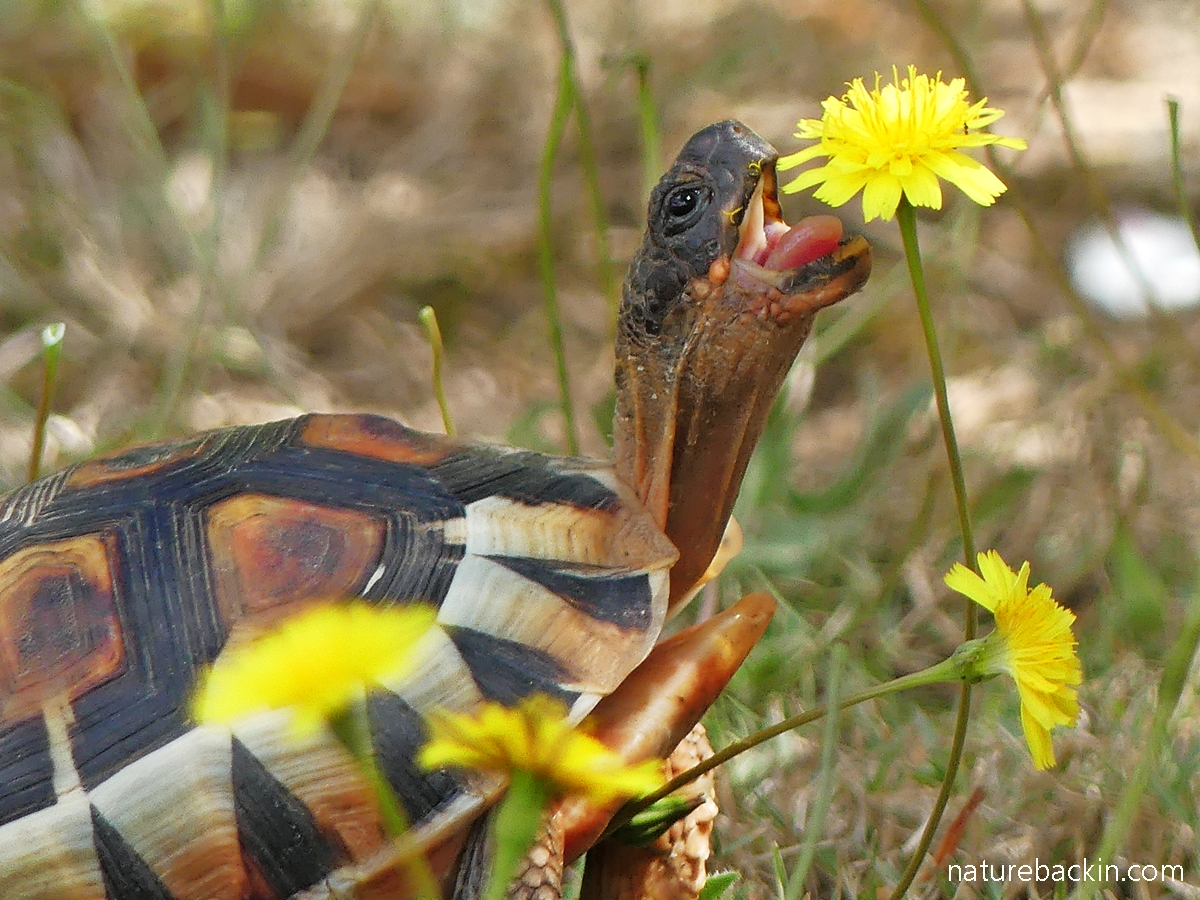
A wild tortoise has been visiting our garden to eat dandelion flowers growing in our “lawn”. The tortoise is small enough to fit under the garden gate. After feeding, it takes a siesta in a small hollow it has burrowed out under an old lavender bush.
Now that the dandelions have finished flowering it is no longer visiting, but it was amazing to see how decisive it was about where it wanted to go, and once it decided to leave it made a determined beeline for the gate and off it went. Tortoises, are not quite as slow as one might think – though of course compared to a hare they are!

The tortoise striding out purposively across our garden
There are two species of tortoise in our area, and this is the larger of the two: the angulate tortoise (Chersina angulata), which is classed as being a medium-sized species. The other species is the small-sized parrot-beaked padloper (Homopus areolatus).
Our visitor is only about 16 cm (6 ins) in length. On average angulate tortoises grow to about 25 cm (10 ins) in length and weigh about 1.5 kg (3.3 lbs), although exceptionally large individuals may be as long as 30 cm (12 ins) and weigh up to 2 kg (4.4 lbs). Unusually for southern African tortoises, males are larger than females. By contrast, female parrot-beaked padlopers are larger than the males, but even the females reach a maximum length of only about 12 cm (5 ins), weighing about 300 g (just over half a pound).
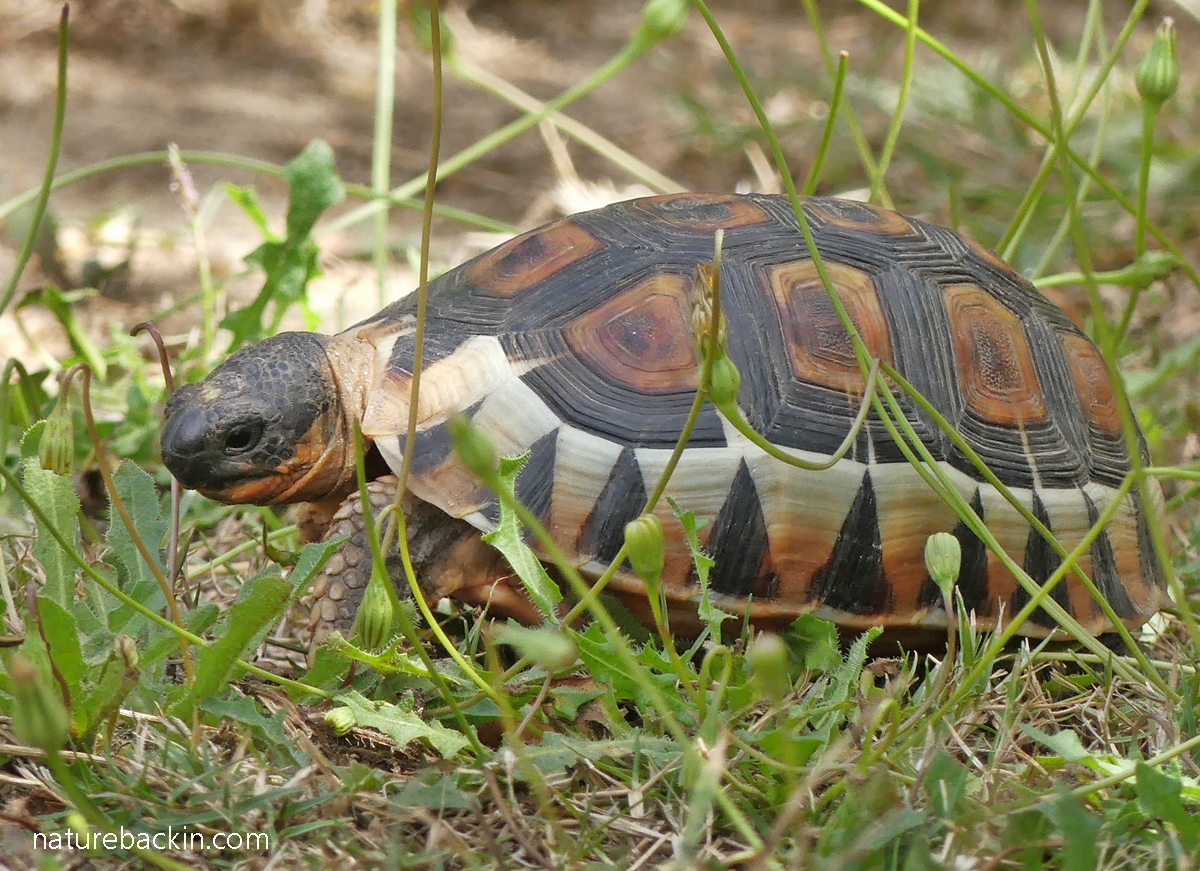
Angulate tortoises are regionally variable in colour, but the characteristic triangular dark markings around the margins of the shell are usually distinct
I had not seen angulate tortoises before moving to the Western Cape. They occur only in the south west of the country, from about East London and westwards along the south coast into the Western Cape and up the west coast into south western Namibia. Populations are most dense closer to the coast although angulate tortoises also occur in the adjacent interior. They also occur on offshore islands, including Dassen and Robben Islands. (For distribution see https://www.iucnredlist.org/species/170519/115655918#geographic-range)
In the wild, it is possible for angulate tortoises to live as long as 30 years. The home range of angulate tortoises varies according to habitat and region, but in the Addo Elephant National Park the home range of individuals was found to be about 2.5 hectares (6 acres). Outside of exceptionally cold snaps, in their natural ranges they remain active throughout the year.
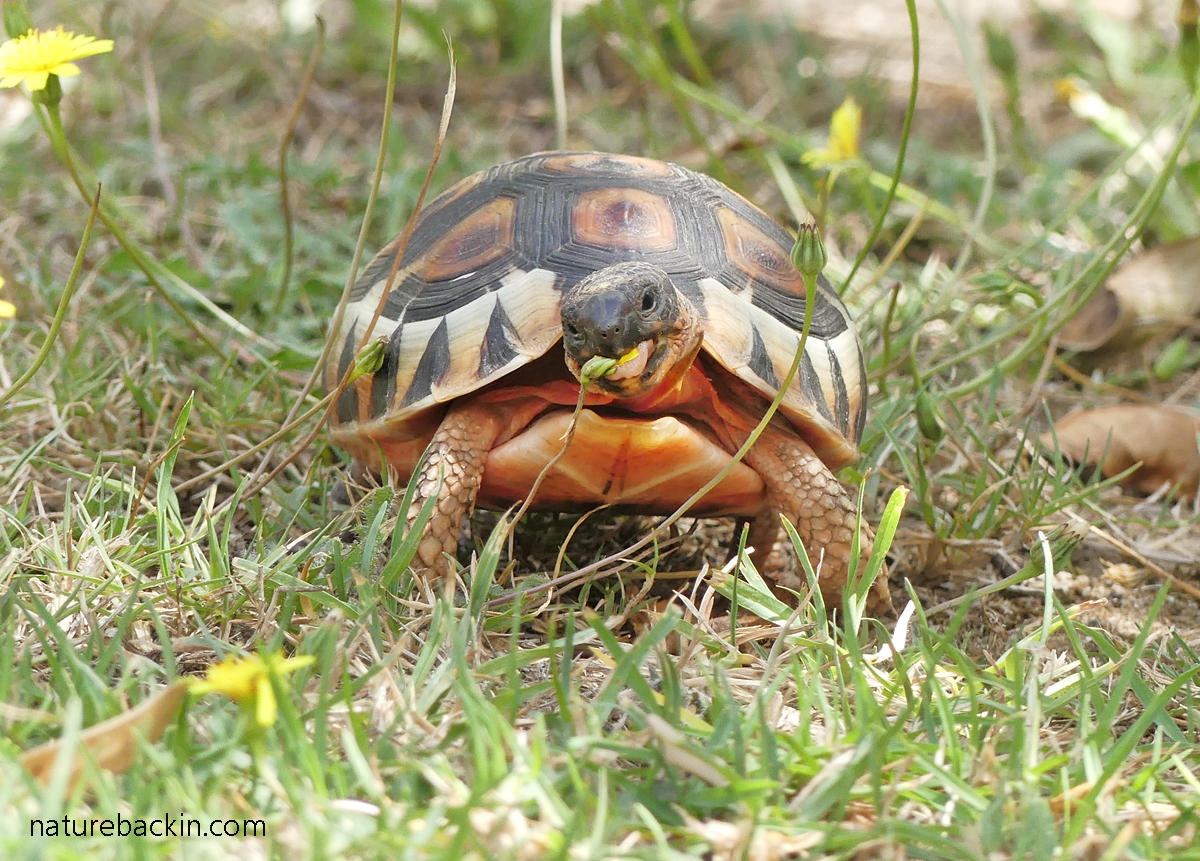
In some regions the underside (plastron) of the angulate tortoise is yellowish and in other regions – such as ours – they are reddish underneath. The gular scute (throat shield) that protrudes under the chin is undivided in the angulate tortoise. In other southern African tortoises, it is divided in two. The gular shield (that can be seen in the above photo) is relatively short – perhaps the tortoise is female or it is too young for the gular shield to have grown to its full length, as it protrudes much further in a mature adult male
The protruding gular shield is so prominent in the male that an alternative name for the angulate tortoise is bowsprit tortoise. The males fight for mating rights (they are not territorial) and when ramming each other they use the gular shield to try to overturn their rival. Usually, with some effort an overturned tortoise is able to right itself, but if turned over in combat the loser will wait for its rival to leave before attempting to right itself.
In a nearby nature reserve, we recently saw two angulate tortoises ramming each other, with the one seemingly more dominant as it appeared to drive the other into some scrubby bushes. At the time, we were not sure if these were rival males or a male asserting himself with a female. However, according to The Southern African Tortoise Book, in angulate tortoises, courtship is “a comparatively gentle affair”, involving “persistent pursuit on the part of male accompanied by head bobbing, nudging biting and the emission of soft grunts” (p.163).

Although the tail of the male is wider and protrudes more than the females, it seems the tail is often tucked in under the shell and out of sight (as shown in the photo of the rear end of our visiting tortoise, above). The shell of the male angular tortoises is longer and the shell flares more at the lower edges towards the tail than in females. As our visiting tortoise appears to be young, I am not sure that the differences between male and female are obvious enough, especially to a novice observer like me
Even when living in high densities, angulate tortoises are loners except for when males are competing for mating rights, and of course during courtship and mating, although there may be small fleeting congregations around food sources in areas that are densely populated. Angulate tortoises take 10 to 14 years to reach maturity (less time according to some sources). Once mated the female can store sperm for some time before using it for fertilisation. Once fertilised the egg starts forming and then a shell forms around the egg. The length of time the egg is retained in the body depends on ambient temperature and rainfall, and varies from 23 to 212 days.
Egg laying is stimulated by rain. The female needs rain-softened ground to make her nesting hole. She excavates the nesting hole using the claws on her hind feet. She lays a single hard-shelled egg in the nesting hole and uses the displaced soil to fill the nest, and then uses her shell to tamp down the soil. The nesting process can take as long as 2 to 3 hours.
The incubation period is also variable depending on the season, and takes from 90 to 200 days. Obviously, the female has long gone by the time the egg hatches, and she has no maternal relationship with her offspring. The female may lay a single egg up to 6 times in a year. When the hatchling does finally appear, it measures 3 to 4 cm (just over 1 to 1.5 inches in length).
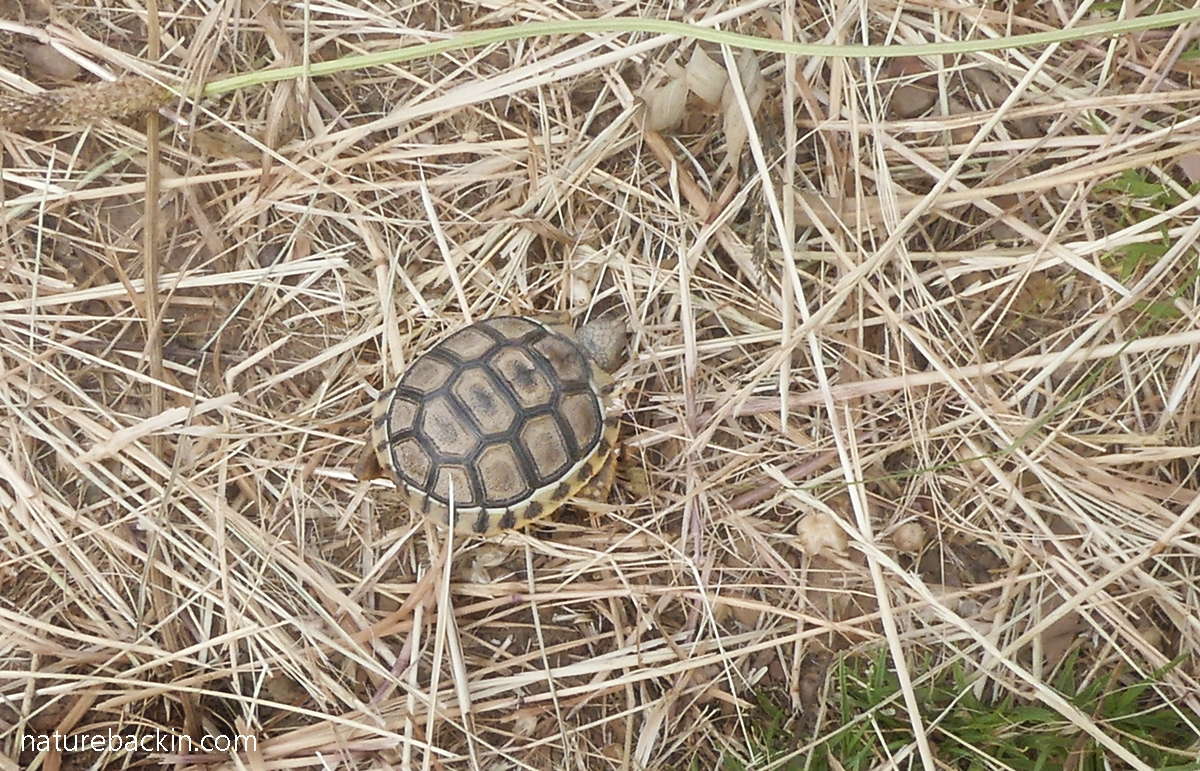
I saw this baby angulate tortoise outside the neighbouring nature reserve – it was about 5 cm (2.5 ins) long. As I was watching it, the manager of the nature reserve stopped as he was driving by. He asked me to pass it through the fence to him so that he could deposit it in the relative safety of the reserve. He said he has seen people doing the most unspeakable things to tortoises.
Obviously, baby tortoises are extremely vulnerable – not only to people’s wanton cruelty, which includes collecting wild tortoises for the pet trade in which many perish, but also to natural predators such as small carnivores, baboons, rock monitors, secretary birds, sea gulls, crows and even fiscal shrikes.
The adults too are vulnerable to predation by humans not only for the local and international pet trade, but also as a food source in some rural areas where tortoises roasted live in their shell over an open fire are considered a delicacy. Tortoises are also killed by traffic on the roads – sometimes deliberately. Domestic dogs can also be added to the dangers that tortoises face.
Environmental destruction due to agricultural and urban development, and the associated fragmentation and degradation of habitats, is another threat to tortoises, as are uncontrolled fires. Increasingly frequent and intense fires fuelled by invasive alien vegetation are deadly for tortoises, especially in sandy areas where they cannot find effective cover, hiding for example in animal burrows or in crevices in rocky outcrops.
After a fire and the consequent absence of vegetation, it is hard for tortoises to recolonize the area where no available cover is available, and in any event, tortoises tend to remain largely in their home ranges. Sadly, unmanaged fires in the Western Cape are becoming far more frequent and widespread.
Angulate tortoises are a protected species in both South Africa and Namibia. As for other species of tortoise, it is illegal to remove them from the wild. Despite the threats facing this species, its current status based on an assessment posted in 2017 on the IUCN Red List is ‘Least Concern’. It is the only living species in its genus.
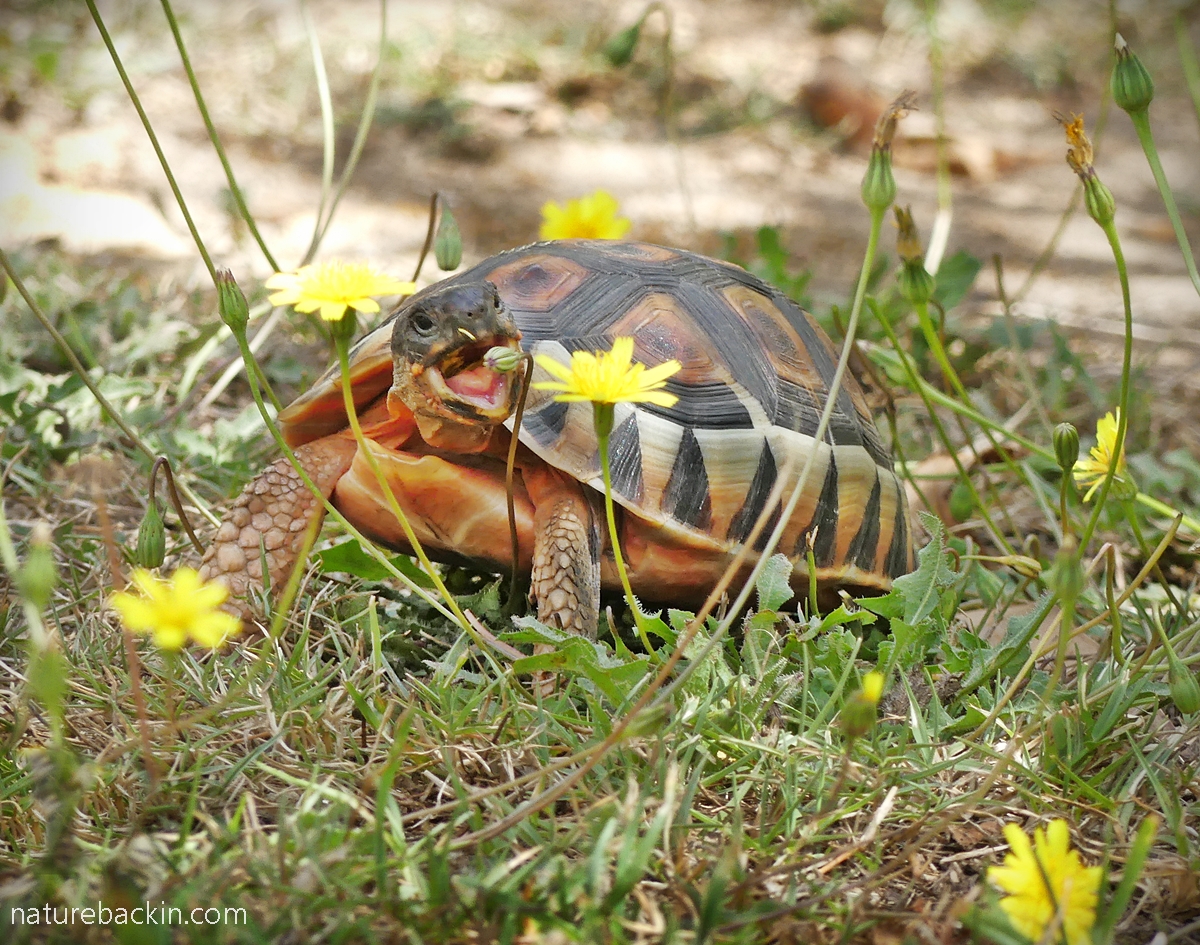
Tortoises do not have teeth. They slice their food with their horny beaks
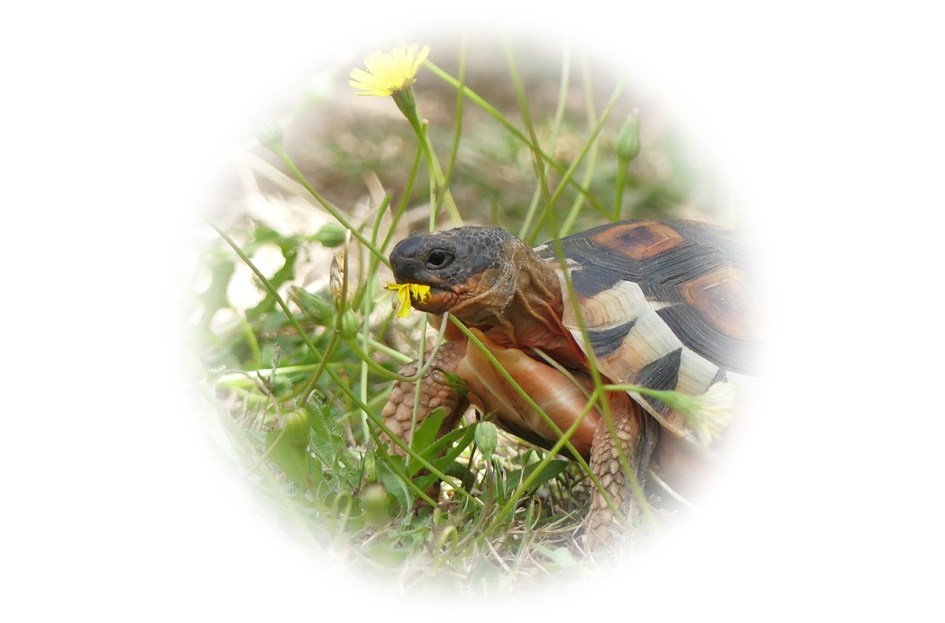
Angulate tortoises eat a diverse range of grasses, succulents, herbs and annuals, and also mosses, mushrooms, insects, snail shells and animal faeces. Our visitor sought out (non-indigenous) dandelion flowers and buds but not so much the leaves and stems. It also sampled a dog turd!
They occupy a range of habitats mostly in arid or semi-arid regions, including sandy coastal regions, Fynbos, Succulent-Karoo, Nama-Karoo, and in the eastern part of its range in Albany Thicket. Within their ranges, given their varied diet and their habit of defecating within the shelter of bushes where young seedlings are protected, tortoises are effective seed disperses.
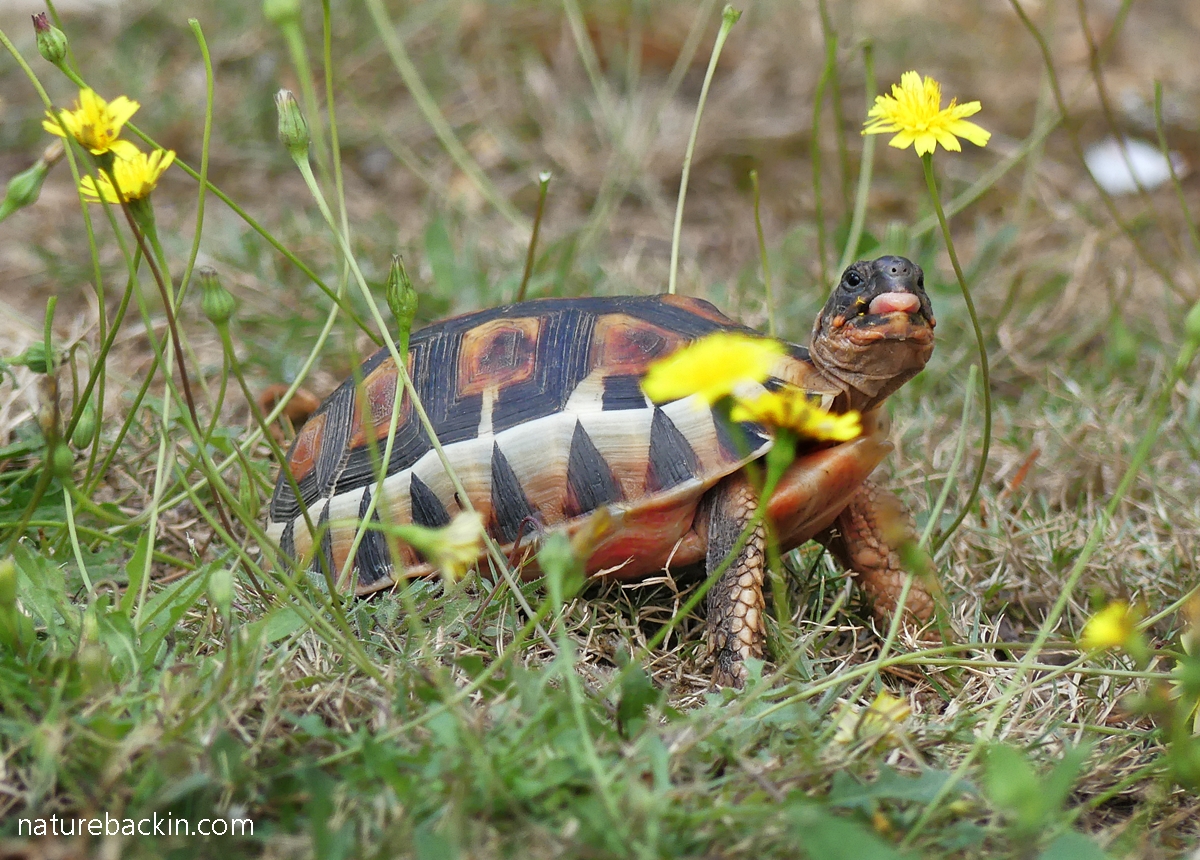
Our visitor showing its surprisingly pink tongue and its small nostrils. Angulate tortoises “drink” by sucking water through their nostrils
In addition to the shell and tough skin enabling tortoises to retain their body moisture, they shelter from the sun and wind on hot days so as to conserve moisture. They are most active during the cooler parts of a sunny day, and are more active on overcast days. When it is hot, they seek shelter by partially burying themselves in a shell-sized burrow under a shady bush.
Another interesting strategy for obtaining extra moisture is for angulate tortoises to position themselves in such a way as to accumulate dew or rainfall on the shell so as to direct the moisture towards their heads so that they can suck up the water through the nostrils.
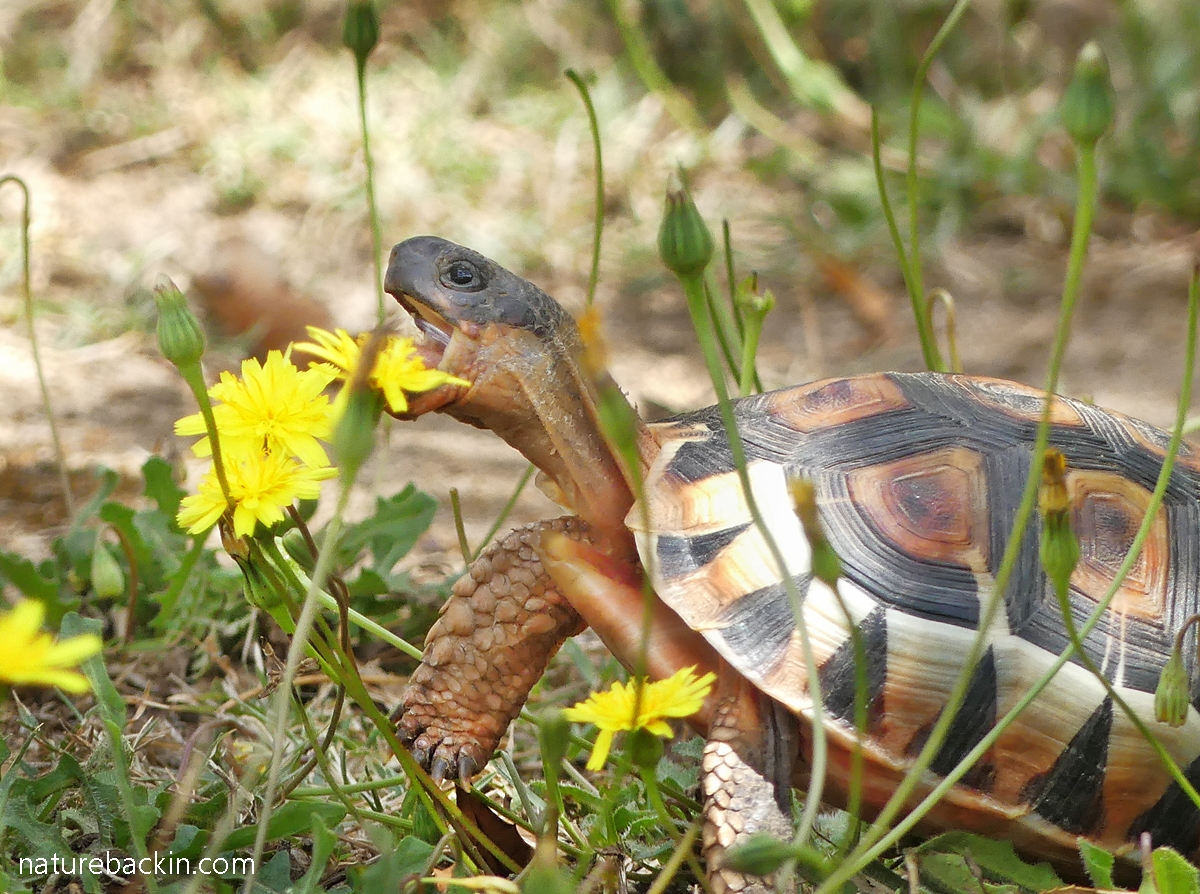
Our visitor rather comically often lifted a foreleg when stretching up to reach a tall flower – in so doing it reveals the claws on a forefoot
Angulate tortoises have five claws on each forefoot and four on each hind foot. The claws are used for digging, and I imagine they provide better traction, especially after having been turned over in a mating rights fight!
Tortoises are thought to have reasonably good eyesight and they have the ability to see colours – explaining how our visitor honed in on the bright yellow dandelion flowers!
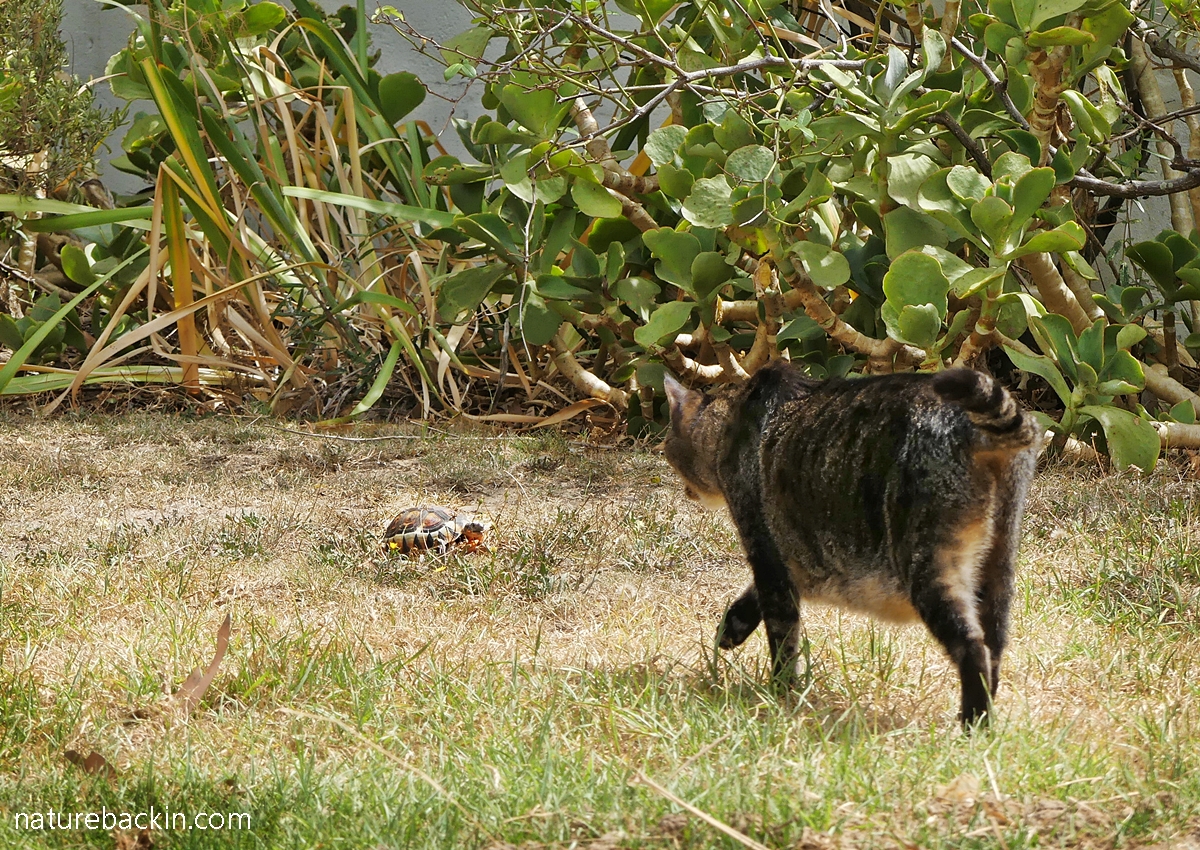
Our cat Nina took a liking to the tortoise – our other cats were afraid of it
Our tabby cat Nina was fascinated by the visiting tortoise. On its first visit she sniffed it and then lay down next to it. The tortoise seemed unfazed and went about its business of eating and then moving into some shade. After several visits it decided that an old lavender bush near the gate was the perfect place to shelter from the hot sunshine.
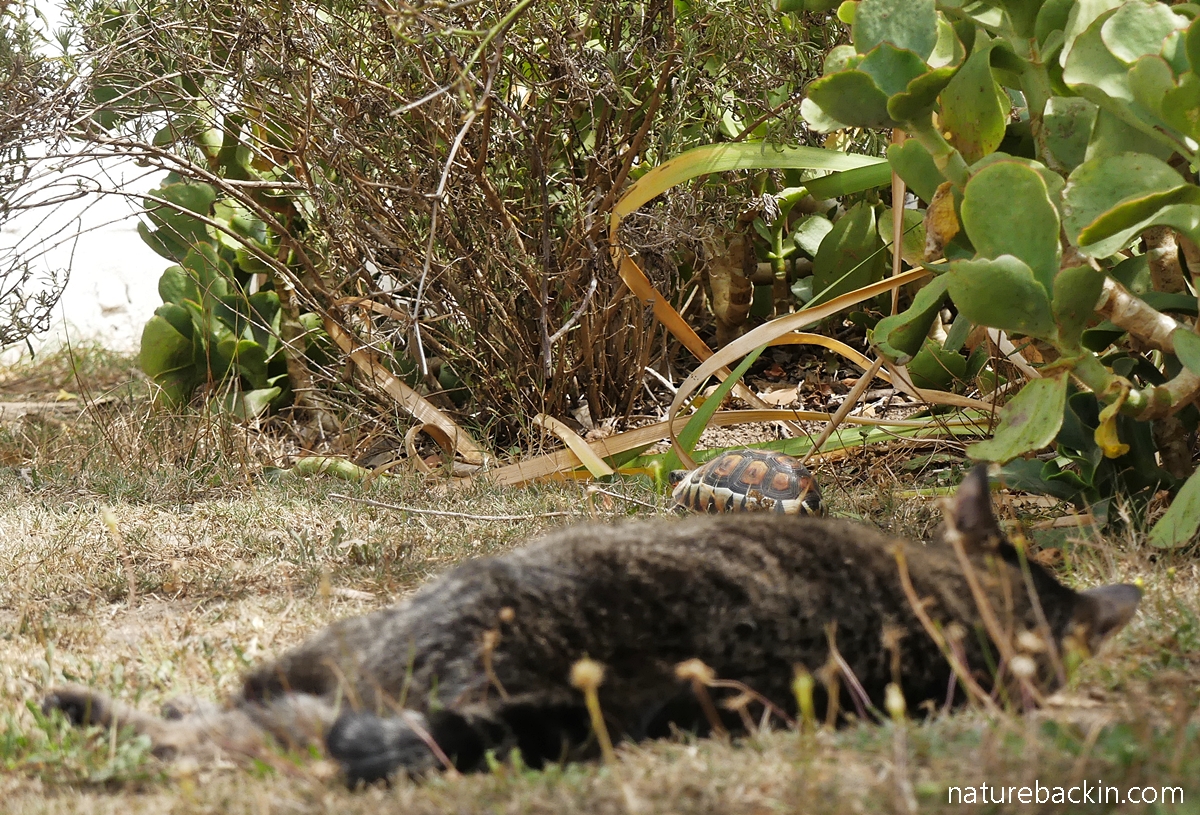
Nina lying down and watching the tortoise who appeared to completely ignore her. Sometimes she would roll around on her back almost flirtatiously
The tortoise took Nina’s interest in its stride and did not retreat into its shell, as tortoises do when they feel threatened. Once it had eaten most of the dandelion flowers that were in bloom it went to the little tortoise-shaped hollow it had made at the shady base of its chosen lavender bush.
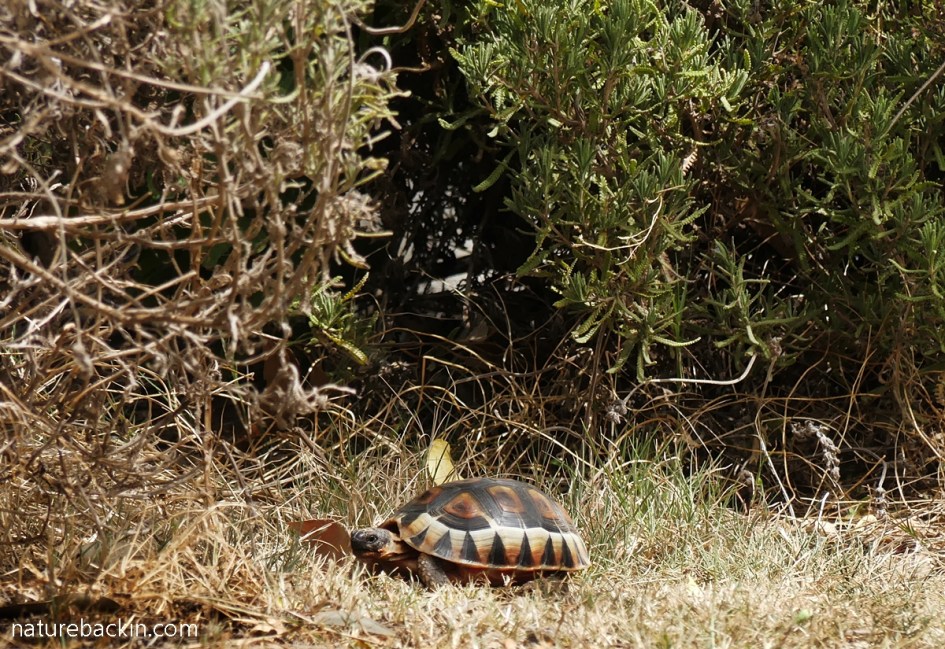
The visiting tortoise approaching the lavender bush for its siesta
Once the tortoise had retreated into the lavender bush and had time to half bury itself in its shallow burrow, Nina would get up and go to the neighbouring lavender bush where she would take a companionable siesta – only an arm’s length from the tortoise.
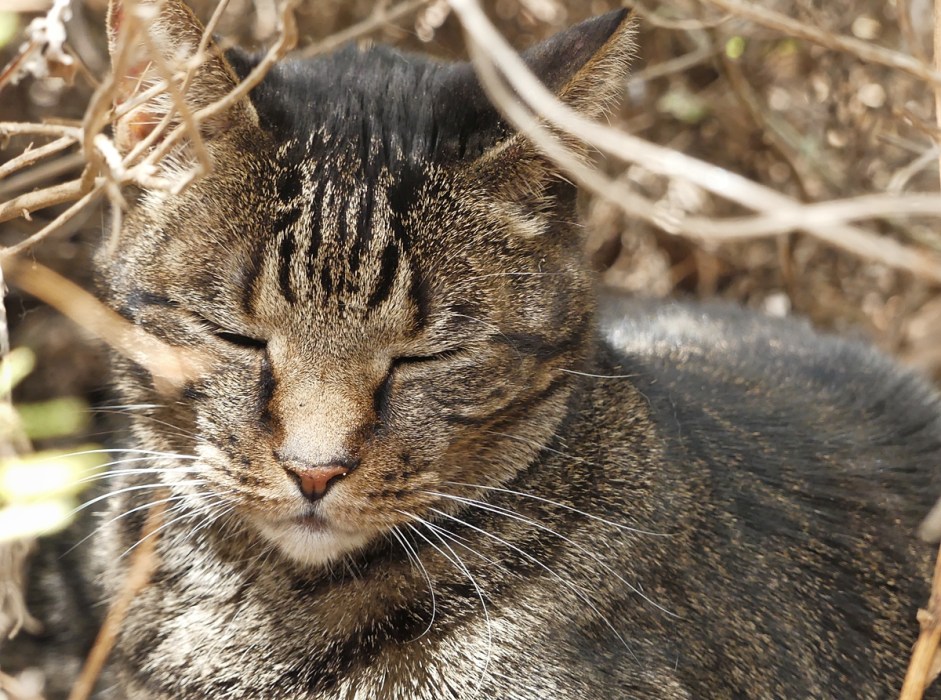
Nina snoozing under the lavender bush while the tortoise rests under the neighbouring bush
I thought it would be too intrusive to try to take a photo of the tortoise in its shelter, but during its visiting time I would sneak a peak and spot its shell in its burrow, generally with Nina in her spot nearby.
This week there is a new flush of dandelion flowers in the garden. We are wondering if the tortoise will be back for them.
Sources:
Alexander, Graham & Marais, Johan. 2007. A Guide to the Reptiles of Southern Africa. Cape Town: Struik Nature.
Harris, Shereen. 2014. Angulate Tortoise. South African National Biodiversity Institute (SANBI). https://www.sanbi.org/animal-of-the-week/angulate-tortoise/
IUCN. 2024. Angulate Tortoise Chersina angulate. The IUCN Red List of Threatened Species. https://www.iucnredlist.org/species/170519/115655918
Wikipedia. 2024. Angulate tortoise. https://en.wikipedia.org/wiki/Angulate_tortoise
Posted by Carol

Discover more from letting nature back in
Subscribe to get the latest posts sent to your email.


March 9, 2024 at 10:30 am
Another fascinating post. Thank you. Your photographs are as good as always, but this time quite delightful. I wonder if anyone else has captured a tortoise eating a dandelion? Love the story of the double berths under the lavendar bushes for tortoise and cat
LikeLiked by 1 person
April 1, 2024 at 2:14 pm
Hi Mariss – thanks very much. Sorry it has taken me so long to reply! The tortoise has not visited recently. It will be interesting to see if it returns when there are more dandelion flowers …
LikeLiked by 1 person
March 5, 2024 at 4:07 pm
These photographs are exquisite! We had an angulate tortoise in our garden for several years – rescued from a man who wished to eat it. Someone brought us two parrot-beaked padlopers that had been attacked by dogs. They are so small that I cannot tell what happened to them for they had disappeared after about a week in our garden. I love that Nina is fascinated by the angulate tortoise 🙂
LikeLiked by 1 person
March 6, 2024 at 7:20 pm
Thanks so much Anne. I think I remember reading in your blog about the tortoises you mention. I hope the parrot-beaked padlopers were able to stay in or find safer territory.
Nina’s gentle interest in the tortoise was very sweet.
LikeLiked by 1 person
March 5, 2024 at 4:52 am
A neighbour coming to weed your lawn is so much more welcome than one coming to “borrow” sugar! 😀
This angulate tortoise obviously has a knack for picking the right friends. I’m sure he will be a familiar favourite for years to come.
LikeLiked by 1 person
March 6, 2024 at 7:16 pm
Yes indeed, the tortoise is a perfect neighbour, and the weeding is most welcome 😊
Hopefully, the visits will continue. I am sure there will always be dandelions!
LikeLiked by 1 person
March 5, 2024 at 1:08 am
Oh so wonderful to read about your visiting angulate tortoise, Carol! I am in awe of this beautiful shell they have, it is so ornate and beautiful that it looks painted. I love how your cat Nina befriended the tortoise, eventually napping when the tortoise napped. I am happy more dandelions have bloomed and I SO hope the tortoise comes back. Thank you for this sweet and well-written story and really fun photographs. I especially like the photo (#9) where he is chomping down on the full-bloomed dandelion flower, and also the one where he is marching determinedly through your yard. Great to have you back.
LikeLike
March 4, 2024 at 5:35 pm
What a delightful visitor. I hope the tortoise returns to enjoy more dandelions, Carol. I’m fascinated by the connection between the tortoise and Nina. Great photos as always!
LikeLiked by 1 person
March 4, 2024 at 6:54 pm
Hi Sandra – good to hear from you. Yes that connection between Nina and the tortoise is not something one might expect. I hope all is well with you in what was a new year but is now March already!
LikeLiked by 1 person
March 5, 2024 at 9:19 am
All is well, Carol. And for us, spring is just around the corner 😊
LikeLiked by 1 person
March 6, 2024 at 7:18 pm
🌱🌿
LikeLike
March 4, 2024 at 10:53 am
I so enjoyed this post and the wonderful photographs, Carol. Nina’s reaction to this visitor is so interesting, too.
LikeLiked by 1 person
March 4, 2024 at 11:09 am
Thanks Christine. Nina’s friendly reaction once she got over her initial surprise was so unexpected. The tortoise being so chilled about it was amazing too!
LikeLike
March 4, 2024 at 5:04 am
I have a great fondness for tortoises (and turtles) having had one as a kid. As always, the observations you share are full of great information and the photos are fabulous. Looks like you’ve spent a fair amount of time lying in the grass recently!
LikeLiked by 1 person
March 4, 2024 at 10:42 am
Tortoises (and turtles) and fascinating. Yes true I was getting a low angle in the grass! If stayed in one shady patch the tortoise tolerated my presence if I didn’t move much.
LikeLiked by 1 person
March 4, 2024 at 12:37 am
Love the tortoise. Great post.
LikeLiked by 1 person
March 4, 2024 at 10:39 am
Thanks so much Sherry. The tortoise is such an intrepid little chap! (No wonder a tortoise beat the hare as legend has it! 😊🐢)
LikeLike
March 3, 2024 at 11:01 pm
Loved reading your post, Carol. What a beautiful tortoise and your description of its behaviors is fascinating. Hard to imagine them head butting! Sad to read about the ranger’s remarks- I wish all humans treated animals with the love and respect that you do. Thanks for your excellent photos, too.
Happy World Wildlife Day! 💚
LikeLiked by 1 person
March 4, 2024 at 10:36 am
Hi Jane thank you and Happy World Wildlife Day to you too!
Yes, I was sad to hear what the ranger had to say about cruelty to tortoises.
The two rivals that we saw were ramming each others shells together rather than literally head butting, but without having seen that I would have found it hard to imagine too as they usually seem so placid! It seems that tortoises lead far more complex and interesting lives than one might initially think.
LikeLiked by 1 person
March 3, 2024 at 9:19 pm
Thank you for sharing so much about this delightful visitor! Very informative and great photos – it’s fun to imagine that he’s only about 6 inches long!
LikeLiked by 1 person
March 4, 2024 at 10:31 am
Thanks Carol. The tortoise packs a lot of personality into its small frame! It is so nice that it is free to live its own life.
LikeLiked by 1 person
March 3, 2024 at 8:07 pm
A sweet story – at least the major part of it. Beautiful tortoise and making friends with your cat was great. Lovely captures of the dinner/lunch meals. Interesting facts as usual!
LikeLiked by 1 person
March 4, 2024 at 10:30 am
Thanks. The tortoise was such a delightful visitor and it was amazing that our cat thought so too, and that the tortoise was unfazed!
I am sure the tortoises generally will be welcoming the lovely rain we are having today.
LikeLike
March 3, 2024 at 5:59 pm
A delightful post and photos, Carol. I enjoyed learning about this beautiful tortoise, but not about its harsh treatment at the hands of humans. 😦 It is just too heartbreaking that folks don’t regard wildlife with respect. Hope you are doing well!
LikeLiked by 2 people
March 4, 2024 at 10:28 am
Hi Eliza
Thanks – it is a very beautifully marked tortoise.
It is heartbreaking they can be subjected to such cruelty.
All good here thanks – and some lovely rain today!
LikeLiked by 1 person
March 3, 2024 at 5:31 pm
Oh hooray! You’re ok! I’ve been thinking about you and realising it was a while since you’ve posted. I’ve only seen tortoises (not this variety) in the wild in Greece, and they shift themselves remarkably quickly. But reading that they require rain-softened ground for egg-laying is concerning, as the Mediterranean region is suffering from drought just now (and it’s winter!). And then there are the forest fires … Not good at all.
LikeLiked by 1 person
March 4, 2024 at 10:24 am
Hi Margaret – I recall seeing tortoises in Greece, though I don’t know what species they were. The ones we saw were quite large. Perhaps they are large enough to be strong enough to dig nests without needing rain? The nesting info I gave was specific to the smallish angulate tortoises. But in any event the drought and fires in Greece (as elsewhere) are a real cause for concern. I hope Greece gets some winter rains before its too late this season.
It is indeed surprising how quickly tortoises move once they get going!
LikeLiked by 1 person
March 4, 2024 at 2:46 pm
The tortoises we saw were small – the sort you occasionally see in England as pets – not much bigger than hedgehogs. So not too tough, I’d have thought
LikeLiked by 1 person
March 4, 2024 at 5:14 pm
At that size they don’t sound tough at all.
LikeLiked by 1 person