
Following the local Wandelpad, I took these photos on a recent walk. From old milkwood trees to tiny flowers, it was good to take a break from home maintenance demands.
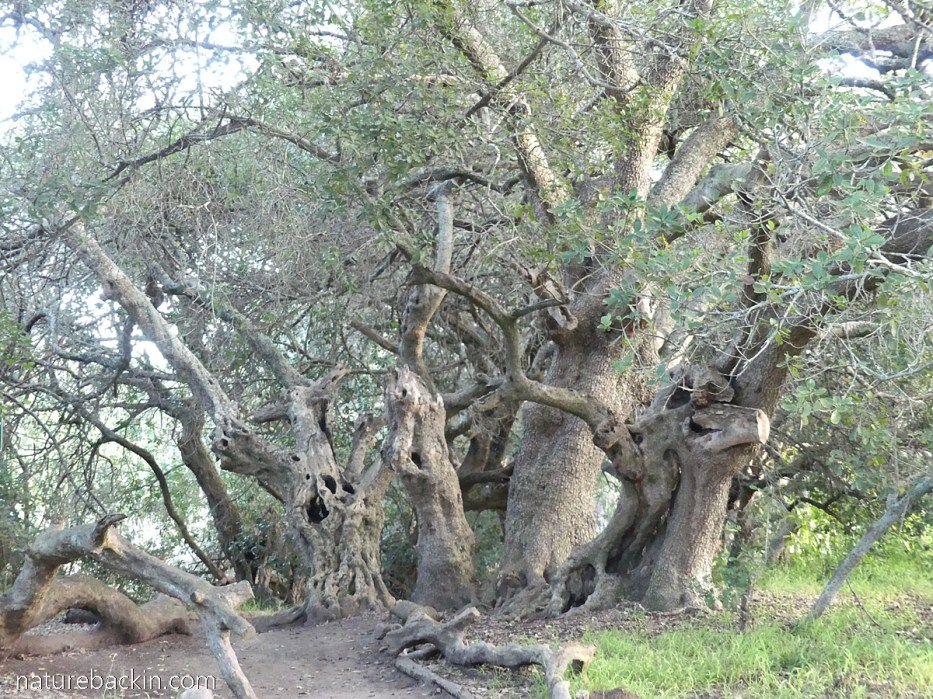
A grove of old white milkwood (Sideroxylon inerme) trees confers a high degree of gravitas on a corner of the Wandelpad. Milkwoods can live at least as long as 500 years and may grow to a height of 15 metres or so. The common name ‘milkwood’ comes from the white latex in the leaves.
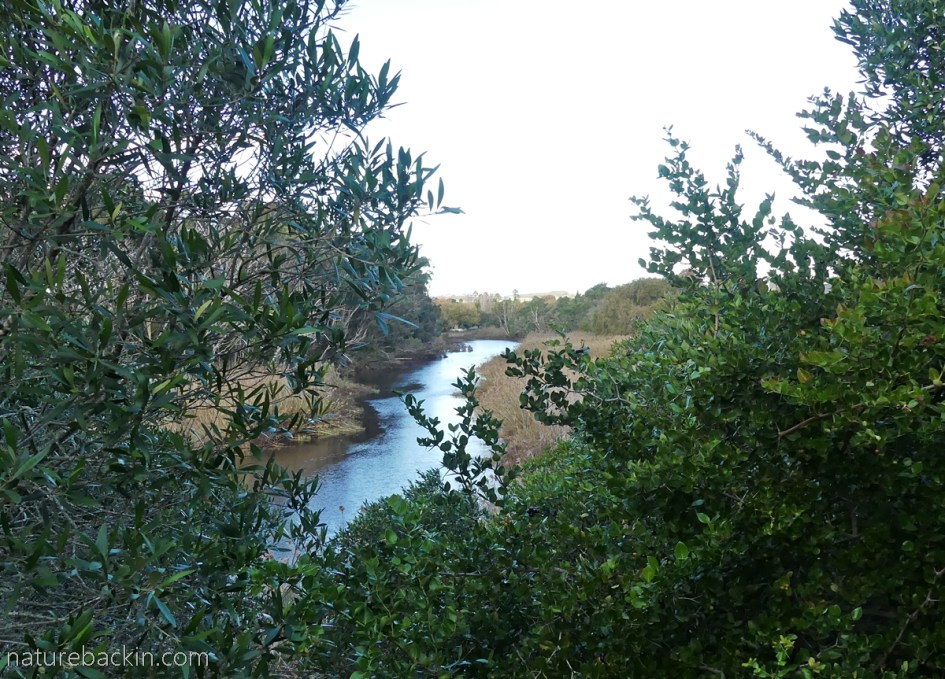
A view of the Klein River from an elevated section of the Wandelpad, which for the most part follows the river that flows past the edge of Stanford village.

Looking from the Wandelpad over fynbos, riverine trees, farmland and across to the Klein River Mountains.
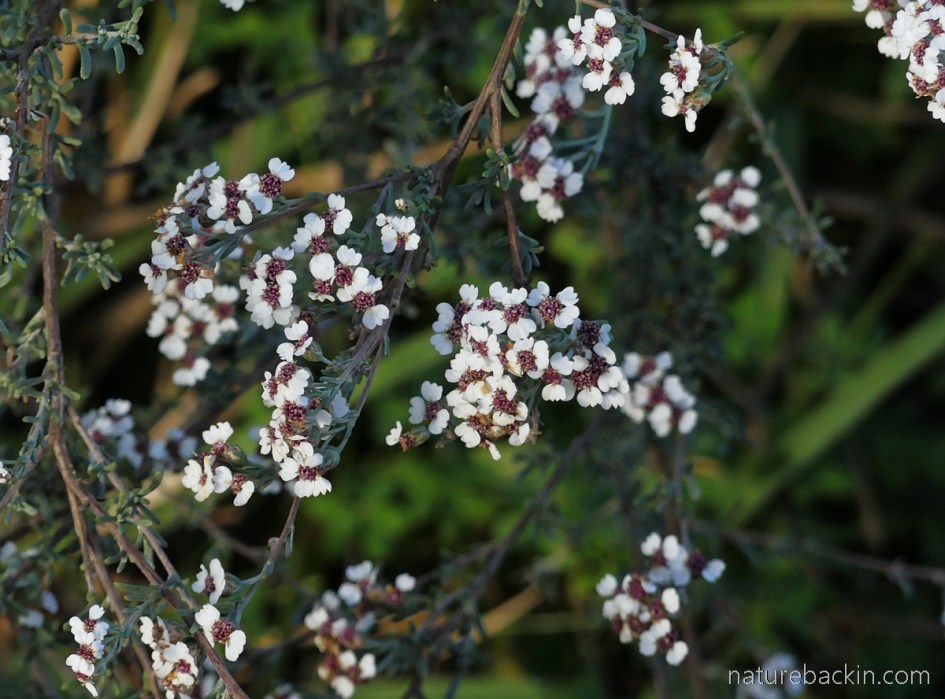
Among the plants growing along the Wandelpad is the winter flowering wild rosemary (Eriocephalus africanus). Although like the Mediterranean rosemary (Salvia rosmarinus) it is an aromatic herb that can be used in cooking and to make tea, the plants are not related. Wild rosemary occurs naturally in the Western and Eastern Cape and in Namaqualand. Its surprisingly extensive lateral roots and a tap root that can penetrate to a depth of 6 metres (over 19 feet) contribute to the plant being drought resistant.
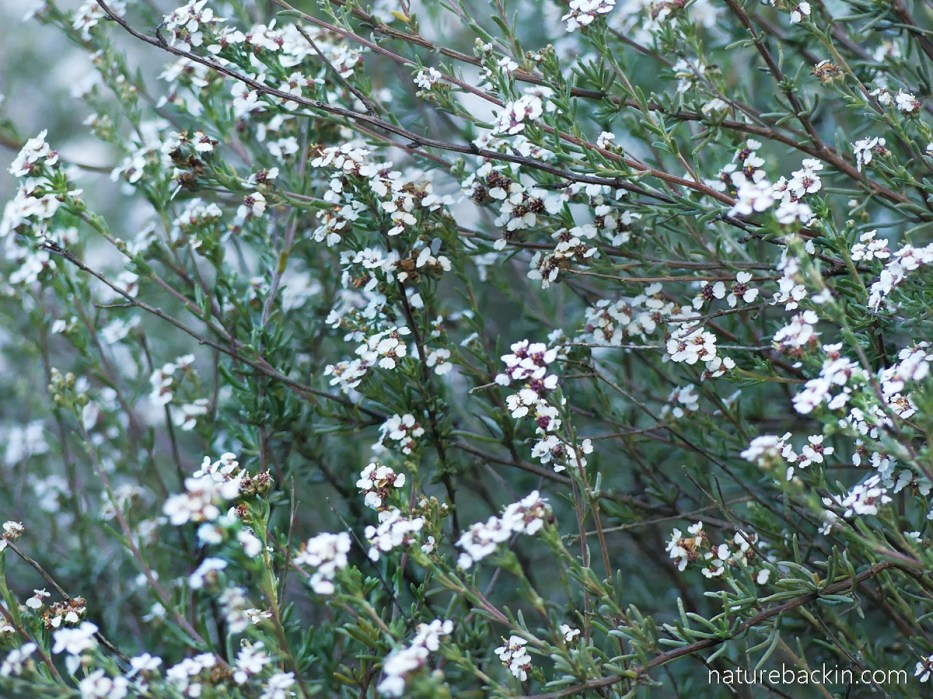
The masses of small white flowers of the wild rosemary attract insect pollinators. Leaf characteristics add to the plant’s drought resistance: the silvery-grey colour reflects sunlight and so keeps the leaves cooler, the silvery hairs on the leaves trap moisture, and the small needle-shaped leaves limit water loss. The aromatic oils also contribute to retaining moisture. Interestingly, wild rosemary plants growing in the salty air near the coast have more succulent leaves than those growing inland (http://pza.sanbi.org/eriocephalus-africanus).

Massed together, profusely flowering wild rosemary certainly brightens up the winter landscape. After flowering, the flowers are replaced by fluffy white seedheads resembling cotton wool or snow, hence the alternative name Cape snow bush or kapokbos in Afrikaans.

I also found some low-growing crassulas growing in small patches near the Wandelpad. This is a clump of Crassula capitella, currently in flower. Although they are known to flower in mid-to-late summer, here they are still flowering. In conditions that include sunshine and dryness, mature leaves can turn red. There are five subspecies growing wild in southern Africa (http://pza.sanbi.org/crassula-capitella).

The small white flowers grow in clusters on long succulent stems.
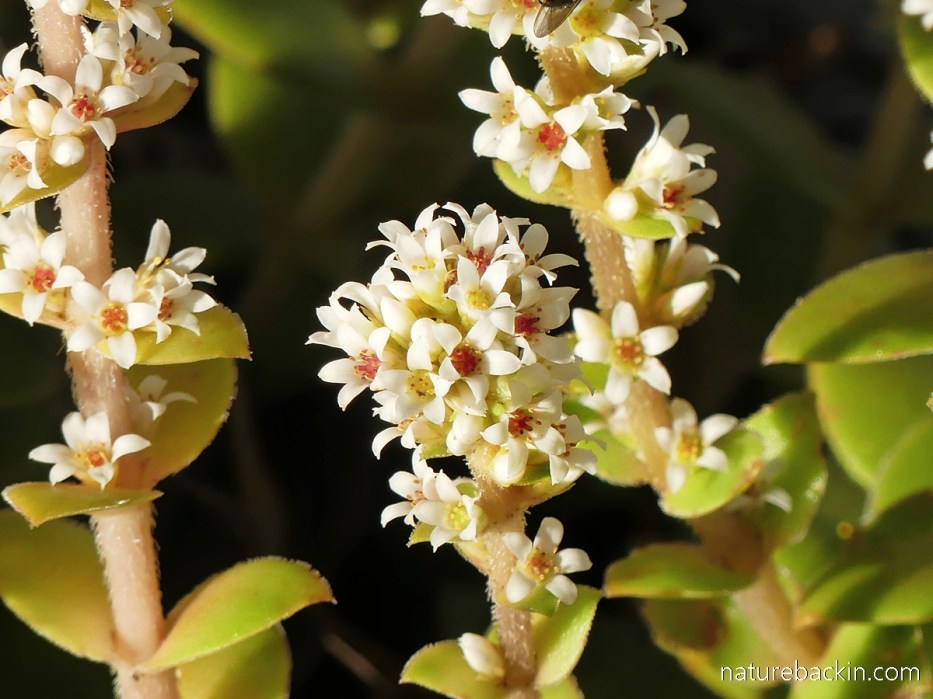
The flowers attract pollinators such as bees and butterflies.

At first I assumed this shrub growing next to the path to be a confetti bush, one of the coleonemas, but I have since learnt that this is a tortoise berry (Muraltia spinosa), a species that flowers during the winter months. In the summer it sports fleshy red berries that are edible to birds and to humans – and to tortoises too, hence the common name.

A fynbos plant in flower that I have yet to identify though I guess it might be one of the aromatic buchu species in the Agathosma genus. There are 150 species of Agathosma in the Western Cape. There is a lot to learn!

Our most delightful discovery so far was finding tiny wild freesias growing on a ridge above the river. I think these are Freesia caryophyllacea, known as fragrant kammetjie. Not only are they very small, but their flowering season is April to June, whereas the fairly similar dune kammetjie (Freesia leichtlinii) is taller, the flowers are radially symmetrical, and the flowering season is later, being July to October.
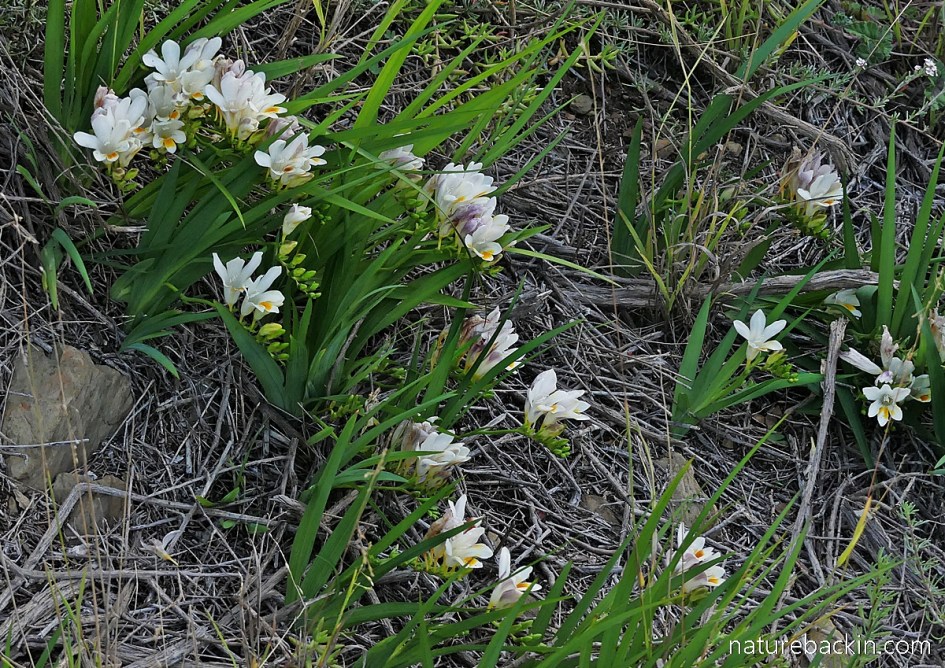
These freesias are very tiny with plants being about 10 cm (4 inches) tall. They are perennial plants and they grow in clay soils and limestone. The flowers are fragrant (though I had to kneel down to catch the scent).
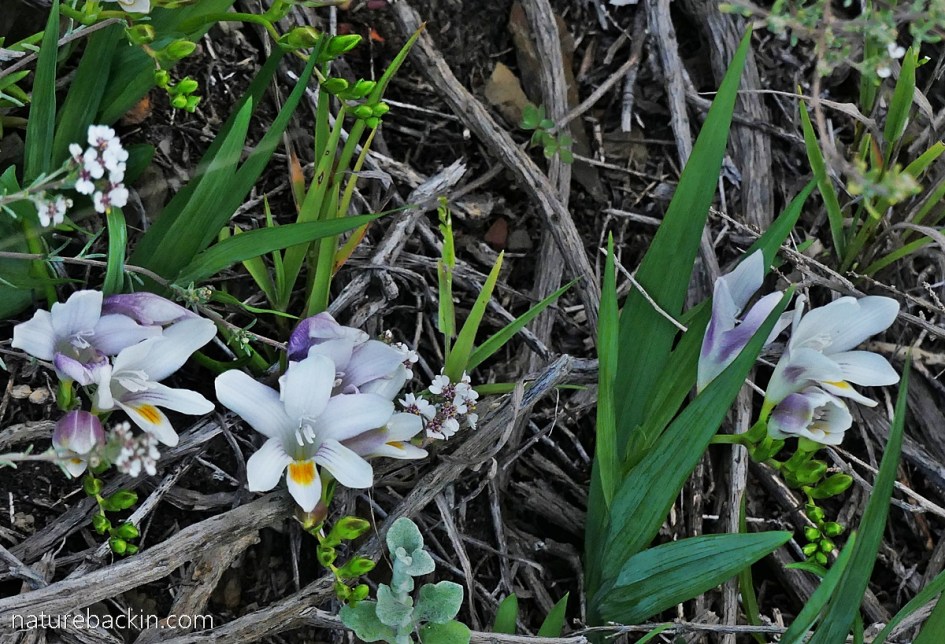
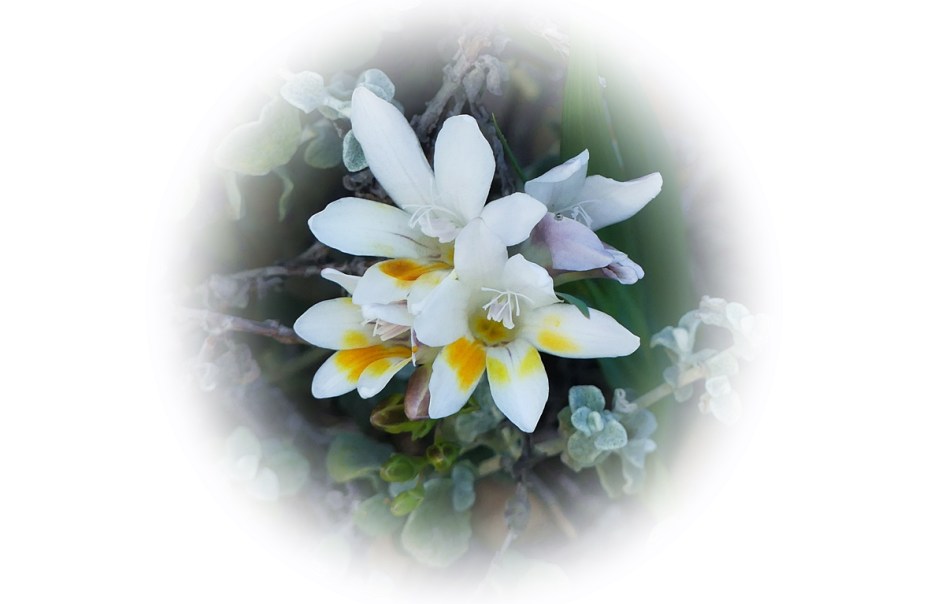
The lower petals are variably marked with yellow.

In some plants only the middle lower petal of each flower is marked with yellow and in others the three lower petals are yellow to a greater or lesser extent.

These little freesias have great charm. When not in flower the small leaves are easily overlooked and so it seems quite magical when suddenly they are in bloom.
In the Red List of South African plants, the status of these freesias is Near Threatened. Despite being formerly widespread and common, only between 25 and 35 locations of this species remain “now largely confined to small fragments due to over 77% habitat loss to crop cultivation. Decline continues”. (http://redlist.sanbi.org/species.php?species=1543-5)
It is fortunate that the elevated section of the Wandelpad where the edges of the pathway are relatively undisturbed provide a small haven for one of these remnant populations of freesias.
Postscript
I have sad news about the baby doves that were in their nest outside our study window. A day or two after my previous post, I opened the curtains to check up on them and the nest was gone. We found the nest upside down on the ground near the base of the tree – there was no sign whatsoever of the babies. We could only wonder what predator had dislodged the nest that had been just over 4 metres (about 13 feet) from the ground. Perhaps an African harrier-hawk? One of the distressed parents hung around in the tree for the rest of the day. I had hoped that the proximity to our house might protect the nest, but that was not to be the case.
Posted by Carol

Discover more from letting nature back in
Subscribe to get the latest posts sent to your email.


June 13, 2023 at 9:37 pm
It is lovely getting glimpses of your part of the world. The milkwoods are very impressive and yes indeed do look resemble an enchanted forest! The wild rosemary is quite stunning. I enjoying seeing some of the Cape vegetation and learning about it via your blog. The tiny freesia is beautiful with its yellow splashes of colour. Such a pity that its numbers have declined so much.
LikeLiked by 1 person
June 19, 2023 at 7:20 pm
Hi Megan – thanks for finding to time to read about our new Cape findings. From large to tiny there is a lot to discover here. It is sobering to learn how many of the fynbos vegetation types and associated plants are under threat but at least there are several initiatives underway to conserve at least some of what remains.
LikeLiked by 1 person
June 20, 2023 at 11:57 am
I know so little about fynbos, so it is great that I can learn more about it via your posts! I a really thrilled to read that there are initiatives out there for conserving what remains. I look forward to reading more of your posts!
LikeLiked by 1 person
June 4, 2023 at 3:19 pm
I’m also sorry about the loss of your doves, Carol. The sad aspects of nature will always be saddening to those of us who care.
That white milkwood tree is impressive. While I don’t know milkwood, I’m familiar with a number of different milkweeds, which also exude a milk-like substance. We are watching a few get ready to bloom in our garden.
What I found interesting linguistically is that I understood the word Wandelpad from my German background.
LikeLiked by 1 person
June 5, 2023 at 7:48 pm
Hi Tanja, yes it is sad about the baby doves and seeing the reaction of the parent(s) too.
We also get milkweeds here but perhaps different species.
‘Wandelpad’ is also used in Afrikaans, which derives from Dutch. The word has a rather romantic ring to it compared to the more prosaic ‘walking trail’ or ‘footpath’!
LikeLiked by 1 person
June 4, 2023 at 9:34 am
I’m sorry to hear of the baby doves’ fate. Another of nature’s cruel twists. We are currently watching the nest box on our balcony where industrious great tits have been raising their brood. We see the babies’ heads now, peering out of the hole. It won’t be long before they go. Meanwhile, I very much enjoyed wandering along the wandlepad with you, Carol. (What a wonderful word, too!) I was delighted to see freesias growing wild. Less delighted to hear how endangered they are.
LikeLiked by 1 person
June 5, 2023 at 7:38 pm
How wonderful to be able to watch the parent great tits attending to the nest and seeing the babies peeking out. You will likely miss them once they have fledged. Baby birds have such a precarious start in life.
I also like the term ‘wandelpad’ and it is great to see the plants growing alongside it. Even though quite a few garden escapees and invasive alien plants are in the mix there are some real gems such as the freesias.
LikeLiked by 1 person
June 4, 2023 at 7:42 am
Looks like you are enjoying finding your way through your new ecosystem and making the acquaintance of the new neighbours, Carol!
LikeLiked by 1 person
June 5, 2023 at 7:33 pm
Yes we are thanks. Little by little!
LikeLiked by 1 person
June 3, 2023 at 4:33 pm
May the wandelpad bring new delights as the seasons change. Thank you for another richly informative post with beautiful photographs.
LikeLiked by 1 person
June 5, 2023 at 7:31 pm
Thanks very much Mariss – we feel lucky to have this interesting footpath on our doorstep.
LikeLiked by 1 person
June 2, 2023 at 10:30 am
Glad to see you are recording your plant life.
John
LikeLike
June 2, 2023 at 8:17 pm
Hi John – there is plenty here that is new and a challenge to record. There is a lot I miss but there is also a lot to learn.
LikeLike
June 3, 2023 at 9:51 am
Life is like that.
LikeLiked by 1 person
June 5, 2023 at 7:30 pm
True!
LikeLike
June 2, 2023 at 7:53 am
Your plant-scape seem so exotic and different to British eyes. And perhaps a little to you too? It looks as though your new surroundings are very unlike those you had been used to? Have fun exploring – and I hope there are no more domestic tragedies like the one that befell your doves.
LikeLike
June 2, 2023 at 8:16 pm
Hi Margaret – some of the plants here are familiar, but others are unique to the Cape. The landscapes here have a very different feel to KZN. The quality of the light and air feel very different too. I am slowly adapting.
Yes the loss of the baby doves was very sad.
LikeLiked by 1 person
June 2, 2023 at 7:30 am
I also liked the freesias – are the plants available from nurseries and would they grow in the KZN Midlands. Thank you for your interesting newsletters and photographs
LikeLiked by 1 person
June 2, 2023 at 8:11 pm
I don’t know if these freesias are available through nurseries in KZN. Many Western Cape plants are very particular as to the soil type they grow in. Although very different, the Freesia laxa that grows in KZN may be easier to find.
LikeLike
June 2, 2023 at 6:30 am
So good to get this mail again, beautiful walk I would imagine. And such beauty if we just choose to stop and look. Loving the new landscape. Much love 💕
LikeLiked by 1 person
June 2, 2023 at 8:08 pm
Thanks Debbie – yes lots of beautiful plants and landscapes around here. xxx
LikeLike
June 2, 2023 at 6:21 am
Sorry to hear about the doves, but nature is like that I guess. I’m glad you’re exploring your new home area. The flowers are lovely and those milkwood trees look like something out of a a scary children’s book!
LikeLiked by 1 person
June 2, 2023 at 8:07 pm
We were very sad about the doves, but of course we know fledglings generally have a high mortality rate.
Those huge old milkwood trees form a very small grove of trees, but nevertheless it does have the feeling of an enchanted forest!
LikeLiked by 1 person
June 2, 2023 at 5:42 am
It is great to hear from you again for your observations are always a delight to read. You seem to have chosen a lovely place to live and I look forward to learning more about it. The freesias in my pot are showing their leaves – I am delighted that you have found some in the wild.
LikeLiked by 1 person
June 2, 2023 at 8:02 pm
Hi Anne – thank you. It is lovely here and very different to KZN. Is your potted freesia the same or a similar species? Have you had much rain in the past few days? Here we have had unexpectedly heavy rains since Monday.
LikeLike
June 3, 2023 at 5:23 am
No. my freesias are pink. May was a good month for rain – the second highest rainfall recorded here in 35 years but very little before or after.
LikeLiked by 1 person
June 5, 2023 at 7:30 pm
It sounds like you too have had a lot of rain – I hope there was no localised flooding, but possibly the dams have benefitted. Hoping so.
LikeLike
June 5, 2023 at 8:00 pm
Not enough for the dams, but good for the veld anyway 🙂
LikeLiked by 1 person
June 5, 2023 at 8:34 pm
We have to be grateful for small mercies!
LikeLiked by 1 person
June 2, 2023 at 5:06 am
Dear Carol, it was wonderful to have your blog pop into my mailbox this morning! A delight to share your new wanderings, my best wishes, xxx
LikeLiked by 1 person
June 2, 2023 at 7:59 pm
Hi Christeen – it is lovely to hear from you. I hope you are feeling settled in your new place? Best wishes from the Cape xxx
LikeLiked by 1 person
June 3, 2023 at 5:06 am
Thank you Carol, yes, we are becoming comfortably settled and enjoying new explorations! xxx
LikeLiked by 1 person
June 5, 2023 at 7:26 pm
Hi Christeen – that is great that you are settled enough to be able to start exploring. Getting settled is taking us much longer than I anticipated but we are getting there! Best from here xxx
LikeLiked by 1 person
June 9, 2023 at 5:22 am
Hi Carol, that is great news. It’s also taking us time, but so enjoying the journey! Lots of love, xxx
LikeLiked by 1 person
June 19, 2023 at 7:17 pm
Good to hear. It does feel like a journey for sure! xxx
LikeLiked by 1 person
June 1, 2023 at 9:29 pm
Sad news about your doves, alas. Nature can be tough.
The small rare freesia you discovered is quite charming. I love the yellow bee path.
I’m enjoying seeing your new surroundings. How cool are your nights there?
LikeLiked by 1 person
June 2, 2023 at 7:58 pm
Indeed nature can be tough. The little freesia is lovely.
The winter night-time temps vary quite a lot – the coolest so far has been about 5 degrees. We are nearish to the coast so it is fairly mild. But my the wind can blow!
Currently and going forward day-time temps do not rise above 20 degrees. This week we have had a huge amount of rain and the ground is sodden. Adapting to wet winters is quite an adjustment!
LikeLiked by 1 person