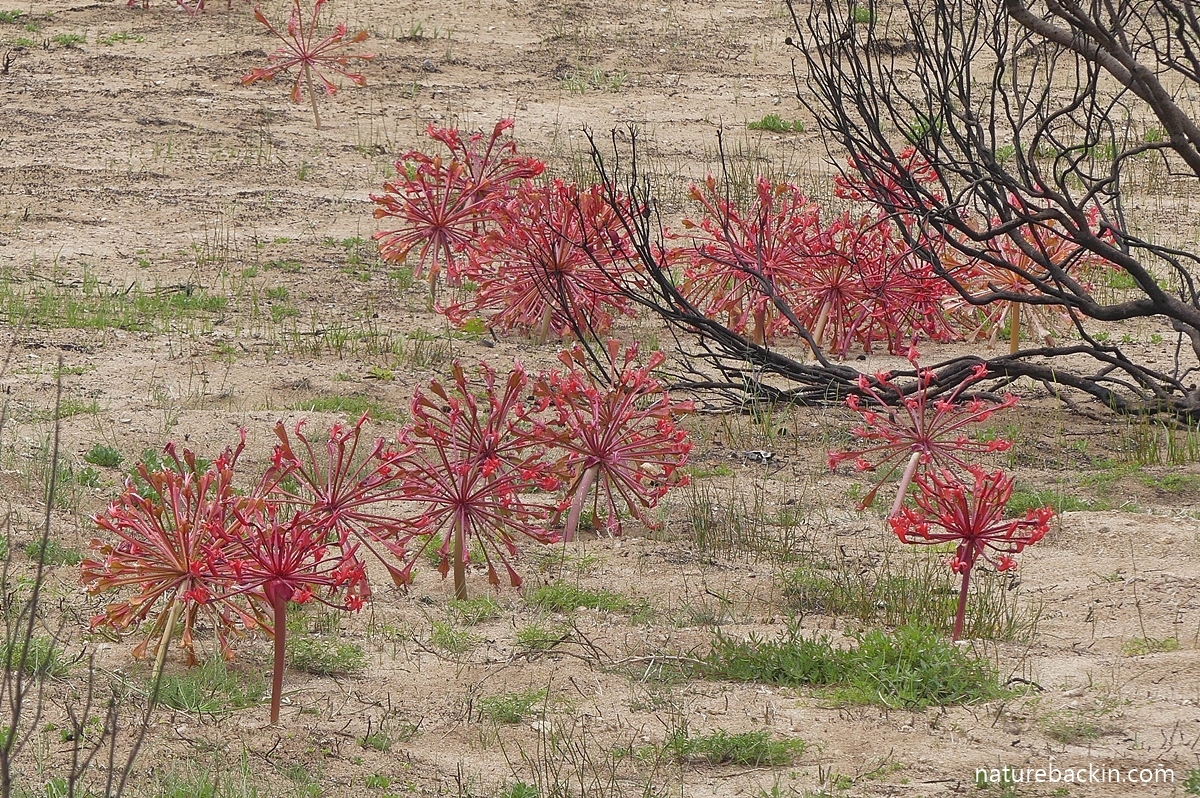
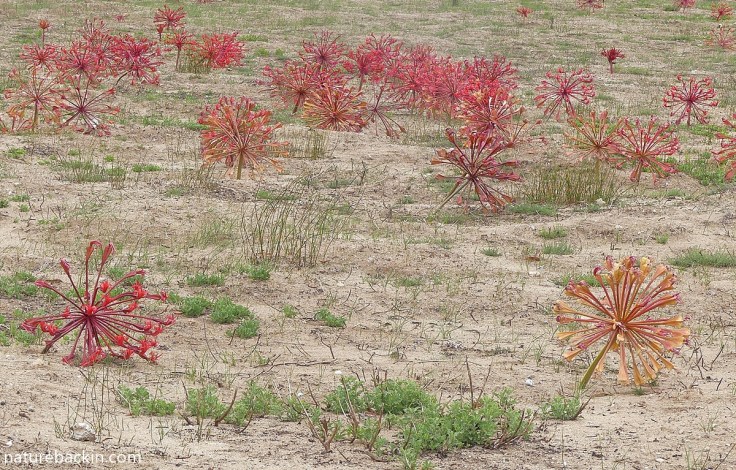
After the recent fires much of the landscape is still barren and bleak. A little rain has coaxed some grasses and resprouters into sparse patches of green, but on the low-lying sandy flats thousands of candelabra lilies (Brunsvigia orientalis) have, almost literally, burst into bloom in an explosion of crimson colour. The sight is even more impressive as little else is flowering.
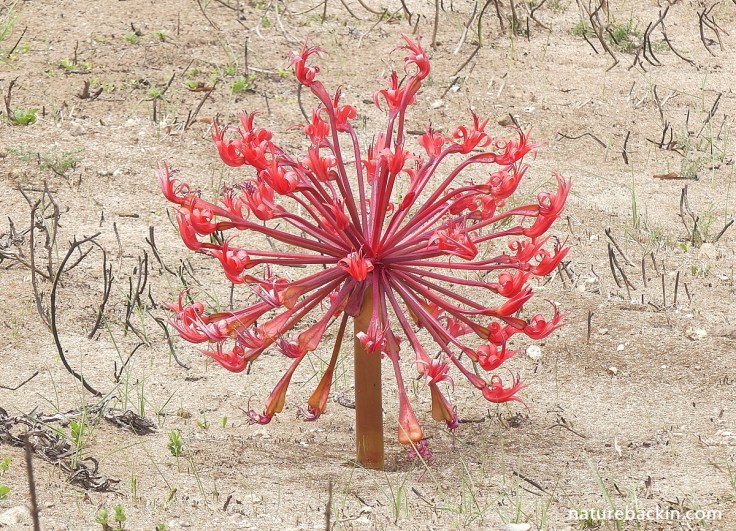
Borne on a fat single stem, the stalks of the ball-shaped inflorescence/flowerhead branch out from the centre, each stalk bearing a crimson flower. The structure is reminiscent of a candelabra, hence the common name. The flowers are pollinated mostly by sunbirds, with the stalks providing sturdy perches for the birds.
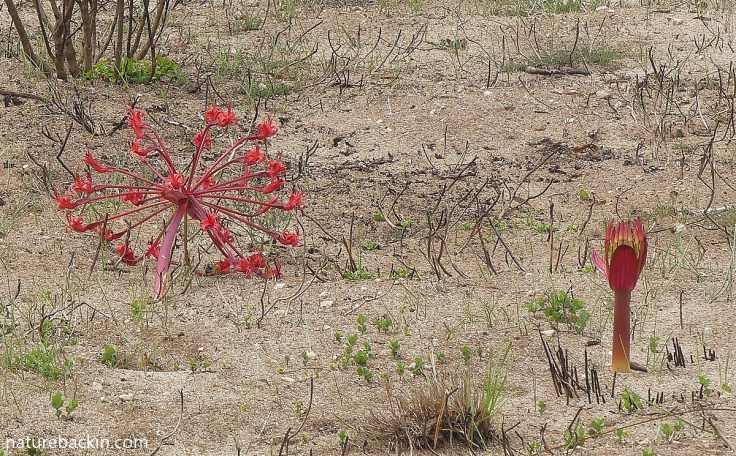
On the right (in the photo above), a candelabra lily stalk has recently sprouted from its large underground tuber and the flower buds are starting to protrude at the top to eventually extend into the candelabra shape. Like other Brunsvigias, the candelabra lily remains dormant until late summer when flowering commences.
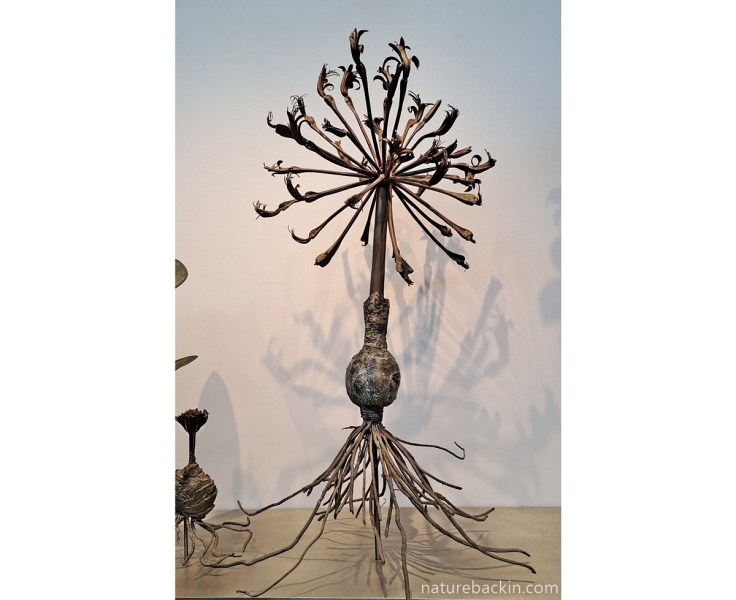
This metal casting in bronze and silver of an entire Brunsvigia orientalis, including tuber and roots, by South African botanical sculptor Nic Bladen (https://www.nicbladen.com/) reveals the underground parts of the plant that sustains it during dormancy, when it is flowering and fruiting, and the subsequent production of a rosette of large flat leaves that lie on the surface of the ground during the rainy months of winter. I photographed this sculpture by Nic Bladen at the Grootbos Florilegium gallery (https://www.grootbos.com/en/florilegium)
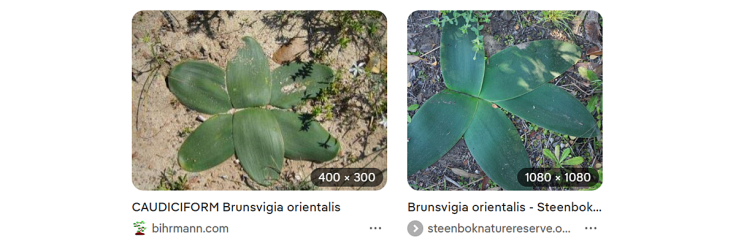
As I don’t have a photo of the leaves, above is a screenshot from Google Images. The large flat leaves are produced after the flowerhead has dried and broken off. The leaves store up nutrients during the wet months of autumn and winter, drying off in the summer when the bulbs are dormant. When the flowers emerge at the end of the summer, no trace of the leaves remains visible.
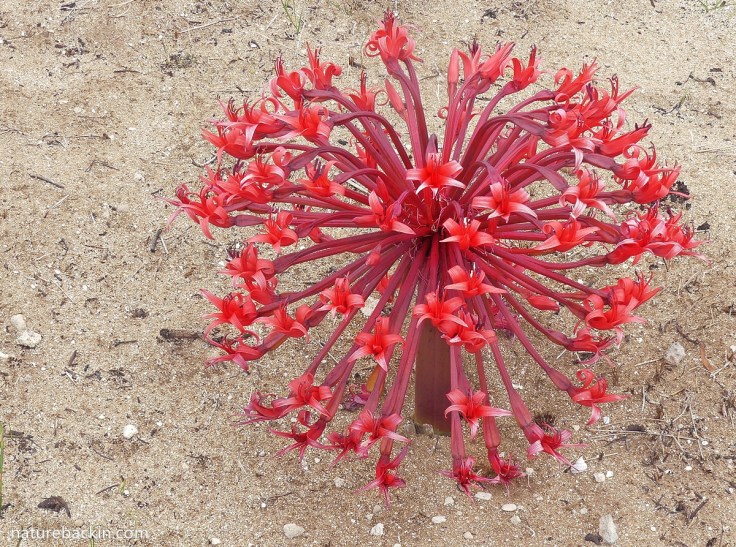
A closer view of the ball-shaped candelabra structure protruding on its fat stem above the bare ground. The flowerhead can be up to 60 cm (24 inches) in diameter, with stems supporting between 20 to 80 flowers.
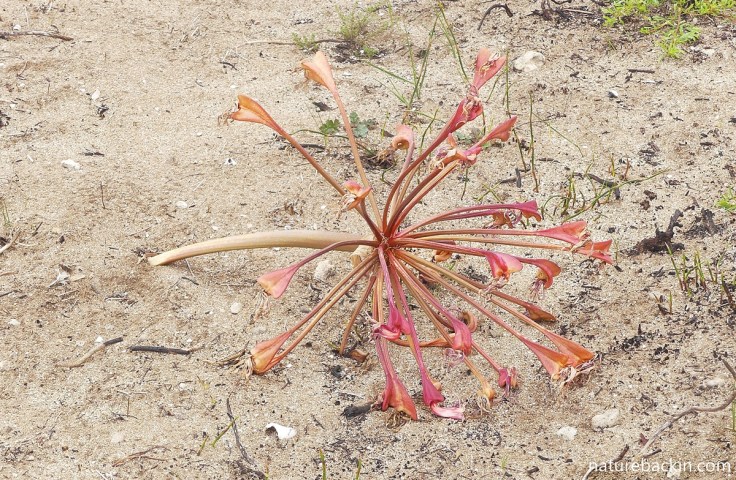
As the seeds start to develop the entire flowerhead dries off. Eventually it snaps off the stem and rolls along like a tumble-weed. The fleshy seed capsules at the tips break off as the flowerhead tumbles along, and the seeds germinate very quickly. Seeds may even begin to germinate when the seed capsule is still attached to the stalks. The timing is such that the new plants have the entire wet winter season during which they can become established. The tumble-weed characteristic of the candelabra lily gives rise to two names in Afrikaans: perdespookbossie, which alludes to it being a bush that spooks horses that are presumably startled by the tumbling flowerhead. The second name, rolbossie, reflects it being a bush that rolls.
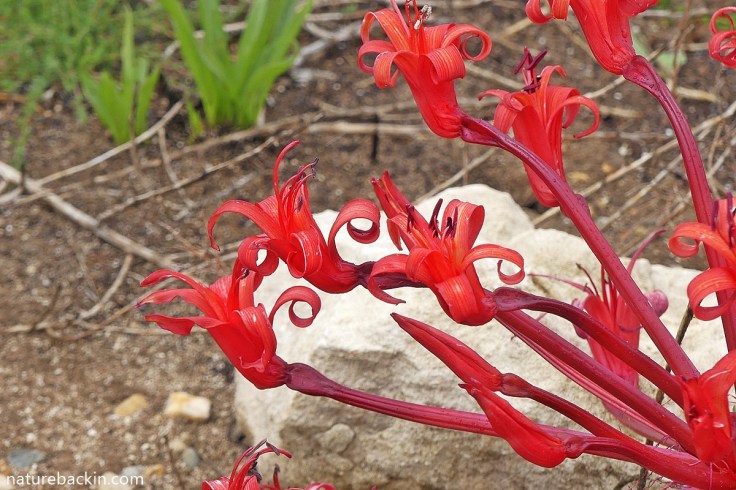
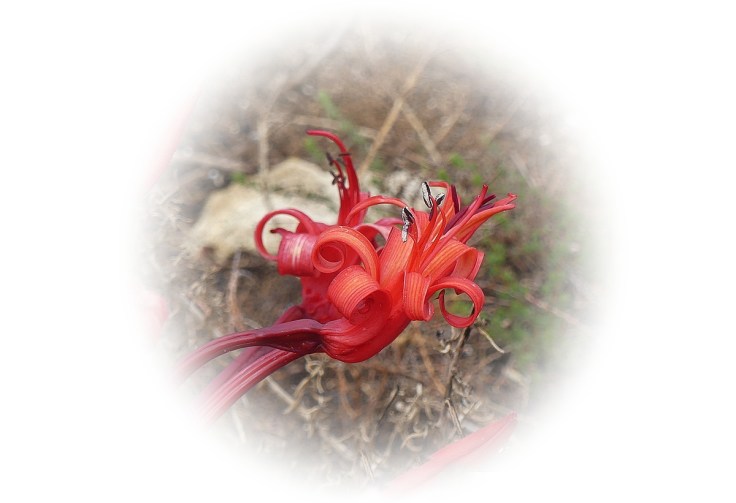
A closer look (above) at the stalks and flowers. The flattening of the stalk visible at the base of each flower is where the seed capsule will develop. It is also clear how the stalk provides a secure perch for visiting sunbirds seeking nectar from each flower.
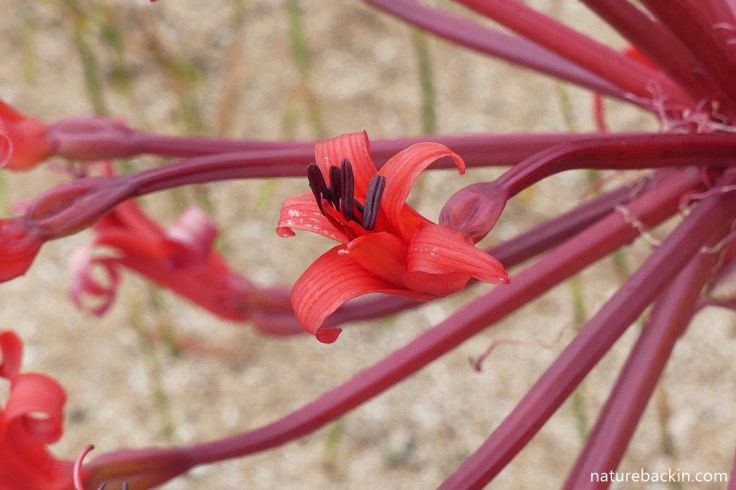
When a visiting sunbird inserts its bill deep into the flower to access the nectar, pollen is deposited on the bird’s head and bill to be transferred to subsequent flowers visited, and so pollination takes place.
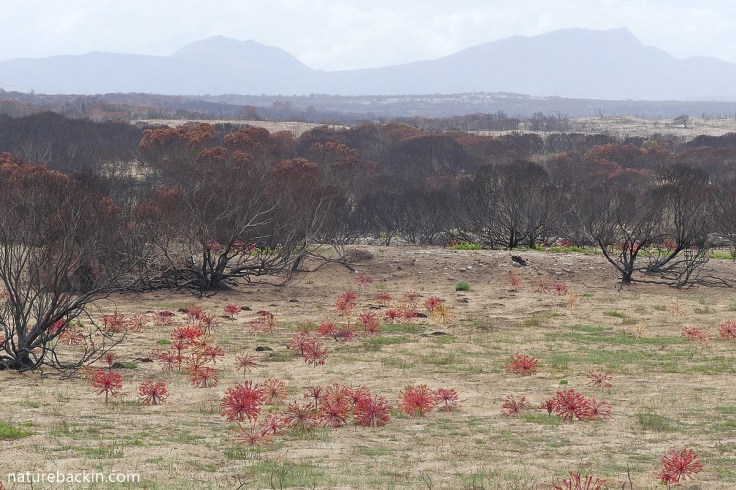
Candelabra lilies in flower on the sandy flats that are still largely barren after the the recent fires with the burnt-off larger vegetation visible in the background. The Kleinrivier Mountains form the distant horizon. Candelabra lilies flower from February to April in response to late summer and early autumn rain. The flowering is more prolific after fire because the overhead scrub has been burned away, reducing shade and competition. Plus, the ash from the recently burnt vegetation provides a boost of nutrition to the soil. In our region this year, the candelabra lilies responded in full flowering force to the recent fires that were followed by unusual late summer rains.
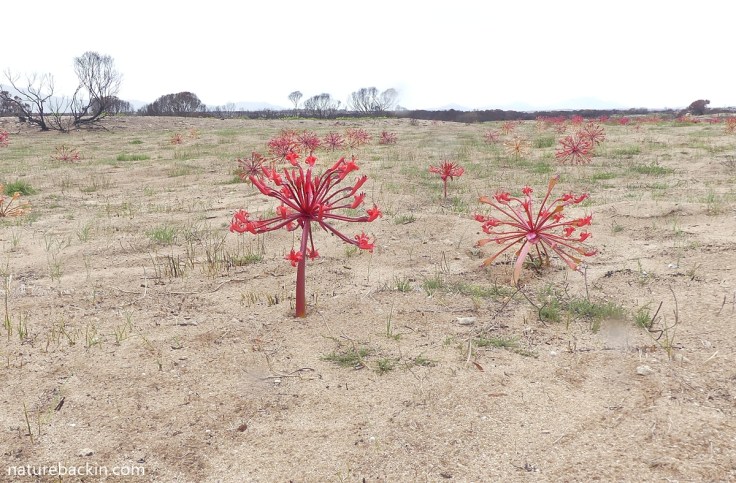
The above photo shows how the candelabra lilies relieve the bleakness of the post-fire landscape.
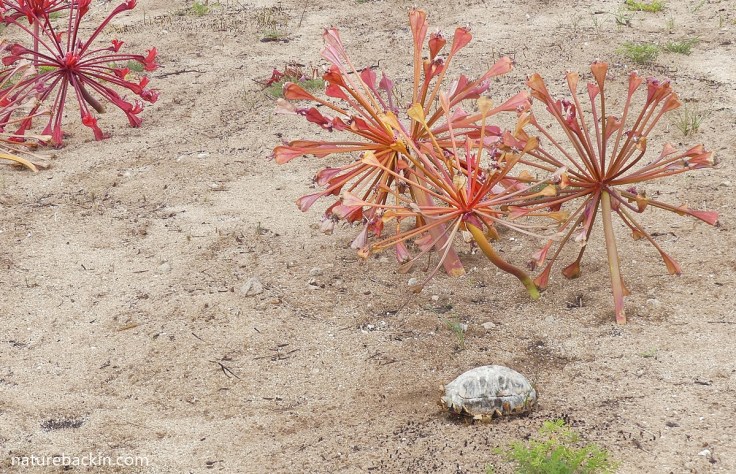
Even more bleak are the burnt remains of numerous angulate tortoises, such as the one above, that we saw amongst the flowers. This sad sight is a reminder of the toll fires take on wildlife.
In case you are wondering from where the botanical name, Brunsvigia orientalis, derives, the genus is named for Karl Wilhelm Ferdinand (1735–1806), Duke of Braunschweig (Brunswick), in 1755 by Lorenz Heister, who was a German botanist in addition to being a professor of anatomy and surgery. Brunsvigias belong to the Amaryllis family. The species name orientalis, meaning eastern, results from the mistaken belief that the plant came from India. In fact, it is endemic to the winter rainfall regions of South Africa.
Sources:
🔖Bladen, Nic. 2022. Nic Bladen. Botanical Sculptor. https://www.nicbladen.com/; 🔖Botanical Society of South Africa. 2020. Autumn colours: A closer look at Brunsvigias. https://botanicalsociety.org.za/autumn-colours-a-closer-look-at-brunsvigias/; 🔖Forrester, Jane 2003. Brunsvigia orientalis. PlantZAfrica. South African National Biodiversity Institute (SANBI). https://pza.sanbi.org/brunsvigia-orientalis; 🔖Grootbos Florilegium. [n.d.] The Grootbos Florilegium: An unforgettable journey. https://www.grootbos.com/en/florilegium/about; 🔖Michaelangelo Foundation. [n.d.] Nic Bladen: Botanical sculptor, Cape Town, South Africa. Homo Faber. https://www.homofaber.com/en/artisans/nic_bladen-botanical_sculpting-cape_town;🔖Privett, Sean & Lutazeyer, Heiner, 2010. Field Guide to the Flora of Grootbos Nature Reserve and the Walker Bay Region. [Hermanus]: Grootbos Foundation. ISBN 978-0-620-47805-2; 🔖Wamono, Carolyne. [n.d.] From Flora to Fine Metal: Exploring the Botanical Artistry of Nic Bladen. Out of Africa. https://www.outofsouthafrica.com/blogs/spotlight-on/from-flora-to-fine-metal-exploring-the-botanical-artistry-of-nic-bladen
Posted by Carol

Discover more from letting nature back in
Subscribe to get the latest posts sent to your email.


March 31, 2026 at 8:53 am
This post really speaks to me, Carol, as a wonderful example of nature’s resilience and exquisite design. The interdependence and overlapping of systems and cycles.
LikeLiked by 1 person
April 1, 2026 at 6:59 pm
Thanks Sandra. Yes this dramatic plant really is a good example of overlapping cycles and interdependence.
LikeLike
March 19, 2026 at 1:30 pm
What interesting and beautiful plants, Carol. I enjoyed your explanation of them. Your reference to the fires prompted me to read your February post, which I had missed. The harrowing number of fires in your region must have been awful. I’m so sorry. As you probably know, we experienced devastating wildfires in LA a year ago. A frightening and sad time to witness. I hope the areas around you continue to heal.
LikeLiked by 1 person
March 19, 2026 at 8:09 pm
Thanks Jane. It is a gorgeous plant.
Our fires don’t rage as hot as the fires in LA, as far as I am aware, so the scale of our fires is far less. We had nothing like the infrastructure destruction that devastated parts of LA.
Nevertheless it was an anxious time with fires often too close for comfort, and for some landowners and farmers there have been significant losses. It is interesting to see though the areas with natural vegetation (and minimal invasive alien plants) starting to regenerate. It is too soon for the plants that seed in response to fires to be germinating yet, but that should happen once the night-time temps drop and we get our first winter rains. Thanks for your good wishes. I hope too that LA continues to recover, though I expect that in the worst affected areas that will be a slow and painful process.
LikeLiked by 1 person
March 19, 2026 at 8:14 pm
Interesting contrasts, Carol. Thanks, for those who lost their homes, recovery has been glacial. ☹️
LikeLiked by 1 person
March 19, 2026 at 8:21 pm
That is very sad. To lose everything and then any real recovery being so fraught is tragic.
LikeLiked by 1 person
March 18, 2026 at 11:53 pm
What a wonderful flower! I had never heard of it before, and it is truly beautiful. Some of the long range pictures you showed reminded me of the short desert bloom time of the American Southwest. It’s so difficult to see the brown after your fires, but nature is quite amazing to provide everything that flower needed for an extra special blooming, isn’t it?
About the fires, how close did they come to you? Is your town/local area changed in any way because of them?
Wishing you a happy Autumn season. Funny to think that as you are in Autumn, I am gearing up after being very tired of shoveling snow, and spend my time poring over seed catalogs and planning my garden.
Best,
Julie
LikeLiked by 1 person
March 19, 2026 at 7:52 pm
It certainly does look deserty on the sandy flats after the fires.
The numerous fires here were very widespread taking out large tracts of land. Very tough for the farmers, for example flower farmers and honey producers too. The fires were hard on wildlife. The natural fynbos, where it still exists, is adapted to fire and so in time regenerates.
Yes the fires came very close to our village. The firefighters were incredible in that most infrastructure was saved and our village did not lose any buildings, though there were some losses in the farming areas, though not of residences, and a nearby big cat sanctuary was badly affected.
After a recent heatwave we are looking forward to autumn and much needed rain (hopefully), It must be great to be planning your garden and the nearly imminent planting time. As you wait for spring I hope you don’t have any more extreme weather.
Best wishes to you to.
LikeLike
March 18, 2026 at 1:37 pm
How fortunate you are to witness this spectacular sight.
LikeLiked by 1 person
March 18, 2026 at 7:06 pm
Yes – it has been an absolute treat.
LikeLike
March 18, 2026 at 10:10 am
Thank you for this wonderful post on the Brunvigias. I loved your photos and the information about the name. I so enjoy seeing the buds erupt from the sandy soil here – knowing what bounty is to follow. Just so terrible about the poor tortoises who couldn’t be rescued.
LikeLiked by 1 person
March 18, 2026 at 7:06 pm
Thanks Christine. Yes it is lovely seeing the buds emerging full of promise. It is very sad that so many tortoises perished.
LikeLike
March 18, 2026 at 8:35 am
An astonishing plant. I can’t think of a single British one where the leaves only appear after the flower has done its work. It’s certainly well-named too.
LikeLike
March 18, 2026 at 5:44 pm
It is well-named and is an amazing plant. I guess no (or few) British plants had to adapt to aridity and so didn’t have to evolve such strategies to save moisture.
LikeLiked by 1 person
March 18, 2026 at 8:30 am
Amazing. Thanks for sharing.
LikeLiked by 1 person
March 18, 2026 at 5:41 pm
Thanks – it was a pleasure to share this amazing plant.
LikeLiked by 1 person
March 18, 2026 at 6:47 am
I simply love this post! These lilies represent some of the best nature can offer and your photographs show this off to perfection.
LikeLiked by 1 person
March 18, 2026 at 5:41 pm
Thanks Anne. They are really spectacular flowers, especially when in such profusion.
LikeLiked by 1 person
March 18, 2026 at 6:17 am
Wow, such a striking sight. A fascinating and spectacular flower. Nature never ceases to amaze.
LikeLiked by 1 person
March 18, 2026 at 5:40 pm
Thanks Graham, yes they really do have a wow factor, especially when so many flower in such masses.
LikeLiked by 1 person
March 18, 2026 at 12:33 am
A fascinating giant of a flower, well-adapted to its environment. It seems primitive in its growth, I wonder if it has a history going back to the first flowers? I can imagine it growing during the time of great volcanic activity!
LikeLiked by 2 people
March 18, 2026 at 5:39 pm
It is fascinating and well adapted to its arid environments. Yes it can appear to have primeval qualities and I like the image of it growing amid active volcanoes especially as it looks rather explosive itself! But as it is adapted to pollination by birds I guess it is likely to have evolved alongside birds on the evolutionary scale.
LikeLiked by 1 person