A September outing took us up a farm road, offering a spot of birdwatching, and then past the Sugarbird Nature Reserve that was rich with flowers as the vegetation regenerated after a previous fire.
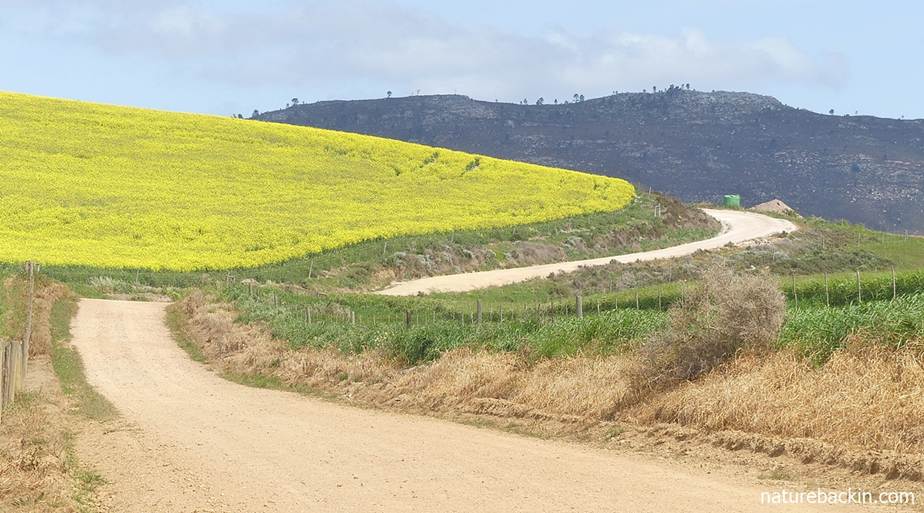
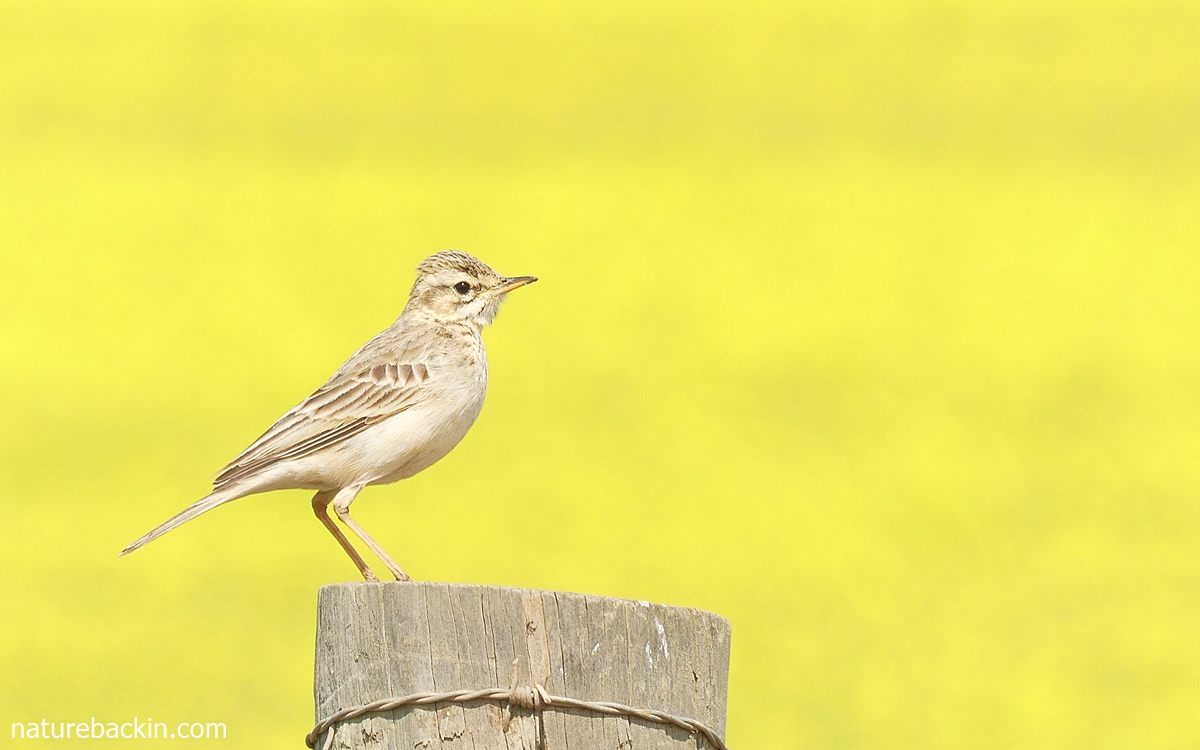
The farm road curved past fields of flowering canola and wheatfields that looked nearly ready for harvesting. Birds used the fences and posts as convenient perches, convenient also for us to photograph them from our car windows. The header photo is of a pipit, most likely the African pipit (Anthus cinnamomeus), perched on a fence post, with the flowering canola forming a bright yellow background.
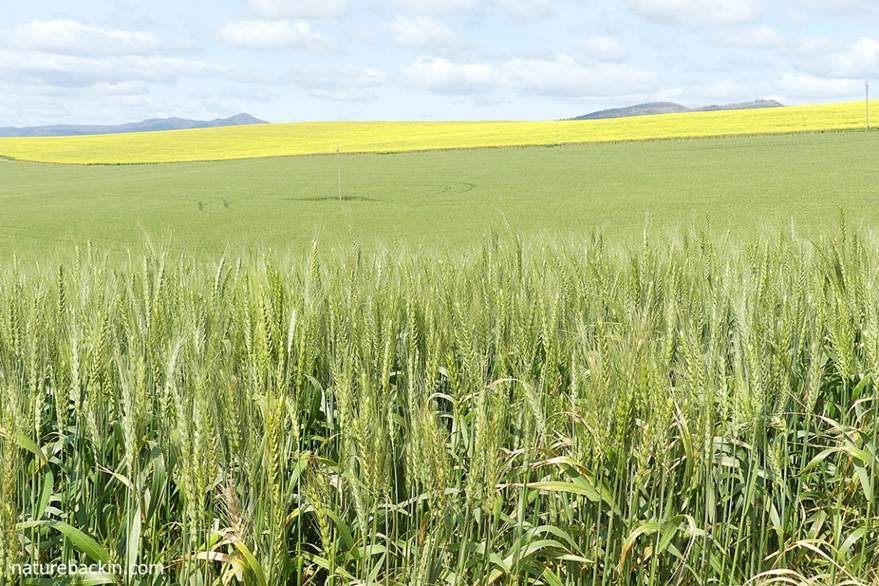
A wheatfield with a canola field in flower behind it, and mountains peeking up on the horizon.
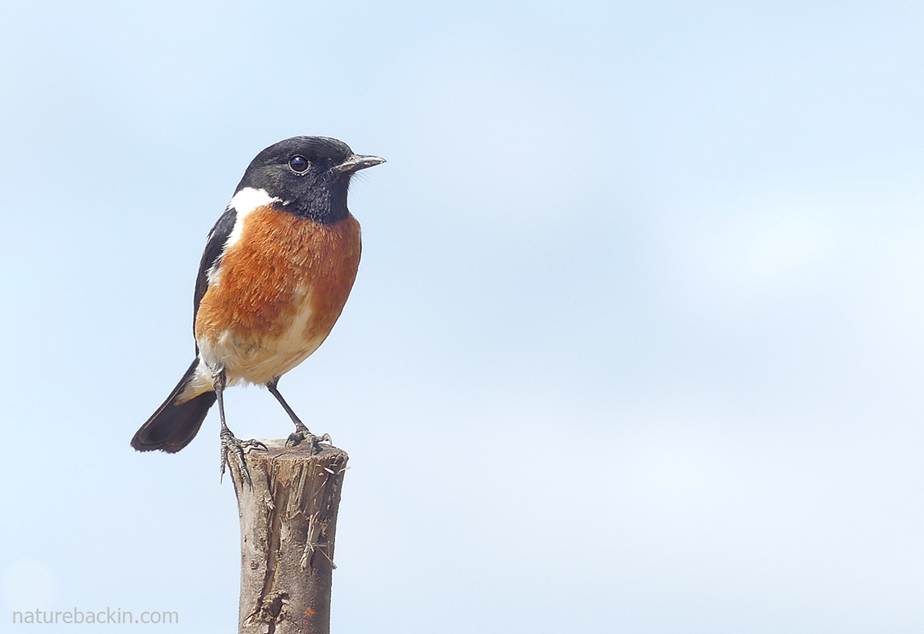
Also perched on a post was an African stonechat (Saxicola torquatus). These little birds are mostly insectivorous, but they are also known to eat small lizards, seeds and fruit.
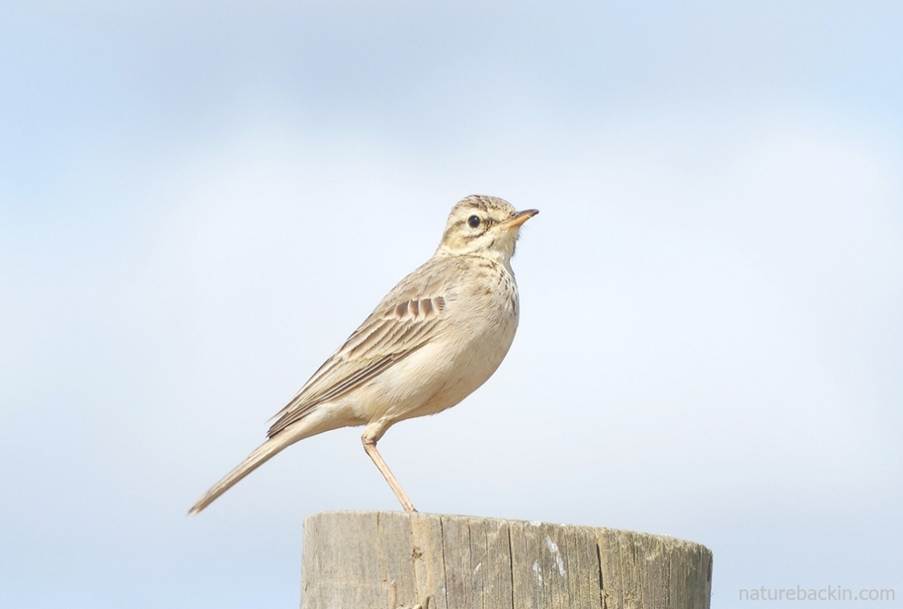
Another photo of the pipit, which like the stonechat is mostly insectivorous. When I first saw this bird, I assumed it to be a lark, but later, looking online, I came across a very useful page (by Faansie Peacock) with an illustration detailing the main distinctions between pipits and larks. Noting the slender uncurved bill, the single row of scapulars and the relatively long tibia, I think it is a pipit, and most likely the African pipit.
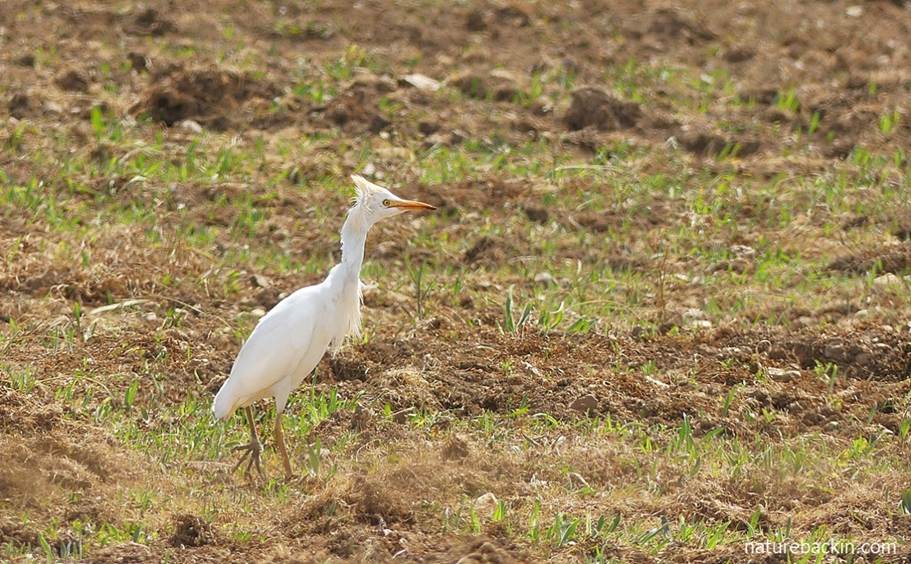
I regret that I did not take a photograph of the farmer driving a tractor that was towing a tilling implement to clear a field. This activity attracted several birds hoping to prey on insects, including this windswept western cattle egret (Bubulcus ibis). These birds commonly follow large animals, such as cattle, hoping to catch insects that are disturbed by the animals as they graze, hence the name “cattle egret”. In this case, from the bird’s point of view, the tractor was fulfilling a similar function to grazing cattle.
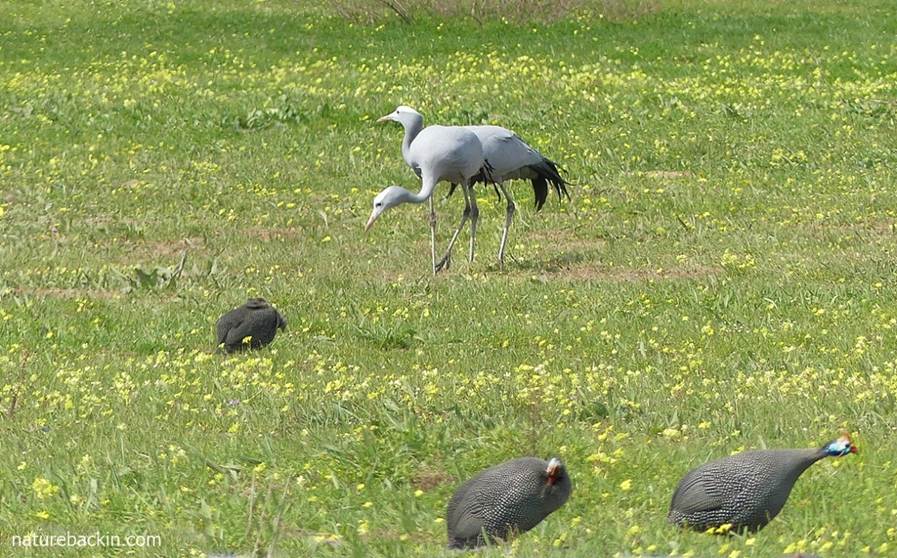
We left the farm road and returned to the main road, from where we spotted these two blue cranes (Grus paradisea) accompanied by helmeted guineafowls (Numida meleagris). We turned off onto another farm road to get a closer look, and then we decided to see where the road took us. As the road climbed up to a ridge, we saw a signboard identifying the land on the high ground as the Sugarbird Nature Reserve.
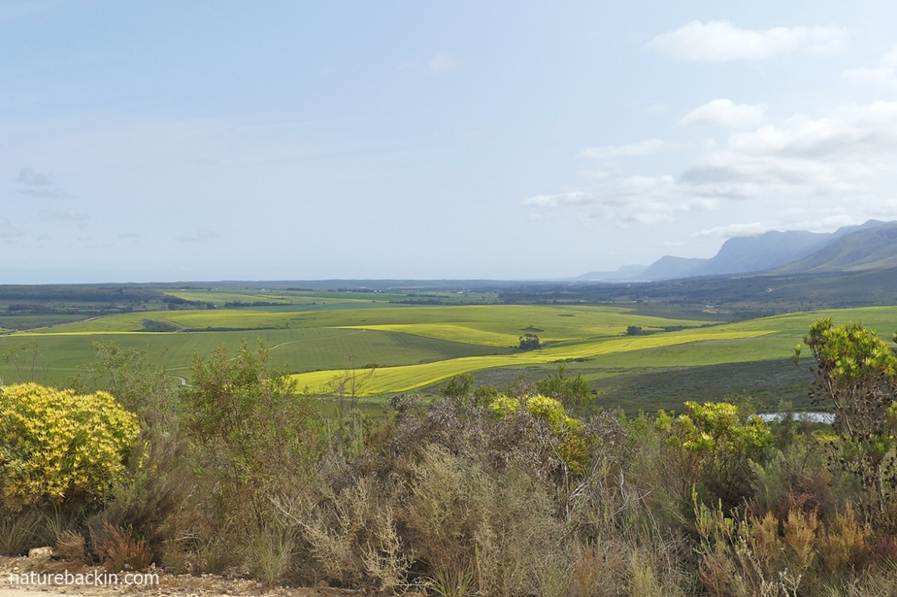
From this ridge we had a great view over the shrubby fynbos bushes (including the yellow Leucadendrons in the foreground), down to the farmlands and canola fields and towards the Klein River Lagoon and the sea. The Klein River mountains can be seen in the distance on the right.
Once back home, I looked up the Sugarbird Nature Reserve and found this description:
In 2015, the Fynbos Trust acquired Lucerne Farm, which had been declared the Honeybird Private Nature Reserve (since renamed Sugarbird Nature Reserve) 13 years earlier. We are continuing the dedicated groundwork of the founder of the Private Reserve on 510 hectares of land predominantly covered with species-rich Overberg Sandstone Fynbos.
(Fynbos Trust.)
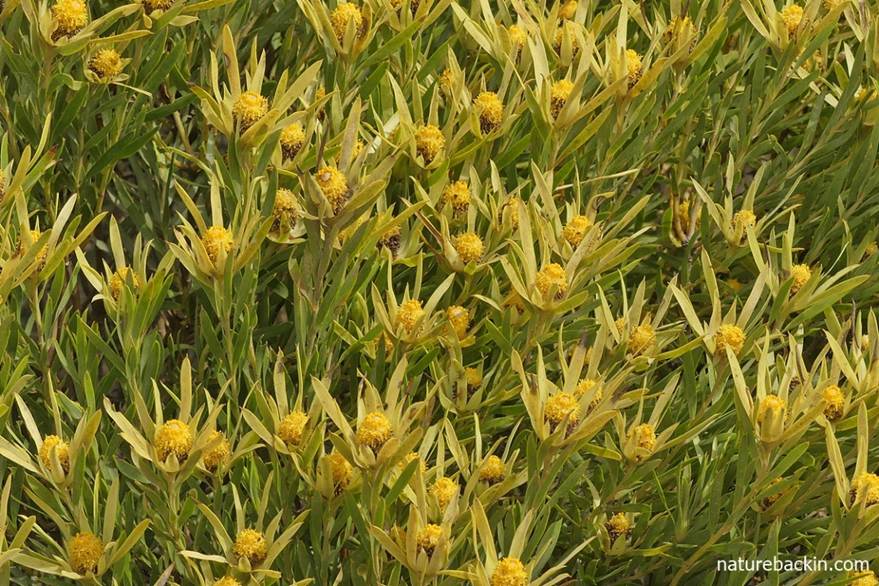
Several species of conebushes or Leucodendrons form bold splashes of colour in amongst the fynbos vegetation. The cone-shaped flowers/fruit are surrounded by colourful bracts, with many species being yellow. Conebushes have separate male and female plants. As there over 80 species of Leucodendrons in South Africa, and they are notoriously difficult to identify, I should not even try to identify the plant in the above photograph. However, because they occur in the region, and the leaves are narrow, slightly curved and have a small point at the end, I think it may possibly be a sickle-leaf conebush (Leucadendron xanthoconys).
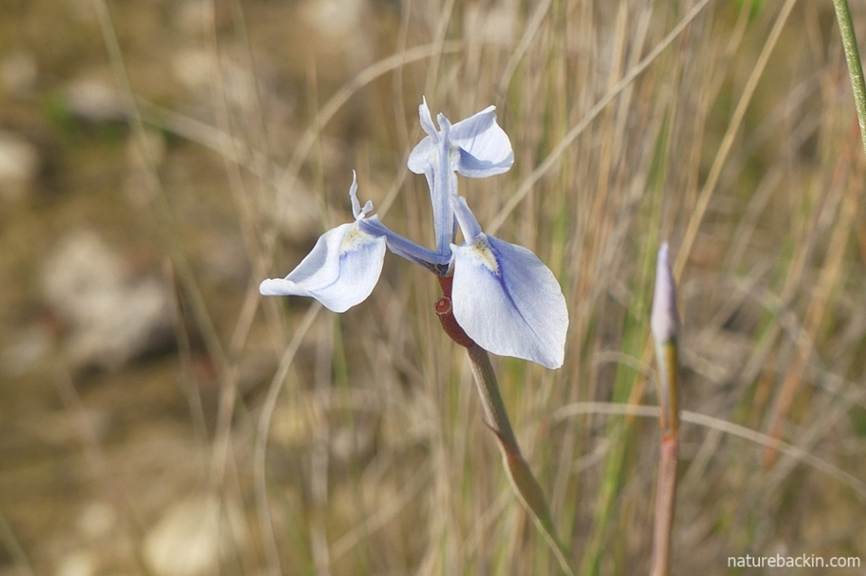
Moreas are deciduous, cormous perennials often with grasslike leaves. They are in the family Iridaceae. Although the flowers of some Moreas may resemble those of true irises, they are more closely related to Dietes and Ferraria. Almost all the 200 species of Moraea occur in sub-Saharan African with the highest concentration being in the Western Cape where there are about 180 species. The flower in the photo above is of the blue uintjie (Moraea tripetala). The flower colour of this species ranges from pale to dark blue to purple, and less commonly may be pink. “Uintjie” is Afrikaans for “little onion” and refers to the corms, which in some species of Morea are edible.
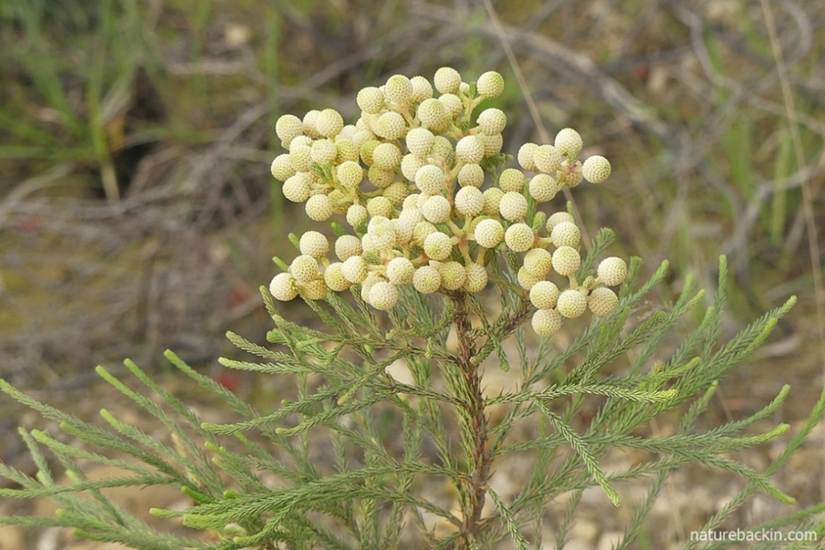
In all species of Berzelia, small flowers cluster in round balls that group in branched heads. These flower heads are very popular in the cut flower trade and they are used as filler plants in bunches of fynbos flowers. All twelve species of Berzelia are endemic to South Africa, mostly to the Western Cape. All of them are able to resprout after fire.
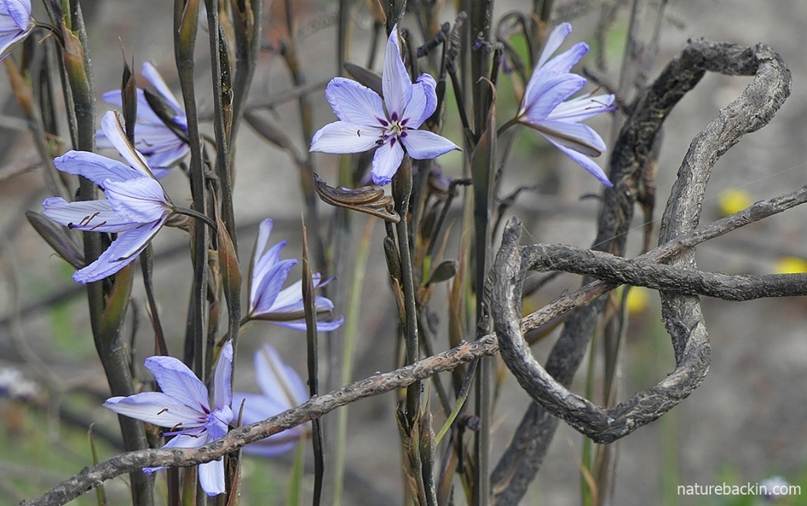
Pale Capeblue (Aristea spiralis), also known as star-eyed aristea, is another member of the Iridaceae family. The beautiful flowers range in colour from white to pale blue. Pale Capeblues flower particularly well after fire. In the wild these plants often grow in clumps, so even though each flower lasts for less than a day, those in clumps have a succession of flowers during the months of spring. The clump in the above photo is surrounded by branches of a fire-damaged shrub.
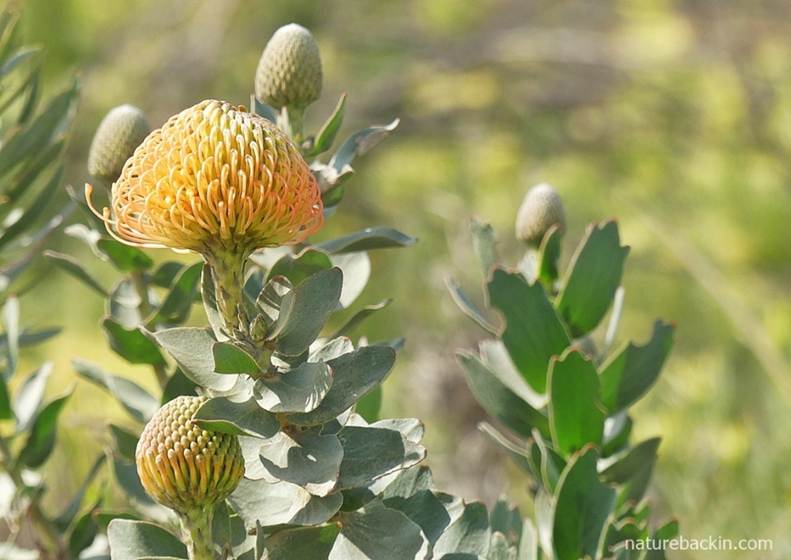
In South Africa Leucospermums (known as pincushions), belonging to the Proteaceae family, are popular as garden plants. The plant in the photo above is growing in the wild and is most likely a Leucospermum cordifolium. In the wild the plants are pollinated by protea scarab beetles and by nectar-feeding Cape sugarbirds and three species of sunbird. The nut-like seeds are collected by ants that carry them to their burrows. The seeds are effectively stored underground and only germinate after fire. Hybrids and cultivars of Leucospermums are farmed in several countries and regions, including in Israel, California, Hawaii, Zimbabwe, Australia and New Zealand, for the cut flower trade.
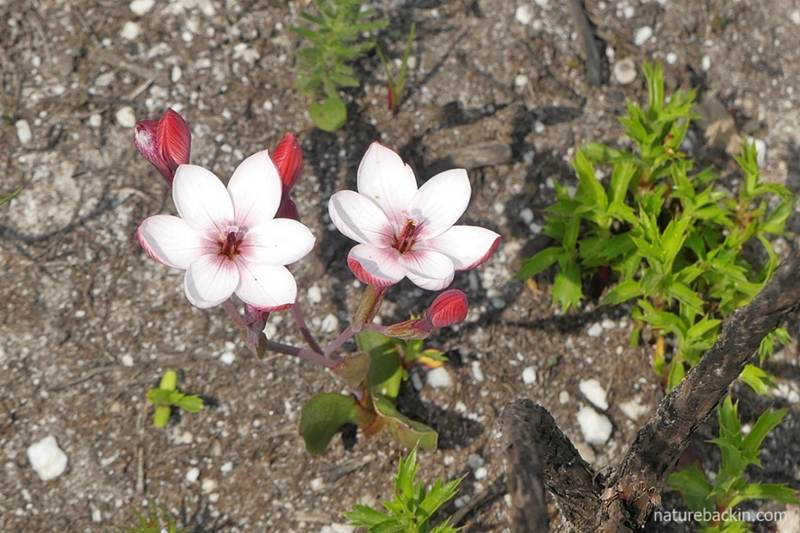
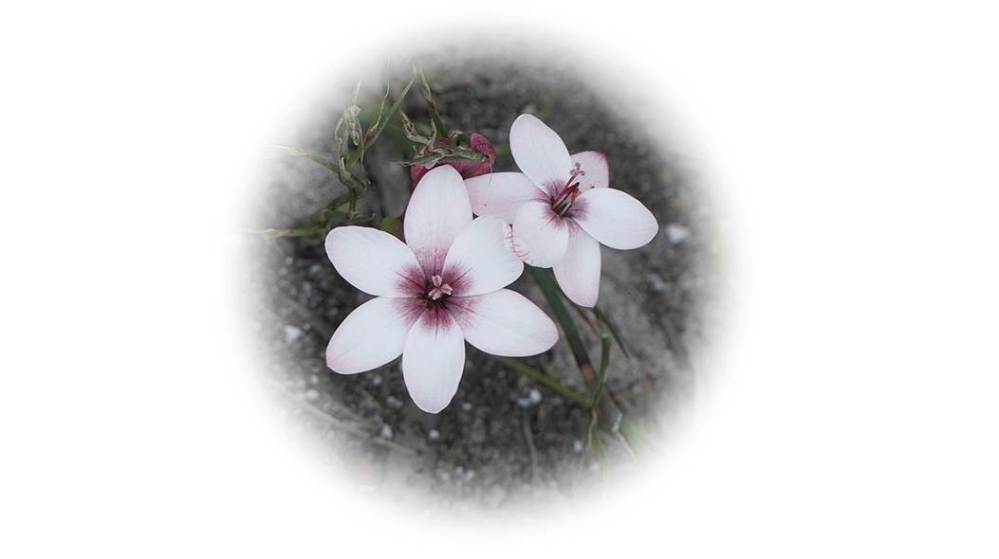
The pink satin-flower (Geissorhiza ovata) blooms most profusely after fire. The corms sprout in autumn and the plant grows during the winter rainy season, producing flowers in the spring. After flowering the plant dies back and is dormant underground during the dry months of summer. G. ovata is one of 104 species in the genus, all of which are endemic to the winter rainfall region of South Africa.
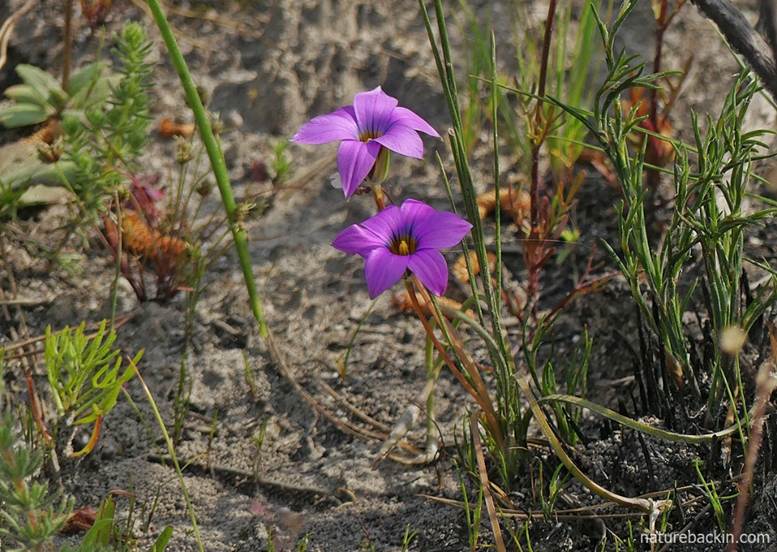
A Romulea species in flower, growing near the remains of still blackened tufts of plants that were burnt in a previous fire. Although most fynbos plants are adapted to fire, if fires are too frequent and/or too hot (for example due to an overgrowth of alien vegetation) fires can be harmful and even eradicate species locally. Romulae species are small, deciduous perennial bulbous plants. Leaves are thin, sometimes grass-like. The common name for Romulae species, “froetang”, is derived from the Portuguese “fruta” as the young seed capsules in some species are edible.
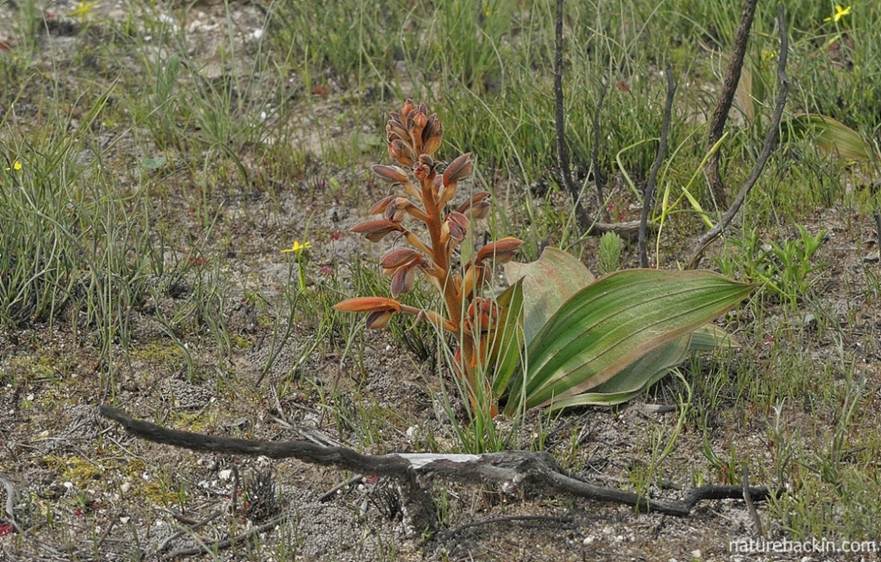
Common Butterflylily (Wachendorfia paniculata) is a strange and beautiful plant. In the above photo the broad pleated leaves of this winter-growing deciduous plant are clearly visible. Sprouting from the base is an upright stem bearing flower buds. This is another species that does particularly well after fire.
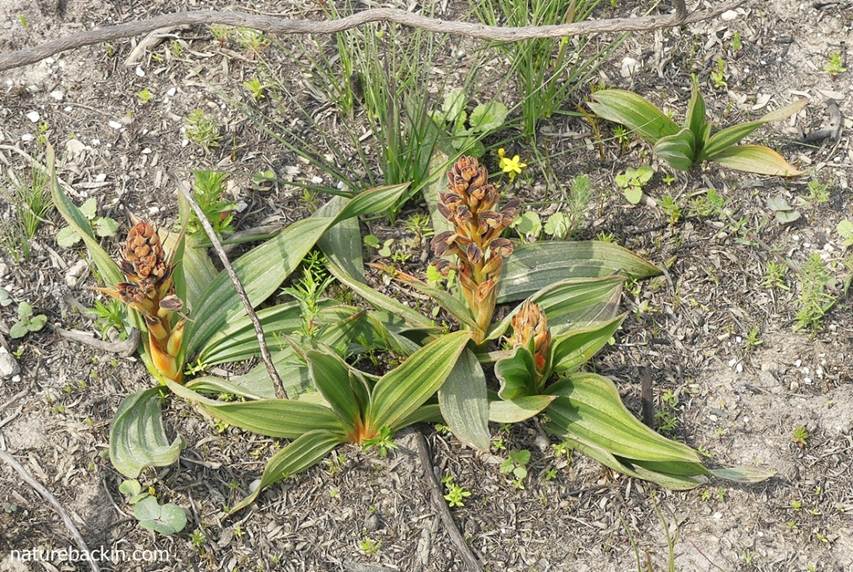
In this photo of a clump of Wachendorfias, its low-growing form and broad, pleated leaves are obvious features, the brownish flower spikes are less so.
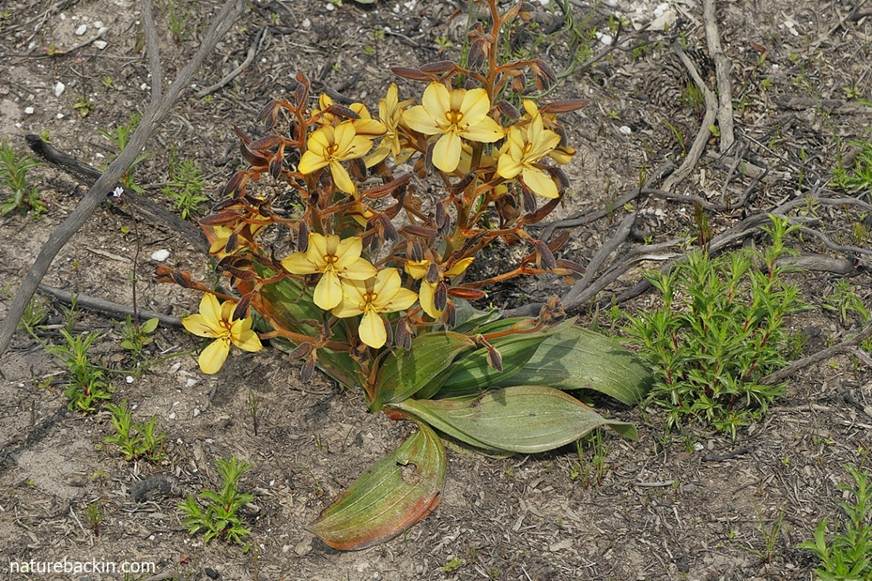
But look what happens when the flowers open! The flowers are unexpectedly showy. It took me a bit of time to realise that the plants bearing open flowers were the same plants as those bearing the spikes with unopened buds. Individual flowers last for just one day. They are pollinated mainly by honey bees.
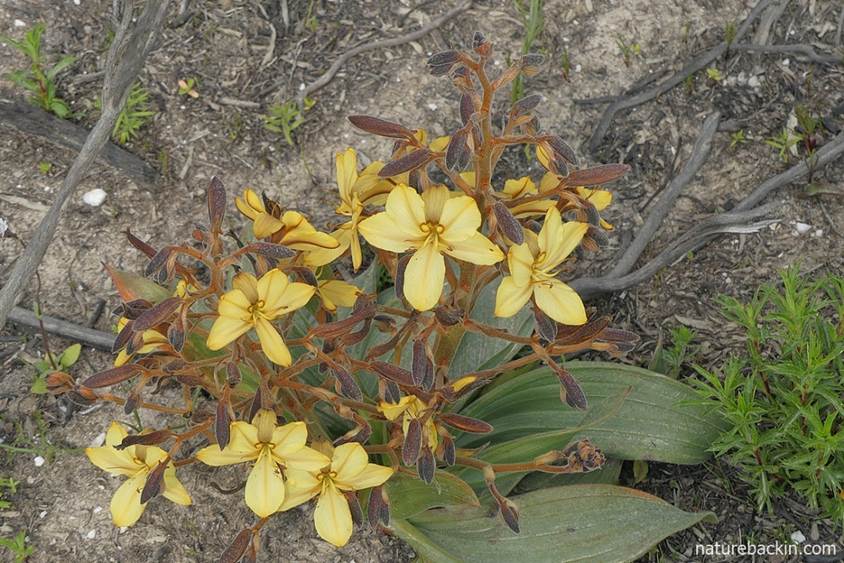
This species is endemic to the Western Cape. Unfortunately, the status of this amazing plant is assessed as being “Vulnerable”, meaning that the plant is at risk of extinction. According to the Red List of South African Plants, “since 1940, 40% of recorded locations have gone extinct. There is a continuing decline due to alien plant invasion, crop cultivation and urban expansion” (Raimondo 2007).
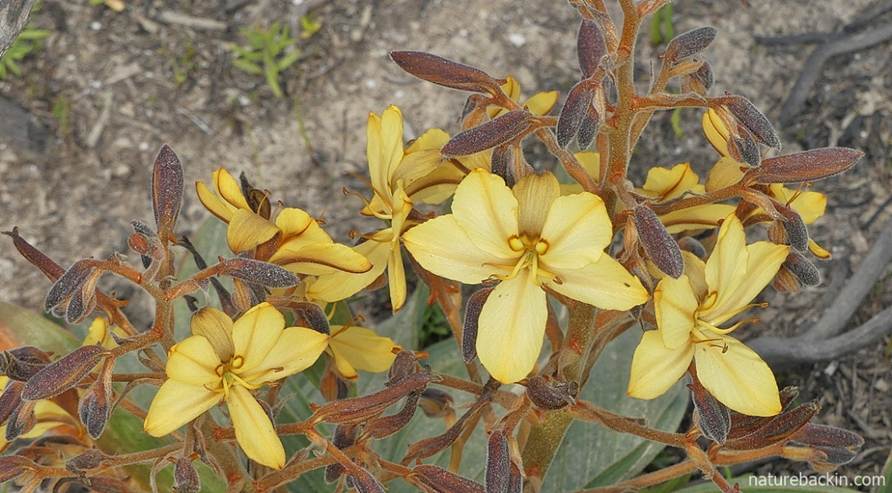
The flowers remind me of a patterned rich brocade fabric. The sap in the roots and stems has been used to make an orange dye, somehow fitting for a plant with such opulent flowers.
Sources:
🔖Fynbos Trust. [n.d.] Sugarbird Nature Reserve. https://fynbos-trust.org/en/sugarbird_en; 🔖Manning, John. 2018 (2nd ed.) Field Guide to Fynbos. Cape Town: Struik Nature; 🔖Peacock, Faansie. [n.d.] [page from] Pipits of Southern Africa, p. 70. https://faansiepeacock.com/wp-content/uploads/2015/05/Pipits_and_larks.pdf;🔖PlantZAfrica. South African National Biodiversity Institute (SANBI). https://pza.sanbi.org/;🔖Raimondo, D., Turner, R.C. & Helme, N.A. 2007. Wachendorfia brachyandra W.F.Barker. National Assessment: Red List of South African Plants version 2024.1. https://redlist.sanbi.org/species.php?species=2047-1
Posted by Carol
Discover more from letting nature back in
Subscribe to get the latest posts sent to your email.


December 12, 2025 at 11:20 am
PS. I like your new banner and catchline
LikeLike
December 12, 2025 at 3:00 pm
Thanks Mariss 😊
LikeLiked by 1 person
December 12, 2025 at 11:19 am
I could almost smell the veld as I read your remarkable post. Thank you for sharing your outing with us in such rich detail
LikeLiked by 1 person
December 12, 2025 at 3:00 pm
Hi Mariss – thanks. It was a brief outing but incredibly satisfying. There is so much on our doorstep here.
LikeLiked by 1 person
December 11, 2025 at 8:35 am
This post offers a real flavour to your stamping grounds to me. Wonderful landscapes, birds that are the-same-but-different from many of ours and such a varied and lovely collection of flowers, all of which are unfamiliar. Your still-newish address must be keeping you very busy. In a good way I hope!
LikeLiked by 1 person
December 12, 2025 at 2:59 pm
Hi Margaret – it is wonderful here. It occurred to me that I have not often shown anything about farmlands in this region, and perhaps I should feature more about them in future and the domestic animals too.
It is nice that we share some familiar birds, even if they may differ at the species level.
Many of the Fynbos flowers are unique and I am enjoying discovering more of them and more about them as I go along.
Yes we are busy here, and in a good way, thank you.
LikeLike
December 10, 2025 at 5:47 pm
Such breathtaking landscapes, even when tamed by wheat and canola. And whereas we have pipits, chats and egrets in the UK, we have nothing like your indigenous flowers: botanic wonders all of them.
LikeLiked by 1 person
December 12, 2025 at 2:55 pm
Hi Tish – that is a good way of expressing it – landscapes tamed by wheat and canola. I prefer the ‘untamed’, but there is not much of that left, sadly, except up in the mountains.
It is interesting how (and to read about when) cattle egrets have extended their range.
The Fynbos flowers are indeed botanic wonders.
LikeLiked by 1 person
December 10, 2025 at 10:30 am
It is always fun to see an array of our indigenous flowers. Your photograph of the stone chat is particularly lovely 🙂 🙂
LikeLiked by 1 person
December 12, 2025 at 2:49 pm
Thanks Anne. I am fond of the stone chats. They are also familiar from the KZN Midlands.
As for the Fynbos flowers – most are totally unfamiliar, but I am enjoying discovering them.
LikeLiked by 1 person
December 10, 2025 at 4:31 am
Lovely birds and flowers. That top photo really glows. I was wondering what the background was. Also fascinating to see and read about all those flowers where fire is a part of their natural cycle. Those Butterflylily flowers are lovely.
LikeLiked by 1 person
December 12, 2025 at 2:48 pm
Hi Graham – it was amazing to see the bird against a totally yellow canola-flower background!
The plants are remarkable – and there are so many! There are said to be 9000 species in the Fynbos Biome, with 2/3 of those endemic. The relationship with fire is fascinating.
Great that you also like the Butterflylily flowers – I am particularly smitten by them.
LikeLiked by 1 person
December 9, 2025 at 8:07 pm
So many exotic (to me) spring flowers! Clearly adapted to harsh conditions, they are amazing and beautiful. Such a pity about plants like Wachendorfia being faced with extinction. The name sounds familiar… I’m wondering if I have seen it at a botanical garden. Like zoos, these gardens’ propagation programmes offer hope for reestablishment of species.
LikeLiked by 1 person
December 12, 2025 at 2:35 pm
The Fynbos plants are amazing – a remarkable combination of toughness and delicacy. Indeed, it is important to preserve individual species, but necessary too to conserve habitats so species can survive in the wild.
Thanks so much for commenting. I really appreciate it, and apologise that I have been so erratic in the blogosphere this year!
LikeLiked by 1 person