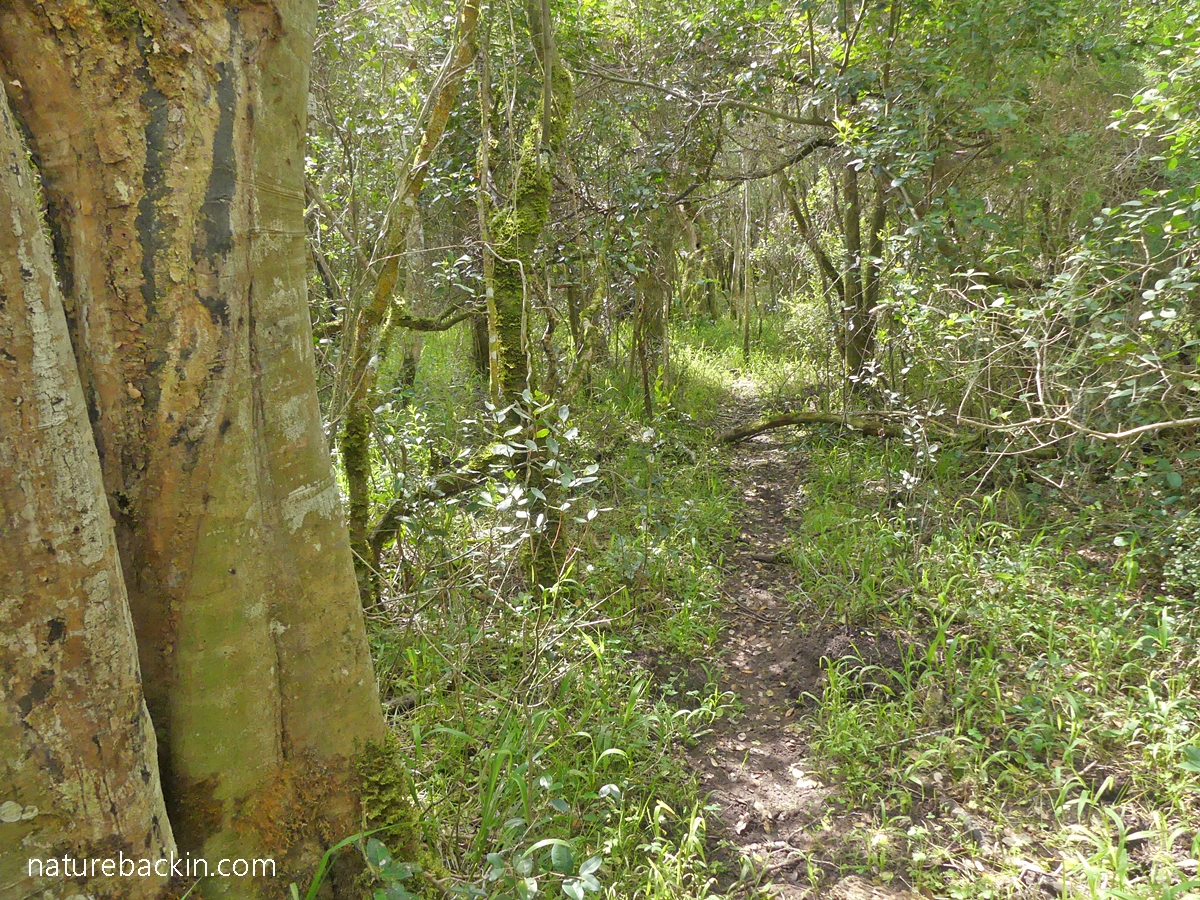
Fynbos shrubland is characteristic of much of the Western Cape’s natural vegetation, but in some patches that are not subjected to high fire danger, remnants of woodland and forests do exist. In the Walker Bay region of the Overberg, between Gansbaai and Hermanus, the Swartkransberg complex of lowland forest patches survive despite historical and ongoing threats to their survival.
The largest remaining fragment of the Swartkransberg Forests is known as Platbos. Unusually, Platbos Forest grows on a gentle slope rather than in a relatively fire-protected kloof (ravine) or riverine or coastal thicket. The Afrikaans “platbos”, means “flat forest/bush”, and with its trees being relatively low growing, from a distance the forest does indeed look “flat”, not rising impressively above the surrounding fynbos shrublands.
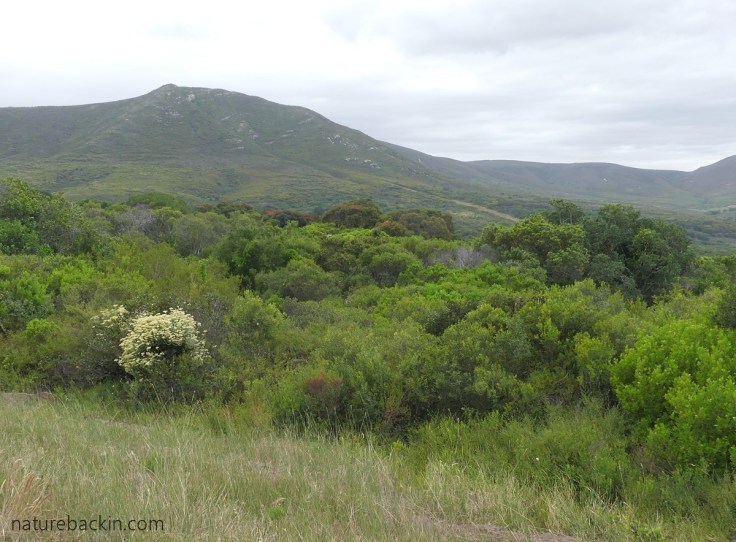
This photo was taken from a fire break looking down over a section of the Platbos Forest
The upper canopy of the forest trees is at a relatively low 4–6m (up to about 10m). As Moll and McKenzie observe: “Interestingly most of the canopy species have almost no trunks, they branch low down. Thus walking through the forest one has the impression of walking through the lower canopy” (Moll & McKenzie).
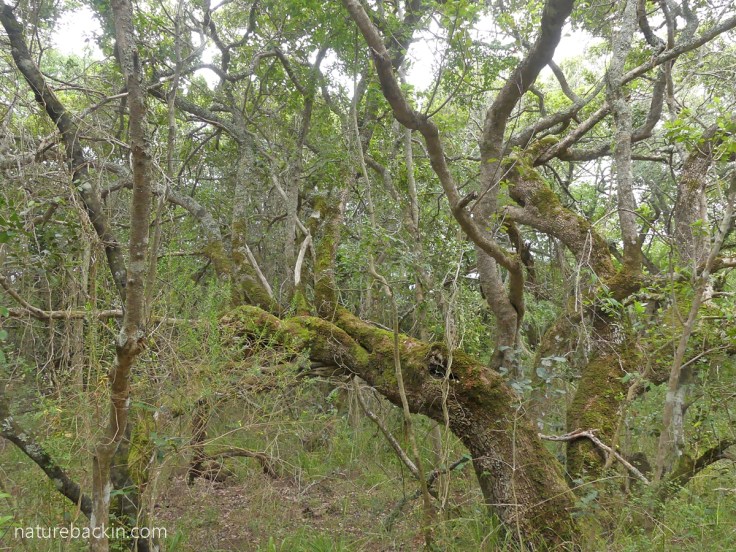
I wonder if this photo taken at Platbos succeeds in illustrating “the impression of walking through the lower canopy”?
In Platbos Forest (especially in the 1930s), like other forests in the region, many of the larger trees were felled for their timber. Other pressures on the forests included trampling and grazing by livestock, and clearing forest for agriculture, often using fire. The practice of using fire to smoke out wild bee hives in the cavities of trees also posed a risk of uncontrolled fires to the forests. Unlike the fynbos vegetation that is fire adapted, fire can entirely wipe out a forest community, especially the hotter-burning fires of invasive alien plants, such as Acacia cyclops (Rooikrans), that can form thickets encroaching into the forest margins.
Today, Platbos Forest is approximately 40 hectares in extent, with 27 hectares privately owned and managed in association with the Platbos Conservation Trust. The Platbos Foreost custodians are committed to conserving the forest and to the ongoing removal of invasive alien species. The Trust, through its Reforestation Project, oversees the planting of Platbos-tree species around the margins of the forest, including on two neighbouring properties, to protect the core of the forest from wind and fire and from encroaching invasive alien plants.
Platbos was legally declared a privately owned Provincial Forest Reserve in August 2018 “after years of relentless campaigning” following Francois Krige and Melissa Saayman Krige buying the property back in 2005. At that time the property was zoned for agriculture and the land was officially listed as “disturbed agricultural land”. The Kriges eventually managed to ensure that the forest received recognition as a National Forest Treasure and Cape Nature has awarded the Platbos property Nature Reserve status (see https://platbos.co.za/platbos-the-reforestation-project/).
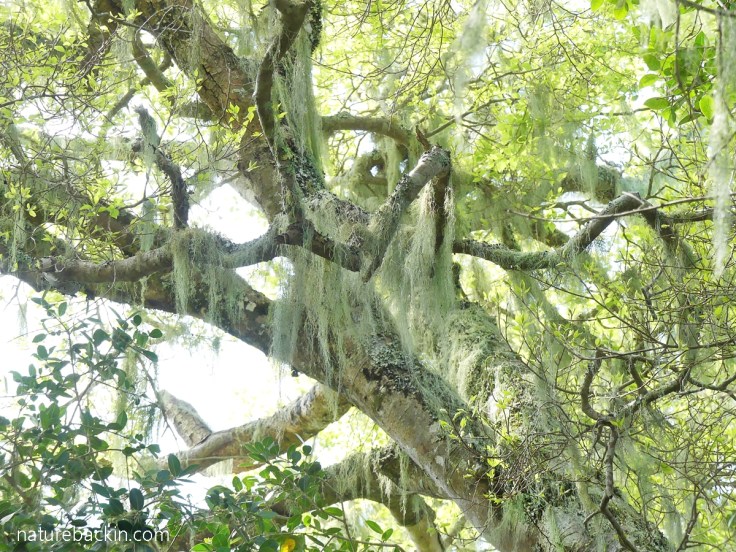
Like most forests, Platbos exudes a magical quality. The gentle festoons of the lichen known as Old Man’s Beard (Usnea spp.) add to the air of enchantment
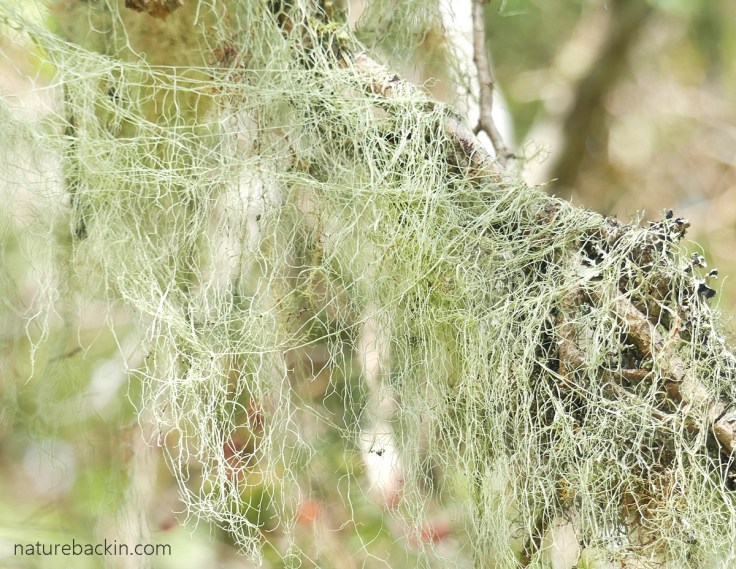
A close-up the Old Man’s Beard lichen. The presence of lichens indicates good air quality as they do not survive in polluted air. These epiphytes at Platbos are sustained in the dry summers by morning coastal fog that extends inland
Platbos Forest has a unique species composition. It does not fit into any existing forest category, but has attributes of Afromontane forests, although with only 40% of the species that are typical of such forests in the region – the ‘thirstier’ species are missing. Growing on sandy, alkaline soil it has attributes of sand forests and has similarities to the Tongaland-Pondoland forests of KwaZulu-Natal. It has also been described by H.S. Taylor as “Celtis-Olinia-Apodites” Tall Forest” (cited by Kruger 1994, p.8) on account of its three dominant tree species.
These three dominant species are the Afromontane species of Celtis africana (white stinkwood), Olinia ventosa (hard pear) and Apodytes dimidiata (white pear). Also prominent are the coastal thicket tree species of Sideroxylon inerme (milkwood), and Chionanthus foveolata (pock ironwood).
How does Platbos survive the hot dry summers on an open slope on sandy soil that does not retain its moisture? Platbos, being on the leeward (eastern) slopes of the Baviaanspoort Hills and 8.5 km inland, is sheltered from drying coastal winds, yet even though on the leeward side it still benefits from blankets of coastal mist and fog that provide necessary precipitation in the dry summer months.
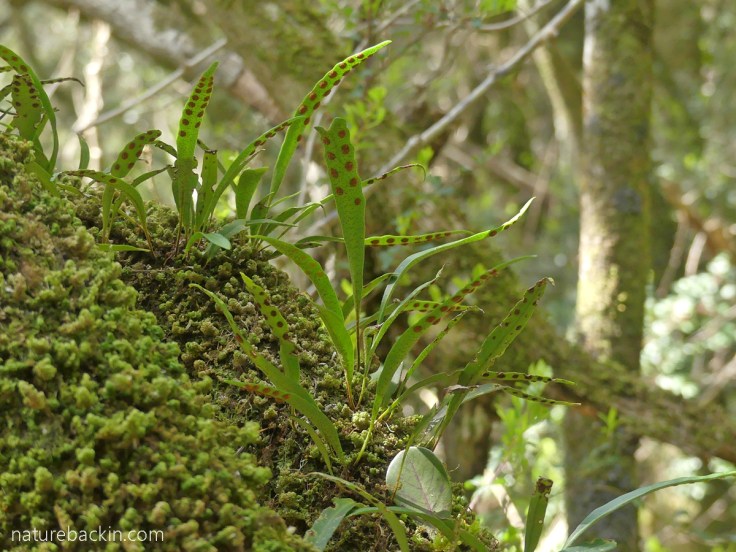
A mostly epiphytic fern (Pleopeltis macrocarpa) growing in the company of moss on the bark of a tree at Platbos Forest. This fern also depends for moisture on the coastal fog in the forest in the summer months. It provides habitat for insects and fungi and it contributes to conserving moisture in its surroundings
As mentioned, Platbos is the largest remnant of the Swartkransberg Forests. Also on the leeward side of the Baviaanspoort Hills, is the Stinkhoutsbos forest patch in Flower Valley, with its own unique composition of tree species. On the seaward side of the hills are the forest patches of Grootbos, Kleinbos, and Steynsbos in the Grootbos Private Nature Reserve. All these forest patches are now protected. In turn the forests provide shelter and food for many wildlife, including birds, mammals, reptiles and invertebrates.
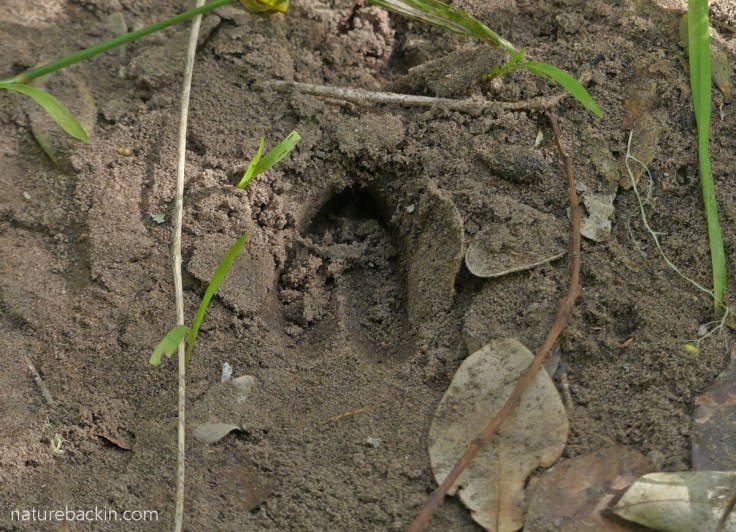
Judging from the size, this hoofprint on the damp forest path was left by a bushbuck. The Swartkransberg Forests form the most southern and western limit of the bushbuck’s (Tragelaphus scriptus) range in Africa. The sandy nature of the forest floor is evident in this photograph
As Moll and McKenzie point out, Platbos has a “unique forest structure, position in the landscape, and unusual assemblage of Afromontane Forest species, Coastal Forest species, and Strandveld elements” (Moll & McKenzie). In the middle of the Platbos forest is one of the Coastal Forest species in the form of an ancient milkwood tree (Sideroxylon inerme), that is estimated to be in the region of 1000 years old.
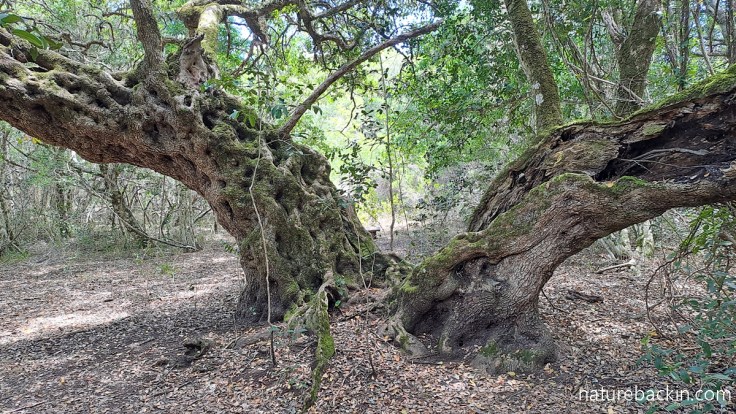
The old milkwood tree at Platbos Forest
The tree, gnarled with part of the trunk hollowed out, stands on a low, raised mound. There is evidence that the tree has coppiced, that is has resprouted from a stump, one of the methods of asexual reproduction that milkwoods are able to achieve, the others being suckering and layering.
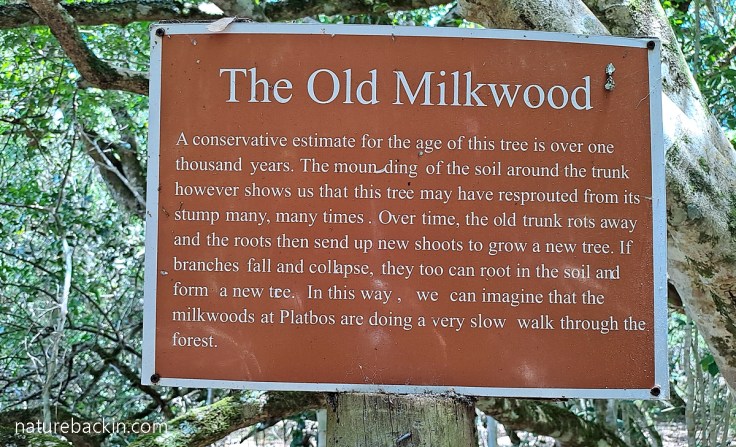
This sign is posted next to the path leading to the old milkwood tree in the Platbos Forest
Francois Krige, an arborist as well as co-owner of Platbos, writes eloquently about the milkwood trees’ survival strategies and endurance in harsh environmental conditions, and how their continuing existence is threatened by a perfect storm that we have created:
The miracle of life and endurance is for me what the milkwood embodies best. Perhaps of all the trees in our biome, they are the ancient ones. They survive in an environment that is evolved to burn and completely depends on burning every two decades or so. Forest comprises .05 percent of the land surface of the Western Cape and is the tiny bit of our landscape that must not burn. In a world where Mediterranean fires have become hotter and more destructive on all the continents, and in a region where alien vegetation grows rampant and burns ferociously, the milkwoods are in need of our care, for we are behind the threats to its survival. They do not burn easily, yet within a few hundred meters of the old milkwood at Platbos, there are the burnt-out skeletons of many trees. They had persisted on the landscape for centuries, surviving regular cooler fynbos fires, till introduced invasives changed the fire regime and caused the inferno that killed them.
Krige concludes by saying that our negligence has created conditions for potentially lethal fires in milkwood stands. Against the gravest of threats created by us, it is our turn to be the guardians of these ancient trees, that for centuries have guarded and sheltered us (see Krige: https://platbos.co.za/milkwoods-a-plea-for-a-tree/).
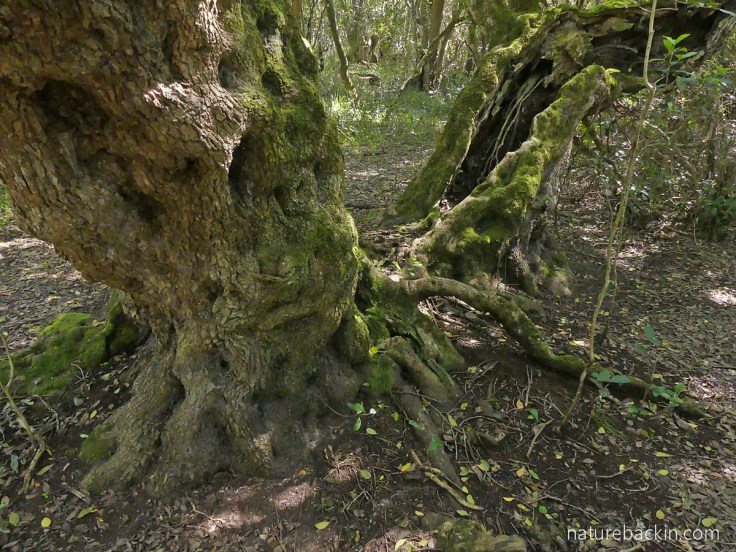
A closer view of the mossy gnarled and partly hollowed section of the trunk of the old milkwood tree at Platbos
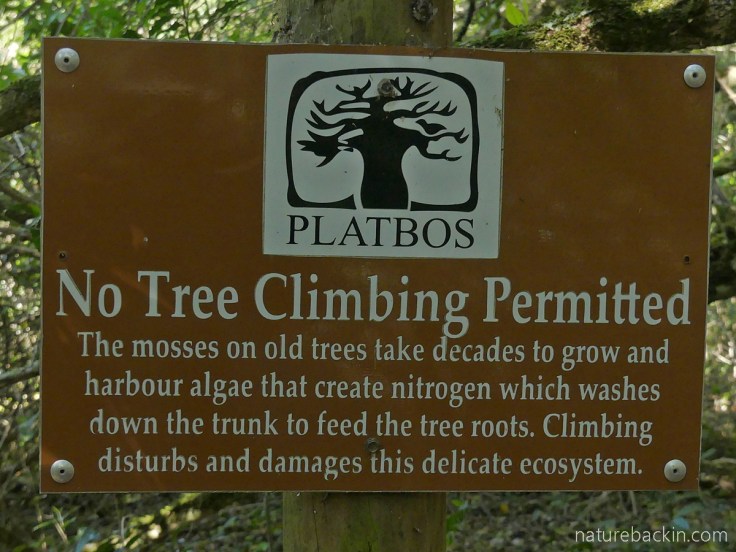
A sign advising why old, mossy trees should not be climbed
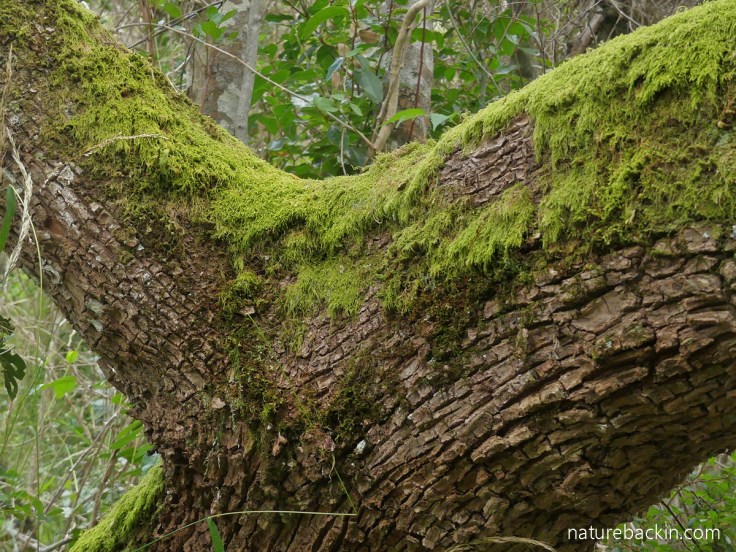
The corky bark of this tree also provides a friendly environment for mosses that in turn contribute to conserving moisture and nutrients in the forest
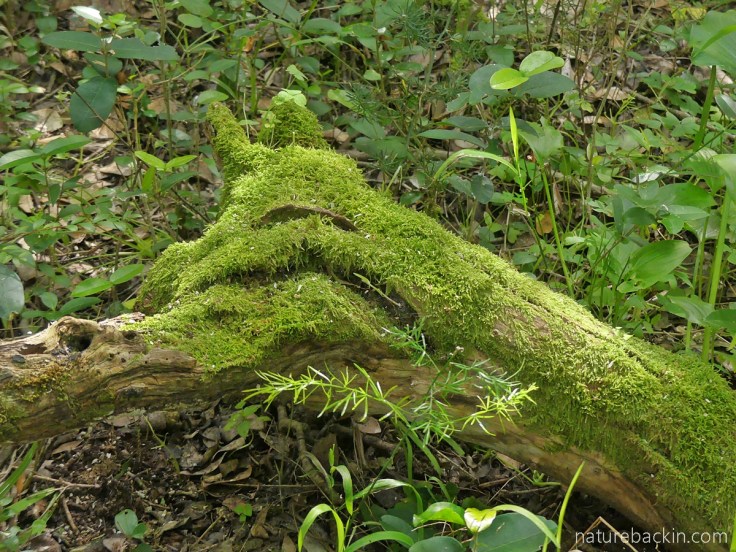
Moss growing on the fallen branch of tree with an interesting formation on the forest floor. In the above photo, forest-floor grasses, a small wild asparagus and tree seedlings can be seen growing in the fallen leaves that litter and ultimately enrich the sandy soil
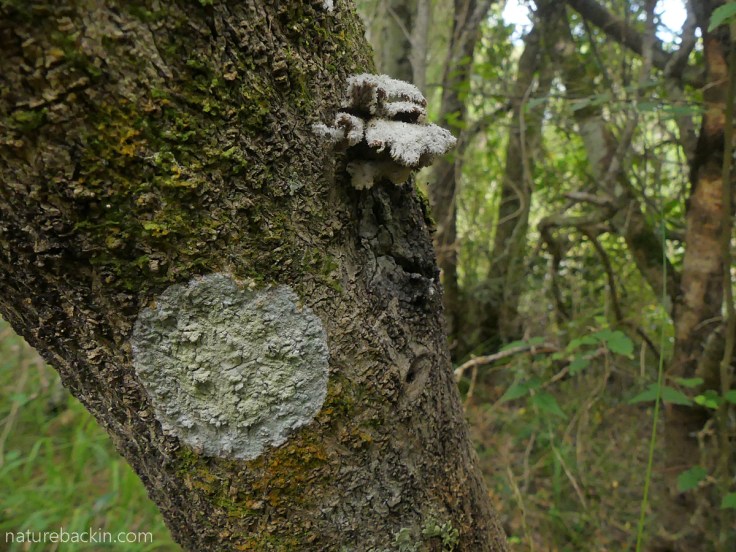
A curiously round patch of lichen forming a near-perfect circle on the bark of a tree trunk that also supports a fungi bract and moss
In general, the southern Cape indigenous forests, including the Swartkransberg forest patches, are thought to be relic or remnant forests dating back to much earlier times, thousands of years ago, when the entire region was largely forested. As the climate slowly became warmer and drier, conditions favoured more heat and drought tolerant plants, and forests “retreated” to survive in isolated damper and fire-protected patches.
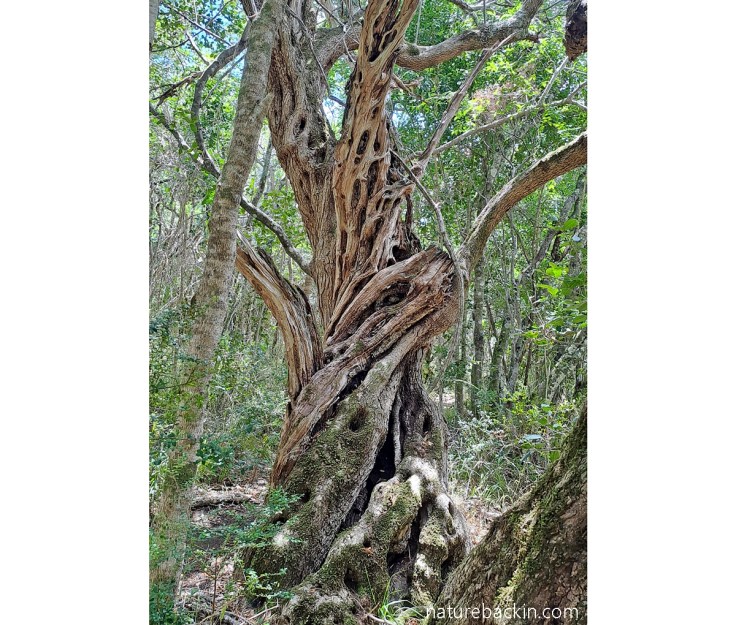
One of the larger trees in the forest – its twisted shape perhaps testimony to the harsh environmental conditions in which it continues to survive

Looking up the trunk of a white stinkwood (Celtis africana) to the canopy above
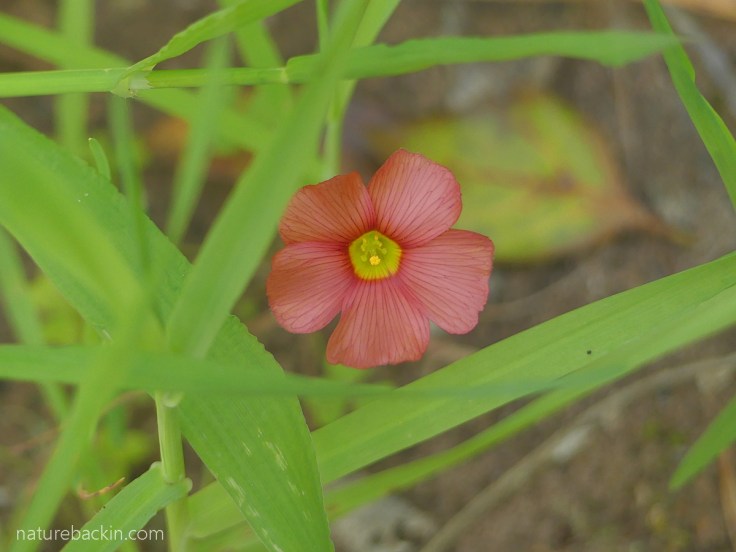
There are some flowering plants in the understory such as this brick-coloured Oxalis
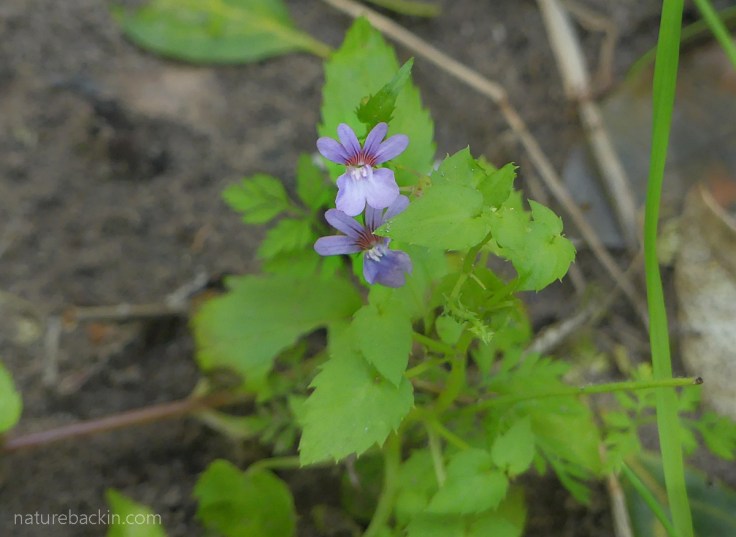
We also saw a few Nemesia plants in flower
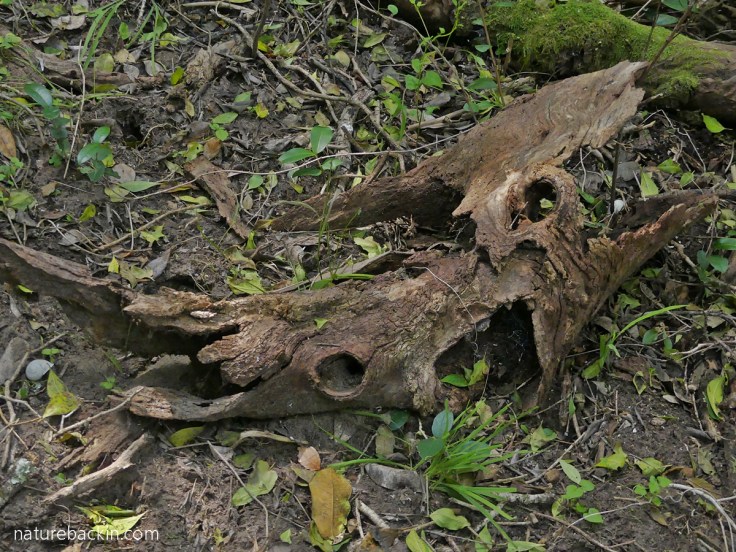
This fallen branch with large knot holes strangely evoked the skull of a mythic animal

White snail shells that have desiccated to a hard calcium-rich casing can be found amongst the leaf litter that enriches the sandy forest floor
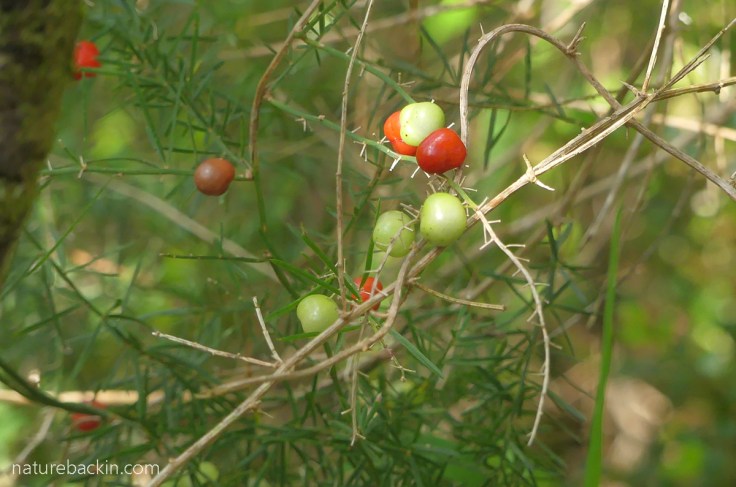
Berries ripening on a climbing wild asparagus (Asparagus aethiopicus)
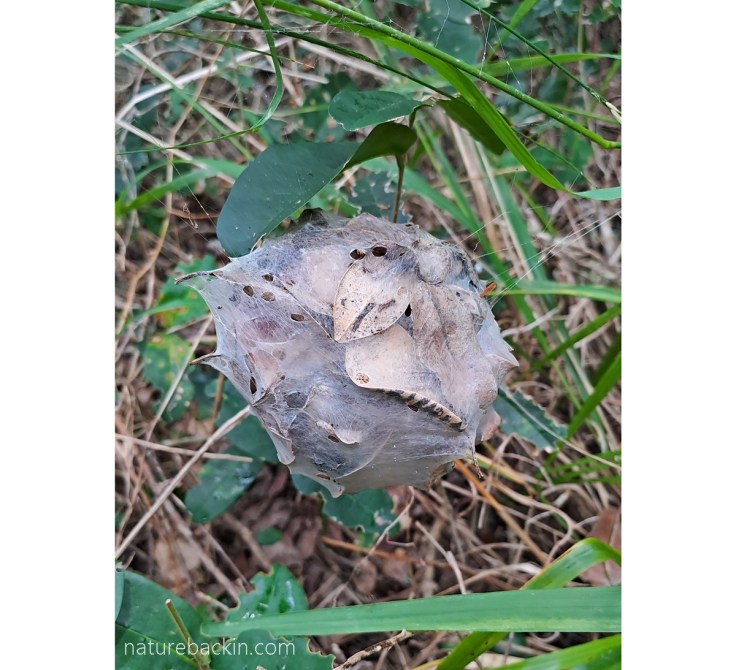
In the understory plants we came across this rain spider (Palystes superciliosus) nest or egg sac that is dextrously made from leaves woven together with silky thread. The holes in the sac indicated that baby spiders have hatched and eaten their way out of the sac
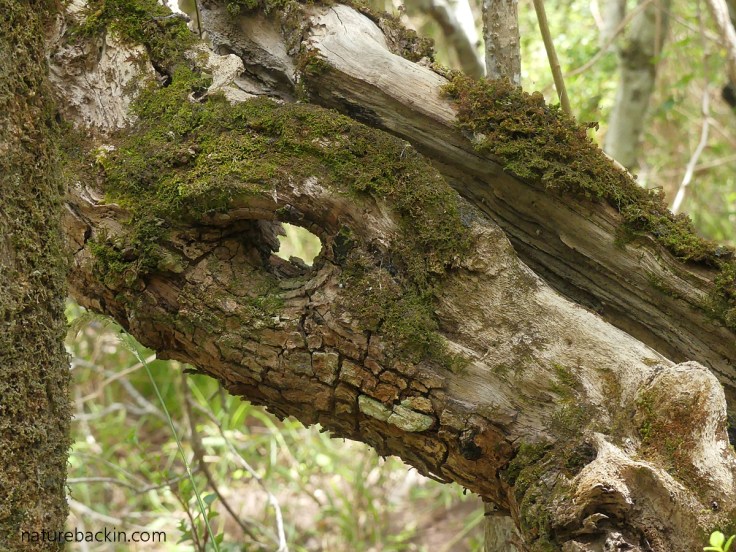
Another animal-like formation – this moss-covered branch is reminiscent of a horse’s head
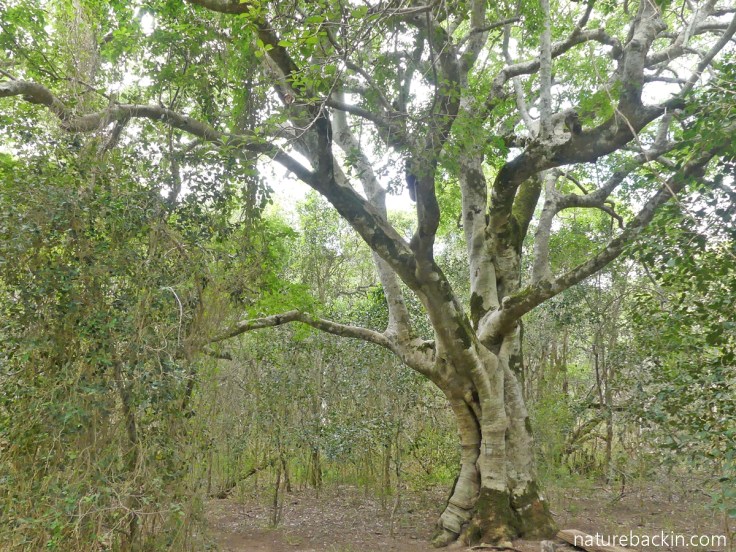
This gorgeous tree is in a relatively open place – I can’t help wondering if some kind of historical forest incursion created this opening, and if so, it will take time for the forest space to re/cover
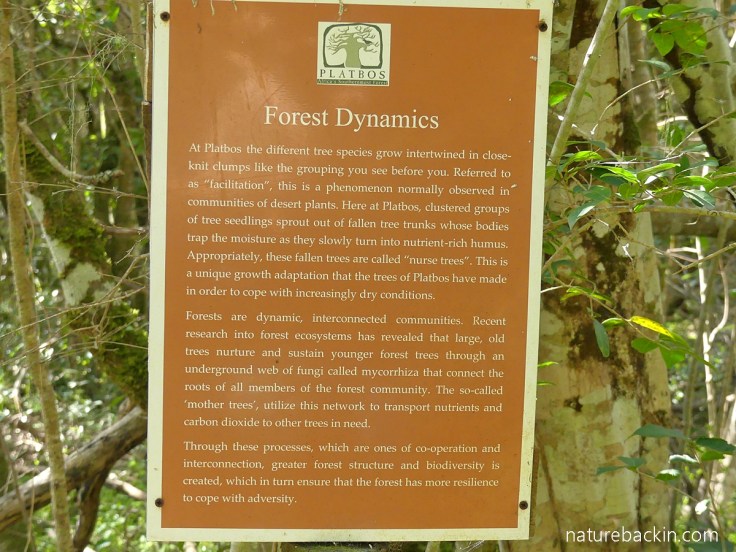
A sign explaining how fallen (or even hollow) older trees can trap moisture and nutrient-rich humus to act as nurseries for tree seedlings (and also sproutings on an older tree). This dynamic is especially important at Platbos as seedlings need to be sustained through the dry summers. “Nurse trees” can lead to different species growing close together in small communities as in the photo below
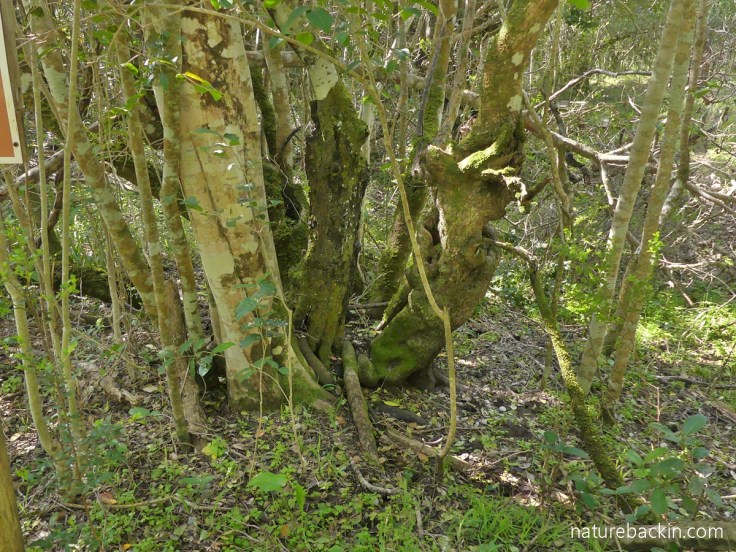
The tree community of different species growing in close proximity. As seedlings their growth and survival would have been facilitated by a “nurse tree”
In natural forests the canopy species include old, big trees that grow slowly and regenerate slowly through producing seed. Such slow-growing species are typically shade tolerant. Taking advantage of any gaps are faster growing pioneer species that are more tolerant of light.
Complicating this dynamic among the seeders, is the presence of sprouting trees that can compete with the gap-requiring seeders, as is the case at Platbos. Gaps created by human activities that include tree felling, fire or livestock grazing and trampling, for example, can favour slow-growing sprouters that are able to displace the faster-growing seeders that prior to the disturbance would likely have been the pioneer gap-seeking trees. Human-engendered disturbances in a forest can result in unintended long-term consequences for the composition and diversity of a forest. (For more see Kruger, 1994).
Protecting the perimeter of the forest, as is now being done at Platbos, may help the old forest, in time, gradually restore its species composition and recover from previous disruptions.
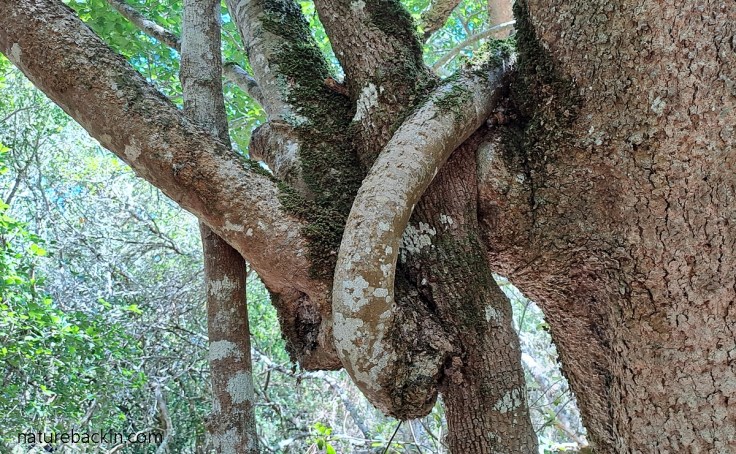
These branches bring new meaning to the notion “tree hugger”
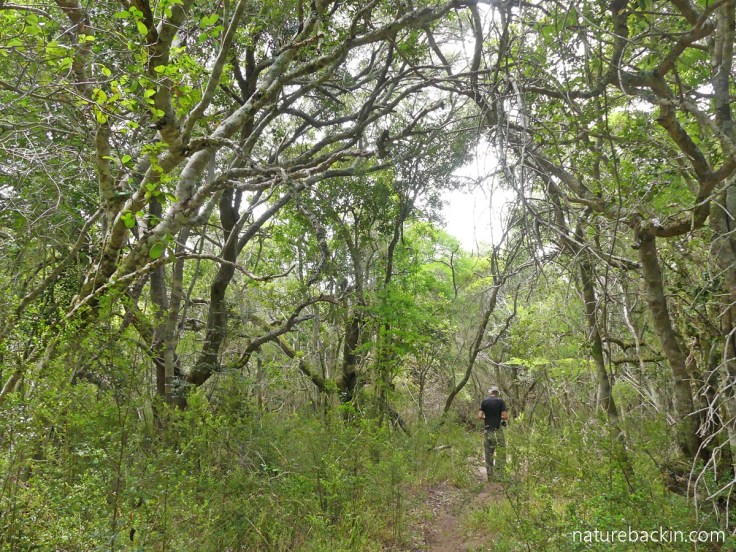
Forests such a Platbos need our protection. They have intrinsic value in their biodiversity and their growth dynamics. Their many contributions to our world include them providing food and shelter for other flora and for fauna; they contribute to improving and cooling the air and they stabilise and revitalise the soil. And also importantly, for humans they provide a sense of sanctuary, solace and a connection to nature and the Earth, and ultimately a feeling of connection to ourselves. They can help us feel rooted rather than cast adrift
Sources:
Krige, Francois. [n.d.] Milkwoods: A Plea for a Tree. https://platbos.co.za/milkwoods-a-plea-for-a-tree/
Kruger, L.M. 1994. Dynamics and Conservation Status of the Swartkransberg Forests. Ecology Project, Botany Honours, University of Cape Town. https://open.uct.ac.za/bitstreams/92136816-20bf-41c2-bdab-9b25b104724a/download
Moll, Eugene & McKenzie, Bruce. [n.d.] Most Unique Forest Patch. https://platbos.co.za/most-unique-forest-patch/
Platbos: [n.d.] Flora at Platbos Forest: A Unique Tree Composition. https://platbos.co.za/flora-at-platbos-forest/
Walker Bay Fynbos Conservancy. 2021. Guidelines for reforestation projects in the Walker Bay Fynbos Conservancy. https://fynbos.co.za/wp-content/uploads/2025/07/WBFC-Reforestation-guidelines-2021.pdf
Posted by Carol
Discover more from letting nature back in
Subscribe to get the latest posts sent to your email.


September 11, 2025 at 10:32 pm
I so very much enjoyed this enchanting visit to Platbos Forest, Carol. Your descriptions are wonderful and you gave us a beautiful array of all the life in this unusual forest. I had never heard of the milkwoods tree and wow, what a beauty. Loved all the lichen, moss, bark and flower photos.
LikeLiked by 1 person
September 29, 2025 at 6:07 pm
Hi Jet – thanks very much for visiting and enjoying the lovely Platbos forest, from the massive milkwoods to the tiny moss. It really is an enchanting place as many forests are.
LikeLiked by 1 person
August 29, 2025 at 4:24 pm
What a wonderful and fascinating article. Thank you. We have just spent nearly 3 restful weeks among the namaqualand flowers meeting many interesting people.
LikeLiked by 1 person
September 7, 2025 at 6:27 pm
And thank you. Three weeks in Namaqualand in flower season must be glorious.
LikeLike
August 24, 2025 at 9:45 am
A remarkable post. Thank you Carol for adding to Krige’s Plea for a Tree. I have been enlightened as, to my shame, I didn’t know anything about the platbos forest.
Your photographs convey the magic and mystery of this ancient forest
LikeLiked by 2 people
August 24, 2025 at 2:48 pm
Thanks Mariss. I don’t know how well-known Platbos is beyond the region.
Perhaps the upcoming Chelsea Flower Show in Stanford will help put local treasures more on the map and increase support for such projects as at Platbos.
Thanks for your comment on the photos as it can be difficult conveying any of such magic via a camera!
LikeLiked by 2 people
August 23, 2025 at 10:51 am
Carol, this is a wonderful description of this marvellous old forest. Your photos really add a lot to one’s understanding of the nature of the forest. One can’t help being in awe of the amazing people who have become the guardians of Platbos.
LikeLiked by 2 people
August 24, 2025 at 2:41 pm
Thanks Christine. It is a marvelous old forest and we are lucky to have it nearby. Also to have such committed guardians protecting the forest 🍃
LikeLike
August 20, 2025 at 3:20 pm
So much to marvel at here, Carol. Thank you for this lovely photo essay.
LikeLiked by 2 people
August 21, 2025 at 11:31 am
Thanks very much Tish. I know that you also have a special interest in old-growth forests.
LikeLiked by 1 person
August 20, 2025 at 12:24 pm
Always good to hear from you, Carol. Your description and the photos of Platbos remind me of the few remaining areas of temperate rainforest in the UK. Wistman’s Wood is on Dartmoor and is currently being slowly expanded. https://en.wikipedia.org/wiki/Wistman%27s_Wood An ancient and magical place.
LikeLiked by 2 people
August 21, 2025 at 11:30 am
Hi Sandra – thanks so much for alerting me to Wistman’s Wood, and I can see why Platbos reminded you of it. It is very interesting to read of the commonalities, and I hope the plans to protect and enlarge Wistman’s Wood are well supported going forward.
LikeLiked by 1 person
August 20, 2025 at 6:40 am
What a delight to hear from you again – and to enjoy your wonderful variety of photographs and interesting information!
LikeLiked by 2 people
August 20, 2025 at 9:53 am
Hi Anne – I keep saying I hope to be more reliably back to blogging! I have enjoyed exploring more about the amazing Platbos Forest.
LikeLiked by 1 person
August 20, 2025 at 4:49 am
Fascinating information as always Carol. It’s really quite beautiful, but when such a small area remains, it’s an uphill battle to preserve it. There are similar situations here and I reflect on the fact that one bad fire could result in the loss of an ecosystem and the plants, animals, and birds it supports.
LikeLiked by 2 people
August 20, 2025 at 9:51 am
Hi Graham – thanks. Such small forest patches are always vulnerable as you say, and the loss of an entire patch would be devastating. Incredibly, Platbos survived a massive fire in the region in 2006 and a another fire in 2019 – though the other forest patches were not so fortunate in 2006. The firebreaks seem to have helped protect Platbos, and because of those fires, alien clearance, firebreak maintenance and appropriate planting of locally indigenous trees on the margins has become a real focus. I really respect those who are committed to the ongoing protection of forest areas.
LikeLiked by 1 person
August 20, 2025 at 3:32 pm
For those who protect these kinds of areas, it’s a real labor of love.
LikeLiked by 1 person
August 21, 2025 at 11:34 am
Yes it is – and hopefully that love is spreading!
LikeLiked by 1 person
August 20, 2025 at 12:56 am
Such a unique and beautiful old forest. The elder trees are amazing!
LikeLiked by 2 people
August 20, 2025 at 9:42 am
Hi Eliza – those grand trees are incredible. The forest has its own special character.
LikeLiked by 1 person
August 20, 2025 at 4:45 pm
A bit like Narnia!
LikeLiked by 2 people
August 19, 2025 at 10:12 pm
Hi Carol, thank you this wonderful post. I cannot imagine the feeling of walking through such an ancient and unique forest. So many forests worldwide need our guardianship and protection. It is articles such as this that can make a difference.
LikeLiked by 2 people
August 20, 2025 at 9:41 am
Hi Laura – Thanks for your lovely comment. Indeed forests everywhere it seems are under pressure and need our active protection. Each one is irreplaceable, and the experience of walking in old forests can’t be matched anywhere else.
LikeLiked by 1 person