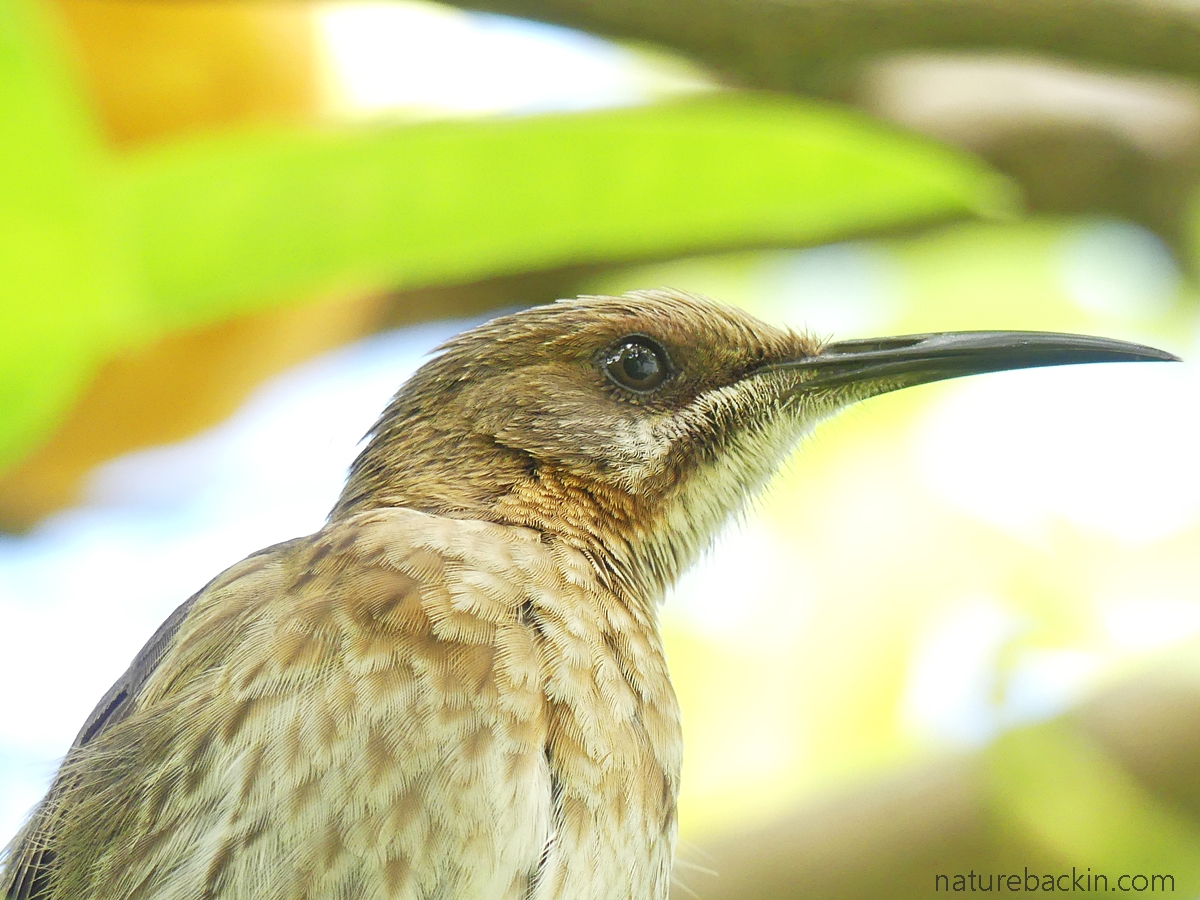
This summer, charismatic Cape sugarbirds (Promerops cafer) have been regular visitors to our garden. Named sugarbirds as they are largely nectar feeders, they are closely associated with proteas for food and shelter. Cape sugarbirds occur only in the fynbos regions of the Western Cape and into parts of the Eastern Cape.
There are the only two species of sugarbird in the genus, with the second being Gurney’s sugarbird (Promerops gurneyi). Although predominantly nectar feeders, both species of sugarbird also supplement their diet by eating insects and spiders. Gurney’s sugarbird is found further to the north (as far north as the highlands of Zimbabwe) and to the east than Cape sugarbirds, occurring in higher altitude regions of montane scrub where proteas and aloes are present.
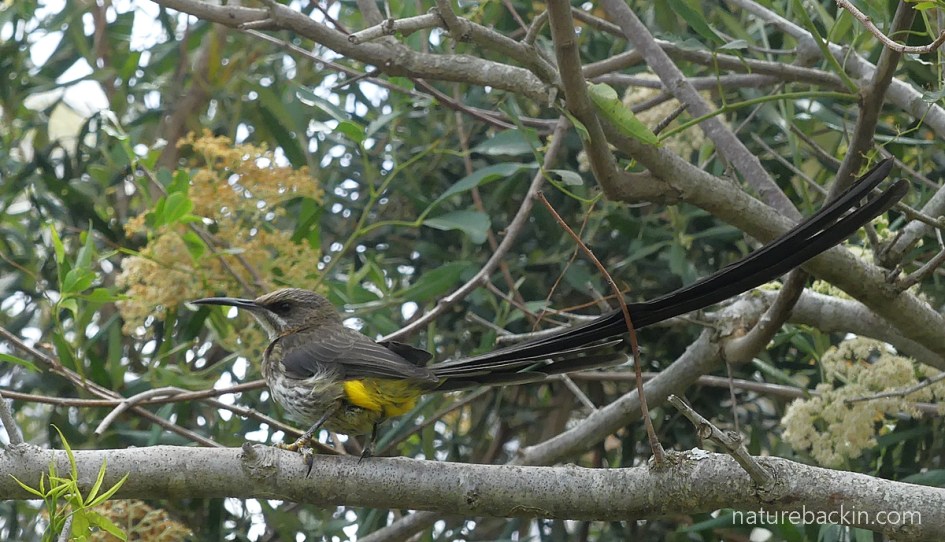
Unsurprisingly, the bill of sugarbirds is long and adapted to probing flowers for nectar. More surprising is the spectacularly long tail of the male Cape sugarbirds
The Cape sugarbird breeding season coincides with the period during the winter months when most protea species are in flower and when more nectar is available. Cape sugarbirds are decidedly territorial during the breeding season, and a high percentage of breeding pairs return to the same nesting site each year. Cape sugarbirds are not migratory, but during the non-breeding season they may be locally nomadic in response to food availability, and they tend also to move away from their territories in the aftermath of wildfires.
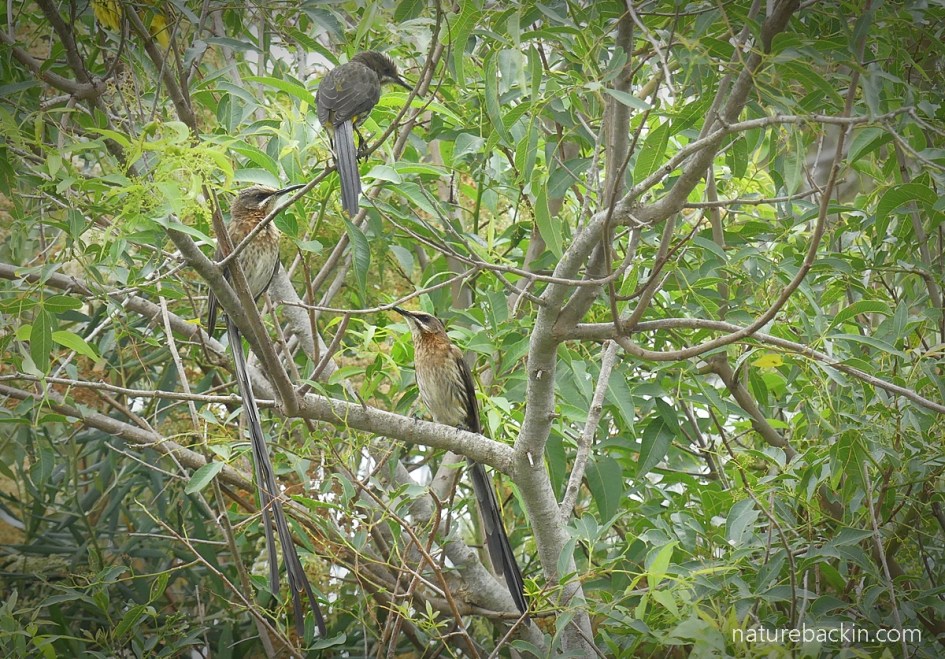
Cape sugarbirds perched in a witkaree tree (Searsia pendulina) in our garden. Females have longish tails but not nearly as long as the tails sported by the males
This summer, Cape sugarbirds have been much more of a presence in our garden than in the previous (our first) summer here. Perhaps we are being more observant, or perhaps it is the fact that a new neighbour has artificial nectar feeders in her garden that are attracting more birds to the neighbourhood, or maybe there are other variables at play? As the main breeding season is about to commence, and in the coming months of winter rainfall when the proteas in the nearby mountains will be in flower, it will be interesting to see if the visiting Cape sugarbirds move off or continue visiting.
Cape sugarbirds are hard to miss and they can be a very vocal presence. When foraging in trees for insects or when hanging out while preening after using our birdbaths, they are very ‘chatty’. Roberts (multimedia edition) describes their vocalisations as “comprising complex grating, chirping, chipping and twanging notes given in sustained series, somewhat drongo-like; interspersed with a variety of hissing and more musical notes”. (For recordings of Cape sugarbird calls, click here: https://xeno-canto.org/species/Promerops-cafer.)
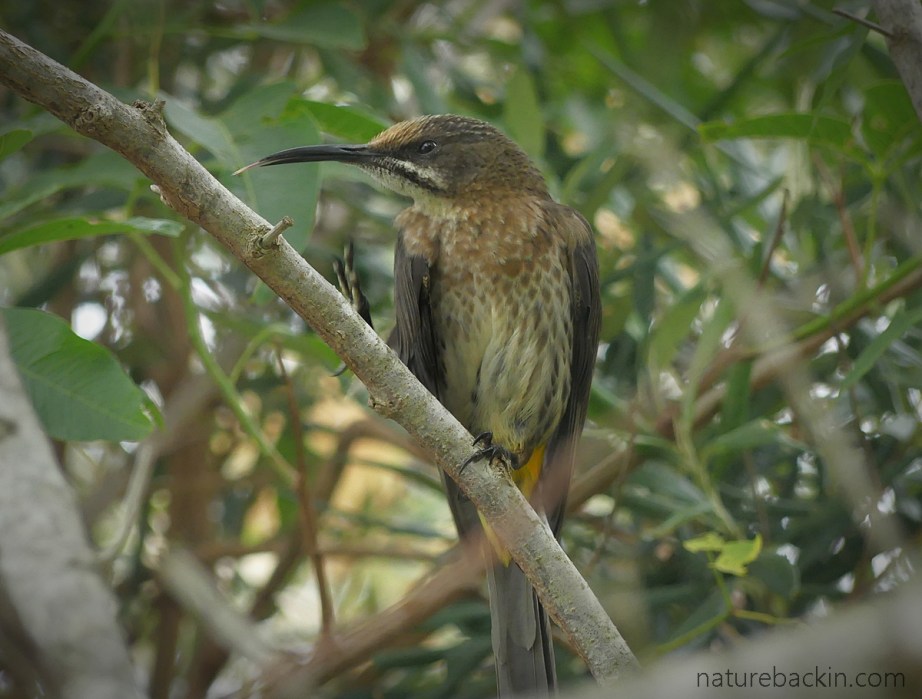
When perching in a tree in our garden, while having a scratch (its lifted right foot is just visible) this Cape sugarbird protruded the end of its long tongue. The tongue of sugarbirds is adapted for nectar feeding – it is long, tubular and brush-tipped
Although Cape sugarbirds take nectar predominantly from proteas, they also feed on flowers from other plants such as ericas (heaths), Cape honeysuckle (Tecomaria capensis), watsonias and kniphofias, and from some exotic species including eucaluptus and syzygium (sometimes called eugenia) trees. Over the past few months there have not been suitable flowers for nectaring available to them in our garden, but I have seen them gleaning small insects from foliage and flowers and I have also seen them wielding and then eating honeybees that they have caught.
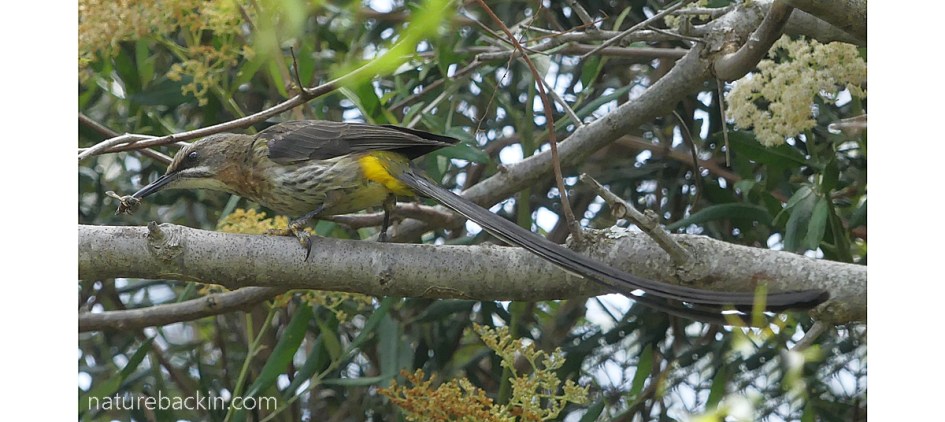
This Cape sugarbird spent some time manipulating an unfortunate honeybee in its bill before eventually swallowing it
Sugarbirds have no close relatives. The genus name Promerops, combines the Greek pro, meaning ‘close to’ or ‘similar’, with the Merops, which is the genus name for bee-eaters. In fact, sugarbirds are not related to bee-eaters, nor are they related to the Australian honeyeater family. The similarity in the structure of the skull and tongue to those of honeyeaters is a result of convergent evolution.
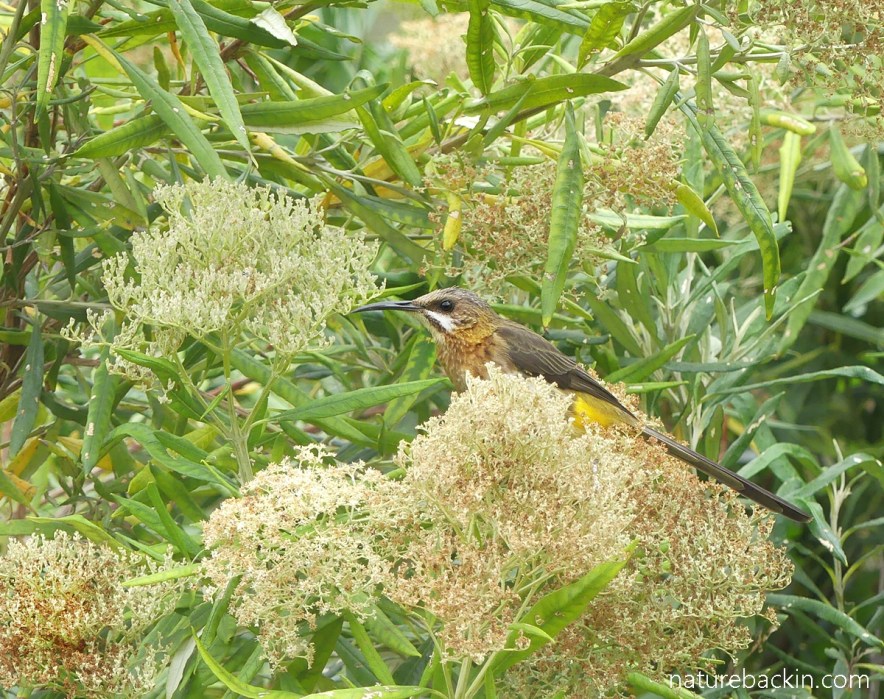
In midsummer, while the sagewoods (Buddleja salviifolia) were flowering (above), I often saw Cape sugarbirds hunting for insects in the flowers and amongst the foliage
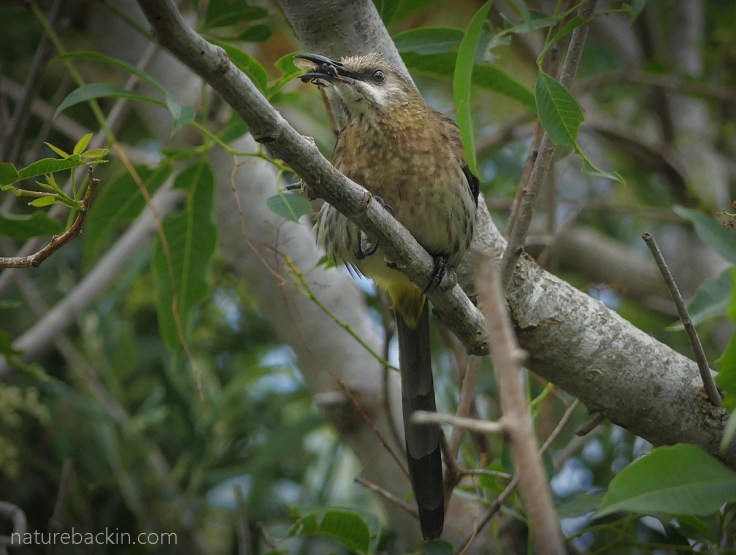
Another honeybee successfully caught. This sugarbird rapped the insect on the branch several times while working it around in its bill before finally swallowing the bee
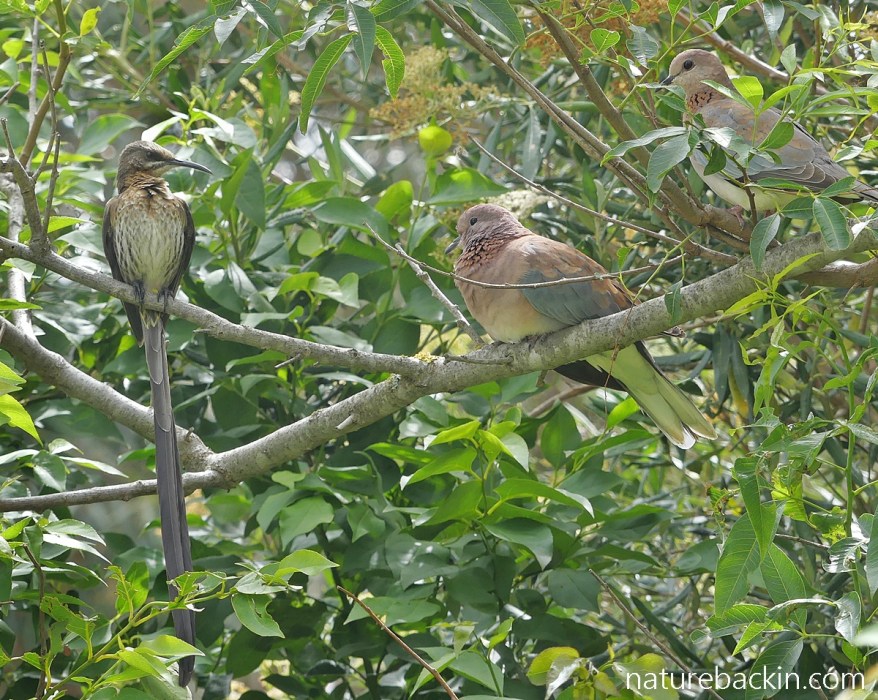
A Cape sugarbird perching on a branch in our garden in the heat of the day in the company of two laughing doves (Spilopelia senegalensis)
Like many of the birds visiting our garden, Cape sugarbirds are less active during the hottest part of the day, spending the time perching in the trees, sometimes in the company of other birds such as the laughing doves as in the above photo. Outside of the breeding season, for the most part we have not seen them exhibiting aggression to other species of birds, or to each other.
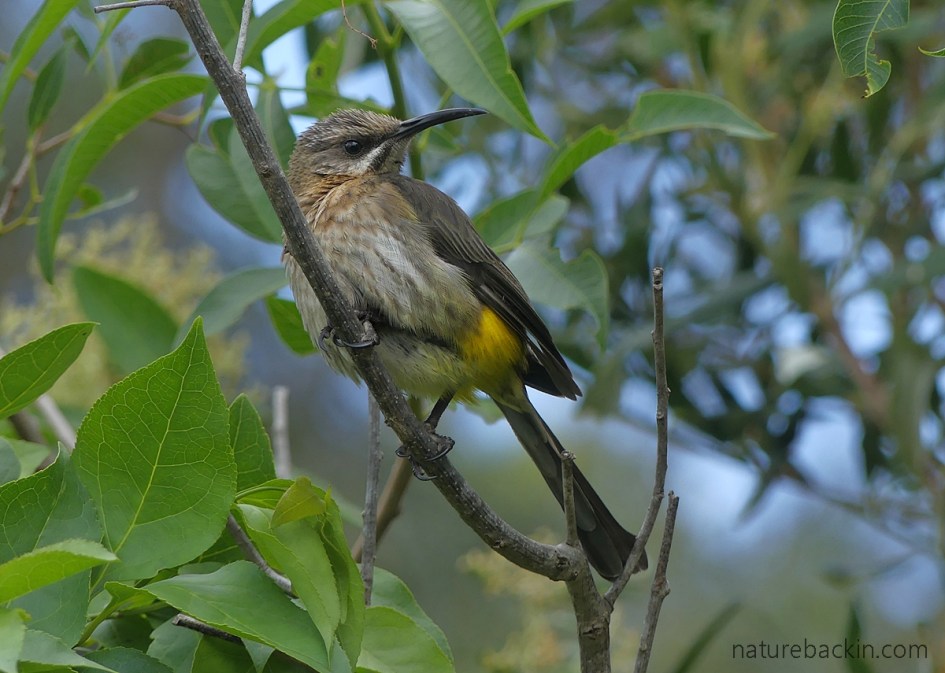
Not always apparent, is the bright yellow rump of the Cape sugarbird
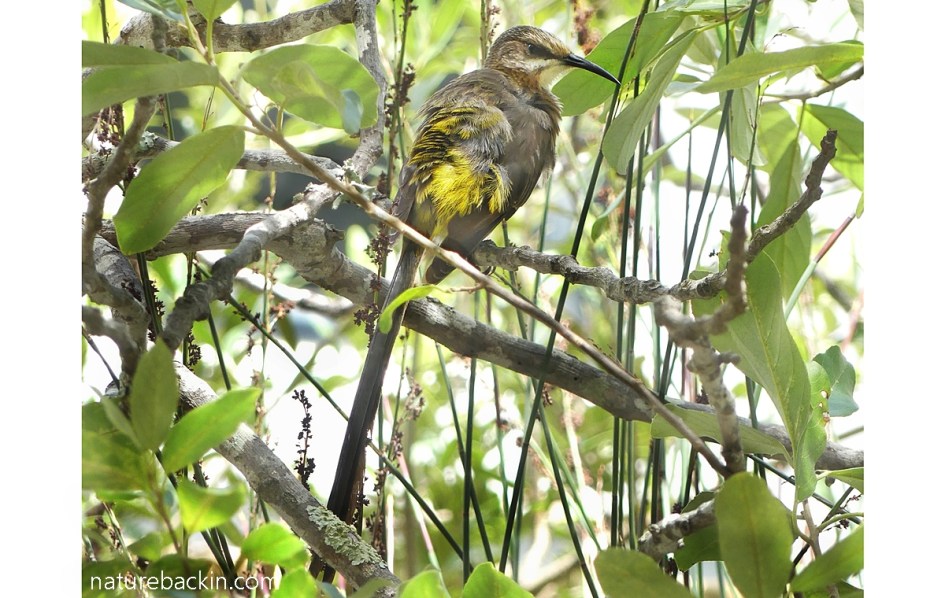
While preening, this Cape sugarbird fluffed and parted its feathers revealing more yellow colouring in its feathers than when it presents a sleeker appearance
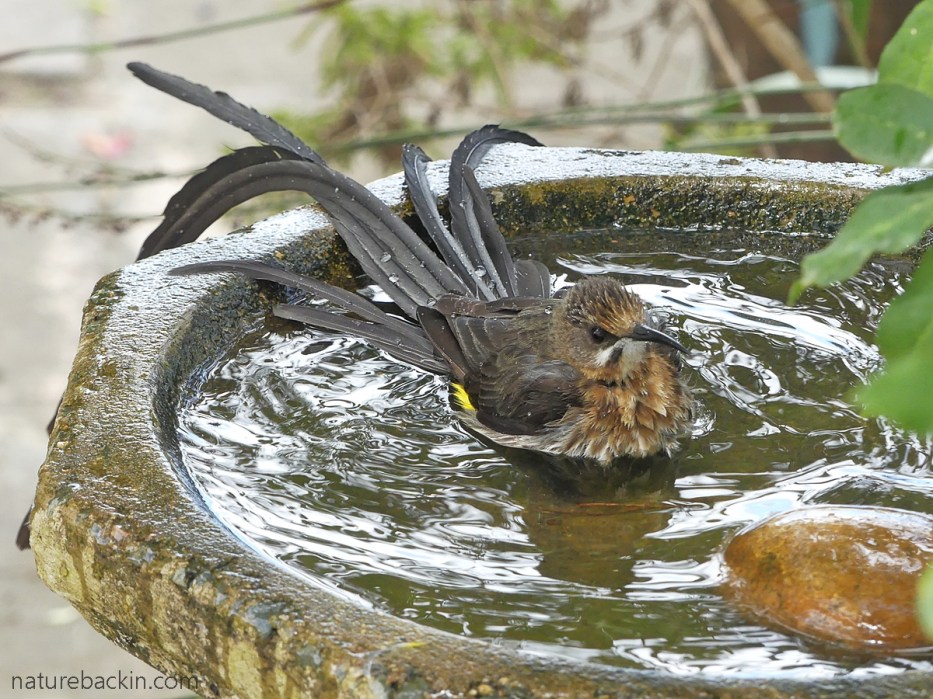
Bathtime appears to be funtime for the Cape sugarbirds. Favourite times for bathing seem to be mid-morning and mid-to-late afternoon
Bathing for the sugarbirds, who use our birdbaths daily, can be quite a splashy affair especially as they like also to saturate their tail feathers. Bathing can be quite social, and there have been times when I have seen up to six or seven sugarbirds sharing the bird bath. So far, I haven’t seen them minding sharing bathing and drinking times with other species, including Cape weavers, Cape bulbuls and Cape white-eyes.
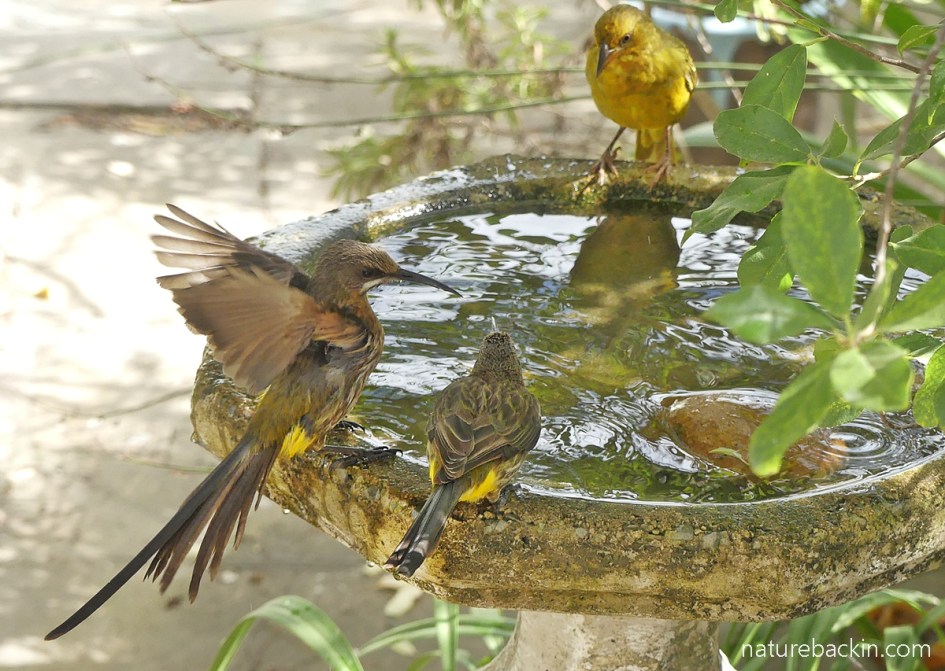
A Cape sugarbird arrives to drink, with wings still outstretched as it lands alongside another sugarbird. A weaver is about to have a drink on the far side of the bird bath
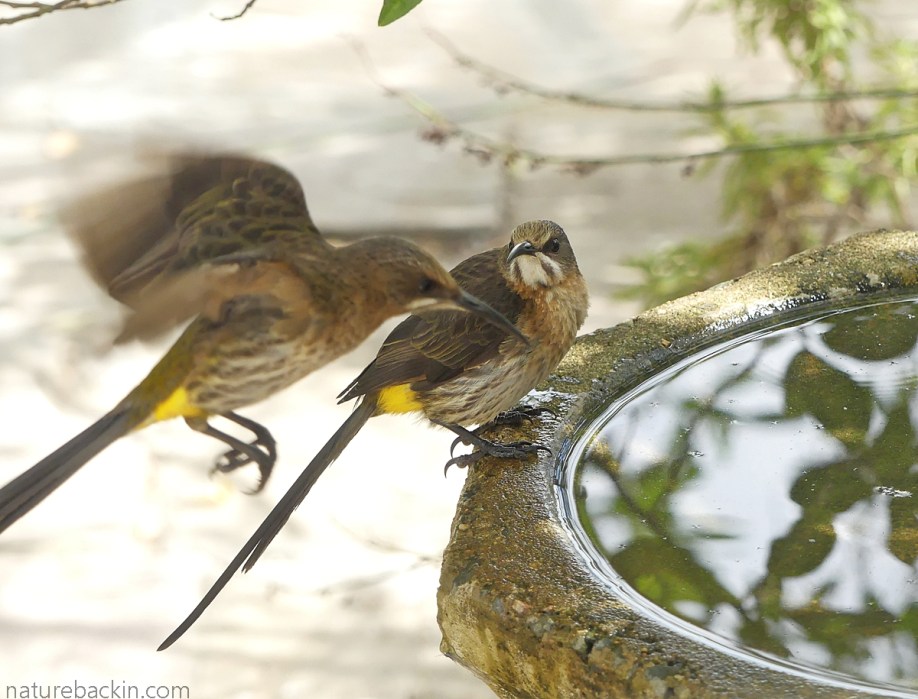
A Cape sugarbird, already at the birdbath, watches placidly as a second sugarbird arrives for a drink and a bath
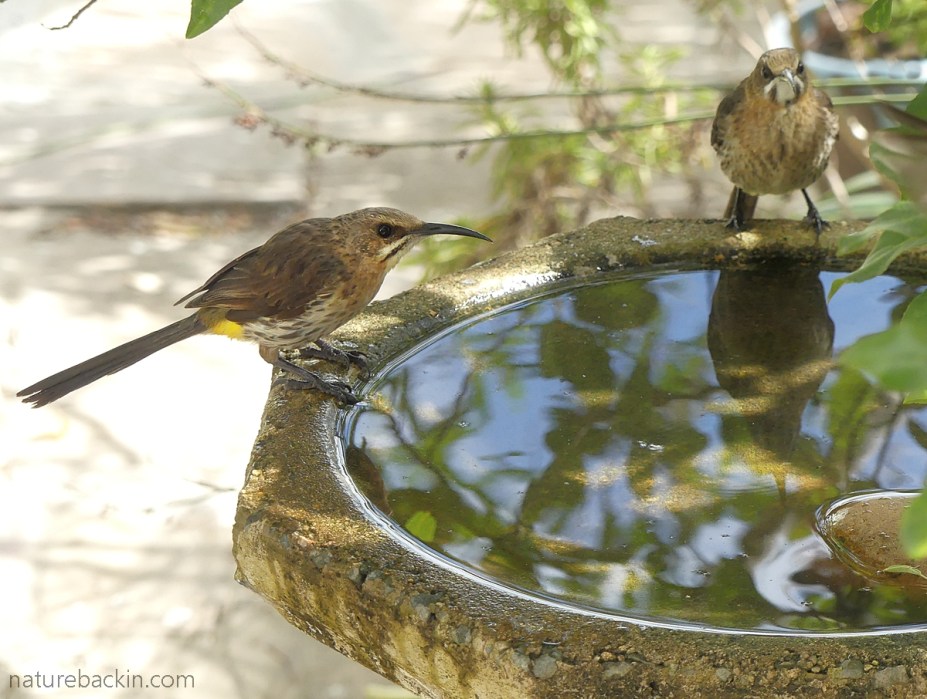
These two Cape sugarbirds were watching me somewhat warily before deciding to carry on drinking and then bathing regardless. I photographed them through a bathroom window, as I stood inside a bit precariously perched on a stool
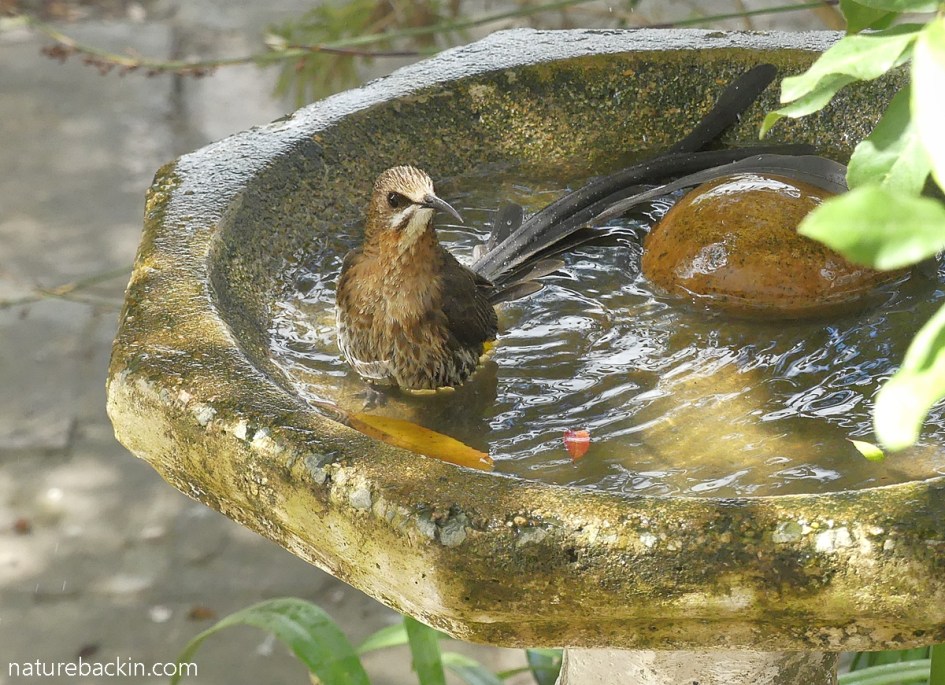
Owing to all the splashing the birdbath empties pretty quickly, but there is enough water left for this Cape sugarbird to soak its tail by vigorously shaking it in the water
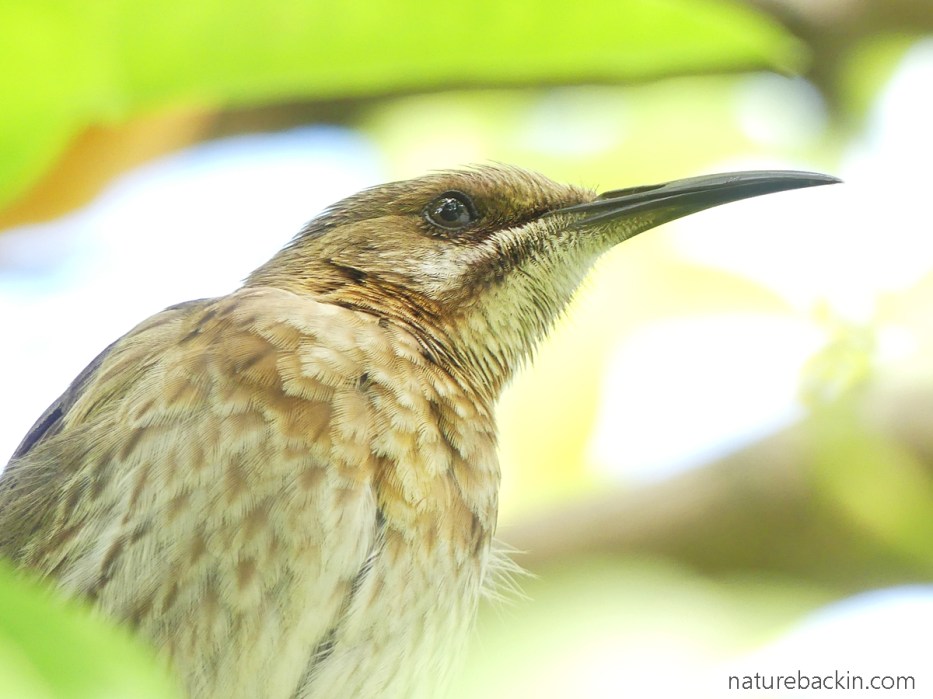
A Cape sugarbird photographed while it was foraging in our lemon tree
During midsummer, almost every morning a small group of Cape sugarbirds would congregate in our lemon tree, singing creakily while foraging for insects. This sugarbird above, allowed me to photograph it while I stood below it in the shade of the lemon tree.
Into March, the sugarbirds were no longer attracted to the lemon tree, but several sugarbirds continued to use our birdbaths daily.
Below is a video of Cape Sugarbirds bathing in one of our garden birdbaths. They are joined also by a rather possessive Cape weaver and also by some Cape white-eyes.
Now in April, the sugarbirds are no longer visiting – perhaps they have left the neighbourhood to return to the nearby mountains for the breeding season.
Sources:
Iziko Museums of South Africa. [n.d.] Promerops cafer (Cape sugarbird). Biodiversity Explorer: The Web of Life in Southern Africa. https://www.biodiversityexplorer.info/birds/promeropidae/promerops_cafer.htm
Maclean, Gordon Lindsay. 1993. Roberts Birds of Southern Africa (6th edition). Cape Town: Trustees of the John Voelcker Bird Book Fund.
Roberts VII Multimedia Birds of Southern Africa: PC Edition. 1997-2016 Southern African Birding. For details go to http://www.sabirding.co.za/roberts7/portal.html
Wikipedia. 2025. Sugarbird. Wikipedia. https://en.wikipedia.org/wiki/Sugarbird
P.P.S. Positive Postscript
In my last post of 2024, I said that I hoped to end each post by logging something positive, adding that we all need to be able to acknowledge the hopeful in these times. I haven’t forgotten, and here is a Positive Postscript for this post.
Agreement reached on expanded no-fishing zones to protect African penguin breeding colonies
The agreement between conservationists and commercial fisheries has established expanded no-fishing zones in coastal foraging areas around six penguin breeding colonies for the next ten years
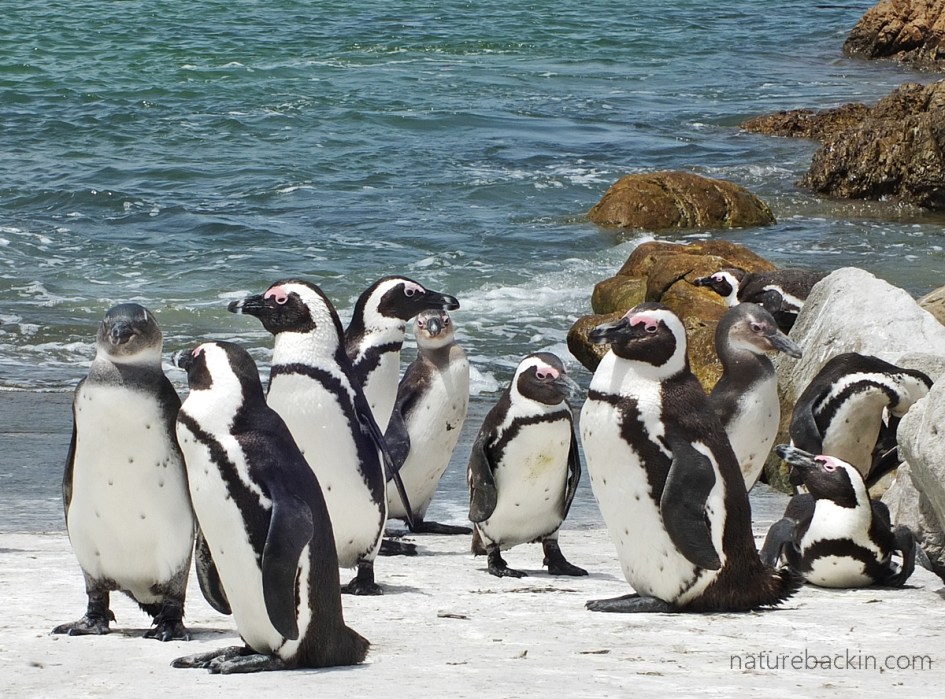
African penguins on the shore at Stony Point Nature Reserve, Western Cape, South Africa
The agreement was made a Court Order on 18 March 2025, after a hard-fought battle spearheaded by BirdLife South Africa and Southern African Foundation for the Conservation of Coastal Birds (SANCCOB) aimed at implementing expanded no-fishing zones that are “biologically meaningful” and so protect coastal foraging areas of the now Critically Endangered African penguin (Spheniscus demersus).
The two conservation bodies – represented by the Biodiversity Law Centre – successfully challenged a previous decision by the Minister of Forestry, Fisheries and the Environment (DFFE) to institute interim no-fishing zones that the conservationists argued were inadequate in size to affect meaningful protection. As a result of the Court Order, the (DFFE) was required to amend the permit conditions applicable to commercial sardine and anchovy fishers so as to maintain the expanded no-fishing-zones over the next ten years. (See https://biodiversitylaw.org/high-court-victory-for-the-critically-endangered-african-penguin/)
The six no-fishing exclusion zones are around the key African breeding colonies at Dassen Island, Robben Island, Stony Point, Dyer Island, St Croix Island and Bird Island. These six sites are home to approximately 90% of South Africa’s African penguins.
A Media Release issued by the conservationists last year, noted that the African penguin has lost 97% of its population. If current trends persist, the species will be extinct in the wild by 2035. The expanded no-fishing zones will help curb the current rate of population decline that is largely driven by lack of access to prey/food, as the penguins have been in competition with commercial fisheries for sardines and anchovies around the breeding colonies,
Dr Alistair McInnes of BirdLife SA, noted that although the case has primarily been about improving the chances of conserving Africa’s only penguin species, the closures to fishing will “also benefit other marine predator species, such as Cape Gannets, Cape Cormorants, and other socio-economically important fish that also eat sardine and anchovy, as well as the livelihoods of many who derive benefits from marine ecosystems that are equitable and judiciously managed”. (See https://sanccob.co.za/news/high-court-victory-for-the-critically-endangered-african-penguin/)
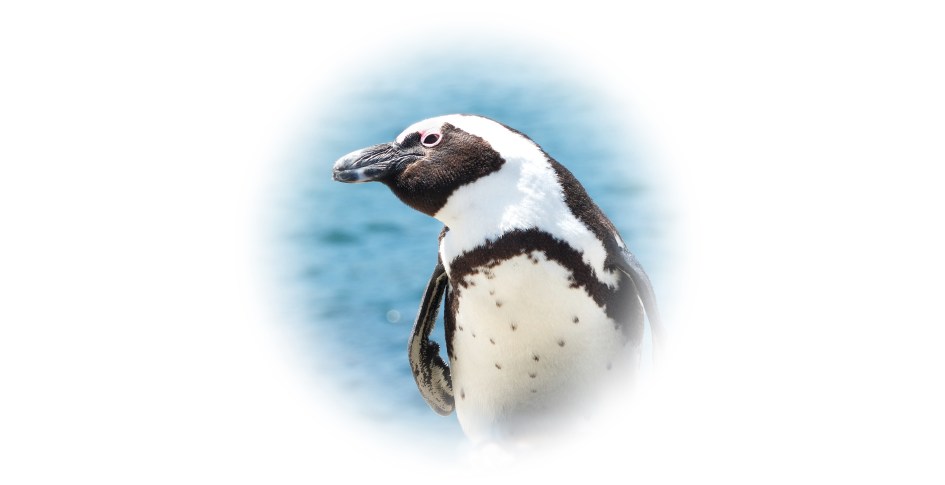
For more on the African penguin see my post: Raising awareness of the endangered African penguin
Posted by Carol
Discover more from letting nature back in
Subscribe to get the latest posts sent to your email.


May 13, 2025 at 9:43 pm
Thank you for introducing the Cape Sugarbirds. I find them very handsome and I love watching them take a bath. It was also nice to listen to their vocalizations. A suggestion, if I may: When you include a link, there is a little box you can click, “open in a separate window.” This will open your link in a second window while keeping your original one open, as opposed to navigating away from the site to look at the link, and then having to come back to your post.
It’s also nice to learn about the new legislation that will help African Penguins and other creatures. Incidentally, our local zoo is home to a small colony of African Penguins and one of them just gave birth. I hope to visit soon to see him/her.
LikeLiked by 1 person
June 27, 2025 at 6:34 pm
Oh thanks – yes I recall that I used to be sure to do that, but I have been overlooking it. Thanks very much for the reminder to open a video link in a separate window.
Oh that will be lovely to see the baby penguin at the zoo.
LikeLiked by 1 person
May 13, 2025 at 8:15 pm
Wonderful Post, Carol. Thank you so much for sharing your lovely images and narrative about the Cape sugarbirds. I’ve never heard of a sugarbird, but wonder if they are related to Sunbirds? Also love your positive postscript! What a great concept!☺️
LikeLiked by 1 person
June 27, 2025 at 6:31 pm
Thanks Carol – so sorry about my delayed reply. Sugarbirds are not related to sunbirds but they are both adapted to feeding on nectar. Glad you appreciated the positive postscript – not always easy to find unfortunately.
LikeLiked by 1 person
April 23, 2025 at 11:54 am
Another beautiful post. Thank you for introducing me to the Cape sugarbird and for sharing their frolicking and feeding in your garden through your remarkable photographs. The birdbath scene is remarkable. They do indeed have long tails!
LikeLiked by 1 person
May 8, 2025 at 12:05 pm
Hi Mariss – sorry about the delay in my reply. The sugarbirds are entrancing, and new to us too with us being from KZN, although we did on occasion see the other species in the Drakensberg.
LikeLiked by 1 person
April 23, 2025 at 10:06 am
I so enjoyed learning more about these lovely birds and your photos are really wonderful! What a privilege to have them visit your garden, Carol.
LikeLiked by 1 person
May 8, 2025 at 12:04 pm
Hi Christine – apologies for the delayed response. Yes we are privileged. They have now disappeared and we are assuming they have returned to the mountains and proteas for the breeding season.
LikeLike
April 18, 2025 at 8:32 am
Interesting species, and not one I was familiar with. Thank you for introducing it and I love the bathtime photo with the splayed tail.
As an aside, I am trying to grow a small lemon tree in my greenhouse this year. Hoping it’ll cope but it would probably be happier in your climate!
LikeLiked by 1 person
April 18, 2025 at 2:09 pm
Thanks Adele. It is interesting to watch how adept they are at wielding those big tails.
I hope the lemon tree thrives in the greenhouse. I think there are smaller varieties suitable to be potted? I do confess that we have a lemon tree that does very well here.
LikeLike
April 17, 2025 at 1:22 pm
I’d never heard of sugarbirds before. They’re far less gaudy than their American cousins (are they in fact related to hummingbirds, or is it only the beaks that are similar?). How lucky to be able to observe them in such detail, and to have them as constant companions at the birdbath. Great news about the penguins too!
LikeLiked by 1 person
April 17, 2025 at 8:06 pm
Yes we are very lucky to have had such lovely visitors this summer. Sugarbirds are from a different family to hummingbirds. Where they look similar is because they are both adapted to feeding on nectar. Unlike hummingbirds, sugarbirds do not usually hover to feed. Apparently, their tails help them balance almost acrobatically, for instance when hanging upside down when feeding from flowers.
LikeLiked by 1 person
April 18, 2025 at 6:30 am
Ah, that makes sense. I can see they are the same but different! What lovely garden visitors.
LikeLiked by 1 person
April 16, 2025 at 6:54 pm
Your post has been a joy to read.
LikeLiked by 1 person
April 16, 2025 at 8:31 pm
Hi Anne, and thanks so much for reading it. They are lovely birds.
LikeLiked by 1 person
April 16, 2025 at 5:27 am
That’s a very distinctive bird and a most impressive tail. The bird bath is clearly a huge draw. I should put one out here. Good news about the penguins too.
LikeLike
April 16, 2025 at 6:07 am
The sugarbirds are distinctive. They are new to us after our move. I highly recommend a birdbath in the garden. We have 4 and each has its own ‘community’ of birds. In fact one is a wall fountain but due to demand we added a pot full of pebbles to enable the birds to bath in there too!
LikeLiked by 1 person
April 17, 2025 at 4:48 am
I recall that you had some at your former home, too.
LikeLiked by 1 person
April 17, 2025 at 12:55 pm
Yes we did – and happily taken over by the new homeowners to give the birds continuity!
LikeLiked by 1 person
April 16, 2025 at 12:18 am
Loved the video of the sugarbirds bathing, and seeing the white-eyes, another pretty bird. Sugarbird heads remind me of our hummingbirds, similarly they are nectar-feeders. Love those long tails!
LikeLike
April 16, 2025 at 6:04 am
Hi Eliza – thanks. Glad you enjoyed the video. The white-eyes are very cute. The long tails of the sugarbirds are amazing. There is some special about the nectar-feeding birds.
LikeLike