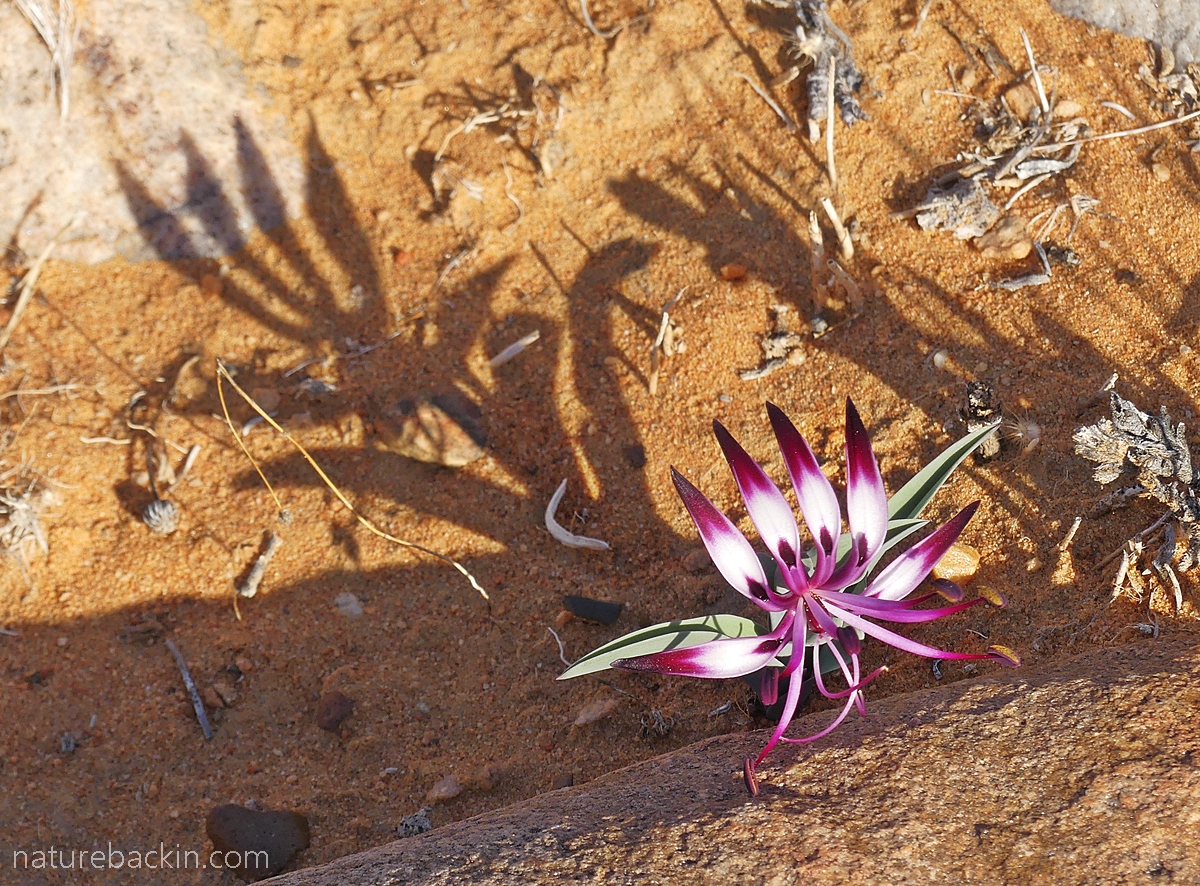
Arid it is in the Tankwa Karoo, but there is life to be found on the stony ground if one slows down and refocuses – generally a satisfying thing to do, and especially so when travelling to new places. And the rocks and stones are interesting not only to geologists and archaeologists. Their variety in colour, form and density are interesting to anyone – though the stones do have their drawbacks for those travelling by road!
Some readers may have recognized the subtitle of this post as coming from the 1972 hit song ‘A Horse with No Name’ by the band America (and written by band member Dewey Bunnell). There are those who think the song is coded for a heroin trip (‘horse’ being slang for heroin at that time) but the band maintained it was about the experience of escaping to an actual desert. (Perhaps it could be both and needn’t be either/or?)

Here is the first verse of ‘A Horse with No Name’. It is not exactly lyrical, but the down-to-earth style is evocative of a desert or at least of an imagined desert.
On the first part of the journey
I was lookin’ at all the life
There were plants and birds and rocks and things
There was sand and hills and rings
The first thing I met was a fly with a buzz
And the sky with no clouds
The heat was hot and the ground was dry
But the air was full of sound

The remarkable coiled leaves of the desert-adapted whirlwind tamarak (Albuca concordiana)
It is thought that the coiled leaves of several karoo species of geophytes – that is plants with tubers, bulbs or other underground storage structures – help the plants more effectively collect and retain moisture from dew and fog. The whirlwind tamarak is one of several species of geophytes with curled leaves that occur in the Succulent Karoo region, of which the Tankwa Karoo is a part.

A group of ostriches (Struthio camelus) in the Tankwa region. Tafelberg, a distinctive flat-topped mountain in the Cederberg range can be seen in the distance
It is possible that these are wild ostriches, but they might also be domesticated ostriches, which are widespread in South Africa. Domesticated ostriches are farmed for meat, feathers, leather and eggs. They are a mixed breed of South African, North African and Arabian ostriches.

Some areas in the Tankwa Karoo are very rocky indeed. Fossilised impressions from ancient plants and other organisms are clearly visible in some of the rocks
The larger Karoo basin was formed and sediments were slowly deposited into the basin even before the slow breakup of Gondwana, very many millions of years ago. Suffice to say here – sedimentary sandstone and shales are the predominant rocks in the Tankwa region.
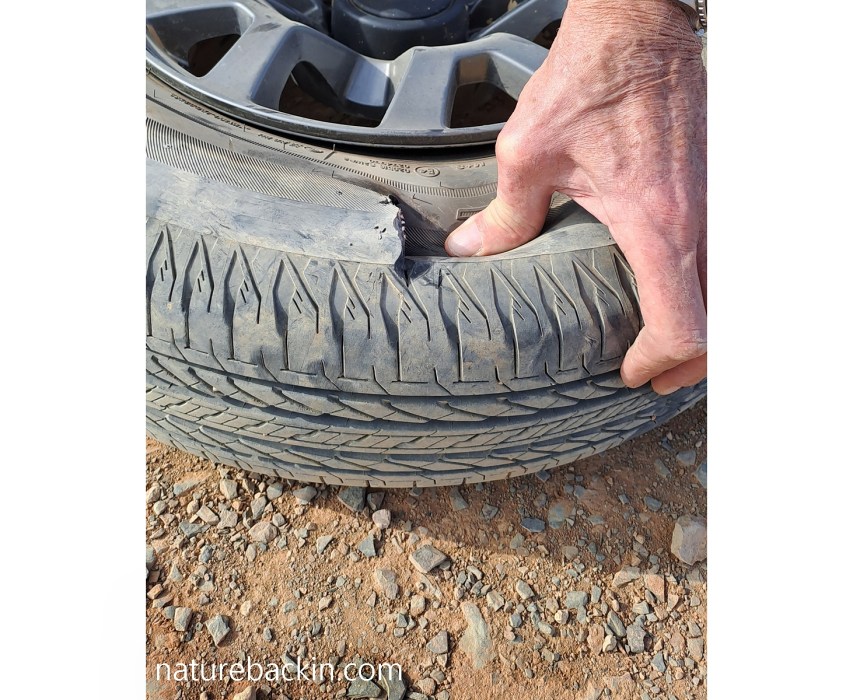
An almost inevitable puncture in the Tankwa – a sharp stone slashed the sidewall of one of our tyres
A downside to the thousands of rocks and stones is that travellers to the Tankwa are warned about the sharp stones that are a danger to tyres. We only drove at a sedate and cautious pace, and the section of road we were travelling on looked harmless enough when we had our puncture. But it only takes one sharp stone at the wrong angle to do serious damage. There seems to be different schools of thought as to whether or not it is advisable to deflate one’s tyres slightly when travelling here.
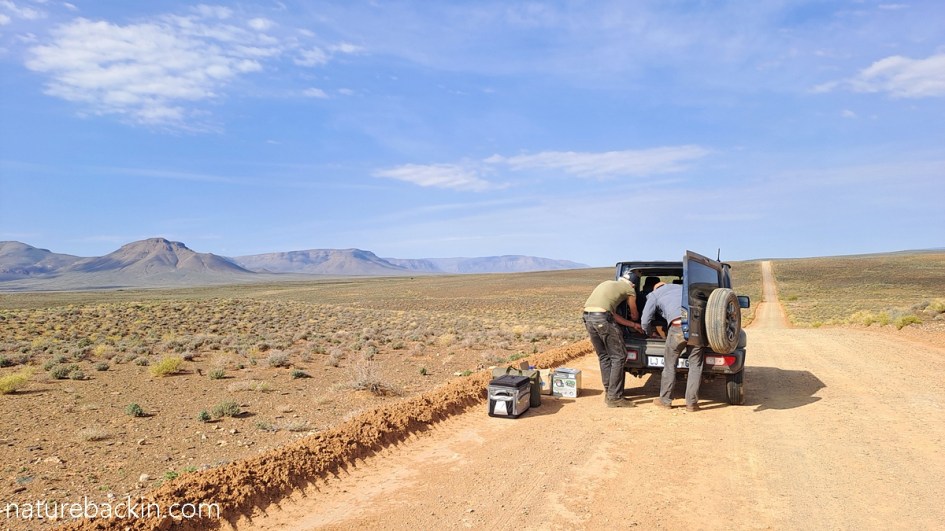
I took this photo after my travel companions had changed the wheel due to the puncture sustained on a stretch of road that looked pretty tidy
We were very lucky to get only one puncture on our trip, especially as we carried only one spare wheel. It is advisable to take two spare wheels when travelling in the Tankwa and to take a full tyre-repair kit too. Of course, many travellers get through unscathed and some pride themselves on this success being due to their driving skills. Obviously cautious driving reduces the risks, but not getting a puncture is down to luck as much as anything else.

The flower of the Karoo slangkop (Ornithoglossum undulatum), which is also the subject of the header photo. I placed my shadow over the plant to try to get less harsh light for this photograph. This perennial plant, a desert plant that flowers in autumn and winter, occurs naturally in winter-rainfall regions of southern Africa, these regions being Western and Northern Cape and northwards into parts of Namibia and eastwards into arid parts of the Eastern Cape
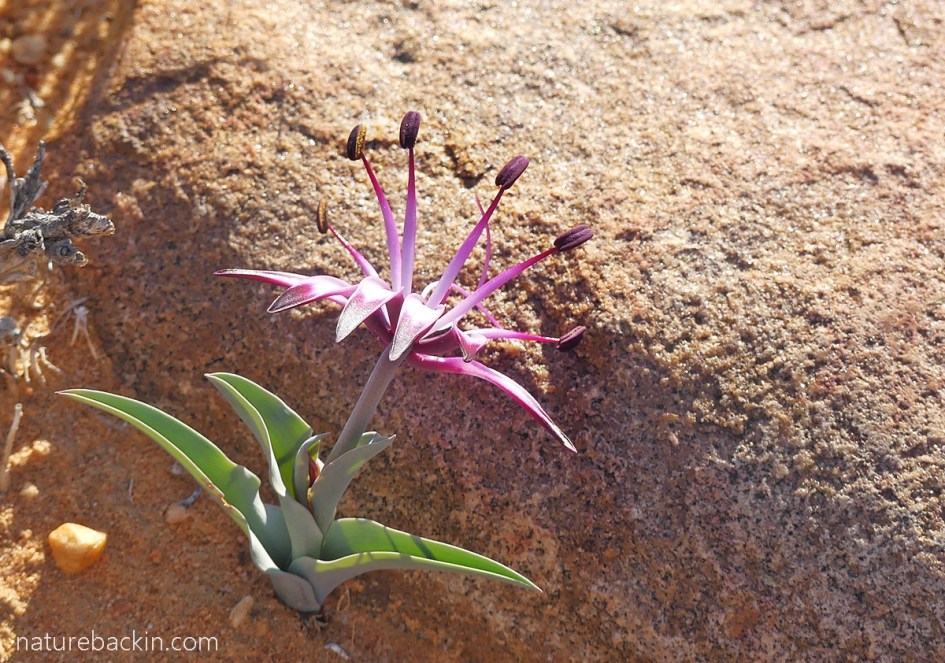
Another angle on this fascinating plant. The plant loses its leaves in the hot dry summer months when the corms are dormant underground. The plant is poisonous and is fatal to humans and animals if eaten

This Spotted Eagle-Owl (Bubo africanus) was standing stock-still on the edge of a dirt road, but flew off a little way after we stopped. The road, though a main route, does not see much traffic. These owls hunt mostly at dusk or at night. Nesting sites are variable and include being on the ground, on ledges of cliffs or even buildings and in hollows in tree trunks

Interesting shale formations in a dry river bed. This section of the river is below an artificial dam wall and the rock is exposed as the river bed has been scoured out by intense flooding over the dam wall after periods of heavy rainfall and flash flooding
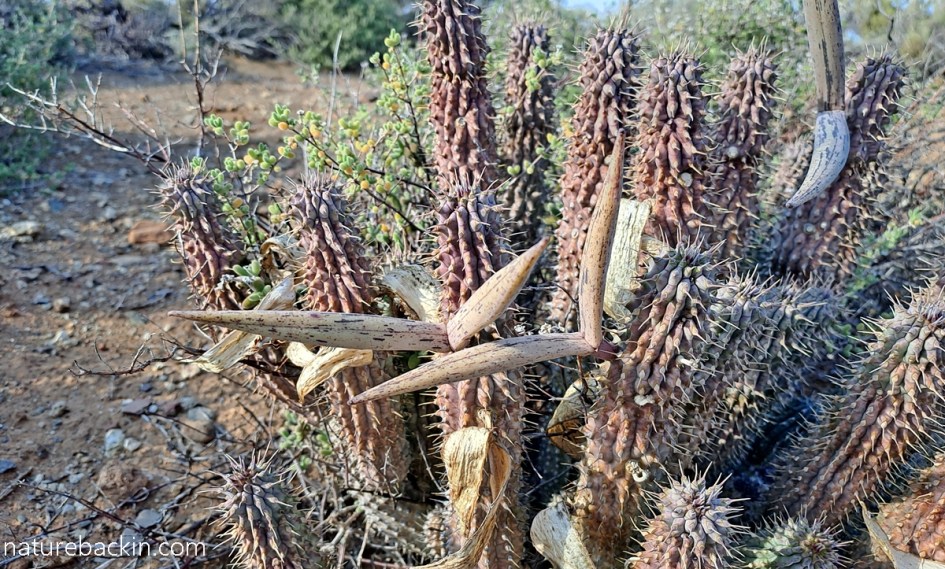
The hornlike seed pods of the wild or bitter ghaap (Hoodia gordonii) become prominent after the plant has flowered. This spiny succulent was used traditionally as a medicine including as an appetite suppressant. Somewhat controversially it has been marketed and sold internationally as a weight loss supplement. This Wikipedia entry provides an overview. Unfortunately, international demand resulted in overharvesting causing a severe decline in the species in the wild, but harvesting is now subject to strict controls
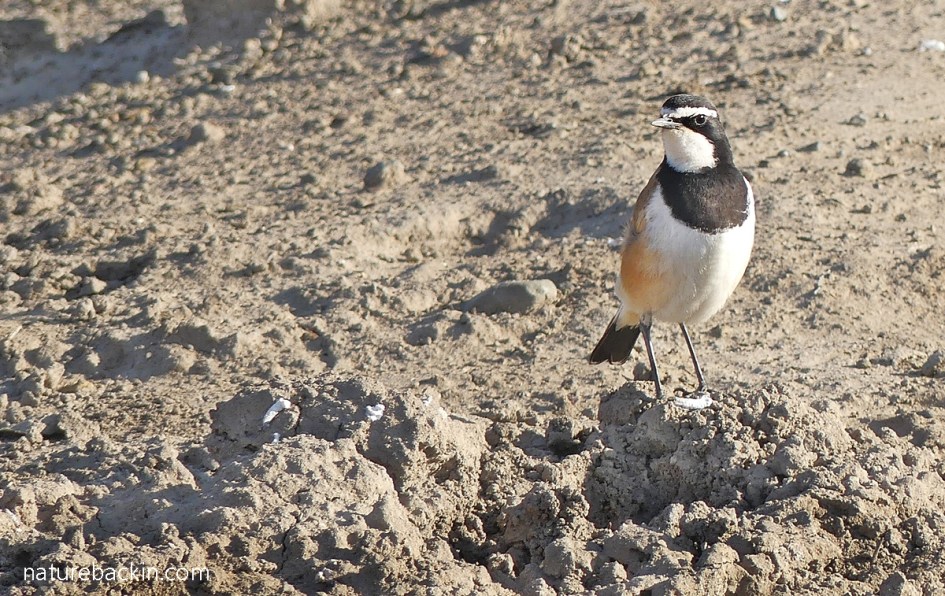
Found over most of South Africa except for the eastern regions, the rather dapper capped wheatear (Oenanthe pileate) forages mostly on the ground for prey that includes insects, spiders and millipedes

An angulate tortoise (Chersina angulata) crossing a dry river bed in the Tankw Karoo. Less than a week after I took this photo, this river was in flood after heavy rain and snow
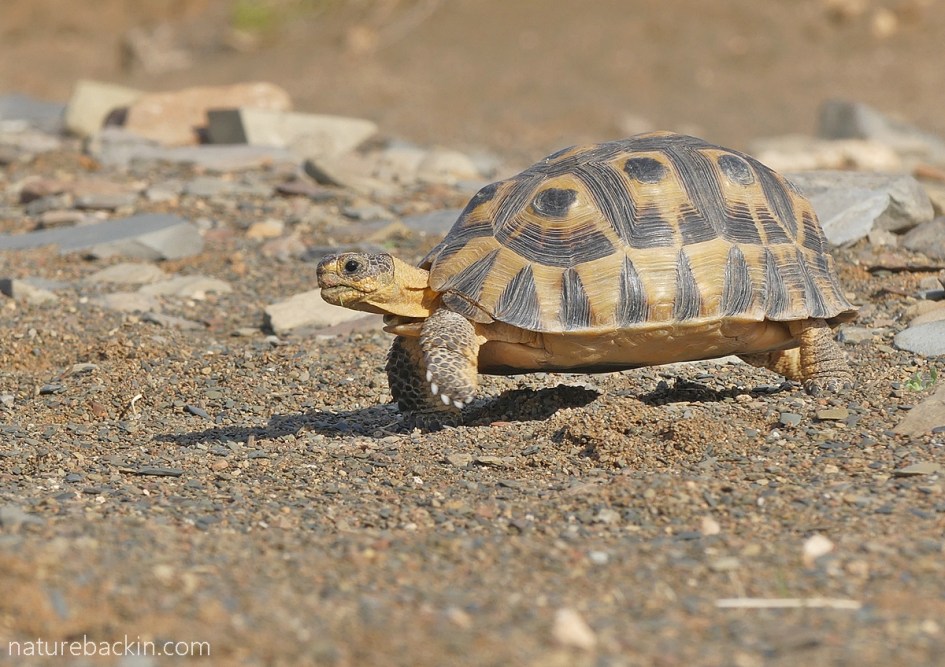
A closer look at this wild tortoise making its determined way across the riverbed
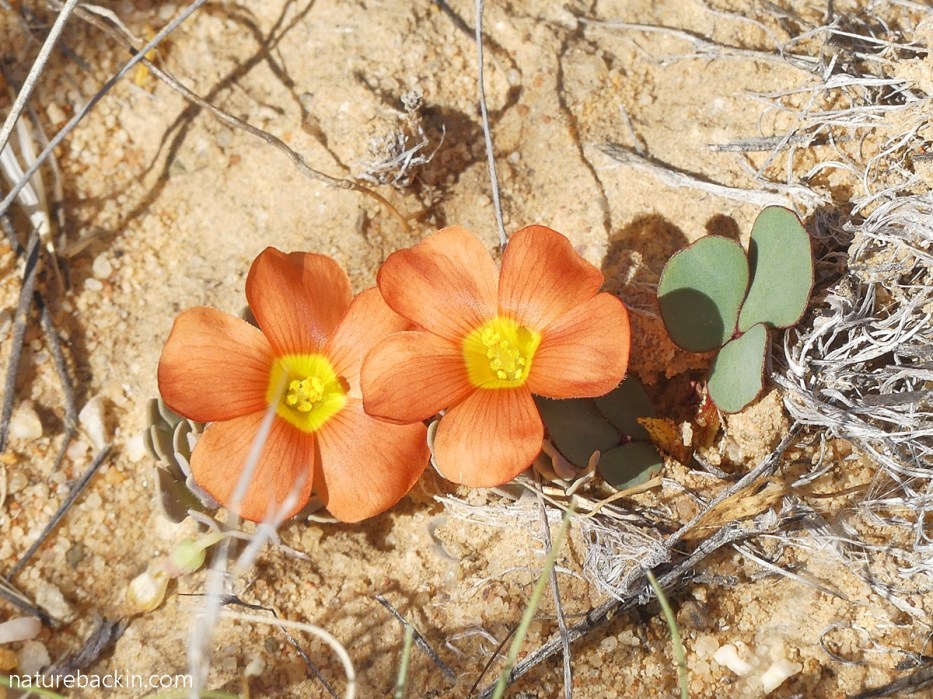
Several species of oxalis (woodsorrels) occur in the Tankwa region. This one is a is a particularly lovely colour

The tubers of this tiny oxalis plant will enable it to survive in the arid conditions. The leaves being flat on the ground appear to be adapted to collecting moisture and perhaps also to regulate temperature
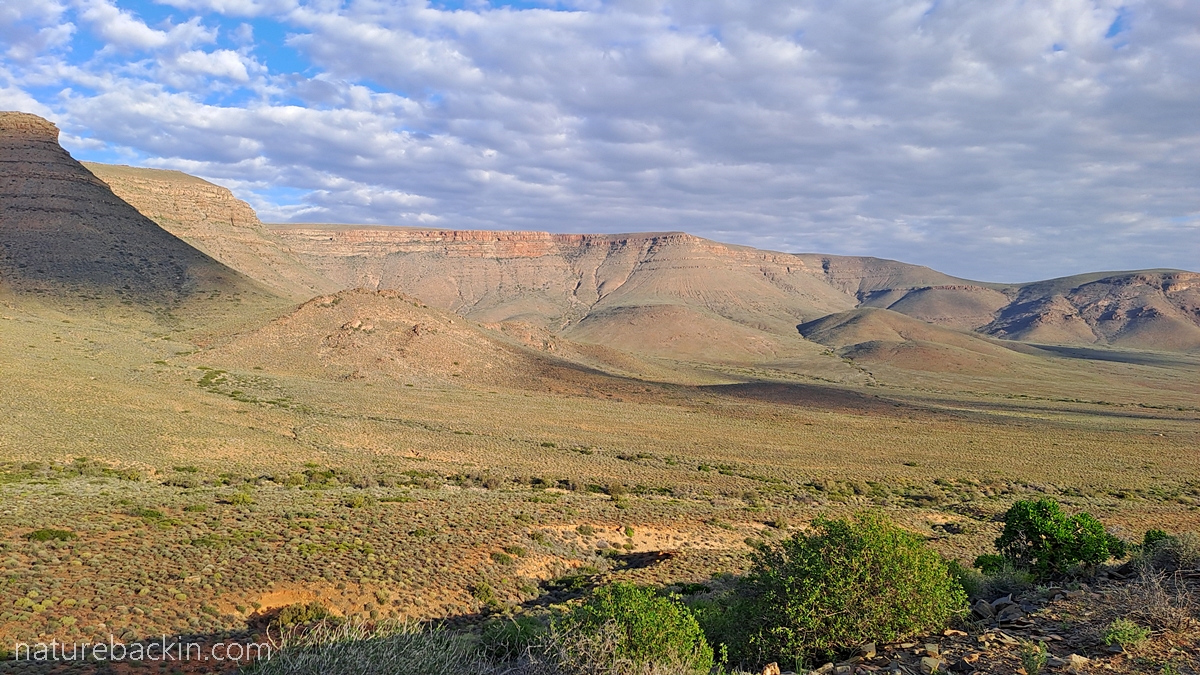
After descending the Gannaga Pass and dropping down into the Tankwa Basin, there is a view of the Roggeveld mountains rising up on the eastern side
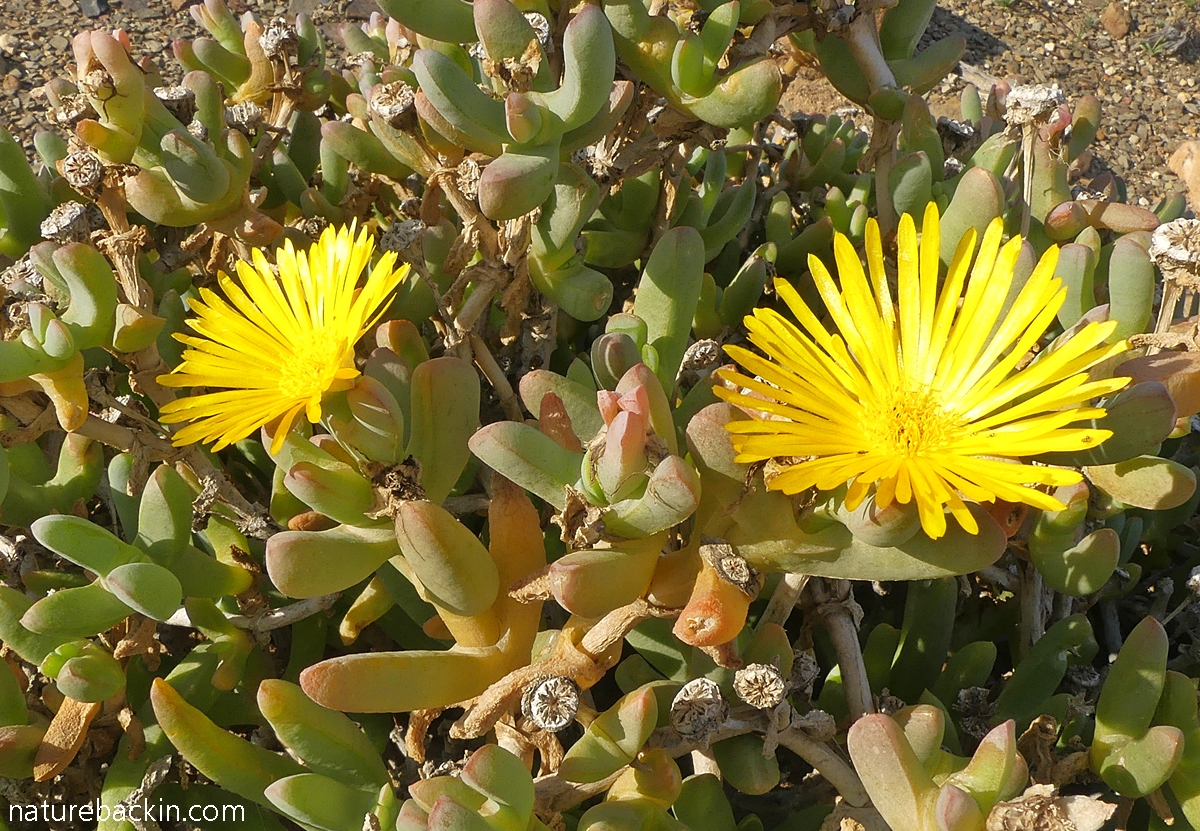
One of the many species of flowering succulents known collectively as vygies that thrive in arid zones and have flowers in day-glo colours

This familiar chat (Cercomela familiaris) lived up to its name, and approached closely to watch us drink our morning coffee on the on the steps of the Tankwa Guesthouse in the Tankwa Karoo National Park, no doubt hoping to scavenge some dropped crumbs from our rusks. In addition to scavenging around human settlements and picnic sites and also from roadkills, its most usual food is in the form of invertebrates. The Afrikaans name spekvreter (fat eater) is due to the fact that in the past these birds were known to eat the grease from wagon axles. (Source: Roberts Multimedia Birds of Southern Africa)
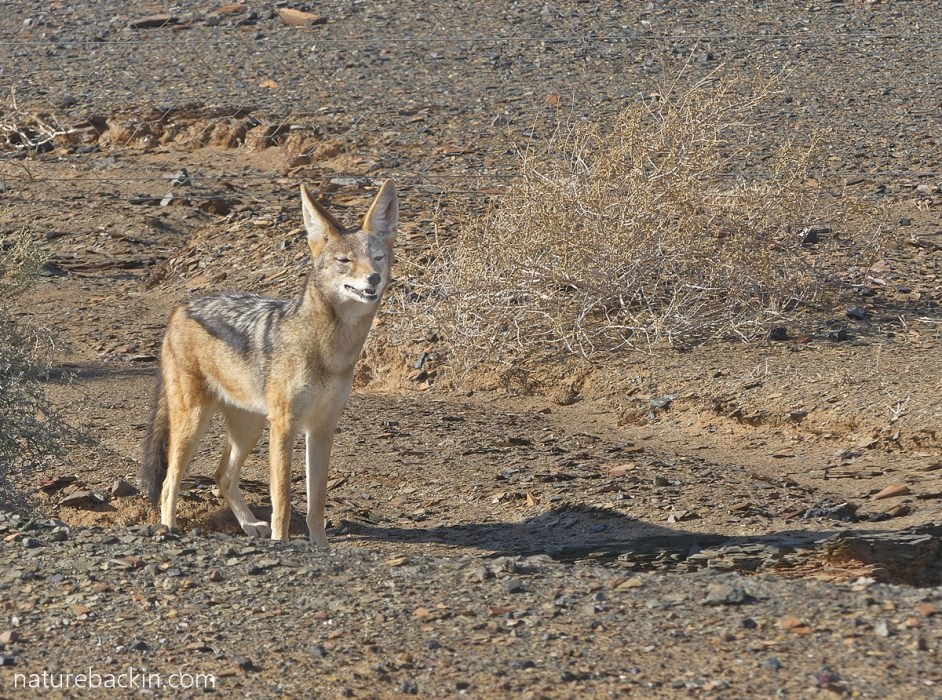
A black-backed jackal (Lupulella mesomelas) that we saw next to the road before it slipped through a fence with practiced ease
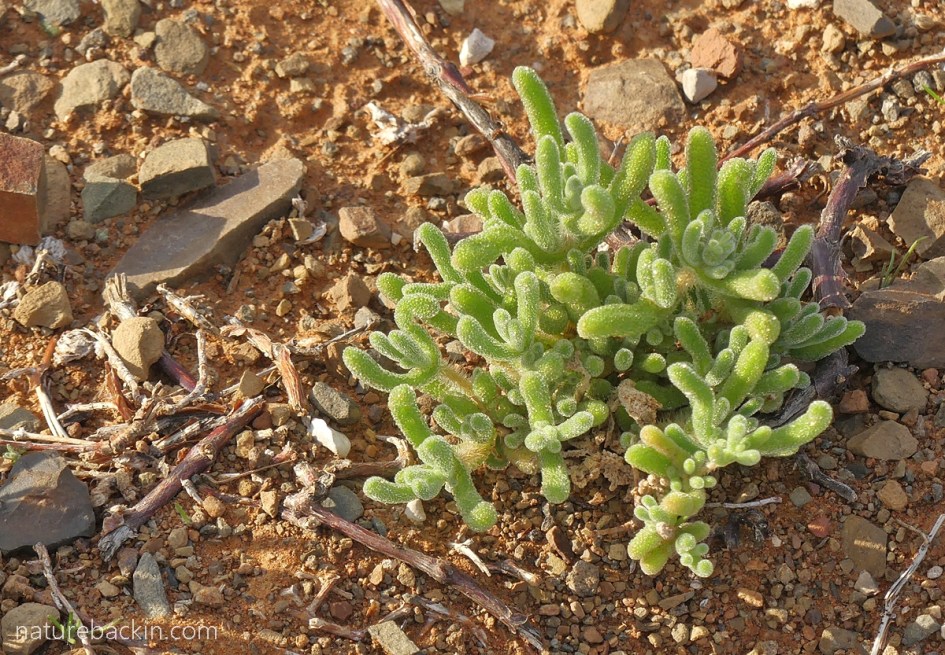
I have not identified this succulent plant – its leaves appear to have unusual moisture-conserving properties
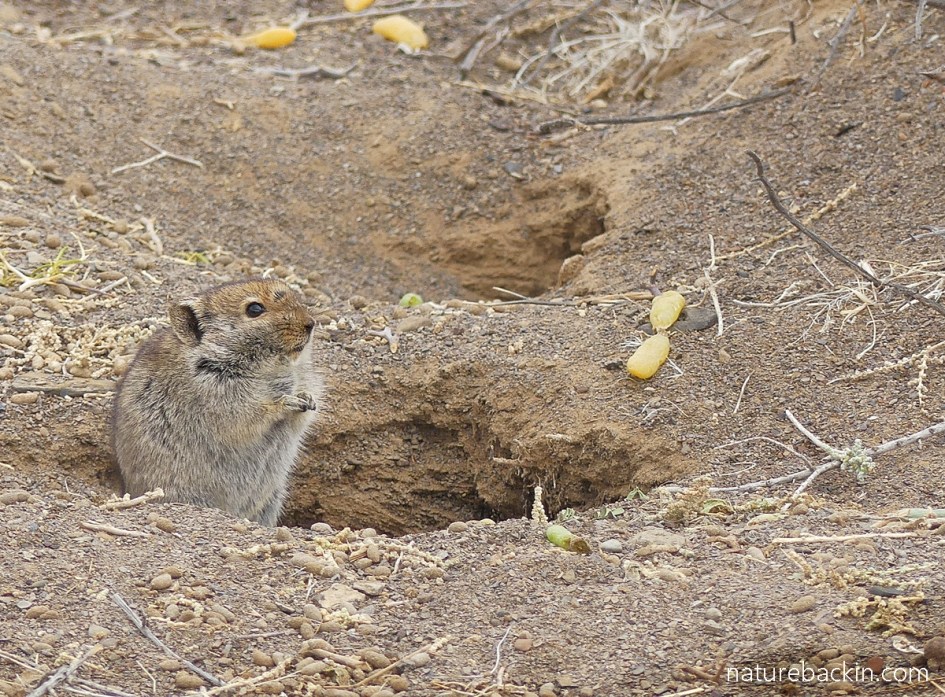
There are two species of whistling rat in the Tankwa – Brant’s whistling rat (Parotomys brantsii) and Littledale’s whistling rat (Parotomys Littledalei). Both species are endemic to the arid west of South Africa. In the field it is impossible to tell them apart. Both make complex burrowing systems, however the Brant’s whistling rat is more likely to make burrows in more open ground, where they feed close to their burrows, than Littledale’s whistling rat that prefers more plant cover
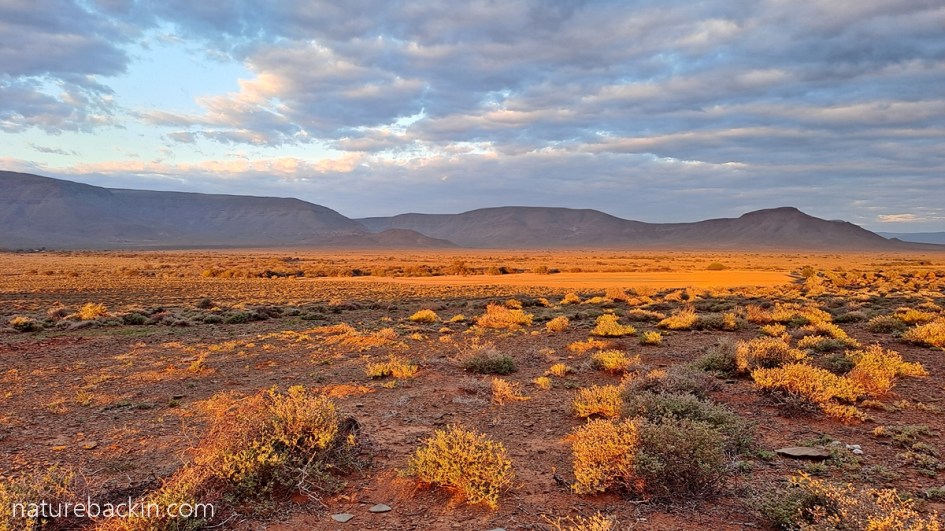
The setting sun casts a golden glow over the vegetation on a farm in the Tankwa Karoo
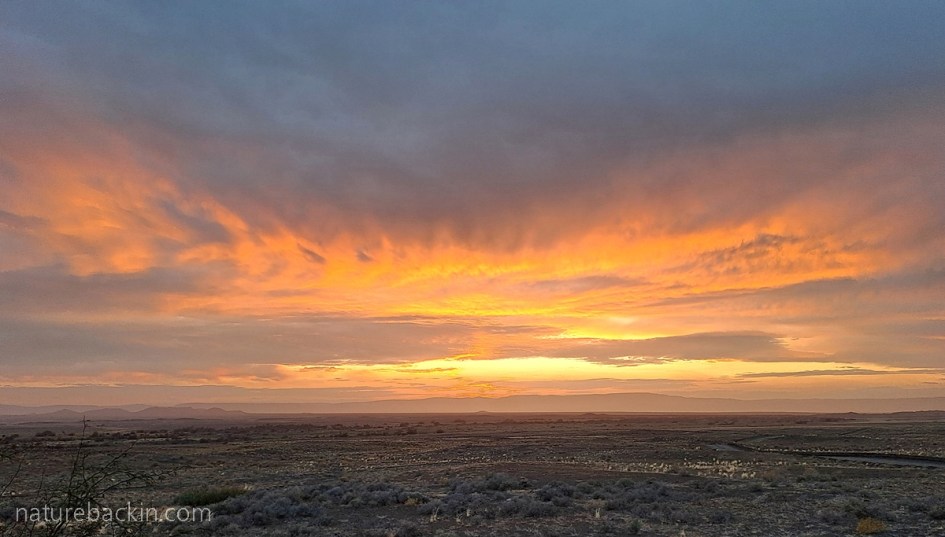
Sunrise highlighting the vastness of the landscape in the Tankwa Karoo National Park
Posted by Carol
Discover more from letting nature back in
Subscribe to get the latest posts sent to your email.


December 19, 2024 at 11:14 am
Thank you, Carol, for the array of stunning photos and interesting notes on them – what an amazingly rich experience on such an arid place!
LikeLiked by 1 person
December 20, 2024 at 9:45 am
Thanks Christine. It is amazing the diversity to be found in arid places – including also the often glorious flowers.
LikeLike
December 13, 2024 at 11:49 am
Your post has brought a strong yearning to return to the Tankwa. Thank you for the beautiful photographs and comprehensive explanations
LikeLiked by 1 person
December 13, 2024 at 1:58 pm
Thanks Mariss. I hope you do get a chance to revisit before too long.
LikeLike
December 13, 2024 at 3:24 pm
Me too!
LikeLiked by 1 person
December 13, 2024 at 9:43 am
Thank you so much for sharing your journey, Carol. What treasures can be found in the most inhospitable of places. Beautiful and exotic plantlife. I am guessing that you needed a lot of time and patience to capture those wildlife shots.
LikeLiked by 1 person
December 13, 2024 at 1:58 pm
Thanks Sandra – arid places never cease to be astounding!
The wildlife was luck more than anything else, but one does need a bit of time to ‘stop and stare’. I did take a bit of time watching the rather charming whistling rat.
LikeLiked by 1 person
December 11, 2024 at 1:04 pm
The Tankwa is utterly amazing. Your photos and descriptions are perfect. Wonder if I will ever visit there again?
LikeLiked by 2 people
December 12, 2024 at 10:35 am
Thanks Nikki – is an an amazing place. I remember reading about your visit there during AfrikaBurn. I hope that you do get to visit there again. (Although sometimes one perfect visit to a special place more than suffices 🙂)
LikeLiked by 1 person
December 11, 2024 at 5:57 am
I love how inhospitable landscapes can actually be full of life. The flowers are gorgeous, especially the first one. The eagle-owl alone would be worth the trip in my book, even with the puncture. Love the tortoise too.
LikeLiked by 2 people
December 12, 2024 at 10:32 am
So true what you say about apparently ‘inhospitable’ landscapes. That first flower fascinated me – it is the only time I have seen one in flower.
It was a thrill to see the eagle-owl – they have quite a powerful presence. The determined tortoise was amazing too – I lay down on my front in the riverbed to get the photos!
LikeLiked by 2 people
December 13, 2024 at 5:22 am
I think owls in general have a strong presence. Well done going the extra mile for the tortoise photo!
LikeLiked by 2 people
December 11, 2024 at 4:49 am
I hear what you say about sharp stones and punctures – no matter how cautiously one drives! We – for the first time there – got two punctures in the Mountain Zebra National Park. Both were caused by sharp stones. Your photographs are a delight to see.
LikeLiked by 2 people
December 12, 2024 at 10:28 am
Hi Anne – indeed that was rotten luck getting two punctures at Mountain Zebra! A bit of a shock too after previously uneventful visits. Tankwa is amazing, but is more remote than one might think. We only passed one other vehicle in our 24 hours in the actual park.
LikeLiked by 2 people
December 10, 2024 at 11:46 pm
Your photos are wonderful, Carol. I loved how you showed us the landscape with its wonderful plants and animals, all so well adapted to the harsh environment. It’s so true that we can find remarkable details if we slow down and pay attention.
LikeLiked by 2 people
December 12, 2024 at 10:25 am
Thanks Tanja. The Tankwa is an amazing place. The landscapes are too vast and wide for my photographic abilities, but the incredible diversity of interesting and often beautiful plants is astounding. Many of the animals are shy or not always seen, but were were happy to see those that we did. Those desert environments do offer one a chance to recalibrate!
LikeLiked by 2 people
December 12, 2024 at 5:15 pm
I feel the same way whenever we spend time in the desert, Carol.
LikeLiked by 2 people
December 10, 2024 at 8:35 pm
Well, isn’t this fascinating? It seems another world, almost another planet. And yet so full of life, despite being so apprently inhospitable. That photo of the ostriches is wonderful! Thanks for sharing this – somewhat challenging – journey with us.
LikeLiked by 2 people
December 12, 2024 at 10:21 am
Those arid regions are full of surprises. They can be so harsh and “other-worldy” and yet nurture such a diversity of plants, including flowering plants.
Those ostriches were a nice surprise turning up on the top of that ridge with the view of the mountains beyond.
LikeLiked by 2 people
December 13, 2024 at 8:10 am
And very photogenic of them!
LikeLiked by 2 people
December 13, 2024 at 1:55 pm
Indeed!
LikeLiked by 2 people
December 10, 2024 at 5:49 pm
Was rather startled to see all the flowers after seeing the location. Nature is as generous as one can be. Also, I never knew before reading your post that ostriches are reared for meat! Have you ever had ostrich meat? Does it taste like chicken?
LikeLiked by 2 people
December 12, 2024 at 10:18 am
I agree – it is surprising to see such a diversity of flowering plants in such a harsh location. Nice to think of it as Nature’s generosity.
As for the ostrich meat – I have not eaten it, but it is a red meat rather than a poultry-like meat. Apparently it tastes like a lean beef with a very mild gamey flavour.
LikeLiked by 2 people
December 10, 2024 at 5:42 pm
What a beautiful post, Carol.
I used to have the America song as a 45rpm. Remember them?
I swapped it for Jethro Tull’s Life’s a long song, single with the elder sister of a mate when I was around 15 or 16.
As Terry Pratchett once write: “We have all passed a lot of water under the bridge.”
Ain’t that the truth!
LikeLiked by 2 people
December 12, 2024 at 10:12 am
Thanks Ark. Yes I remember well the 45 rpm singles.
I wonder if you think the America song has stood the test of time more so than the Jethro Tull song?
Ha ha to the Pratchett quote 🙂 Indeed lots of waters under the bridge!
LikeLiked by 1 person
December 12, 2024 at 10:31 am
Both songs have their merits, but given the choice again I would have Horse with no name.
It was one of the witches who used to say the water under the bridge thing… Nanny Ogg if memory serves.
LikeLiked by 2 people
December 12, 2024 at 10:50 am
I agree re the songs.
I am embarrassed to say that I am not a Pratchett aficionado. Perhaps I am old enough now to give his books another try! 🙂
LikeLiked by 2 people
December 10, 2024 at 5:03 pm
So many very interesting adaptations for the desert climate, both plant and animal. I love the Albuca concordiana, so cool. Great photos, Carol!
LikeLiked by 2 people
December 11, 2024 at 2:20 pm
I agree the adaptations are so interesting. The Albuca is amazing. Thanks very much Eliza.
LikeLiked by 1 person
December 10, 2024 at 3:07 pm
How interesting! Thanks for sharing.
LikeLiked by 2 people
December 11, 2024 at 2:06 pm
Thank you! I enjoyed picking out some photos to share and it is a fascinating place.
LikeLiked by 2 people