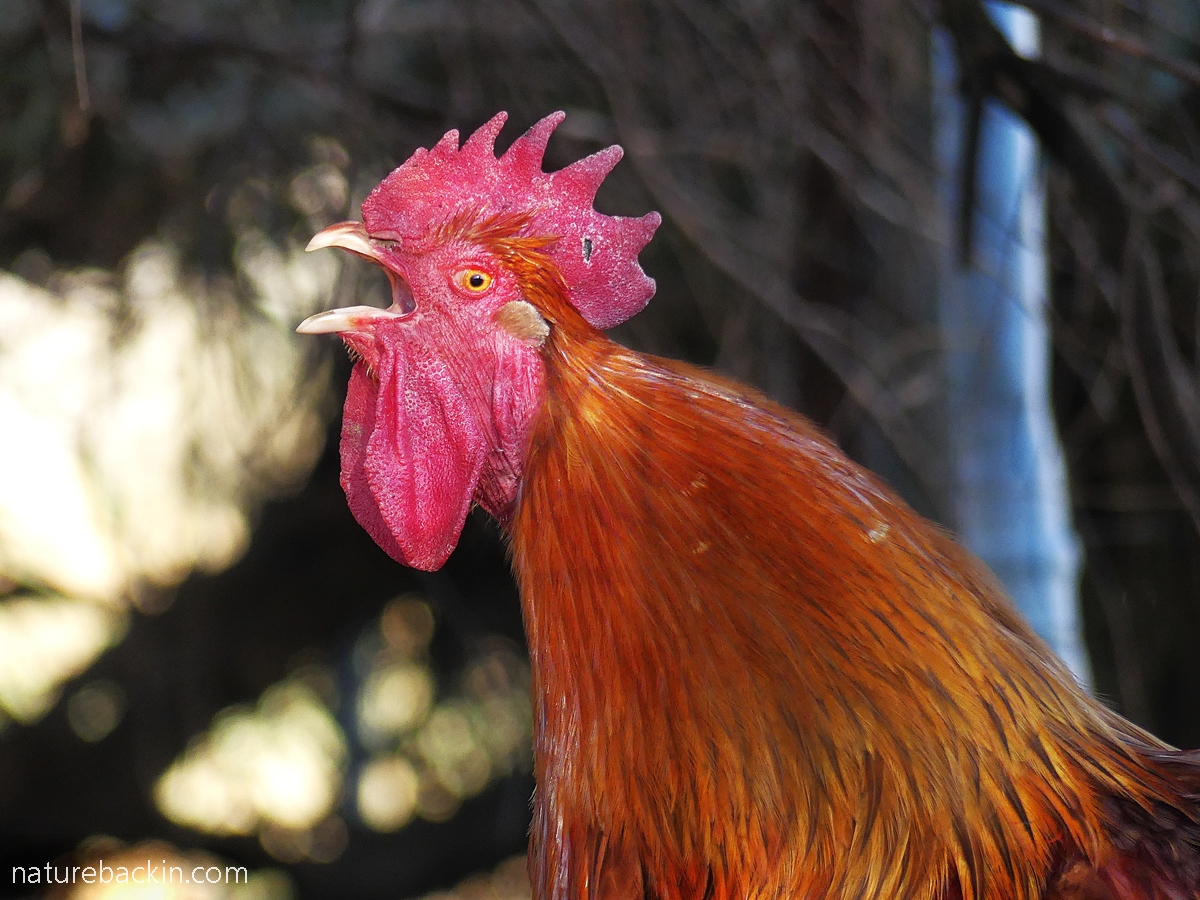
A friend kindly took us on an unexpected road trip to the Tankwa Karoo in late June this year. Who would think on a trip to the arid lowlands of the Tankwa basin that is surrounded by rugged mountain ranges, we would come away with photographs of farmyard animals? We stayed at self-catering farm accommodation on our route, where homesteading activities provided picturesque pastoral escapism somewhat at odds with not only the aridity but also the harsh realities of farming.
The timing of our trip was fortunate in a region of extremes. We enjoyed gorgeous mild weather, but the day we left the Tankwa the weather started changing, leading a few days later to freezing temperatures, heavy snow and flash floods that caused many road closures, including roads in the Tankwa Karoo National Park, which was our main destination.
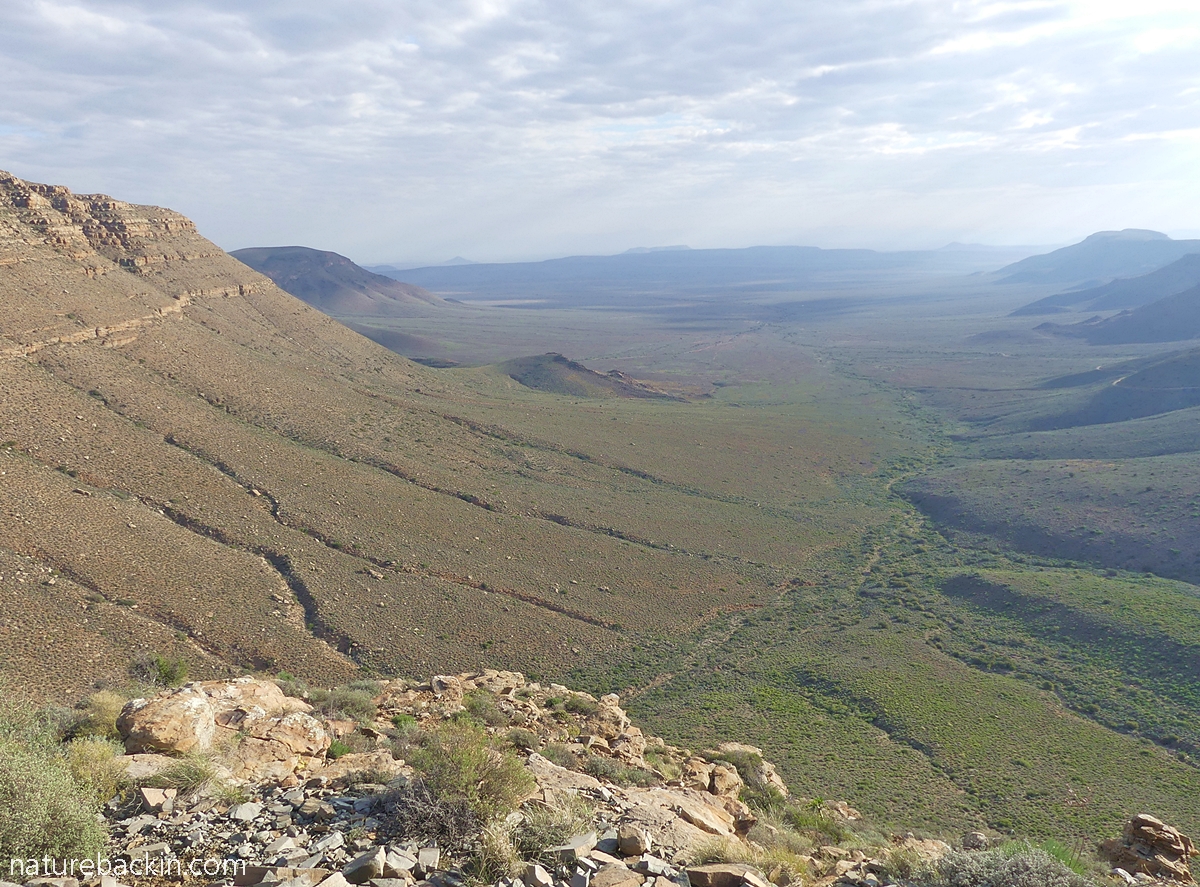
A sneak preview: a view of the Tankwa plains below from the Gannaga Pass in the Roggeveld Mountains
The Tankwa Karoo National Park straddles the boundary between the Northern Cape and Western Cape provinces. The Roggeveld Escarpment is in the east, the Cederberg in the west and the Klein Roggeveld Mountains are to the south.
Map of Northern and Western Cape showing location of Tankwa Karoo National Park
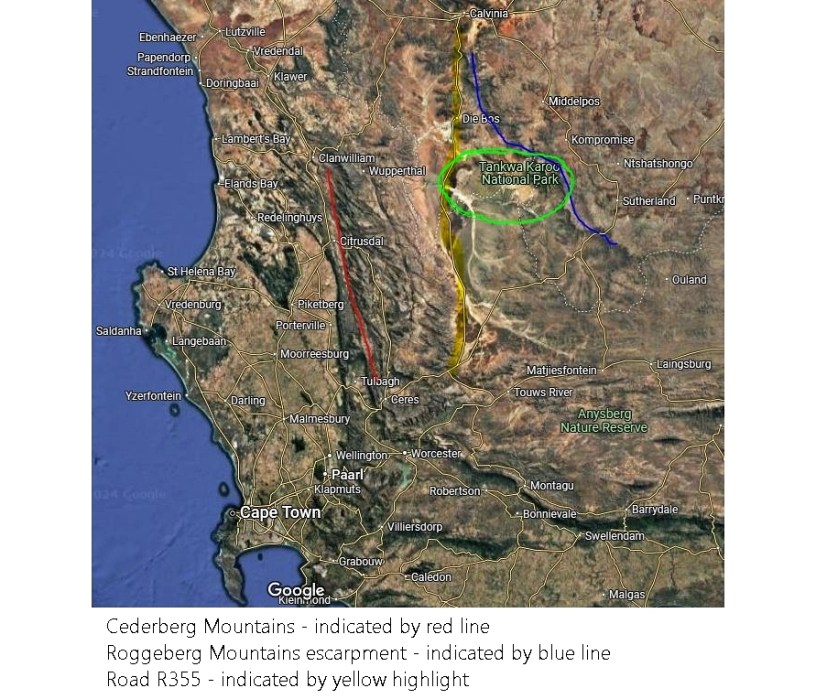
From: Google Maps
We travelled up on the western side of the Tankwa Karoo National Park from De Doorns (not shown on map) in a northerly direction to Calvinia, mostly on the gravel R355 road. Along this route to Calvinia we had three farm stays. One farmyard in particular had a children’s farmyard storybook vibe going on, especially in the warm glow of late afternoon sunshine.
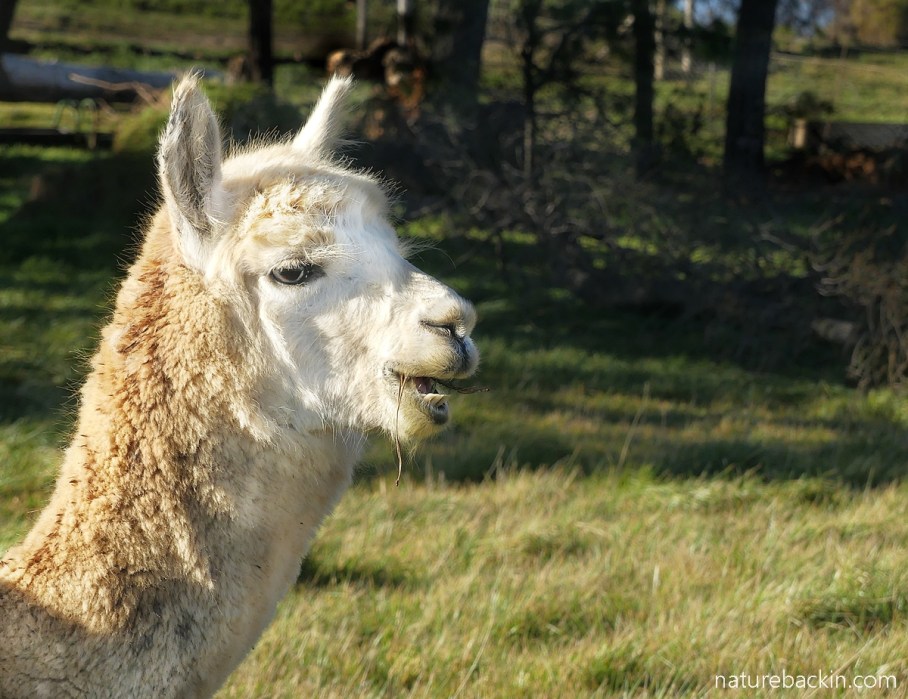
We encountered some alpacas that were much friendlier when we were in the company of the farm manager. Without him with us, they were disengaged, if not disdainful
The farmyard is in the vicinity of dormitory style accommodation (designed for school camps and such like). It was lively with poultry and peacocks and a not-so-lively slumbering pig. Adding to the activity were sparrows nesting in the trees. Some of their nests were adorned with peacock feathers.
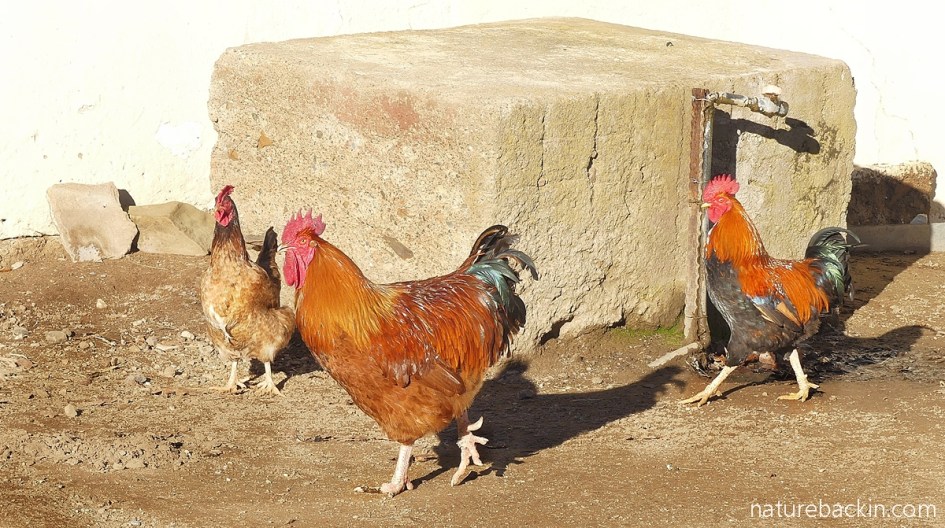
Part of a farmyard poultry parade in late afternoon sunshine
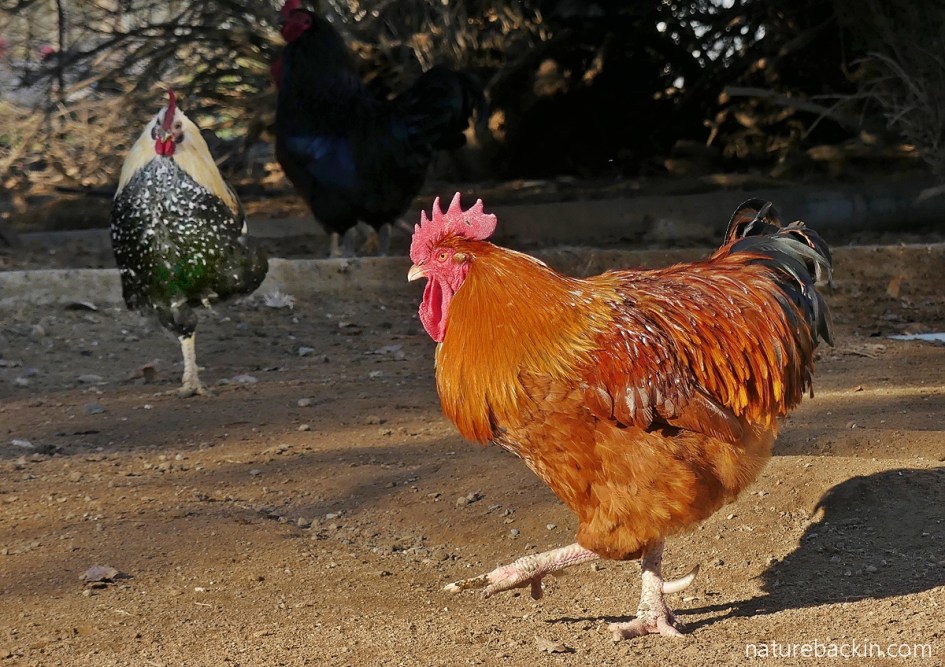
High stepping his way towards his night-time roost

This attractive hen has a sedate gait and dignified demeanour

With its fine feathers in many shades of gold and orange, I wonder if this were a rare and wild bird might we not flock to see it?

A little more understated, this bird is also rather beautiful

This pig was absolutely not bothered by the parading roosters
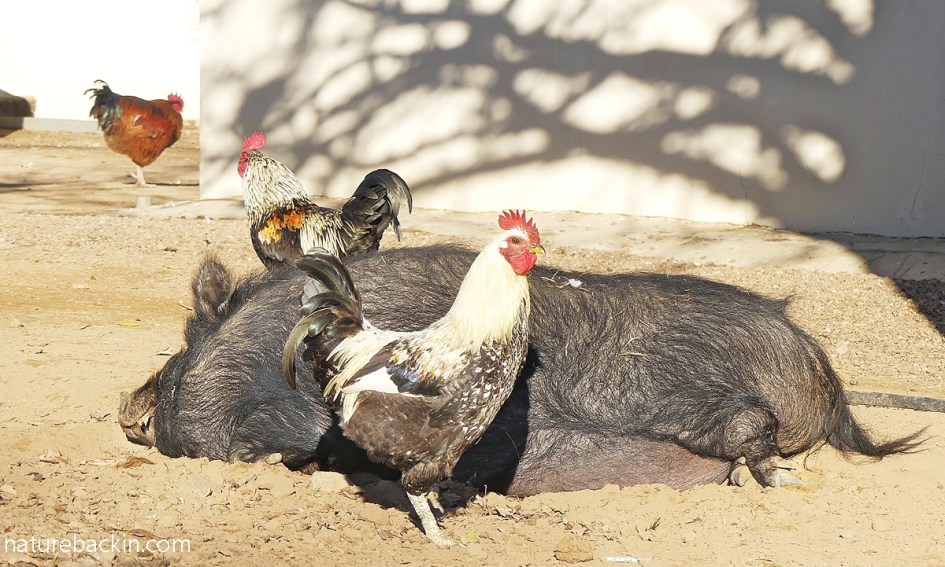
It didn’t take long for it to resume slumbering – apparently taking the comparatively glamorous poultry for granted

The pig did not mind being used as a perch
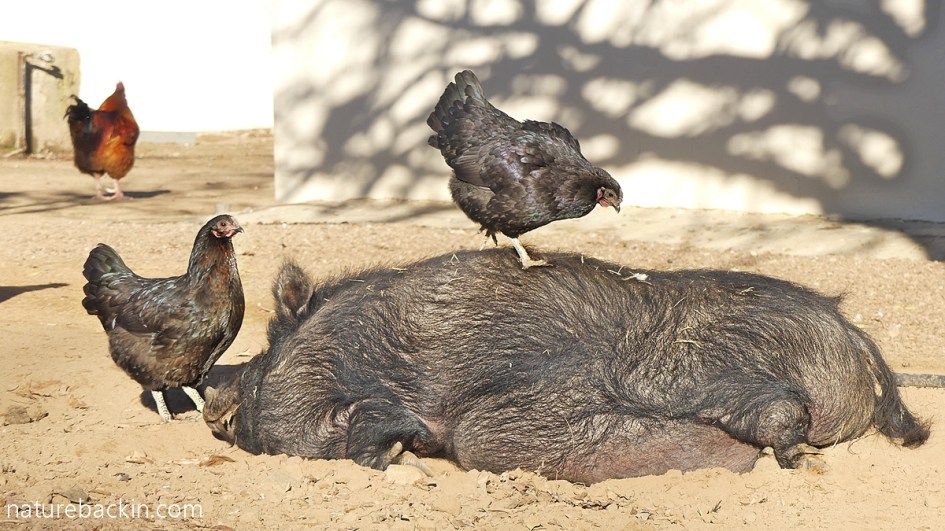
Nor did it bat an eyelash when walked on
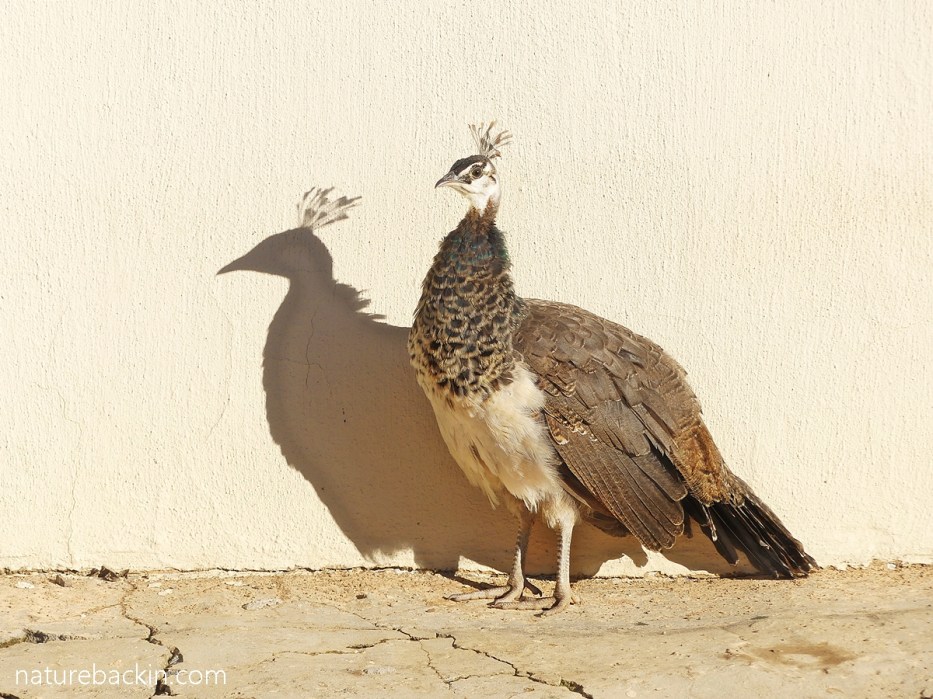
A peahen, soaking up the afternoon sunshine, oblivious of its own shadow
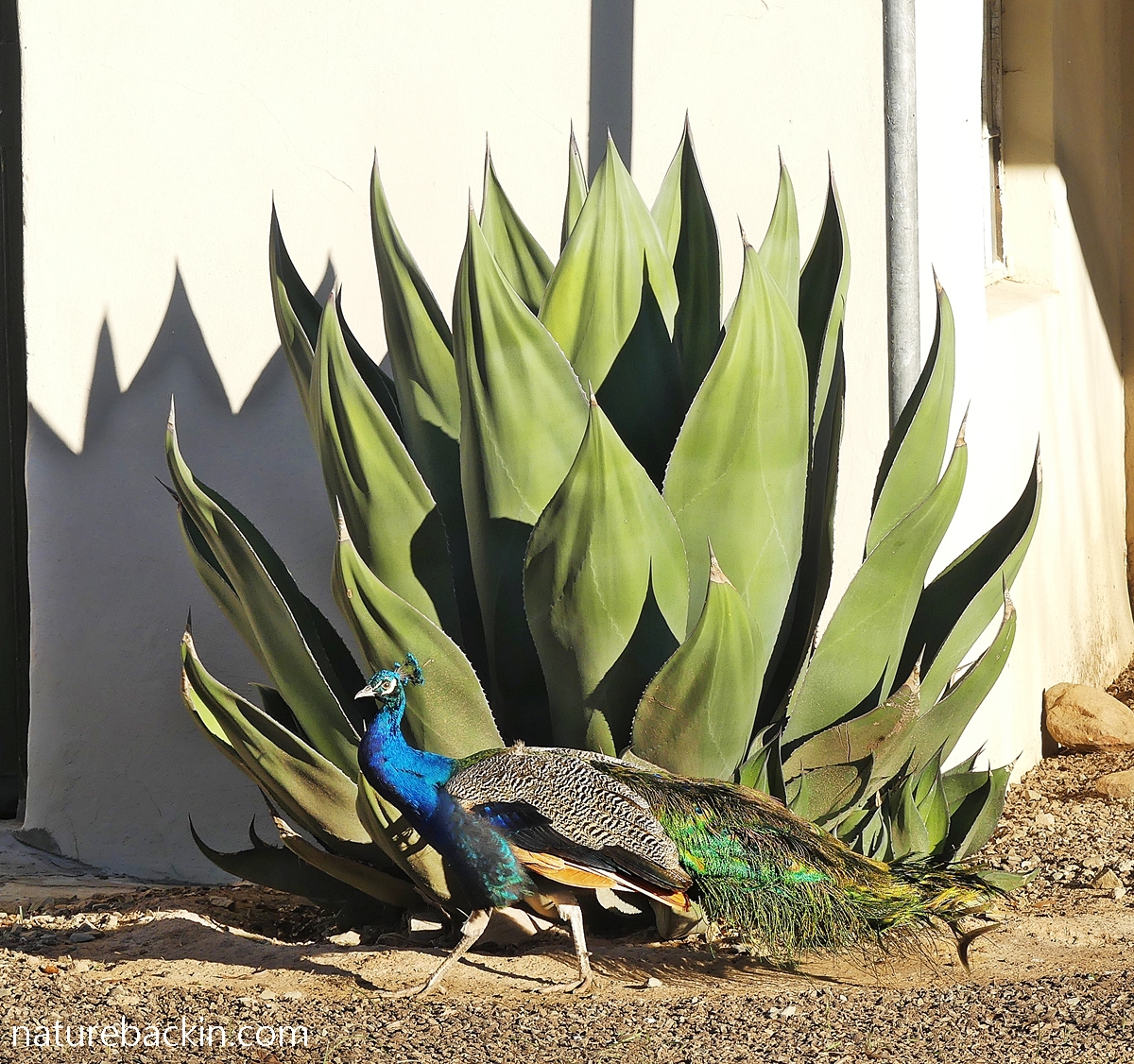
It was hard to decide whether the peacock or the plant was more eye-catching
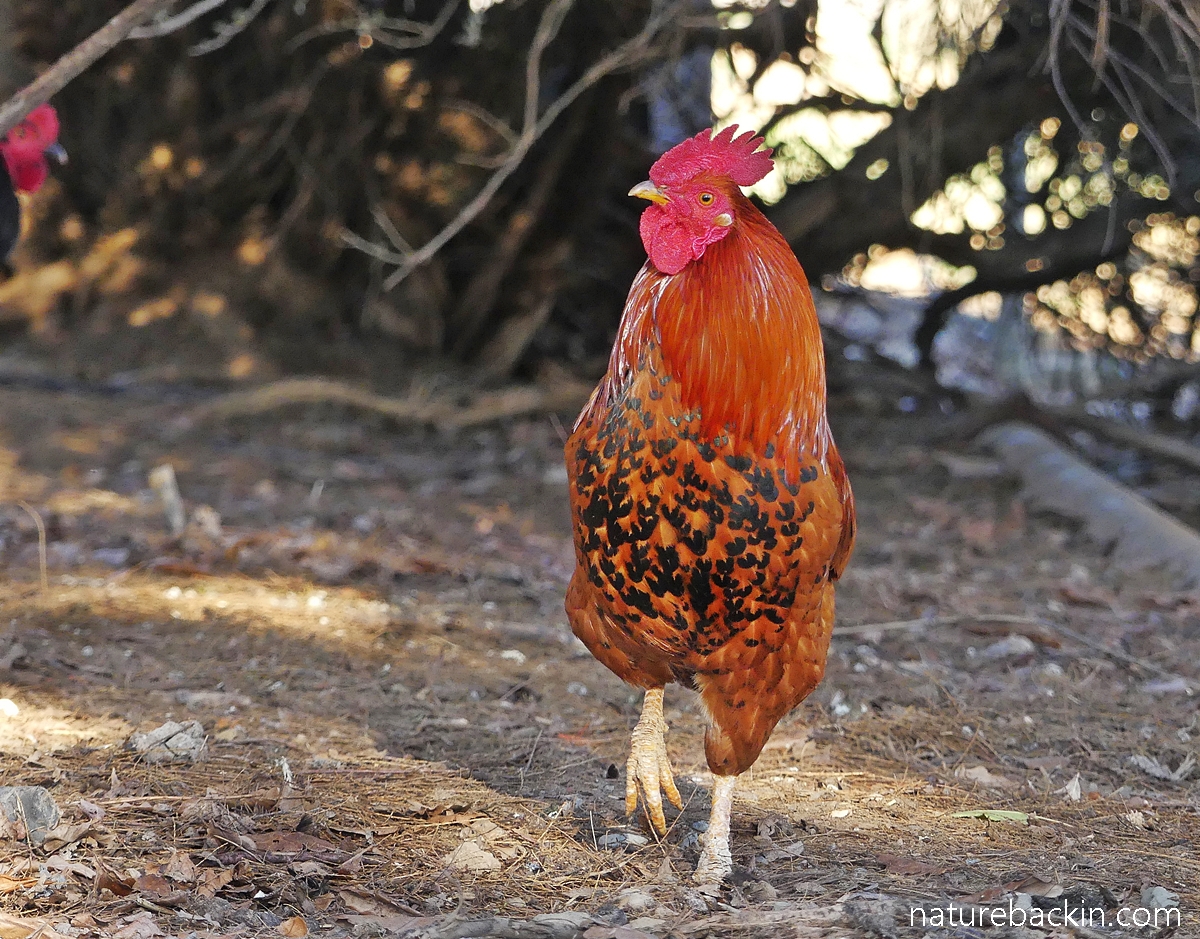
Conditioned as we are to regard peacocks as magnificent, and indeed they are, is this rooster also not magnificent with his rich colour and intricate markings?

Resplendent
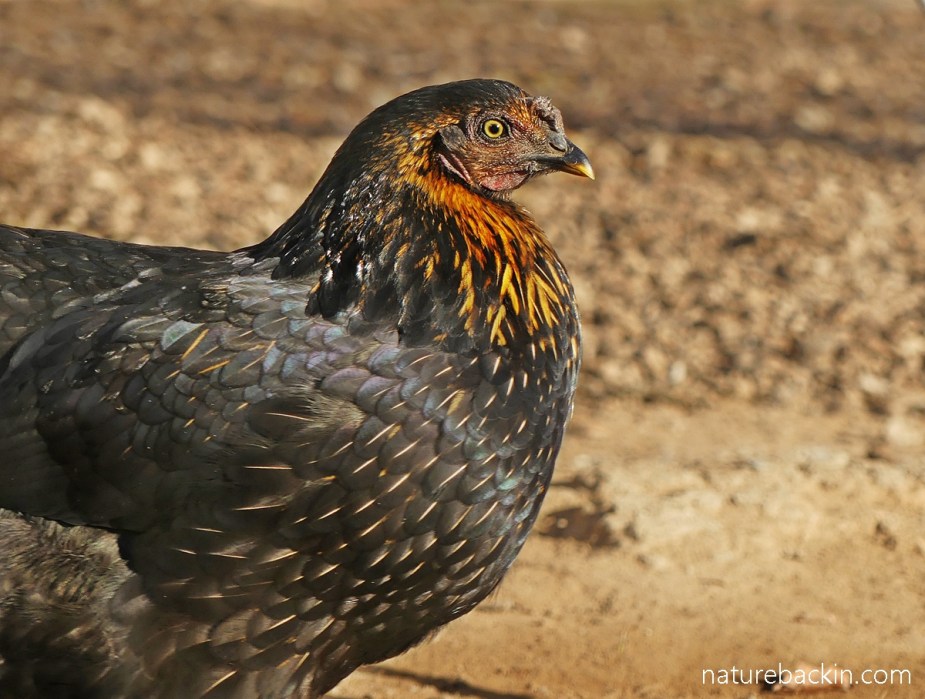
Burnished
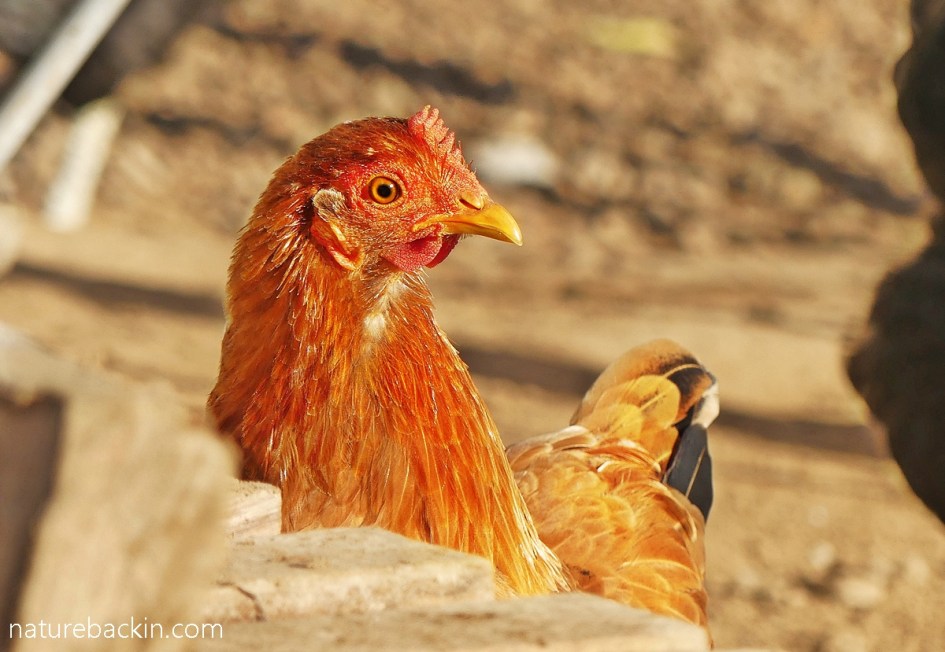
Sun-kissed

One of the also glamorous horses that roamed near the farm dam
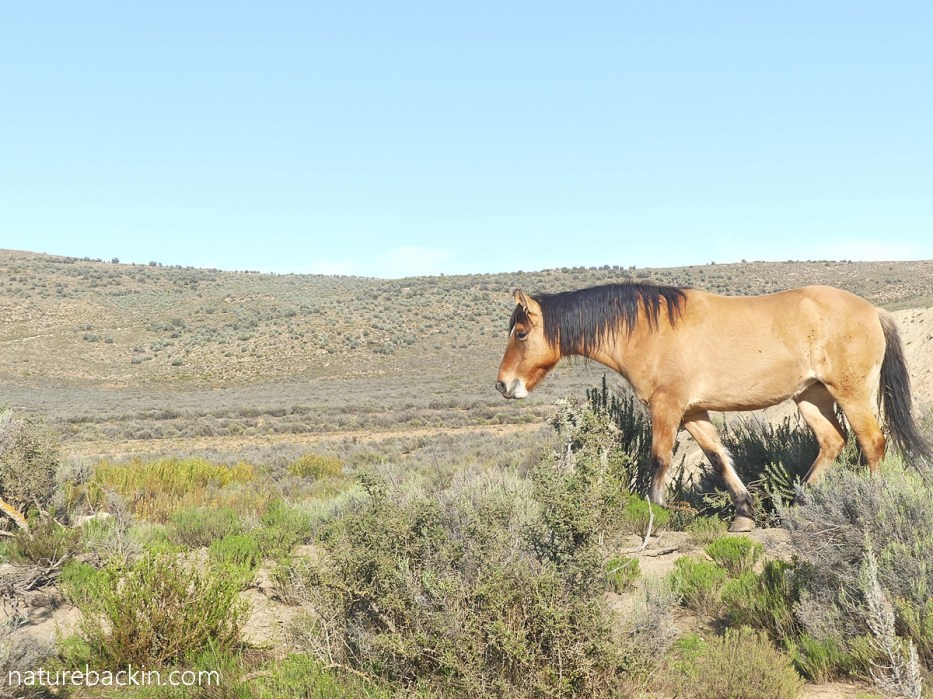
Another of the farm horses roaming free

A sheepdog herding a small flock of dorper sheep back home at dusk. The shepherd is walking behind them off camera. Farming with sheep is still a mainstay of the karoo regions
Of course, sheep farming in the region goes back a long time, centuries in fact, with nomadic transhumant herders (referred to variably, including as Khoi or Khoikhoin or Khoekhoen) moving their stock according to the seasons and availability of grazing and water. Alongside them and for many, many more centuries previous to them, hunter-gatherers (usually referred to as San or Bushmen) were the first human inhabitants in the Tankwa Karoo region.
A booking site for the Tankwa Karoo National Park describes the history of the park as follows:
Before the park was a conservation area, farmers would frequent the area with their livestock. As a result, the park’s plant life was completely over grazed. Humans have been living in the area for the last 10 000 years, with the Bushmen being the first inhabitants, followed by the Khoi. Both groups moved their livestock along with the migration of wildlife. After them, the trekboer farmers would graze their sheep here, moving with the seasons. Over time, farmers would settle there but found that the nomadic grazing was simply not sustainable.
https://www.tankwakaroonationalpark.co.za/#show
This typically anodyne brief history erases the fact that the trekboers (pioneer migrant farmers – settlers in the Dutch Cape Colony – who from 1714 onwards moved outside the formal boundaries of the Cape Colony to “loan farms” permitted by colonial authorities where they could graze their stock) dispossessed the Khoikhoin and the San (collectively referred to as Khoisan).
Historically, transhumant herders built, using local stone, kraals (or folds) for their animals to protect them at night. These kraals marked the migratory routes the herders took with their stock animals up into the Roggeveld mountain escarpment in the months of summer. Winters were spent down in the lowlands, such as in the Tankwa Karoo.
When Trekboers first appeared in the Roggeveld in the 1740s and while their numbers were still low, they could learn the local transhumant practices from the Khoikhoin before there was much competition. But as the trekboers increased in number and as they started settling, they began claiming resources, such as reliable water sources, as their own (Regensberg, p.36).
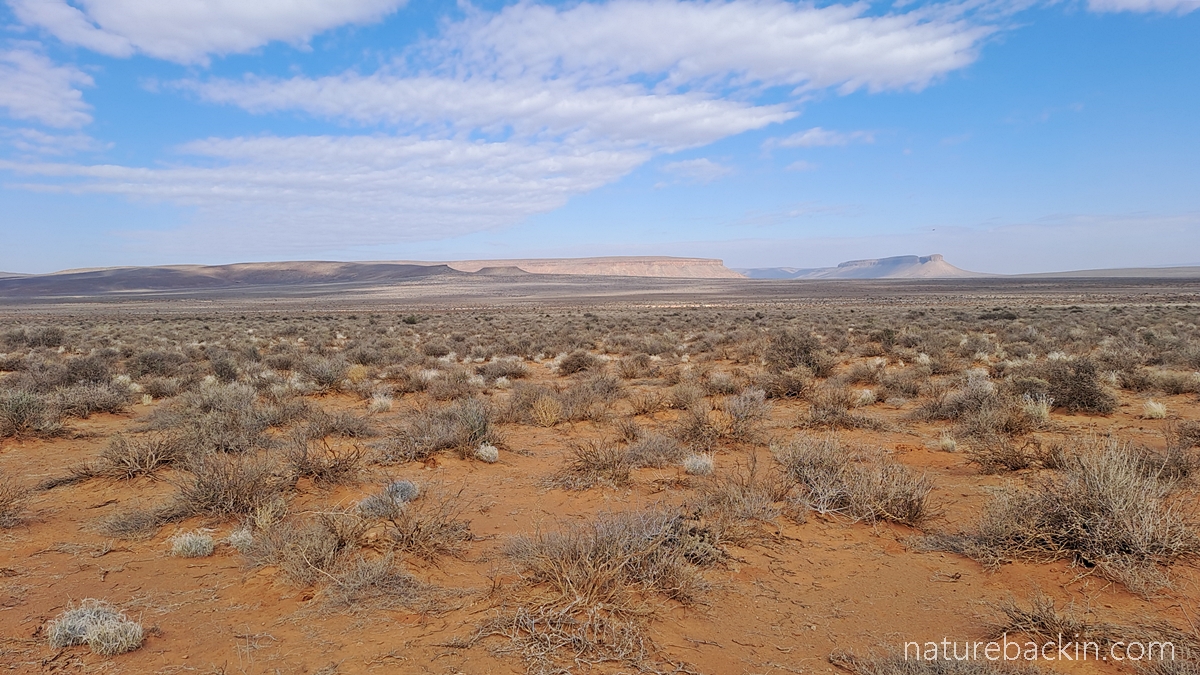
Dry lands in the Tankwa Karoo Basin
There were many complexities in the colonial conquest that took place in the interior of the Cape Colony and beyond, but as John Laband writes in his book The Land Wars, for most of the Khoisan peoples, “the expansion of the trekboers, always backed up the threat of violence by a commando, ultimately wrecked their economy, disrupted their long-established trading networks, destroyed their social system, obliterated their political structures and robbed them of their independence” (Laband, p.155).
In a context of plundering and counter-raiding from both the invading settlers and those Khoisan who resisted, advancing into the arid regions such as in the Tankwa Karoo, the trekboers learnt the strategic advantage of controlling water resources. “Control of water meant control of pasturage as well, and the Khoisan found it even harder to resist” (Laband, p.156). As the Khoikhoin pastoralists lost access to water and pasture, and as they lost their livestock through enforced bartering, they were forced into the settler system as labourers and lost their autonomy (Regensberg, p.36).
Laband writes that over decades of fighting, the settlers and their Khoi allies who rode on commandos with them, killed thousands of Khoisan. The commandos discriminated particularly against those identified as San, killing the men “as if they were no better than vermin”, and capturing San women to use as concubines or as slaves and taking the children captive too. By the end of the eighteenth century, “commandos were being called out specifically to take captives for bonded labour, and thousands suffered this fate (Laband, p.164).
By 1778, the Tankwa Karoo region was already within the formal boundaries of the Cape Colony. On the northern frontier, eventually the Khoisan were worn down “by the scale of their casualties and the numbers they had lost as captives. Besides, the interminable conflict and the shooting out of the herds of wild game [by the trekboers] destroyed their age-old way of life” (Laband, p.164).
In 1809, the by now British colonial authorities proclaimed in the Caledon Code that all Khoisan, that the colonialists called “Hottentots”, must carry a pass. Only those in service or living at a mission station could get a pass, so as Regensberg points out, this code basically rendered independent or semi-independent Khoe pastoralists illegal” (Regensberg, p.36).

Wagon relic in the Tankwa Karoo National Park, of the type used by trekboers. Ox-drawn wagons, covered in canvas stretched over wooden hoop-shaped frames, served not only as transport but also as “mobile homes” at semi-permanent camps
The Tankwa Karoo National Park was proclaimed in 1986. The park is named for the Tankwa River that provides water in the arid, semi-desert region. Although the river itself is not perennial, some pools are permanent or semi-permanent.
Since the park’s proclamation, other farms have been acquired, increasing the conservation area from the original 27064 hectares (67000 acres) to more than 146373 hectares (362000 acres) in 2014. The park is situated in the Succulent Karoo Biome and is an arid biodiversity hotspot, comprising desert, open grasslands and a mountain escarpment (see https://www.sanparks.org/parks/tankwa-karoo/explore/natural-cultural-history)).

An abandoned farm house in the Tankwa Karoo National Park. This dwelling, made of local stone and bricks made from local clay or mud, is representative of the small houses transhumant herders or farmers stayed in during winter when grazing their livestock in the Tankwa Karoo
Writing about vernacular architecture in the Tankwa Karoo, Munting explains that the dry-packed stone wall section of the building (in the above photograph) was the kitchen and the brick section the living room. Several dry-stone animal kraals are in the vicinity of the house. The house is likely to have been built in the mid-to-late 1800s. According to Munting, the house was built by local craftsman, Frederik Petoors. While the house was in use, the clay-brick walls would have been maintained by being regularly replastered using local materials. Without a roof and without being maintained, unfortunately the walls are disintegrating. The original roof would have been a flat brakdak, that is a roof that includes a thick insulating layer of dry mud.

A windmill pump at a campsite on a working farm in the Tankwa Karoo that is outside the boundaries of the Tankwa Karoo National Park conservation area
Outside of the Tankwa Karoo National Park, farming activities continue where possible in the Tankwa Karoo and surrounding regions. Sheep for mutton and for wool remain important in the region. In addition to the sheep used for meat, merino sheep were introduced into the region in the mid-1800s, and the numbers of sheep increased rapidly as the global demand for wool fostered a huge international trade to which the region became a major contributor as subsistence farming was overtaken by commercial farming. Nowadays, merino sheep continue to be farmed across South Africa.
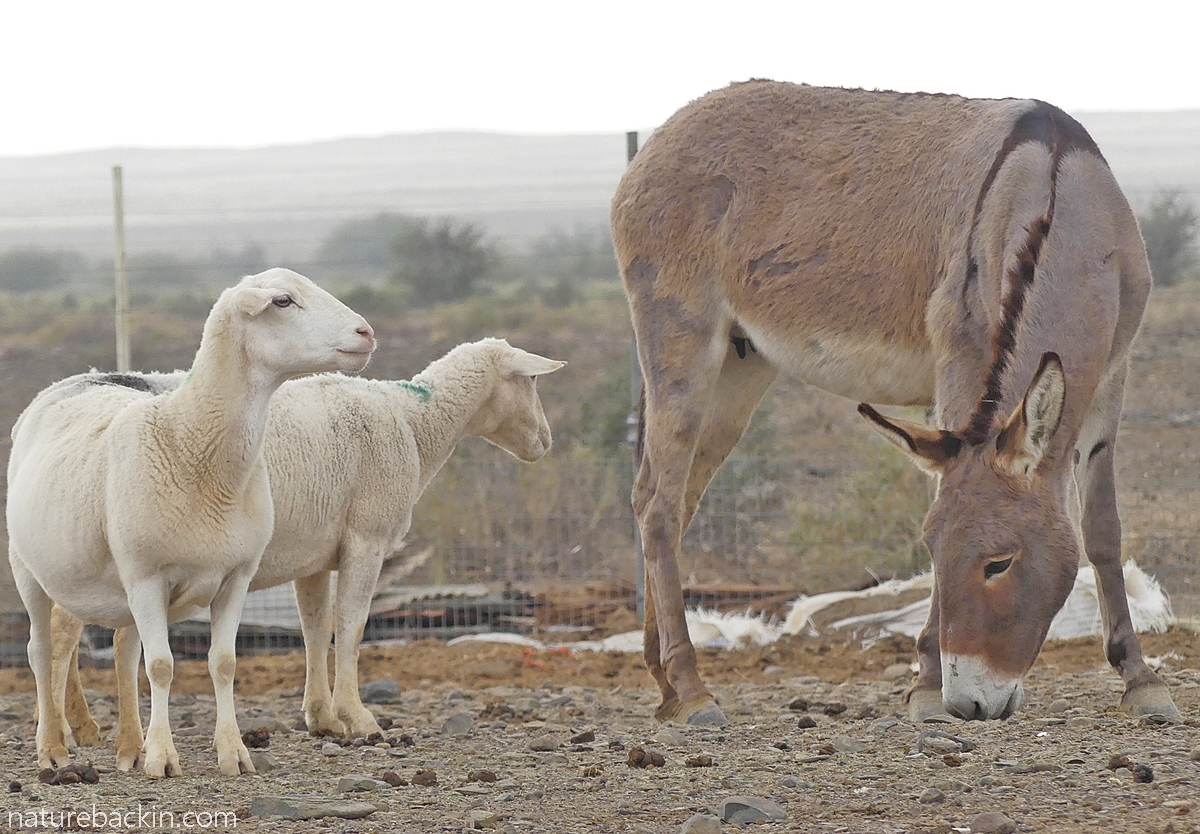
Two sheep and a donkey on the premises of a padstal (roadside stall) outside the southern boundary of the Tankwa Karoo National Park. I would guess the sheep are white-headed dorpers rather than merinos, but I stand to be corrected on that!
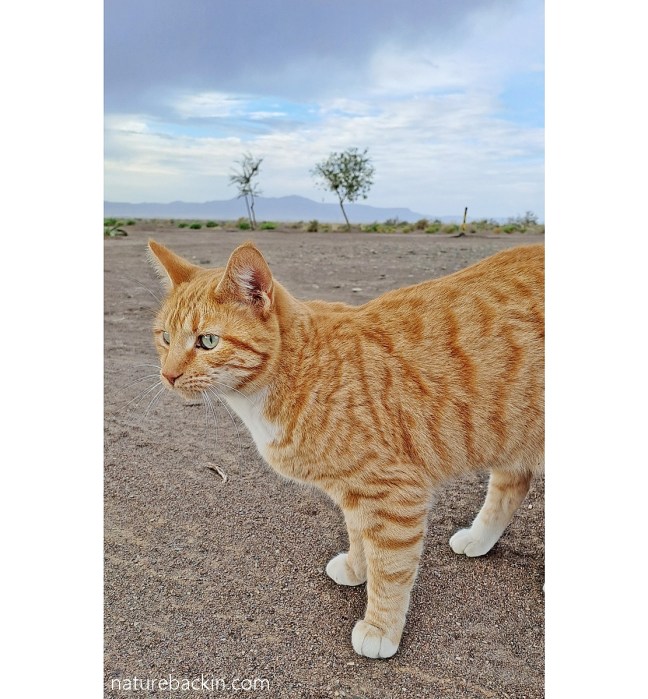
Also at the same padstal was this charismatic and friendly ginger cat. This cat was the last animal I photographed on our road trip around the Tankwa. The Roggeveld mountains can be seen in the distance
Sources and further reading:
Laband, John. 2020. The Land Wars, The Dispossession of the Khoisan and Amaxhosa in the Cape Colony. Cape Town: Penguin Random House, ISBN 9781776094998.
Munting, K. 2024. ‘Cultural landscapes and the vernacular: A case study of the Tankwa Karoo’, Koedoe 66(2), a1801. https://doi.org/10.4102/koedoe.v66i2.1801
Regensberg, R.M. 2016. ‘Pastoralist systems of the Roggeveld in the 18th and 19th centuries’, Dissertation presented for the degree of Master of Science in the Department of Archaeology, University of Cape Town. https://open.uct.ac.za/items/0e2a2d61-9dc6-4848-a4bf-b8a4c8ddccd3/full
Sadr, Karim. 2008. Invisible herders? The archaeology of Khoekhoe pastoralists. Southern African Humanities. Vol.20, pp. 179-203. https://www.academia.edu/1090921/Invisible_herders_The_archaeology_of_Khoekhoe_pastoralists
Sleigh, Vita. 2019. ‘The Farm Myth: Fantasy Farms, Factory Farming’. Sloth, vol.5, No. 1. The Animals and Society Institute. https://www.animalsandsociety.org/research/sloth/sloth-volume-5-no-1-winter-2019/the-farm-myth-fantasy-farms-factory-farming/
Posted by Carol

Discover more from letting nature back in
Subscribe to get the latest posts sent to your email.


December 4, 2024 at 3:43 pm
As ever thank you for a most interesting article. We have never been to Tankwa but an opportunity to go there has arisen as our daughter-in-law has been invited to exhibit at the Tankwa Burn!! Since we are quite ancient we get to go free but whether we will be brave enough for this sort of scene still has to be established. But it is a chance to explore the area and we wonder if you could pass on contact details or recommendations for the farms you stayed at. We are regular campers so could also aim for that.
LikeLiked by 1 person
December 4, 2024 at 8:07 pm
Thanks Colin. The scene at Tankwa Burn will be interesting to say the least, and it will also be good to explore the area.
The place we stayed at most proximate to that part of the Tankwa was on a farm called Hartnekskloof, We stayed in a comfy converted barn that sleeps 4 – it is called The Barn 🙂 See this link for info https://www.pressreader.com/south-africa/go-karoo-test/20240901/283386247201497
If you explore further there is a great camping site and also a separately situated self-catering place for 2 on a farm at Ymansdam. https://www.facebook.com/people/Ymansdam-Camping-Self-Catering-Cottage/100089255967120/
I hope you have a fun trip.
P.S. Beware of sharp stones – it only takes one to slash a tyre!
LikeLike
December 4, 2024 at 8:42 pm
Thanks so much for the prompt reply. Those places look great. I’ll let you know if we make it!
LikeLiked by 1 person
December 4, 2024 at 10:08 am
There is so much to digest and think about in this post. Your research and knowledge is expansive.
Dare I say that I relished the delightful photographs of the farmyard activities and your witty captions more than confronting the turbulent history of the magnificent Tankwa.
I have been there and enjoyed revisiting the place through your photographs. Thank you
LikeLiked by 1 person
December 4, 2024 at 7:54 pm
Hi Mariss – good to know you have also been to Tankwa.
When I started the post with farmyard animals I didn’t expect to start reading history. But once I started, I found I couldn’t just look away, so it ended up being an odd juxtapositioning I guess.
The farmyard animals, especially the roosters and hens, are captivating 😊
LikeLiked by 1 person
December 2, 2024 at 11:47 am
A fascinating read Carol! I enjoyed the beautiful roosters and hens too!
LikeLike
December 11, 2024 at 2:12 pm
Thanks Christine – so glad you found it interesting even though a bit of a contrast to the splendid roosters and hens. I have just discovered that somehow your comment got put into spam, hence my late reply. I have just retrieved your comment from spam – I am not sure why that happened …
LikeLike
November 30, 2024 at 11:20 pm
Seeing your beautiful photographs of the landscape and farm animals was very enjoyable, Carol.
Reading about the human-caused misery not so much. Claiming some people are “no better than vermin” seems to be a universal reason for colonization, exploitation, and mayhem the world around. It’s a very depressing truth about the human character.
I hope you are well.
Tanja
LikeLiked by 1 person
December 1, 2024 at 1:22 pm
Hi Tanja – so true what you say. Tragic that dehumanizing already marginalized groups of people remains pervasive and part of the dynamic of persecution to this day.
Even though depressing, once I started reading about the history of the region, I felt I had to acknowledge some of its violent past. It was not something I anticipated doing when I started compiling photos of farmyard animals!
LikeLiked by 1 person
December 3, 2024 at 3:13 am
I think it’s very important to talk about our depressing past and mistakes so I appreciate you including that history. I still harbor some hope that at some point we will learn from past mistakes and do better in the future.
LikeLiked by 1 person
November 30, 2024 at 4:58 am
Stunningly beautiful photographs from such a stark environment, Carol! I’ve not yet visited Tankwa, having read so much of the tire-shredding capabilities of the local roads. Any such calamity on your travels?
LikeLike
December 1, 2024 at 1:14 pm
Thanks Dries. Indeed it is stark, yet the diversity of plant life is incredible.
Yes, the roads are tyre-shredders. The roads are very stony and many of the stones resemble arrowheads. We were lucky to have only one puncture – a sizeable gash in a side-wall, and we were going cautiously and on a well-travelled piece of road that looked harmless. No wonder 2 spare tyres are recommended when travelling there, or at least a comprehensive tyre repair kit that includes an inner tube in case the side-wall is slashed. and of course take an air pump.
LikeLike
November 30, 2024 at 4:14 am
Farm and domestic animals are photogenic too, especially in that great light! The colonial history on the other hand is a good deal darker. It would be nice to think that we have learned better, but the current state of the world unfortunately suggests otherwise.
LikeLiked by 1 person
December 1, 2024 at 12:52 pm
Hi Graham, yes that light was great.
After our dark history, I agree, most sadly, that the current state of the world does not leave much room for optimism.
LikeLiked by 1 person
November 29, 2024 at 6:01 pm
Hi aunty Carol
such an interesting read. I agree with one of your readers. A sad tale indeed.
but it’s good to read about it, lest we forget.
many thanks ♥️
LikeLiked by 1 person
November 29, 2024 at 10:27 pm
Thanks Debbie – I agree it is important to remember, and also acknowledge and try to learn about our histories.
LikeLike
November 29, 2024 at 9:52 am
So interesting, Carol, and of course offering much pause for thought. Beautiful photos as always.
LikeLiked by 1 person
November 29, 2024 at 10:24 pm
Thank you Sandra. Yes, lots of sobering and sad histories that are not always acknowledged to think about.
LikeLike
November 29, 2024 at 5:10 am
I have been meaning to visit this area for a long time so am pleased to read what you have gleaned of its background. As always, your photographs are magnificent!
LikeLiked by 1 person
November 29, 2024 at 10:21 pm
Thank you Anne. The poultry in particular was rather glorious to photograph. Tankwa is interesting to visit but can be tough on tyres!
LikeLiked by 1 person
November 30, 2024 at 4:47 am
Useful to know that 🙂
LikeLiked by 1 person
December 1, 2024 at 1:08 pm
The stones are sharp and even going cautiously, a sharp-pointed stone can slash a hole in the tyre (including the side wall). We were lucky to get only one puncture on our trip – and on a piece of road that looked innocuous! Common advice is to take 2 spare tyres when travelling there (we only had one).
LikeLiked by 1 person
November 29, 2024 at 12:42 am
Handsome poultry and great photos, Carol. Colonial history all over the world is a sad tale for the native dwellers. Hopefully, humans can learn from it.
LikeLiked by 1 person
November 29, 2024 at 10:19 pm
Thanks Eliza. Yes sad histories of colonialism everywhere, and in contemporary times aspects remain, unfortunately.
LikeLiked by 1 person
November 28, 2024 at 3:46 pm
So nice to have a post from you, Carol.
Smashing Read. 😊
LikeLiked by 1 person
November 29, 2024 at 10:13 pm
Thanks Ark. Good to read that you liked the post. Nice to hear from you.
LikeLiked by 1 person
November 28, 2024 at 3:28 pm
Well, if you hadn’t included landscape photos, this could have been a traditional English farm – even alpacas are common enough these days, and some even have a peacock or two – just for fun. But the back-story is clearly quite different. A lovely – and rather different – post from you.
LikeLiked by 1 person
November 29, 2024 at 10:12 pm
Thanks Margaret – the post did go in a different direction to my initial idea.
It is interesting that the notion of the traditional farmyard is almost cosmopolitan.
LikeLiked by 1 person