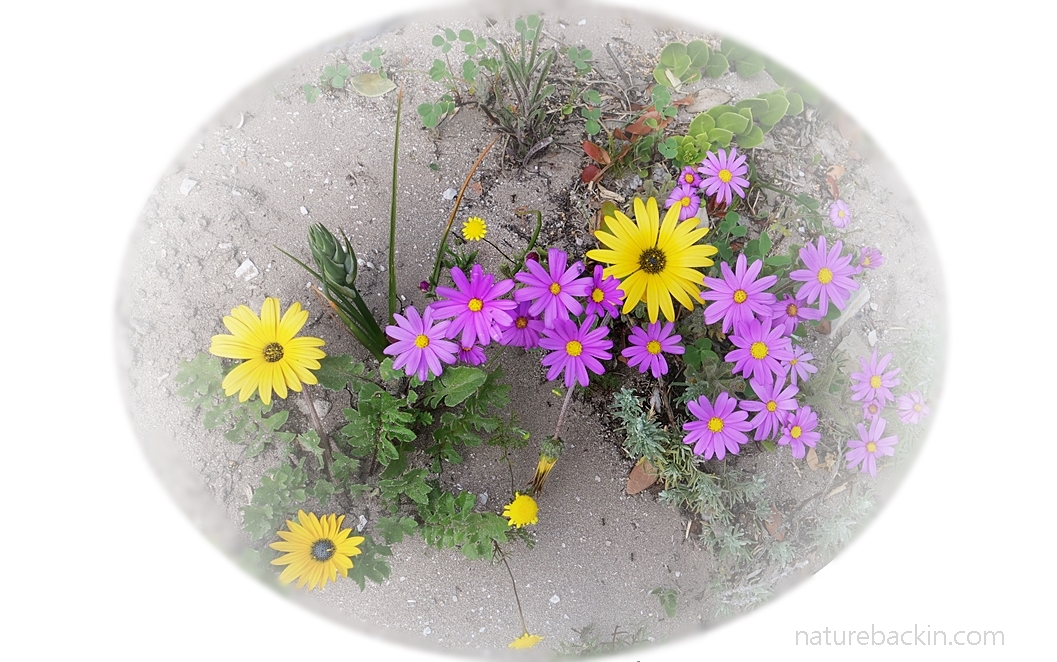
Spring in our winter-rainfall area is rich with a huge diversity of wild flowers. We recently revisited the coastal area around the small Danger Point peninsula near Gansbaai in the Overberg, mostly to see the spring flowers that grow along the roadsides and down to the seashore.
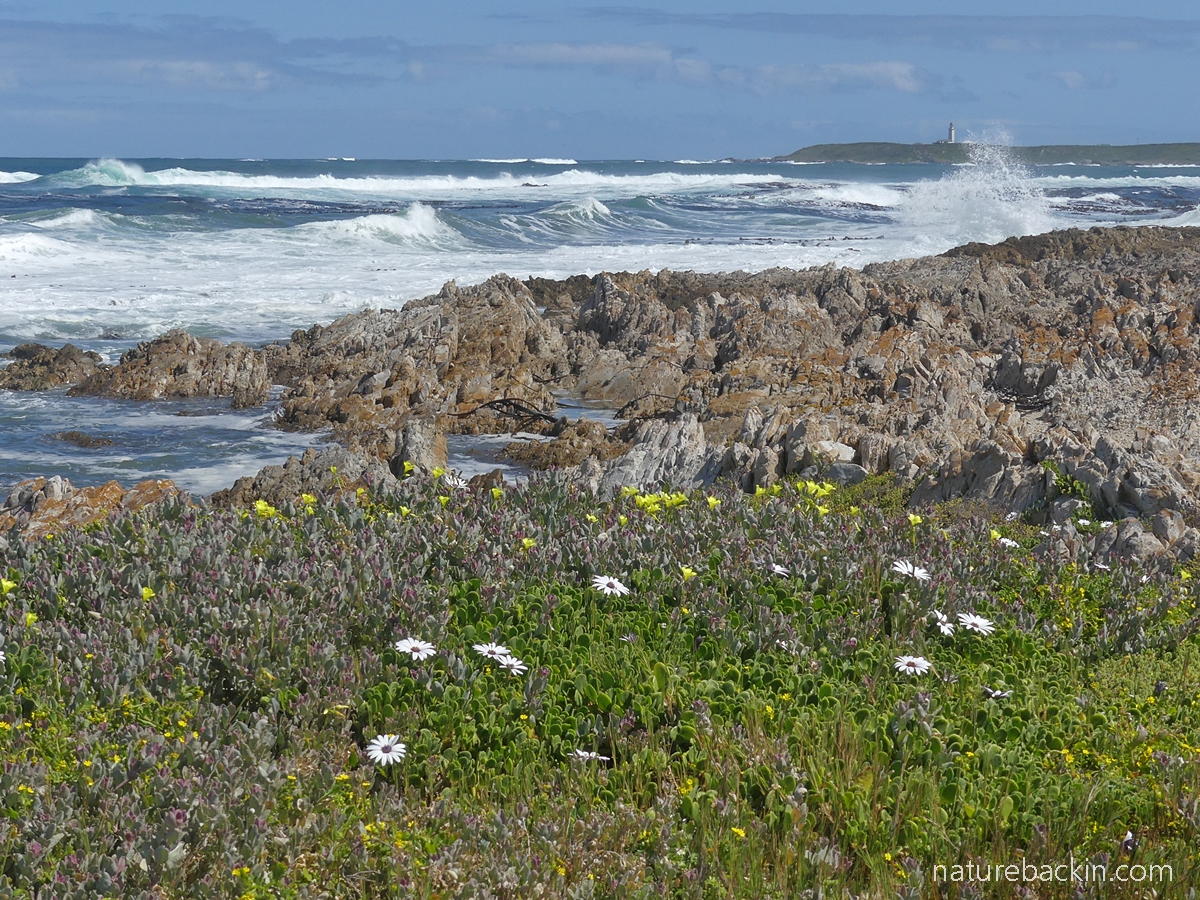
Flowering plants growing down to the seashore. Danger Point Lighthouse can be seen on the horizon on the other side of a small bay alongside the peninsula.
There are three shrubland vegetation types in the Fynbos Biome of the Western Cape, and these are true fynbos, renosterveld and strandveld. And within these three categories further subtypes that depend on region and soil type can be identified.
Strandveld usually grows in coastal lowlands and dunes, often in alkaline soils, and it can incorporate thickets. Strandveld does not extend right to the shoreline where the low-growing coastal vegetation is subject to sea spray.
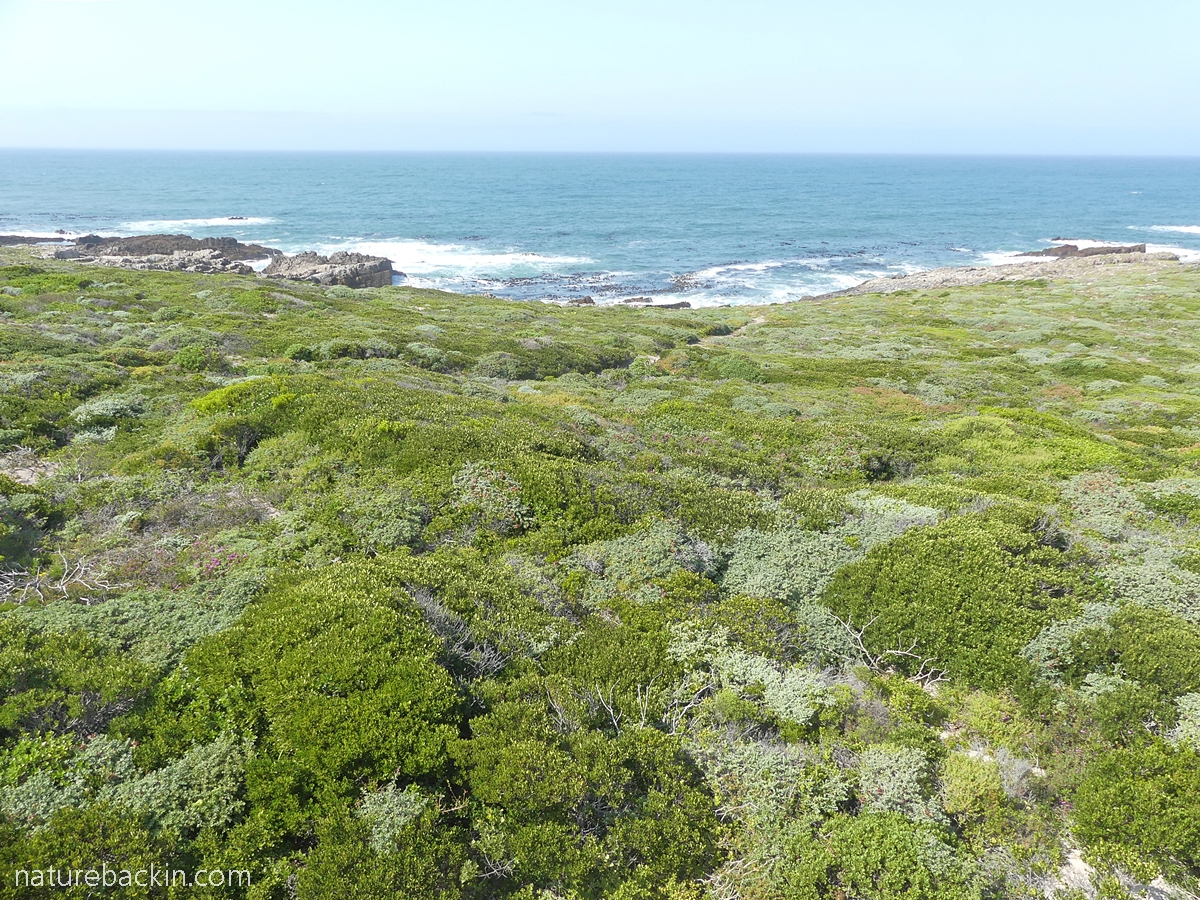
A view from the base of the Danger Point lighthouse of the strandveld where it forms a shrubby thicket
The vegetation at Danger Point is categorised as Overberg Dune Strandveld, which like most strandveld, is associated with alkaline soils and consists of shrublands and coastal thickets.
Along the roadsides where the soil has been disturbed there are many flowering annuals, including from the daisy family. The diversity of plants that occurs in the narrow band between the roadside and the strandveld thicket is quite incredible.

A stand of pink-flowered terrestrial orchids, Satyrium carneum, growing amongst other plants in disturbed sandy ground next to the road
Instead of featuring photos of some of the flowers we saw in a style reminiscent of a field guide, I decided to try “reframing” them so as to see them in a slightly different way.

The above photo was taken on the edge of the tall dense strandveld vegetation that includes brown sage (Salvia africana-lutea) and the yellow-flowered bietou, Osteospermum moniliferum, which is known as the tickberry due to its small berries resembling ticks.
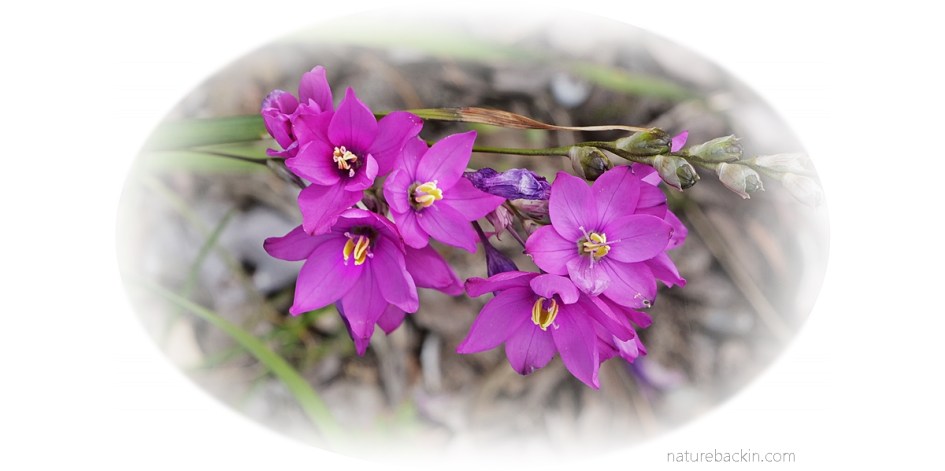
A species of Ixia – delicate in both colour and form – grows in small clusters at the road side. This plant is no longer upright and sprawls over sideways.
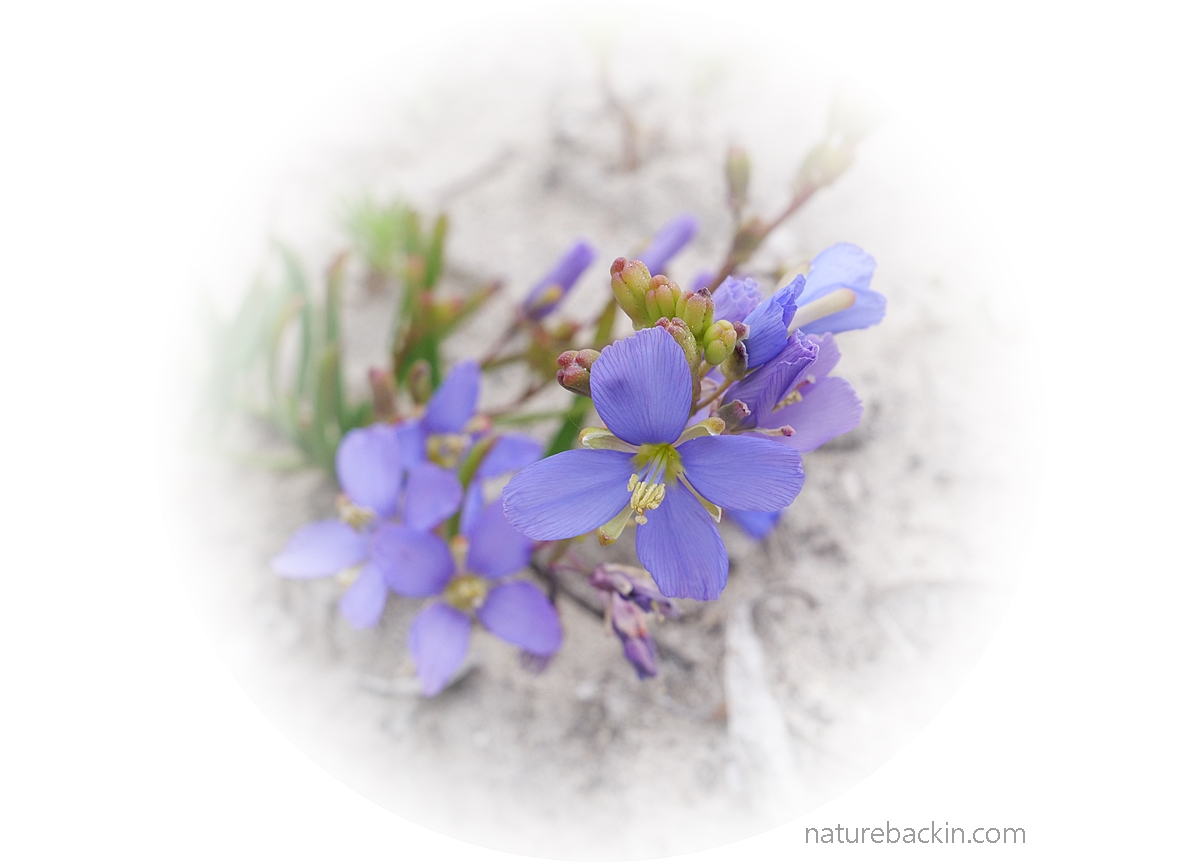
A beautiful blue Heliophila. The name comes from the Greek helios (sun) and philein (to love). Species of Heliophila thrive in sunny positions. The flowers close in the absence of sunshine at night or in cool overcast weather. This plant (above) is possibly Heliophila subulata, known as common sunspurge.
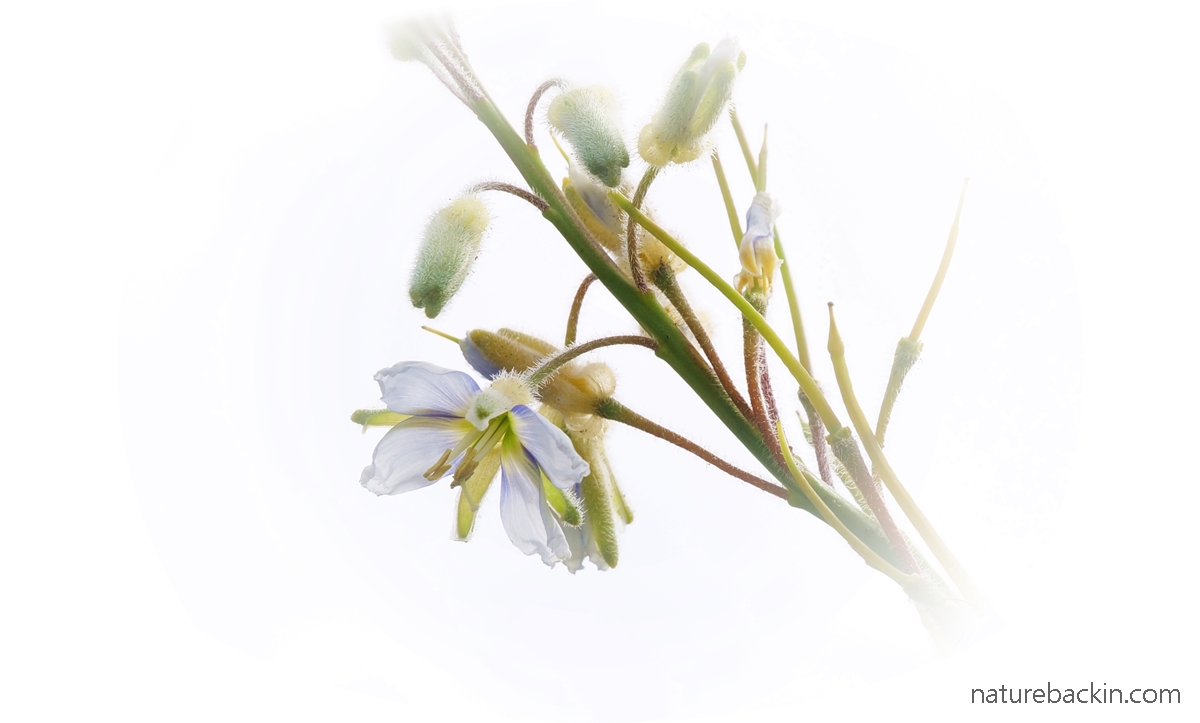
As I am totally smitten by them, I include several photos of Heliophilas. This flower (above) has more delicate notes of blue.

And another Heliophila – several species occur in the region.
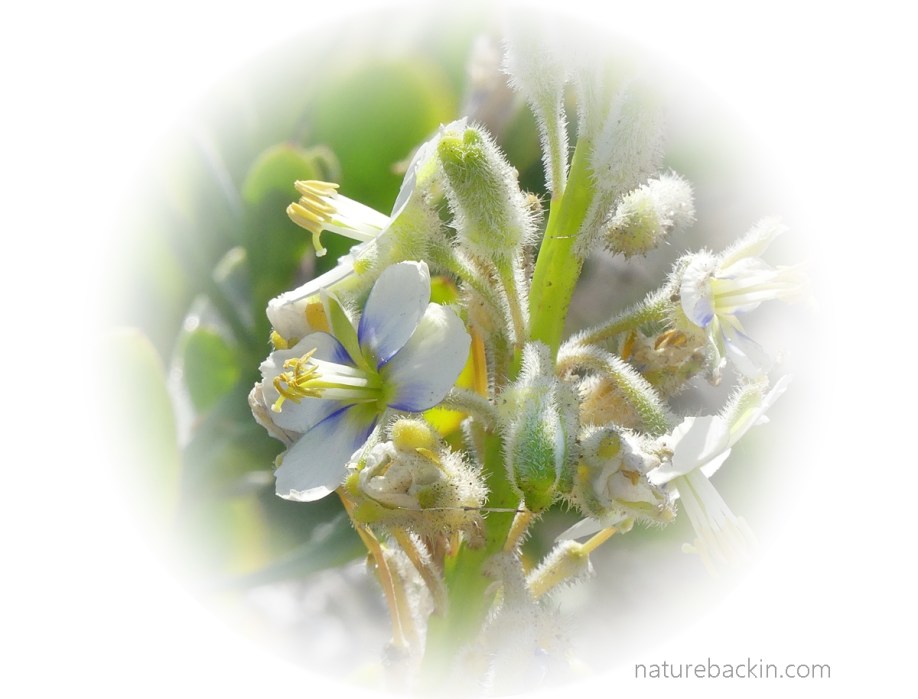
Photographed in fairly harsh sunlight, this Heliophila grows very near the coast. It has plump almost succulent leaves, unlike the others that have very narrow leaves. I think this may be Heliophila linearis var. reticulata, which occurs only in the Gansbaai area (Privett and Lutzeyer, p. 180).

Obviously, this is a member of the daisy family. The orange blooms make a very showy display when growing in massed groupings. I am still trying to learn to distinguish between various daisy genera such as Arctotis, Artotheca and Ursinia!
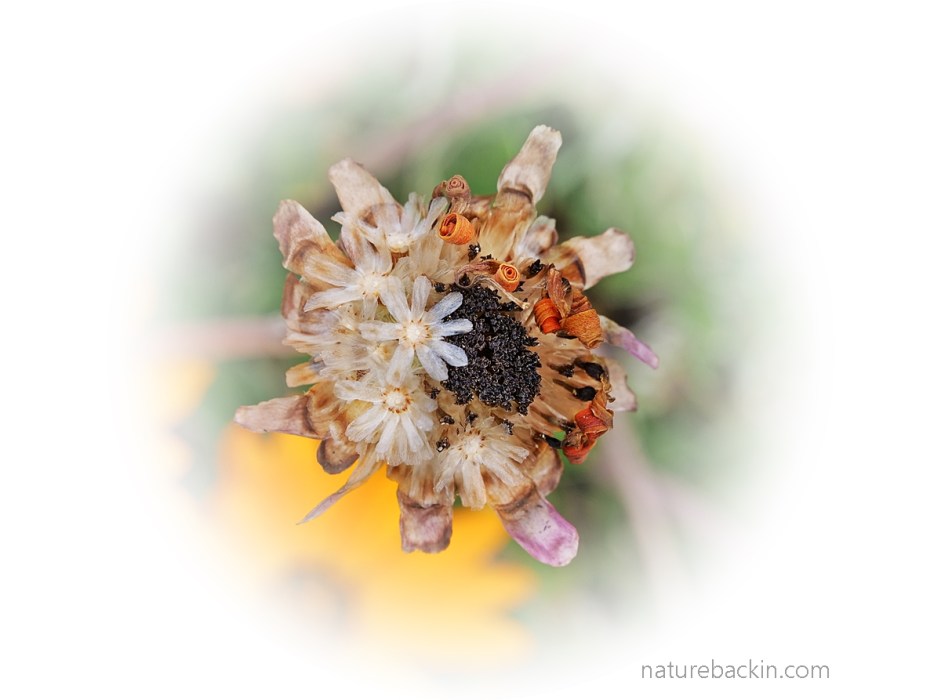
One of the daisies gone rather decoratively to seed.

Also in the daisy family, a pair of gazania flowers – most likely Gazania pectinata, a species that is pollinated by monkey beetles. As noted in the field guide to Grootbos Nature Reserve, the brown marking with a white dot at the base of each petal resembles a monkey beetle. The markings are thought to act as decoys to attract male monkey beetles that then pollinate the flower (Privett and Lutzeyer, p. 244).
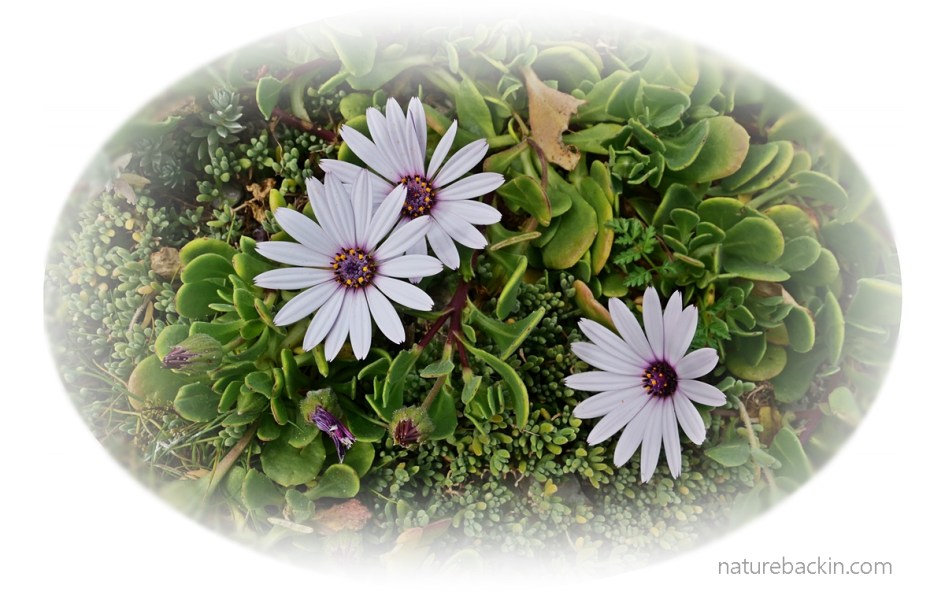
Growing close enough to the sea to be affected by sea spray were many Dimorphotheca fruticosa in flower.
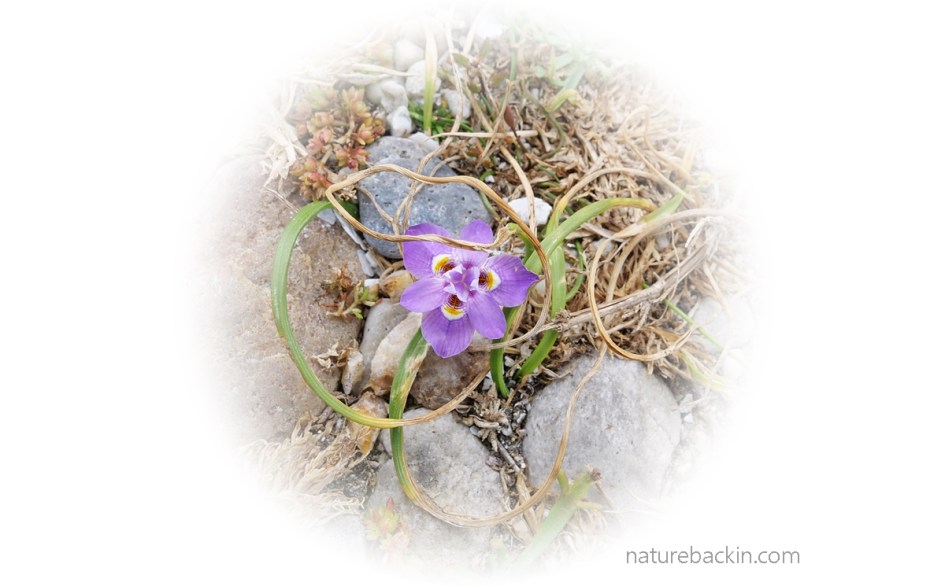
A very tiny, low-growing Moraea setifolia photographed not far from the seashore.
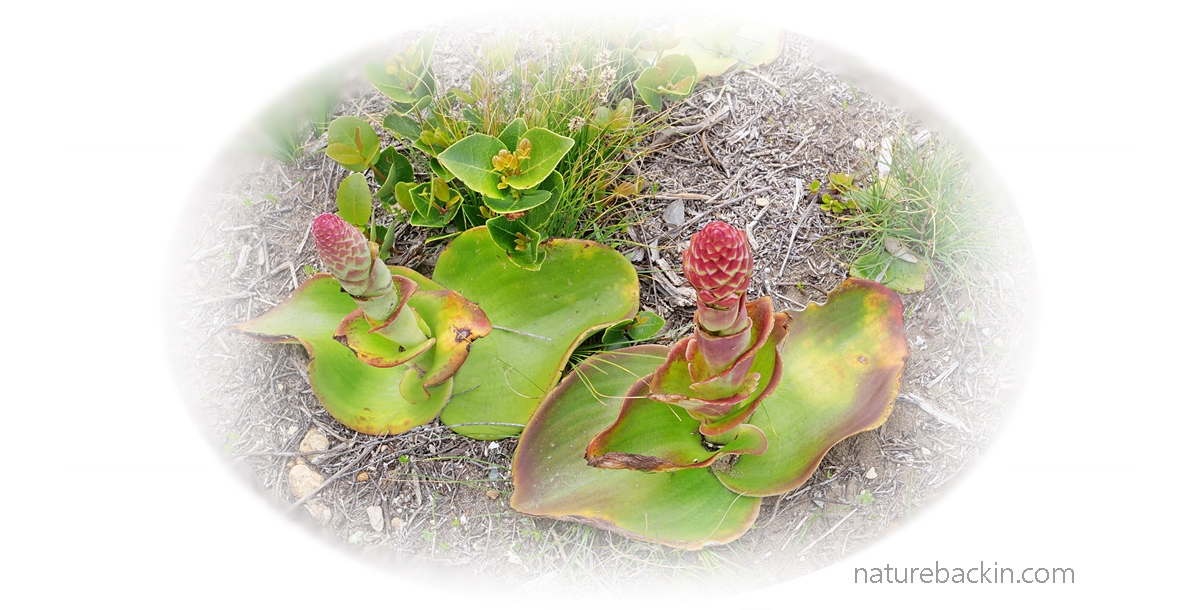
Stubby flower spears of the terrestrial orchid, Satyrium carneum, emerging from the broad, flat leaves. As the spears grow taller the flowers start opening. The leaves can fill with water that is retained and so forms a kind of a moat that prevents ants from reaching the nectar (Privett and Lutzeyer, p. 66).
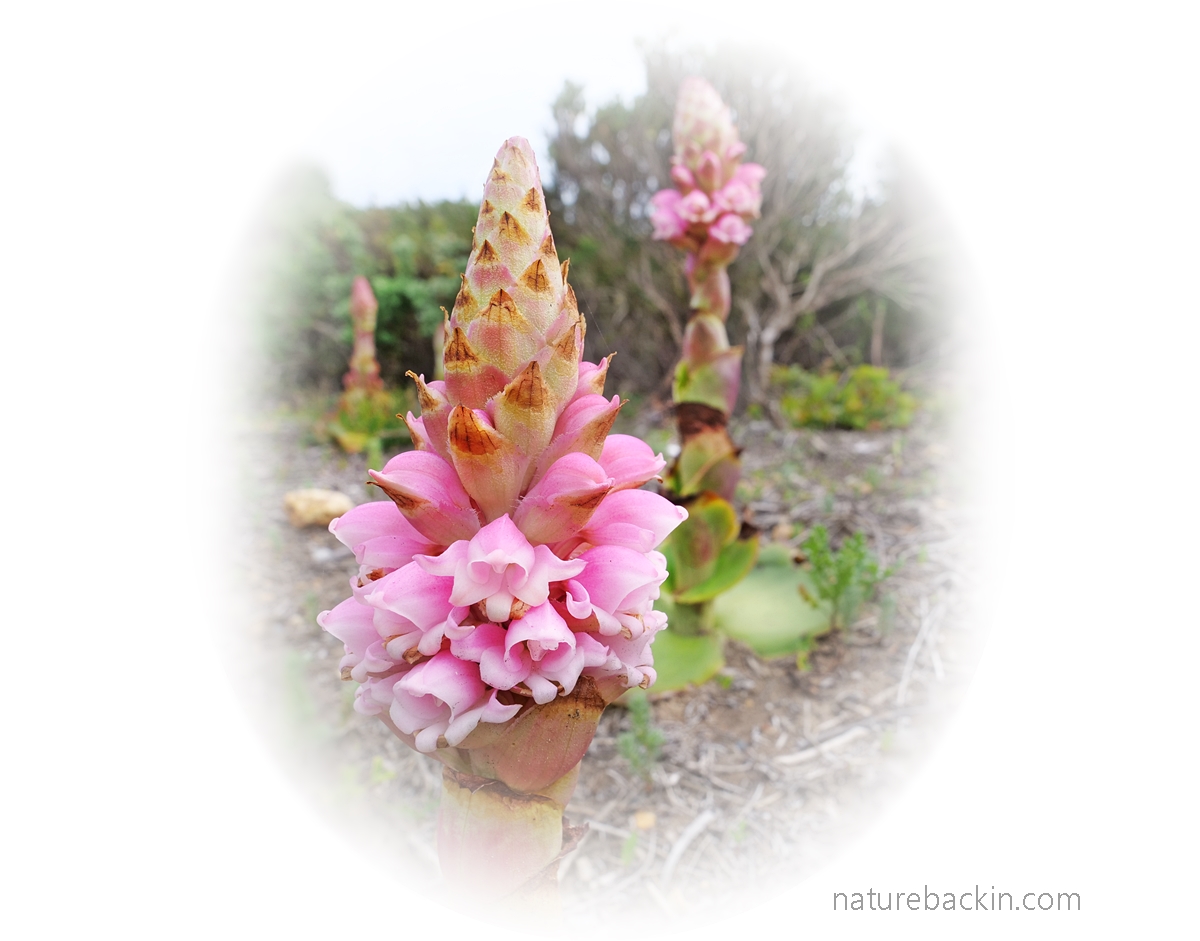
The flowers of the Satyrium carneum start opening from the bottom of the spear. The flowers are pollinated by sunbirds.

A species of Senecio – this little plant has taken root in the side of a low rock retaining wall on the side of the road. Grains of sand cling to the slightly hairy stems and leaves.
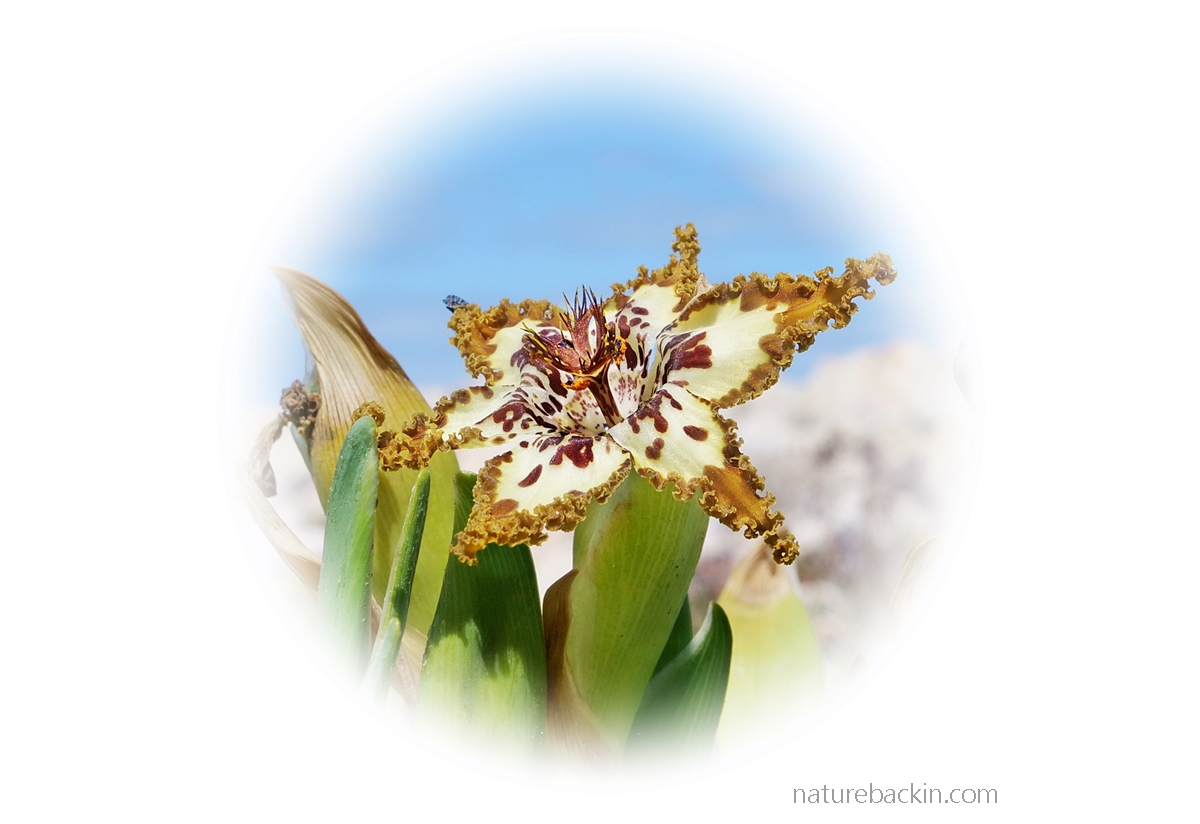
We were lucky to come across a black spiderlily (Ferraria crispa) in flower – not least because each flower remains open for less than a day before drying off and blackening. Also, the plant we came across close to the seashore, was small and could easily be overlooked, so we were fortunate to notice it.
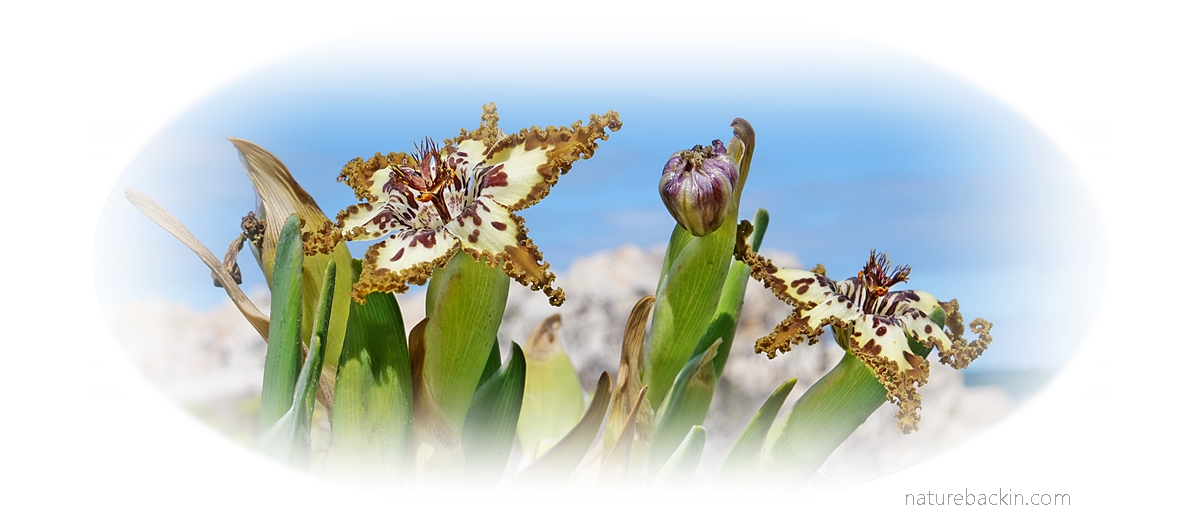
Each flower is spectacular even though they are small, only about 3,5 cm (1.5 inches) across. The edges of the flowers are crinkly and chocolate coloured and the cream petals are speckled. They are carrion-scented to attract their fly pollinators.
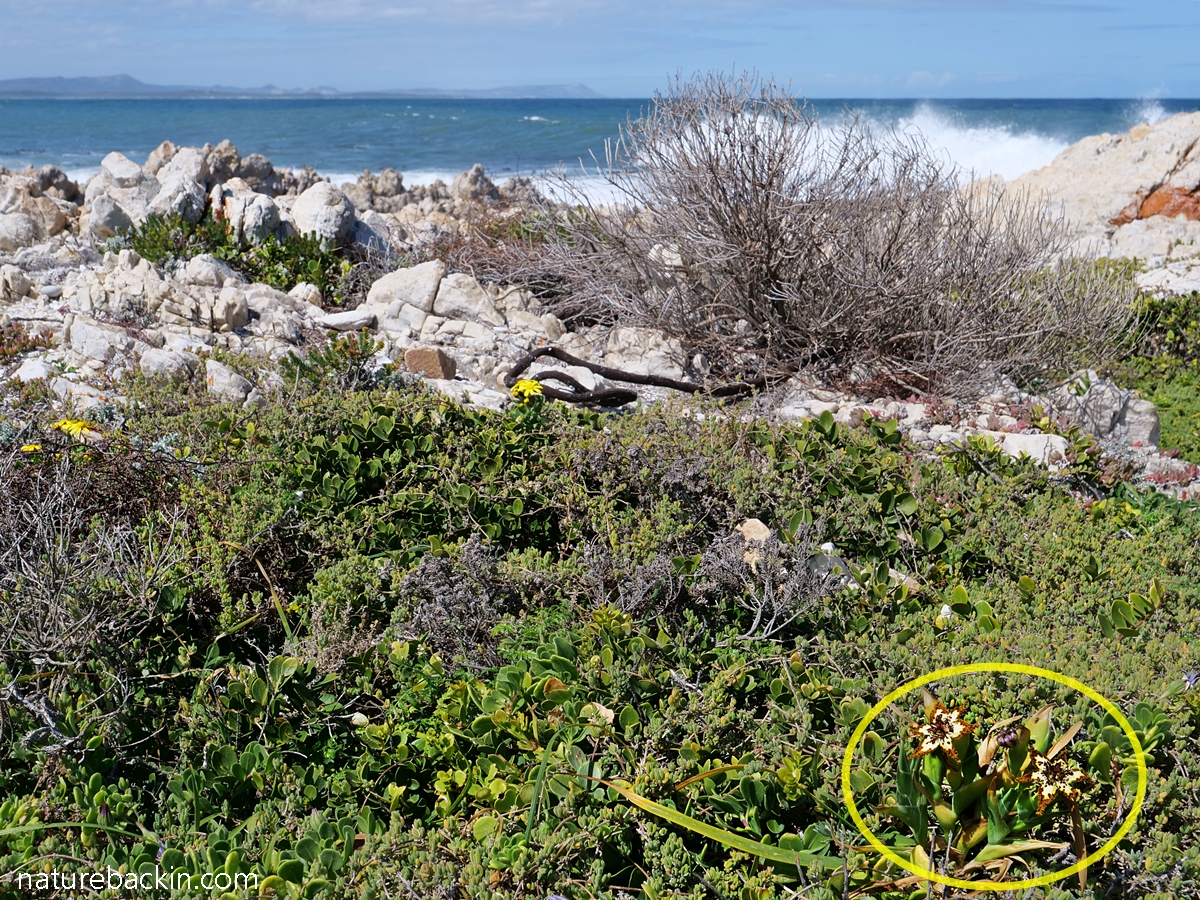
And to show the black spiderlily in context – the plant with its succulent leaves and the two open flowers is ringed in yellow in the bottom right-hand corner of the photo.
Sources:
Manning, John. 2018 (2nd ed.) Field Guide to Fynbos. Cape Town: Struik Nature. ISBN 978-1-77584-590-4; Privett, Sean & Lutazeyer, Heiner, 2010. Field Guide to the Flora of Grootbos Nature Reserve and the Walker Bay Region. [Hermanus]: Grootbos Foundation. ISBN 978-0-620-47805-2; Rebelo, A.G., Boucher, C., Helme, N., Mucina, L., Rutherford et al. 2006, “Fynbos Biome” https://www.researchgate.net › publication › 236896350_Fynbos_Biome (Chapter from book) In: Mucina, L, Rutherford, M.C., Powrie, L. (eds) 2006. The Vegetation of South Africa, Lesotho and Swaziland. South African National Biodiversity Institute. ISBN 1919976213, 9781919976211
Posted by Carol
Discover more from letting nature back in
Subscribe to get the latest posts sent to your email.


November 30, 2024 at 6:46 pm
Oh Carol. Thank you for sharing these beautiful flowers. A brilliant post.
LikeLiked by 2 people
December 1, 2024 at 1:15 pm
Thanks so much Mariss. The flowers are beautiful and also very cheering.
LikeLiked by 2 people
November 26, 2024 at 10:06 am
So beautiful, great post!
LikeLiked by 1 person
December 11, 2024 at 2:14 pm
Thank you very much. I have just discovered and retrieved your comment from the spam folder – I am not sure how it got there!
LikeLiked by 2 people
November 12, 2024 at 6:54 pm
Hi Carol… thanks for the lovely flowers! 🥰 I seem to be in a muddle. Everything seems to be hitting at once. We are moving (perhaps not quite as far as your move, but it’s still a tedious process. It does not get any easier with advanced age!)
My WP program is about to expire (or already has? I noticed that my latest post isn’t showing up.) But it may take awhile before I try to deal with going back to the free version.
It’s good to see you exploring your new location. I’m hoping perhaps I can eventually get to a situation where I can do the same.
Wishing you all the best.
LikeLiked by 2 people
November 14, 2024 at 2:38 pm
Hi Gunta – thanks for finding the time to visit my blog.
So are you moving too? I hope it all works out well. Moving is stressful and there is a mixture of loss and sadness, together with a degree of relief and the interest of new things to experience. Wishing you all the best too. Hoping to stay in touch with your blog when it moves too!
LikeLiked by 1 person
November 12, 2024 at 12:53 am
What lovely floral portraits, Carol. I really like the frames and dreamy appearance of some of your images.
Not surprisingly, all species are new to me (we share some genera). The black spiderlily is spectacular and it’s helpful to see its natural setting as well as a close-up.
Thank you for sharing some of your spring beauties. 🙏
LikeLiked by 2 people
November 14, 2024 at 2:25 pm
Thanks Tanja. Giving these flowers such close attention is like a form of meditation, or at least distraction!
LikeLiked by 2 people
November 11, 2024 at 5:33 pm
What beautiful and delicate flowers. And so wonderfully photographed too.
LikeLiked by 2 people
November 11, 2024 at 6:50 pm
Thanks so much Margaret. I think it is possible to get addicted to photographing such gorgeous flowers!
LikeLiked by 2 people
November 11, 2024 at 7:06 pm
A great addiction!
LikeLiked by 2 people
November 11, 2024 at 7:31 am
So beautiful. 🙂
LikeLiked by 2 people
November 11, 2024 at 1:36 pm
Thanks Edith – the flowers along the coast are remarkably rich.
LikeLiked by 1 person
November 10, 2024 at 9:25 pm
A wonderful array of flowers and I love the way you’ve presented them. The spider lily is a fabulous find and so exotic looking. And any place called Danger Point should certainly be home to a lighthouse!
LikeLiked by 2 people
November 11, 2024 at 1:35 pm
I am glad you liked the presentation Graham. So many flowers to enjoy and photograph. The spiderlily is very special. It is the only one we have noticed in flower so far, and now we are always on the lookout for them.
Absolutely Danger Point needs a lighthouse. I think I mentioned in another post some time back that the lighthouse was built after the famous troopship the Birkenhead struck a rock and sank offshore in 1852.
LikeLiked by 2 people
November 11, 2024 at 9:00 pm
I remember that post. I didn’t realize it was the same point.
LikeLiked by 2 people
November 11, 2024 at 9:37 pm
Certainly a place revisiting often! I think I should have mentioned the previous post.
LikeLiked by 2 people
November 10, 2024 at 10:41 am
Beautiful photogrpahs.
LikeLiked by 2 people
November 11, 2024 at 1:30 pm
Thanks so much. We are truly spoilt for choice around here!
LikeLiked by 1 person
November 10, 2024 at 8:56 am
thank you. A very interesting and gentle account of the coastal flowers
LikeLiked by 2 people
November 11, 2024 at 1:29 pm
Thanks very much Thelma. I really appreciate your comment.
LikeLiked by 1 person
November 10, 2024 at 8:42 am
I so enjoyed this informative record of your outing to this area, and the wonderful photographs.
LikeLiked by 2 people
November 11, 2024 at 1:28 pm
Thanks Christine – it is a wonderful place for repeat outings as every visit yields new treasures.
LikeLiked by 1 person
November 10, 2024 at 8:27 am
What a treasure of the most beautiful blooms, Carol, and so beautifully presented! Made me feel like I was looking at specimens preserved with great care!
LikeLiked by 3 people
November 11, 2024 at 1:27 pm
Oh thanks so much Dries. The flowering plants here truly are treasures.
LikeLiked by 2 people
November 10, 2024 at 5:20 am
Your posts are always worth waitng for and this one is no exception. You have a host of wild flowers to get to know in your new home environment – what a joy!
LikeLiked by 1 person
November 11, 2024 at 1:50 pm
Thanks Anne. As you know from when you moved to where you are now, it is an enjoyable exploration getting acquainted with a wide array of ‘new’ plants in such a different environment.
LikeLiked by 2 people
November 10, 2024 at 12:21 am
Delightful post, Carol! Such beautiful flowers, some of which are familiar annuals grown here in summer, like Gazania and Osteospermum. I love the black spider lily!
LikeLiked by 2 people
November 11, 2024 at 1:23 pm
How nice to know that some of our showy local plants are familiar to you and grown in your summertime gardens.
That spiderlily is most intriguing. We are on the lookout to spot another in flower!
LikeLiked by 2 people
November 9, 2024 at 9:58 pm
The wildflowers the are showcased here are lovely, I really like the way you framed them.Isn’t it wonderful what nature does without human involvement?
LikeLiked by 2 people
November 11, 2024 at 1:20 pm
Thanks Laura. I agree that nature’s ‘garden’ is wonderful. Makes me think that more human gardeners should try incorporating locally occurring native plants in their gardens!
LikeLiked by 1 person