I am always happy when volunteer plants in our garden turn out to be interesting, non-invasive and preferably indigenous. One that is all three (or so I first thought!) is a species of milkweed, which is known colloquially as balloon milkweed, balloon wild cotton or hairy balls. One of its attributes is that it is a host plant for the African monarch butterfly.
It is a curious plant in many respects. Its inflated, hairy fruits or seed pods are intriguing enough that pod-bearing stems, both fresh and dried, are used in floral arrangements.
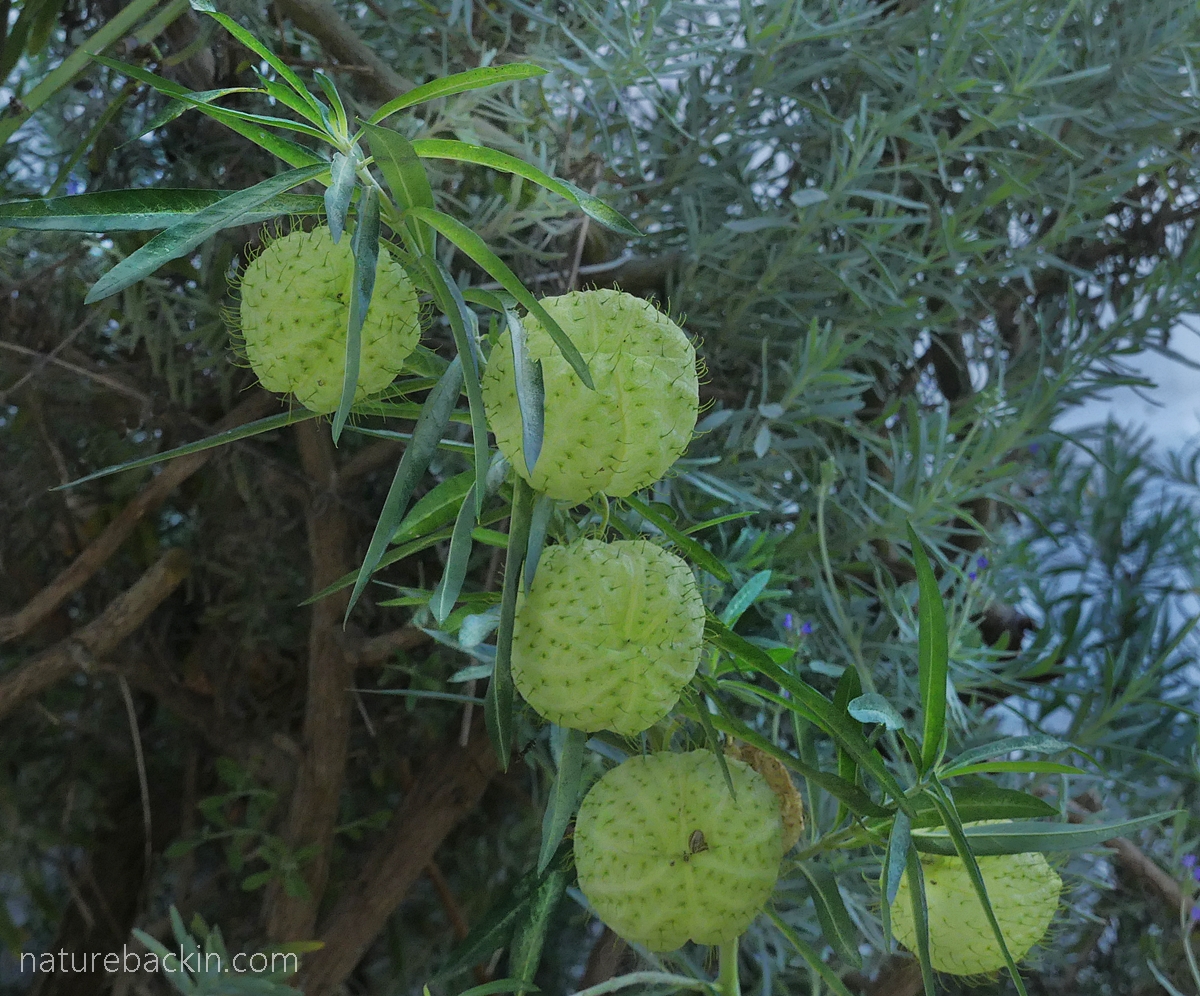
The inflated and hairy pods are decorative both in the garden and in the vase
The physocarpus part of its species name, Gomphocarpus physocarpus, is straightforward and refers to the bladder-like fruit – derived from the Greek physa meaning bladder and karpos meaning fruit. But the genus name has changed over time depending, following ongoing DNA analysis, on whether it is classed using a broader or narrower categorization. Formerly it was known as Asclepias physocarpa, but now it is Gomphocarpus physocarpus. The current genus name, Gomphocarpus, is from the Greek gomphos meaning a club, and karpos meaning fruit (as also in the species delineation).
Previously it was lumped into a broader genus category, namely Asclepias, but now Gomphocarpus and Asclepias, among other genera, are deemed to be members of the milkwood subfamily Asclepiadoideae (in the family Apocynaceae). The well-known American milkwoods, which host the iconic monarch butterflies (Danaus plexippus) that are famous for their mass migrations and mass roostings, are members of the Asclepias genus.
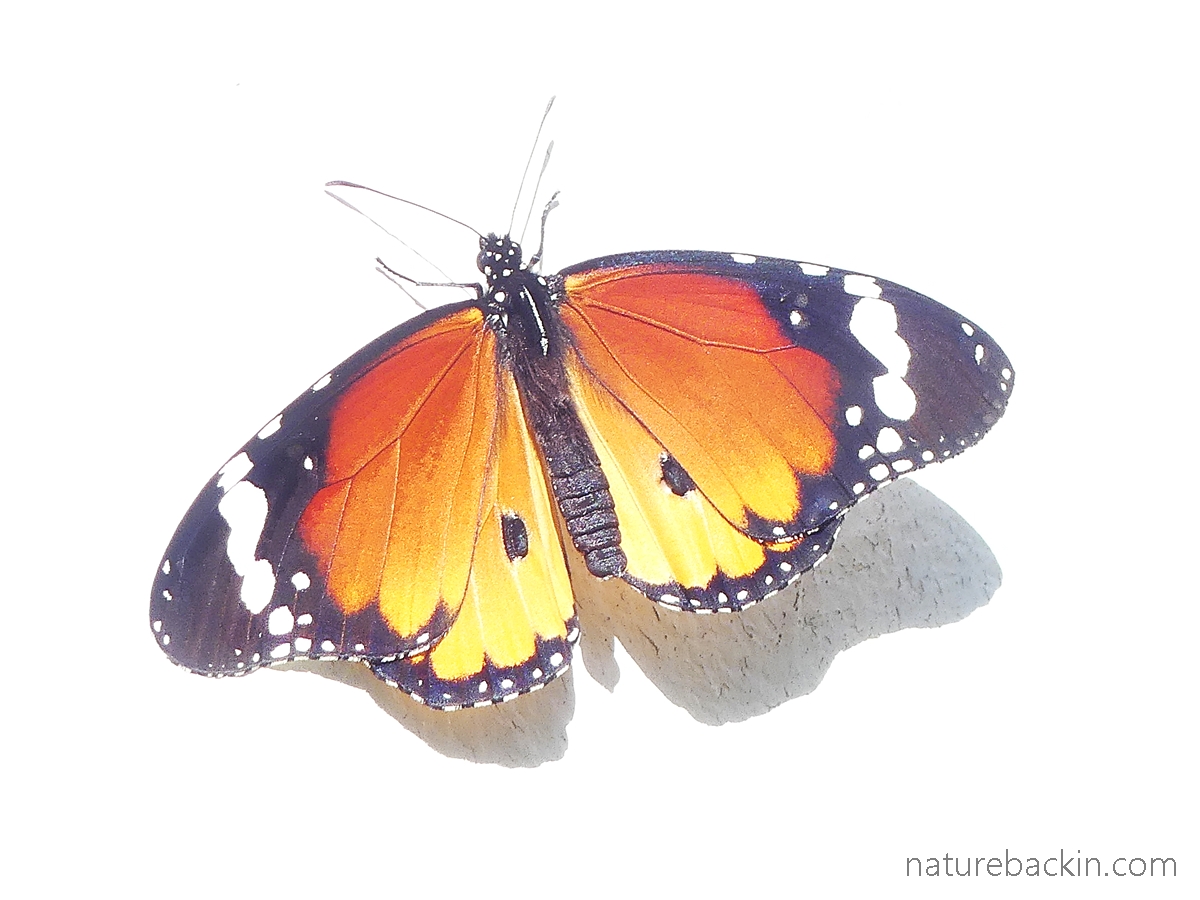
An African monarch butterfly basking in sunshine on a white wall in our garden
The African monarch butterfly (Danaus chrysippus) has a large range over most of Africa and much of Asia, including India, and into many islands in the south Pacific and also in parts of Australia. It is also known as the plain tiger and as the African queen. Its many host plants include some of the Gomphocarpus milkweeds.
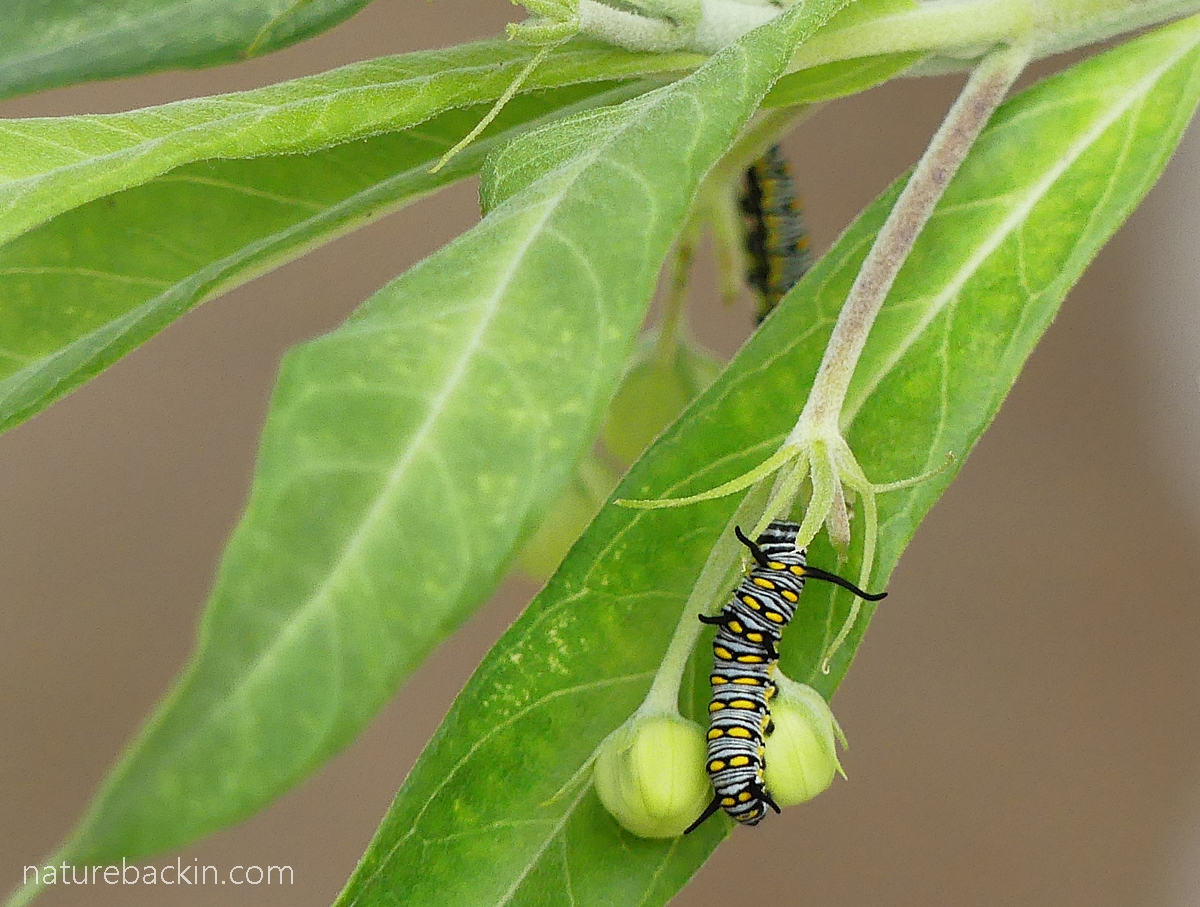
Baby butterflies, i.e. caterpillars/larvae of the African monarch butterfly, on a balloon milkweed plant in our garden
When eating the leaves, the caterpillars/larvae are unaffected by the toxic alkaloids that are present in the milkweed and that make the plant unpalatable and/or poisonous to most other creatures. The caterpillars pass the toxic properties on to the pupae and to the adult butterflies. Further, the adult male butterflies themselves may absorb alkaloids by feeding on the sap of specific species of damaged plants. The presence of these alkaloids makes the monarchs unpalatable to most predators. The colours of the larvae and adults serve as warnings (or reminders) so that would-be predators avoid eating them. Interestingly, some species of edible butterflies “mimic” the warning colours and benefit from the protective effect.
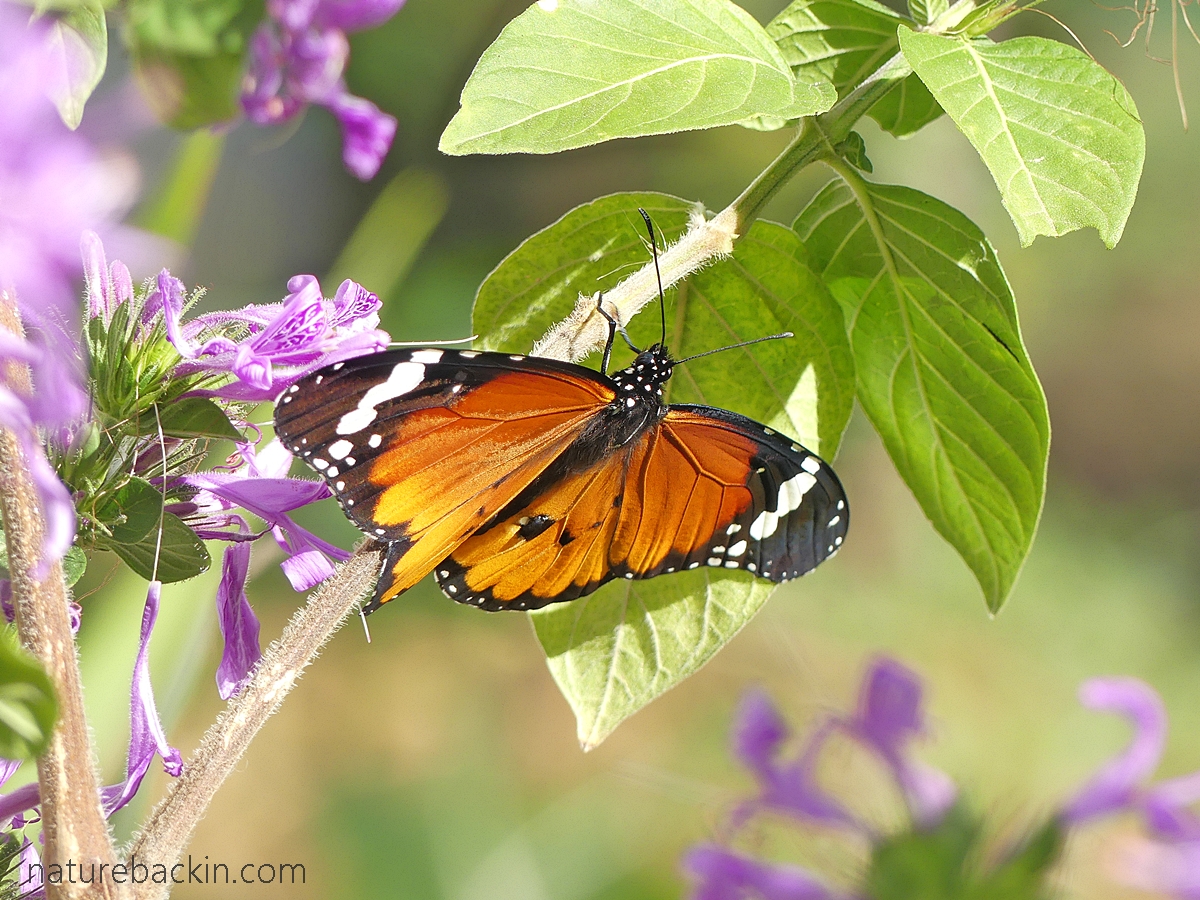
The adult African monarchs, i.e. the butterflies, take nectar from a wide variety of flowers. This butterfly is basking on a ribbon bush (Hypoestes aristata) in our garden
Although the African monarch butterflies do feed on nectar from the flowers of the balloon milkwood, the primary pollinators of Gomphocarpus species (and other species in the Asclepiadoideae subfamily) are vespid wasps. The flowers are constructed in such a way so as momentarily trap a leg or mouthpart of visiting wasps and in the process transferring pollen to the wasp. Pollination is affected when the wasp visits another flower on another plant and transfers the pollen from a previously visited flower.

The flowers of the balloon milkweed (Gomphocarpus physocarpus) are small and hang in drooping clusters. The shape of each flower is complex – they almost resemble tiny orchid flowers

Over a period of days, I saw a small group of brightly coloured milkweed bug nymphs (probably Oncopeltus famelicus) on one of the balloon milkweed plants in our garden. Oddly, I never saw any in adult form. In addition to feeding with impunity on Gomphocarpus species, these insects also feed on several other species of plants, including granadillas, cotton and sweet potatoes
Gomphocarpus physocarpus is not the only species in this genus occurring in South Africa. Also in the areas of the Western Cape, I have seen Gomphocarpus fruticosus (formerly Asclepias fruticosa) which is so closely related to G. physocarpus that they are known to hybridise. It is referred to as milkweed or wild cotton and is also known as the narrow-leaved cotton bush or the swan plant. Like the balloon milkweed it can be found in regions across South Africa. I have not yet seen the broad-leaved Gomphocarpus cancellatus, which is acknowledged as being a fynbos species, although it also occurs in other arid regions in the south west of southern Africa.

A shrubby Gomphocarpus fruticosus plant growing near a country roadside in the Overberg. These plants often grow in disturbed land such as along roadsides or in abandoned fields

The fruit or seed pod of the Gomphocarpus fruticosus is not spherical as in G. physocarpus, but is oval with a curved tip, so the shape can be fancied to resemble that of the neck of a swan or goose
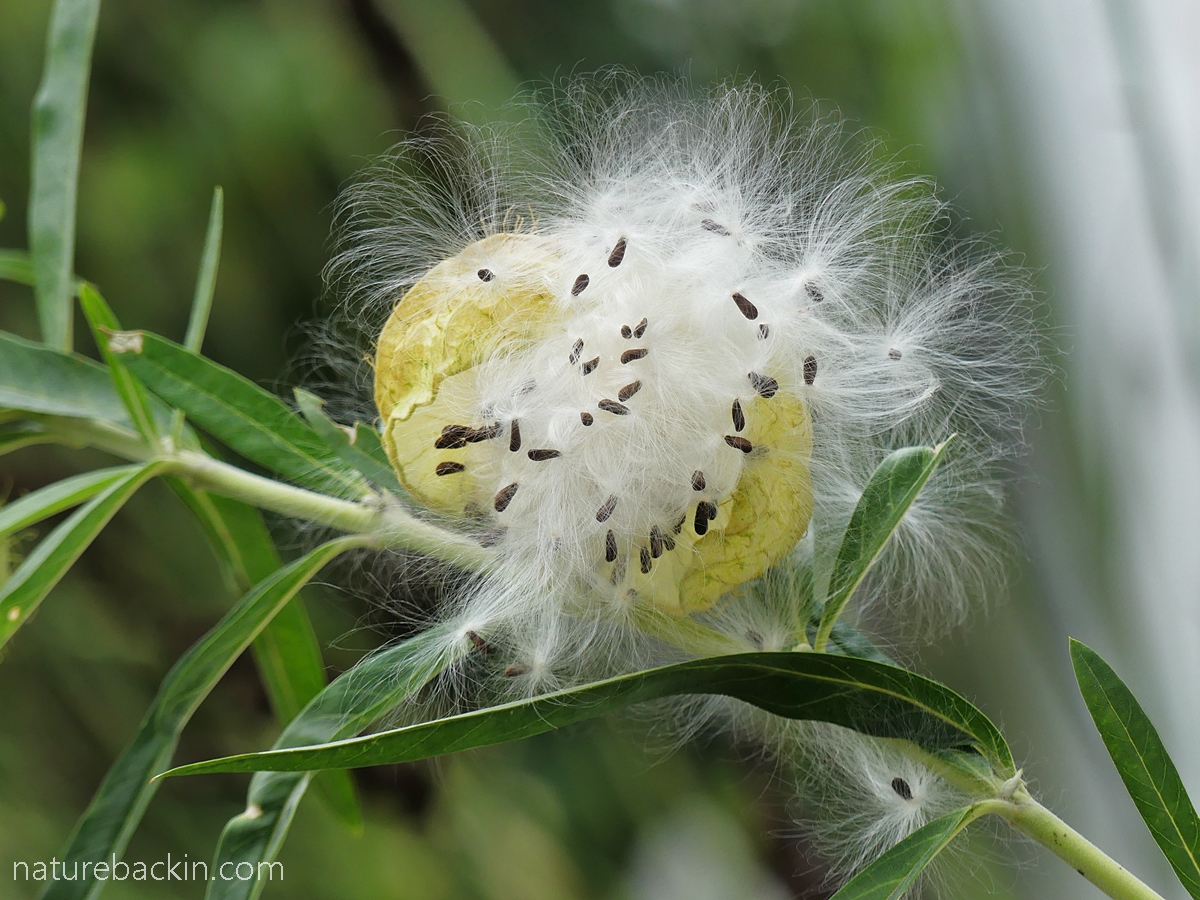
When the pods of both these species split, the seeds are revealed, showing that each seed has a silky tuft of hairs attached at one end. The silky tufts enable the seeds to be dispersed by the wind.

The seeds with silky tufts attached can clearly be seen as a round pod splits open on a balloon milkwood, Gomphocarpus physocarpus, in our garden
We only have the one species, Gomphocarpus physocarpus, volunteering in our garden. It self-seeds readily but is easy to control and so far, it is not at all invasive.
I assumed that this species is indigenous to South Africa, and indeed most websites I consulted confirmed this, with some adding that it is also native to Eswatini and southern Mozambique. But confusingly, some sites suggested that although the plant has naturalised across much of South Africa, it was originally introduced from tropical Africa.
So, which is correct – is it a native plant or an introduced naturalised “weed”? I decided to let the Royal Botanic Gardens Kew ‘Plants of the World Online’ be the final arbiter. It states that “the native range of this species is S. Mozambique to S. Africa”. See the distribution map here. As can be seen from the map, the balloon milkweed, Gomphocarpus physocarpus, has been introduced to many other countries, including elsewhere in Africa, in south and central America, parts of Europe, India and Australia and to some islands including Jamaica, Hawaii, and Seychelles. Unfortunately, in many of these places it has become invasive.
And so, while at it, I also checked what Kew’s ‘Plants of the World Online’ says of the distribution of Gomphocarpus fruticosus. Its native range is a little more widespread: “The native range of this species is Eritrea to S. Africa, Arabian Peninsula”. See the distribution map here. Similarly to the balloon milkweed, it has also been introduced to other countries in Africa and across the globe.

A stand of Gomphocarpus fruticosus on disturbed farmland. I took this photo in the De Doorns region of the Hex River Valley in the Western Cape
Traditionally, both these species of Gomphocarpus have been used medicinally, despite all parts of the plant being poisonous – not only to stock animals but to humans too. The leaves when dried have been made into a snuff that acts as a sedative and treats headaches. The milky latex has been used to treat warts. Infusions and decoctions from the roots of G. fruticosus have been used to treat abdominal pain.
In addition to its medicinal uses, the stems have been used for fibre. Apparently, fresh leaves and stems shoved down mole holes deter the moles from returning. And of course, both species can be used for their decorative qualities and because they attract butterflies to the garden.

Sources:
Gomphocarpus fruticosus. Plants of the World Online. Royal Botanic Gardens Kew. https://powo.science.kew.org/taxon/urn:lsid:ipni.org:names:97610-1#distributions
Gomphocarpus physocarpus. Plants of the World Online. Royal Botanic Gardens Kew. https://powo.science.kew.org/taxon/urn:lsid:ipni.org:names:97670-1#distributions
Naidoo, Alec. 2005, Gomphocarpus fruticosus. PlantZAfrica. South African National Biodiversity Institute (SANBI). Kirstenbosch National Botanical Garden. https://pza.sanbi.org/gomphocarpus-fruticosus
Notten, Alice. 2010. Gomphocarpus physocarpus. PlantZAfrica. South African National Biodiversity Institute (SANBI). Kirstenbosch National Botanical Garden. https://pza.sanbi.org/gomphocarpus-physocarpus
Posted by Carol

Discover more from letting nature back in
Subscribe to get the latest posts sent to your email.


October 19, 2024 at 11:22 pm
Nice post. The flower buds of the balloon milkweed evoke those of Platycodon. Lovely photos.
LikeLiked by 1 person
October 21, 2024 at 6:37 pm
Thank you. I have just looked at some photos online of the Platycodon flower buds and I see what you mean!
LikeLike
October 4, 2024 at 1:25 pm
What an informative post. Thank you
LikeLiked by 1 person
October 9, 2024 at 7:58 pm
Thanks Mariss.
LikeLiked by 1 person
October 4, 2024 at 12:58 pm
Thank you for a fascinating post. I have always been intrigued by these plants and was pleased to learn so much about them – lovely photos once again!
LikeLiked by 1 person
October 9, 2024 at 7:58 pm
Thanks Christine. They are intriguing plants and something different to the garden.
LikeLike
October 3, 2024 at 11:41 am
Thank you for your most interesting articles. I learn so much about the interaction of plants and insects: much wider and more interesting than gardening articles on how to grow the newest hybrids. Your articles are so aligned with my thoughts on nature and gardening. I thoroughly enjoy each newsletter. I am going to try the Gomphocarpus in the small plot of “experimental grassland” that I was permitted to develop in our Retirement Village in Pretoria.
LikeLiked by 1 person
October 3, 2024 at 7:38 pm
Thanks so much for your comment and it is so nice to know we share a similar approach to nature in our garden spaces. That is great that the retirement village is allowing your experimental grassland. It will be interesting to see what turns up of its own accord as well as planting plants that grow, or used to grow, naturally in grasslands in your area. I hope the Gomphocarpus makes itself at home.
LikeLike
October 3, 2024 at 10:34 am
I also like the phrase ‘volunteer plants’; I have several! Fascinating post, Carol.
LikeLiked by 1 person
October 3, 2024 at 7:33 pm
Yes we all experience those volunteers. As Margaret pointed out – not all volunteers end up being welcomed! But it is interesting to see what turns up, and give them a chance while I try to figure out what the unfamiliar ones are.
LikeLiked by 1 person
October 2, 2024 at 7:44 pm
lovely! I’m envious. I’ve tried for years now to establish some milkweed with no success!
LikeLiked by 1 person
October 2, 2024 at 8:13 pm
Oh that is disappointing. Do they occur naturally in your region?
LikeLike
October 9, 2024 at 10:05 pm
Yes, we specifically searched for varieties native to our area, but I think our steep bank and drought conditions in the summer made it a definite challenge. But I haven’t given up entirely. YET.
LikeLiked by 1 person
October 12, 2024 at 2:37 pm
Sorry about the summer drought. I hope you have success with milkweeds going forward.
LikeLike
October 2, 2024 at 9:17 am
That’s so interesting, thank you. Great pics, too. I had the balloon milkweed growing in my Eastern Cape (Port Alfred) garden. I haven’t seen it at all since moving “up the road” to East London. Before I found out what it was, I was both fascinated and a little alarmed by its (almost literally, to me) alien appearance. Luckily for the plant itself, not to mention the butterflies, its oddness was also what made me decide not to turf it out.
Warm regards, Stevie (Stephanie) Godson
LikeLiked by 1 person
October 2, 2024 at 7:02 pm
Thanks for being in touch. I agree that the plants do have a rather alien aspect! I also felt rather puzzled by them initially, when they started appearing in our previous garden in KZN. The fluffy strands that transport the seeds almost like parachutes are particularly intriguing. It seems that the plants are rather “spotty” in their distribution.
LikeLike
October 2, 2024 at 7:23 am
I love your phrase ‘volunteer plants’. Such a positive spin on these not always wanted guests, though the subjects of your post seem quite welcome. Interesting facts about the Monarch butterfly too. Another post worth waiting for!
LikeLiked by 1 person
October 2, 2024 at 6:56 pm
I picked up the phrase from reading about gardeners in the US promoting gardening with locally indigenous plants. I also like the positive spin 😊
LikeLiked by 1 person
October 3, 2024 at 8:09 am
Me too. Adopted forthwith!
LikeLiked by 1 person
October 2, 2024 at 6:25 am
These plants were very common in the Mmabatho area when we lived there and so I was delighted to find one growing in our garden some time ago. It only lasted for a season though. I occasionally see a few growing in the wild here, but perhaps the climate is not suited to them. Your photographs are magnificent – always a pleasure to look at.
LikeLiked by 1 person
October 2, 2024 at 6:54 pm
What a shame your plant didn’t propagate. I gather that for pollination of the milkweed to be successful pollen has to be transferred to a flower on another plant, and not on the same plant. But then if your plant fruited, then it must have been pollinated?!
LikeLike
October 3, 2024 at 5:55 am
There are a few plants growing on the verges in out neighbourhood. Perhaps too, my garden is becoming too shady as the trees we planted mature.
LikeLiked by 1 person
October 3, 2024 at 7:30 pm
Your garden has transformed into a lovely woodland 🙂
LikeLike
October 4, 2024 at 7:13 am
It has indeed and so we have a shift in the bird population compared with what it was over thirty years ago 🙂
LikeLiked by 1 person
October 2, 2024 at 3:11 am
Interesting stuff Carol. We do have balloon plants here, though I’m not sure which one. Anything which helps the monarchs is a good thing in my book though.
LikeLiked by 1 person
October 2, 2024 at 6:49 pm
Yes, it does seem that monarch butterflies in America need all the help they can get.
LikeLiked by 1 person
October 1, 2024 at 10:32 pm
I loved learning about your beautiful native monarch and the plants that host its larva. As you know, monarchs here are imperiled here, so they are of great interest to me. Your photos are beautiful as well!
LikeLiked by 1 person
October 2, 2024 at 6:48 pm
Thank you Eliza. The migrations and the mass roostings of the monarchs in America are incredible. It does seem that the protecting the monarchs has attracted widespread attention and I hope it translates to conserving the species. The monarch butterflies here are relatively low key!
LikeLiked by 1 person