
Our small garden attracts a number of species of birds across the seasons. Here are some photos I snapped of visiting birds over the past few months. The delicately hued laughing doves (Spilopelia senegalensis) are among the more numerous of our visitors.
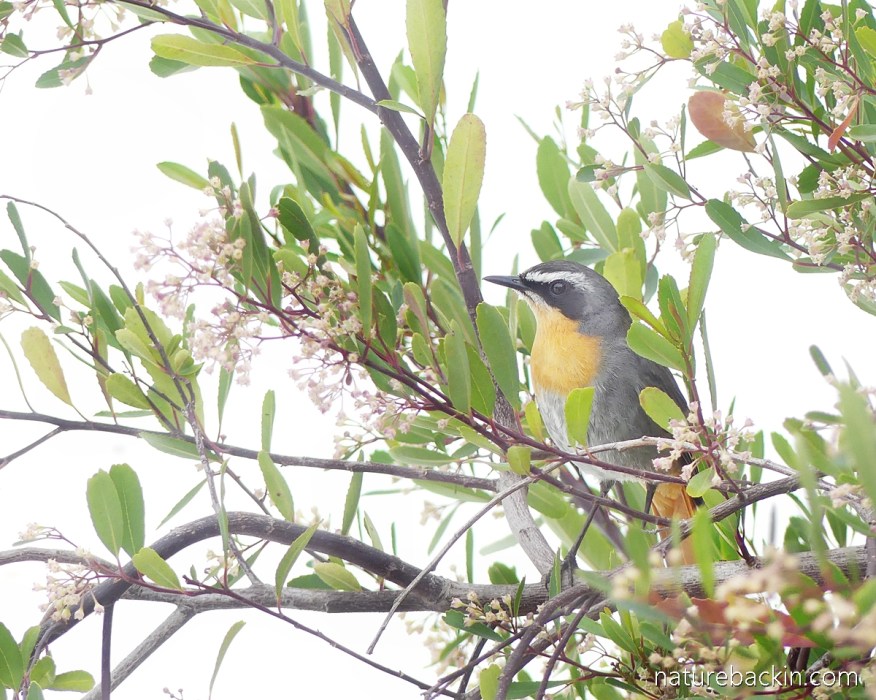
A Cape robin-chat (above) perched in a flowering tree in our garden. (I am yet to identify the tree.)
One of the most regular visitors to our garden are Cape-robin chats (Cossypha caffra), mostly seen singly, although we often see a pair together too – they form monogamous breeding pairs. Male Cape robin-chats are known to be highly territorial, for example chasing off other males, so possibly we only have two individuals from the breeding pair visiting our garden? Perhaps though, some degree of territorial overlapping is tolerated, especially outside of the breeding season, and so other individuals may also visit. Cape robin-chats are among the most eager users of our garden birdbaths.

Also daily visitors to our garden are southern double-collared sunbirds
Tiny and exquisite, southern double-collared sunbirds (Cinnyris chalybeus) never cease to be enchanting. When I say they are tiny they weigh around 8 grams (0.3 ounces) and are about 12 cm (4.5 inches) in length, including the tail. Southern double-collared sunbirds are endemic to regions of South Africa and to Eswatini (Swaziland) and the southern border area of Namibia.
Although in some ways they may remind one of hummingbirds, sunbirds are from a different taxonomic family. Sunbirds occur in Africa, Asia and Australasia, and hummingbirds in North and South America. Although they can hover, sunbirds usually perch when feeding on nectar from flowers, unlike hummingbirds that hover when feeding from flowers.

Another angle on a male southern double-collared sunbird. One of the yellow pectoral tufts (small patches on either side of the chest) can just be seen. These tufts are not always visible.
When not breeding, male sunbirds lose their bright iridescent breeding plumage and resemble the relatively drab females. Female southern double-collared sunbirds are grey with slightly paler underparts. In the Western Cape the southern double-collared sunbirds’ breeding season includes the rainy months of winter – they breed from March through to September – whereas in KwaZulu-Natal they breed in early summer (October to December), which is the wet season there.
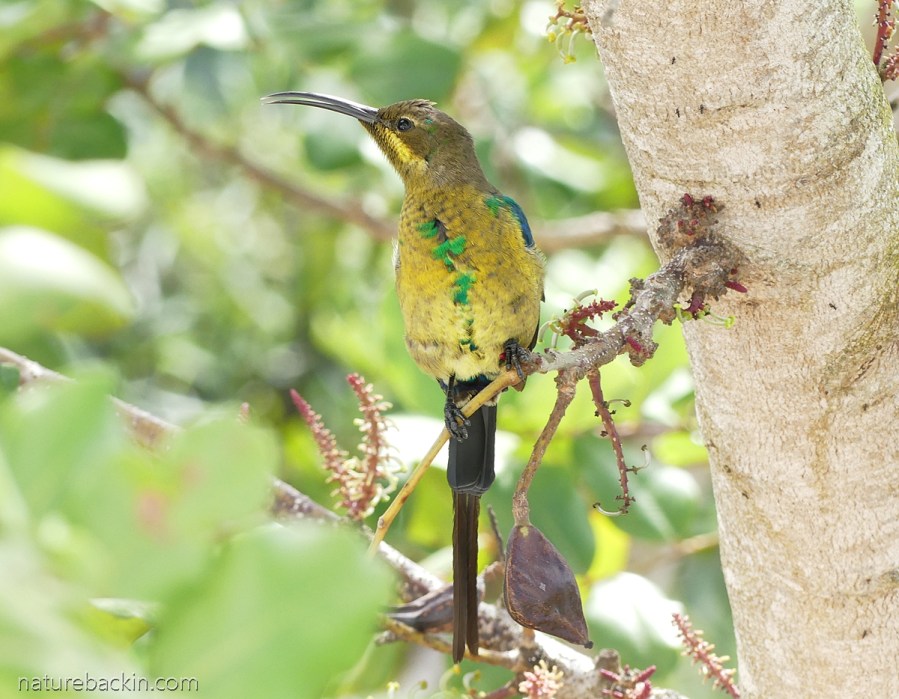
A male malachite sunbird in eclipse plumage
The breeding plumage of male malachite sunbirds (Nectarinia famosa) is a bright metallic green – a similar green to that of malachite stone, hence the name. However, in eclipse plumage, when malachite sunbirds are acquiring their breeding colours ahead of the breeding season, they can appear quite blotchy, as can be seen in the bird in the above photo. In the Western Cape their breeding season is May to November.
Malachite sunbirds are relatively large, with males being 25 cm (9.9 inches) in length and weighing about 20 g (0.7 ounces). The smaller females average 15 cm (6 inches) in length and weigh 15 g (0.5 ounces). Malachite sunbirds are much larger than the southern double-collared sunbirds.

A southern red bishop in eclipse plumage. Red bishops are only occasional visitors to our garden
In August, many of the southern red bishops (Euplectes orix) visiting our garden were males in eclipse plumage, but now most of them have their full breeding colours. Southern red bishops are colonial nesters, predominantly in reeds and bulrushes. In the Western Cape they breed from spring into the months of summer.

On the left (above) is either an adult female or a non-breeding male southern red bishop. On the right is an adult male in breeding plumage
Southern red bishops are seedeaters and they are much heavier in proportion to their size than the much slighter sunbirds, which are predominantly nectar feeders.

A male fiscal flycatcher watching out for prey while perching in our garden
A pair of fiscal flycatchers (Sigelus silens) are regulars in our garden. We usually see one or both perched silently in a tree or on a fence watching for prey. They are very confiding and often perch close by when we are in the garden. As the name implies, they are predominantly insectivorous, although they do include some nectar or fruits from specific species of plants in their diet.

A juvenile fiscal flycatcher chirping as it perches in our garden
Fiscal flycatchers spend a lot of time perching so as to keep a look out for prey. Most prey they catch on the ground, but they are also known to briefly fly out to hawk flying prey on the wing.
Another predominantly insectivorous feeder often in the neighbourhood is the fork-tailed drongo (Dicrurus adsimilis). Drongos are feisty and intelligent birds. For more about them see here.
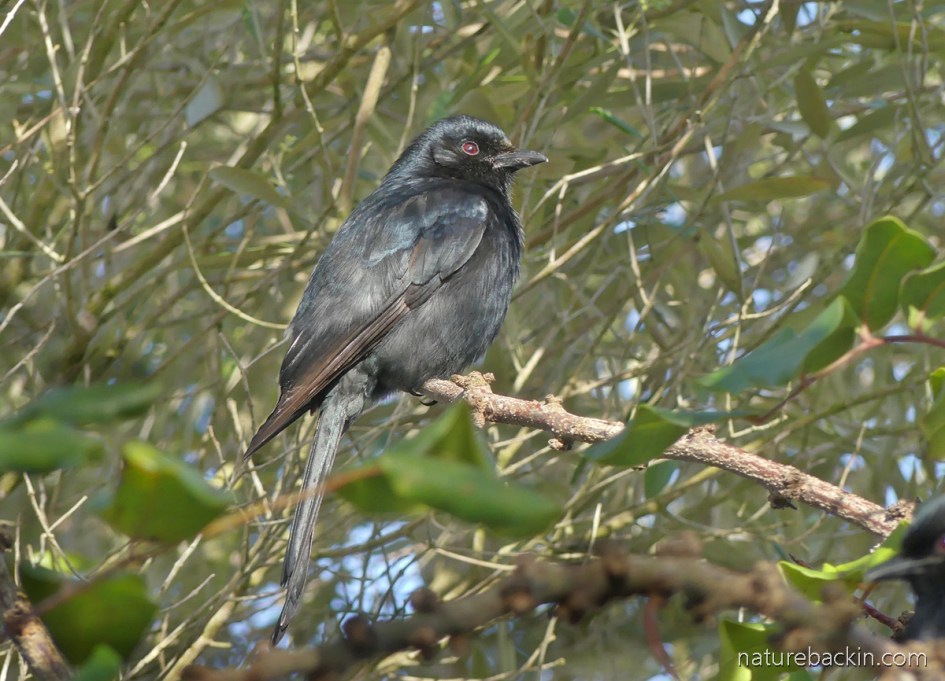
A fork-tailed drongo enjoying some late afternoon sun
In contrast to visiting insectivorous birds, such as flycatchers and drongos, are the mainly fruit-eating speckled mousebirds (Colius striatus). In addition to a wide range of fruit, their plant-based diet includes also buds, flowers, nectar and leaves. They are very sociable and often forage in trees and bushes in groups, and group members sleep clustered together at night.

Speckled mousebirds are indeed a mousy colour – these birds were photographed in a friend’s garden. The upper mandible is black and the lower is pale. Strangely enough, in juveniles this colouration of the bills is reversed
When they are foraging, speckled mousebirds often adopt unusual postures. Two of their four toes can grasp either forwards or backwards, and so they can grasp onto vegetation in a versatile manner and even suspend their bodies below the level of their feet, sometimes even hanging upside down.

A male Klaas’s cuckoo perching in the carob tree in our garden
The Klaas’s cuckoo (Chrysococcyx klaas) is a brood parasite, and its commonest host species are batises, small warblers and sunbirds, including the southern double-collared sunbird and malachite sunbird. In our first summer here last year, I often heard the call of the Klaas’s cuckoo in our neighbourhood and less often the call of the Diderick cuckoo (Chrysococcyx caprius). Last spring, only a few times, I heard the call of the red-chested cuckoo or Piet-my-vrou (Cuculus solitarius).

The Cape weaver is one of two species of weaver that visit our garden
The Cape weaver (Ploceus capensis) is the commonest weaver in our neighourhood. In our previous garden in KwaZulu-Natal very few visited, with the commonest weaver being the village weavers (Ploceus cucullatus) that even spent periods building nests in our garden. I am yet to photograph the southern masked weavers (Ploceus velatus) that visit our current garden only occasionally.

A Cape weaver perched on our garden washing line. With light rain falling, tiny beads of rain settled on the bird’s back can be seen, and a falling rain drop looking like a falling needle is visible in the photo
Cape weavers can be a very vocal presence in the garden. Roberts VII Multimedia Birds of Southern Africa: PC Edition describes the song as being “a long sequence of chattering, wheezing and bubbling notes on 1 pitch” and “gradually fading out without clear ending”. Somewhat amusingly to us, the song “sometimes speeds up and intensifies”, and it usually lasts 7-10 seconds, but can go on as long as 27 seconds.
Other vocal garden visitors are common starlings (Sturnus vulgaris) also known as European starlings. Roberts describes their song as comprising “whistles, rattles, squawks and trills”, often incorporating mimicry of other birds. They are not indigenous to South Africa, but have naturalised in some parts of the country. It is thought that birds captured in the United Kingdom were first released in South Africa in Cape Town by Cecil Rhodes in 1897 and at first their range was confined to parts of the Western Cape, but in the 1970s they were recorded as having spread to KwaZulu-Natal
They have been introduced and can become invasive in other continents and countries outside of their native range elsewhere too, including in North and South America and Australia. Interestingly, there has been a decline in their numbers in their native range in parts of Europe, perhaps because of increasingly intensive agricultural practices and a consequent reduction in the availability of small invertebrate prey.

The common starling is an introduced species that has adapted to living in South Africa where it is closely associated with people – in urban areas and in agricultural areas where there are irrigated fields
The intriguing white chevrons or spots at the ends of the feathers are most obvious in new feathers after the annual post-breeding moult, but these pale ends wear off and the birds appear progressively more uniformly black over time.
An indigenous bird that has managed to significantly extend its range is the hadeda ibis (Bostrychia hagedash). One factor in this increase in range is the occurrence of alien trees that provide nesting sites in previously treeless areas. A hundred hears ago it was considered to be a threatened species – for more see here.

A young hadeda ibis looking for food in our small garden in the Overberg
Hadeda ibises featured prominently in several posts about our garden in KwaZulu-Natal. Perhaps one of the most intriguing was a post on midwinter sunbathing that included photos of a number of hadedas sunbathing together as a group.
The last photo in this post on sunbathing was of our Ridgeback dog Rory, when he was also indulging in basking in the midwinter sun. I have sad news to report about Rory, our wonderful friend and companion. He already had an issue with his back, but chronic pain medication kept him relatively comfortable. However, a sudden deterioration about two weeks ago, meant that we took the sad decision that euthanasia was the kindest option.
Not only do we miss him terribly, but his canine friend Amy, his feline friend Ella and our other two cats do too. At the time when we were starting to think about relocating to the Western Cape in 2022, I posted this tribute to Rory.

Rory at the beach in August last year
Posted by Carol

Discover more from letting nature back in
Subscribe to get the latest posts sent to your email.


October 6, 2024 at 6:20 pm
I never cease to be amazed by the depth of research and tremendous detail you include in your posts, Carol. Absolutely fascinating! Your photos are always marvelous, and I especially love your sunbirds! Very sorry to hear about the loss of Rory – what a wonderful shot at the beach you included as a tribute to him.
LikeLiked by 1 person
October 9, 2024 at 8:07 pm
Thanks for your sympathy about the loss of our dog, Rory.
So glad you like our lovely sunbirds, and I am happy that you find our local birds of interest – especially as you feature such stunning birds in your posts!
LikeLiked by 1 person
September 20, 2024 at 1:32 pm
It is always a joy to read your posts, Carol, thank you. I was sorry to hear about your beloved Rory. The birds were wonderful to see. I felt like I was visiting my old friends from the birding trips to Africa that I’ve taken–weavers, sunbirds, mousebirds, hadeda ibis. I could never get enough of the sunbirds, so I can imagine how fun it is to have multiple species right in your backyard. Interesting, too, that their plumage changes, didn’t know that about sunbirds. Wonderful to see the fork-tailed drongo, too. All of your photos are fantastic and your narrative is soothing and pleasant.
LikeLiked by 1 person
October 1, 2024 at 7:07 pm
Hi Jet – thanks so much and for your sympathy re losing Rory. How nice that you have been reminded of some of your birding trips in Africa. The sunbirds are definitely among my favourites too.
LikeLiked by 1 person
September 17, 2024 at 12:32 am
Every bird you photographed and described is a wonder, Carol. The Sunbirds are particularly spectacular as is the breeding plumage of the Red Bishop. I’m sorry you lost your dog, Rory.
Thanks for the wonderful tour of backyard birds.
LikeLiked by 1 person
September 17, 2024 at 7:09 pm
Thanks so much Jane. The red bishops mostly visit when the light is low, so I am still waiting for better light opportunities when I am around with the camera and they are here. The birds brighten our garden in many ways. Thanks re Rory – he leaves a large Rory-shaped space …
LikeLike
September 14, 2024 at 12:00 pm
I am sorry that Rory is no longer a large presence in your lives. I remember the photograph of him in the wheelbarrow.
Thank you for a fascinating and informative post. Our garden is atwitter with birdsong at the moment. As I was reading — with surprise — that the ha di dah nearly became extinct I heard a loud HAAa from the sky!
LikeLiked by 1 person
September 16, 2024 at 7:31 pm
Thanks Mariss. Yes Rory used to enjoy the wheelbarrow 🙂
Glad to hear that your garden is brightening up with spring birdsong – including the hadedas!
LikeLiked by 1 person
September 9, 2024 at 8:28 pm
Sorry to hear about your dog, but happy that your new garden is bountiful with bird life. Excellent photos and information as always.
LikeLiked by 1 person
September 16, 2024 at 7:27 pm
Thanks very much Graham. The bird visitors are very cheering.
LikeLiked by 1 person
September 9, 2024 at 10:39 am
Why not join us for Bird Place of the Month if you can just link your posts in the comments. I will collate and see how far round the world we can connect!
LikeLike
September 9, 2024 at 10:36 am
Good to see your beautiful birds and yes, so sad to lose our animal companions. I have no pets now because of moving between two homes too much, just the birds and wildlife. Hope your wildlife uplifts you.
LikeLiked by 1 person
September 9, 2024 at 7:48 pm
Thanks very much. We are feeling the loss and he leaves a big space.
The birds and wildlife really are uplifting and add such a richness to one’s life.
LikeLiked by 1 person
September 9, 2024 at 10:13 am
What a wonderful array of birds you have in your garden, Carol. I so enjoyed your careful, informative commentary and excellent photos.
LikeLiked by 1 person
September 9, 2024 at 7:46 pm
Thanks Christine – I was happy to use the photo of the mousebirds that I took in your garden. Live would be a lot poorer without our bird visitors.
LikeLike
September 9, 2024 at 10:01 am
I’m so sorry to hear about Rory. I know too well how it is to lose a beloved pet. Your birdlife is a delight. I remember several of those species from my visits to South Africa and felt very pleased with myself when I recognised a bird from its photo before reading your caption! Over here, robins have just started to sing again as autumn approaches. They’ve been silent through the summer and will have hidden away for their annual moult but now the males are back and singing again, claiming their territory ahead of winter. I didn’t know you had european starlings. I remember the glossy starlings which irridescent purple and very beautiful. They don’t quite rival the sunbirds though!
LikeLiked by 1 person
September 9, 2024 at 7:44 pm
Thanks Sandra – yes we are feeling sad at the loss of our lovely friend Rory.
I am glad that some of the birds were familiar and brought back memories of your time in South Africa.
I didn’t know that robins in the UK start singing at the end of summer. They must look gorgeous in their new feathers!
There are a lot more European starlings in the Western Cape than in KZN where I hardly ever saw them, at least where we lived.
The iridescent glossy starlings are very beautiful, as are what used to be call plum coloured starlings (now called violet-backed starlings). The sunbirds are in a class of their own!
LikeLiked by 1 person
September 10, 2024 at 8:57 am
Carol, you’ve solved a riddle for me. I thought I remembered plum coloured starlings. Now I know I wasn’t mistaken. Our male robins are in their best red-fronted plumage and are visible again. And singing sweetly. Britain’s best loved bird of course and the gardener’s friend. But fiercely territorial amongst themselves just as your cape robins are.
LikeLiked by 1 person
September 16, 2024 at 7:29 pm
Plum-coloured starlings are rather memorable! Glad I helped solve the riddle,
The robins must look very dapper in their new plumage.
LikeLiked by 1 person
September 9, 2024 at 7:12 am
I feel a lump in my throat at the loss of Rory – we still miss our animals keenly. On the brighter side, it is a joy to see such wonderful photographs of familiar birds as well as others that do not occur in our garden. I get to fleetingly see (usually only one or two) red bishops during December.
LikeLiked by 1 person
September 9, 2024 at 7:37 pm
Ah thank you Anne for your sympathy and understanding – it is true that one goes on missing the animals one has loved and had as daily companions.
We got a big thrill in seeing red bishops visit our garden here, as they did not visit our neighbourhood in KZN. In fact when they first visited here they did not have their breeding colours and it took me a bit of time to figure out who they were!
LikeLiked by 1 person
September 9, 2024 at 12:52 am
Dear Carol,
I’m sorry you lost your beloved Rory. I hope your beautiful bird companions help alleviate some of your sadness.
Kindest regards,
Tanja
LikeLiked by 1 person
September 9, 2024 at 7:34 pm
Thank you very much Tanja. We are feeling the loss.
The bird visitors are a lovely distraction and brighten up each day.
LikeLiked by 1 person
September 8, 2024 at 11:31 pm
Beautiful backyard visitors… they must be gearing up for breeding season? Or maybe unlike our birds, they breed in winter?
So sorry to learn of your loss of Rory, he was a handsome boy. Losing pets can be so painful, esp. the ones that are like a member of the family. 💕 🙏🏼
LikeLiked by 1 person
September 9, 2024 at 7:33 pm
Thanks so much Eliza – it is very sad and painful losing a dear animal companion and friend.
Some of the birds here are winter breeders – the wet season in this region, but others breed in the spring/summer and so are gearing up, and some breed almost year round!
LikeLiked by 1 person
September 8, 2024 at 8:54 pm
My wife was looking at ways of making our garden secure for the cats the other day over breakfast, as she tends to do any time one of the tribe stays away for a day.
Your name came up and your cat fence at your old place. I mentioned you had moved but hadn’t seen a post in a while, so as Margaret noted, nice to see a post.
LikeLiked by 1 person
September 9, 2024 at 7:30 pm
Thanks Ark. Nice to hear from you! I hope your cat returned home before too long?
We have made a catio here in our new place , and in addition the walled garden is a secure place for our old cats to access while we are home. Perhaps I should do a post on the new kitty arrangements!
LikeLike
September 9, 2024 at 7:40 pm
The cat came home.
Yes, please, Carol, do a catio post. It would be most welcome, especially for my wife and daughter.
LikeLiked by 1 person
September 9, 2024 at 7:51 pm
So glad your cat came home!
Okay, I will put something together on the catio. I have not settled into a blogging routine since moving and there are lots of other demands – but I will get there! I hope spring brings you lots of good cheer!
LikeLiked by 1 person
September 9, 2024 at 8:13 pm
Hey, we blog for fun, so you will get round to it when you feel inspired. No worries.
Spring is great. Busy doing some landscaping to grow more food and trying to talk my missus into developing a food forest rather than this expanse of lawn.
LikeLiked by 1 person
September 16, 2024 at 7:25 pm
A food forest sounds great!
LikeLiked by 1 person
September 8, 2024 at 8:35 pm
What sad news about Rory. I’m so sorry. But what a wonderful life he had with you all! In a happier comment, I’m in awe of all your avian wildlife. The immense variety of extraordinary birds must be a constant pleasure. And if you must have starlings (you’re right, they’re in decline here) I hope you get to witness their extraordinary murmurations, usually best seen in the winter months. Lovely to have a post from you. I noted life must have got in the way, and have missed you!
LikeLiked by 1 person
September 9, 2024 at 7:28 pm
Hallo Margaret – thank you for your sympathy re Rory.
We do enjoy our bird visitors.
As far as I know numbers of starlings here are not sufficient to make those fantastic murmurations. They must be fabulous to see.
Indeed life has got in the way of blogging. I am still trying to balance things!
LikeLike
September 10, 2024 at 7:56 am
Life should win on the whole, even though I miss your posts!
LikeLiked by 1 person