
A day trip to the De Hoop Nature Reserve could not possibly do justice to its wonders from the high sand dunes near the coast to the mountains on its inland side, its endangered lowland fynbos vegetation and the 12 km-long (7,5 miles) vlei (lake) that is rich with waterbirds. Plus, its rocky shoreline adjoins a marine protected area in the Indian Ocean. De Hoop, home to Cape Nature’s Whale Trail, offers remarkable land-based whale watching opportunities from June to September each year.
On our day trip there in March, when first driving into the reserve through a dense range of fynbos plants, we looked forward to seeing resident animals, such as bontebok and Cape Mountain zebra, and a huge variety of birds.

On an overcast morning, from high ground we looked over the long vlei (lake) and towards the high sand dunes and the Indian Ocean hazy on the horizon
De Hoop Nature Reserve was first proclaimed in 1957 as a nature reserve primarily for the breeding of endangered animals, including bontebok and Cape mountain zebras. Since then, it has acquired additional land and it is currently about 34000 ha (84000 acres) in size. Its conservation objectives have also been enlarged and now include the conservation of rare lowland fynbos vegetation and protecting breeding grounds for many species of birds, and extend also to the marine protected area that extends 5 km (3 miles) out to sea.
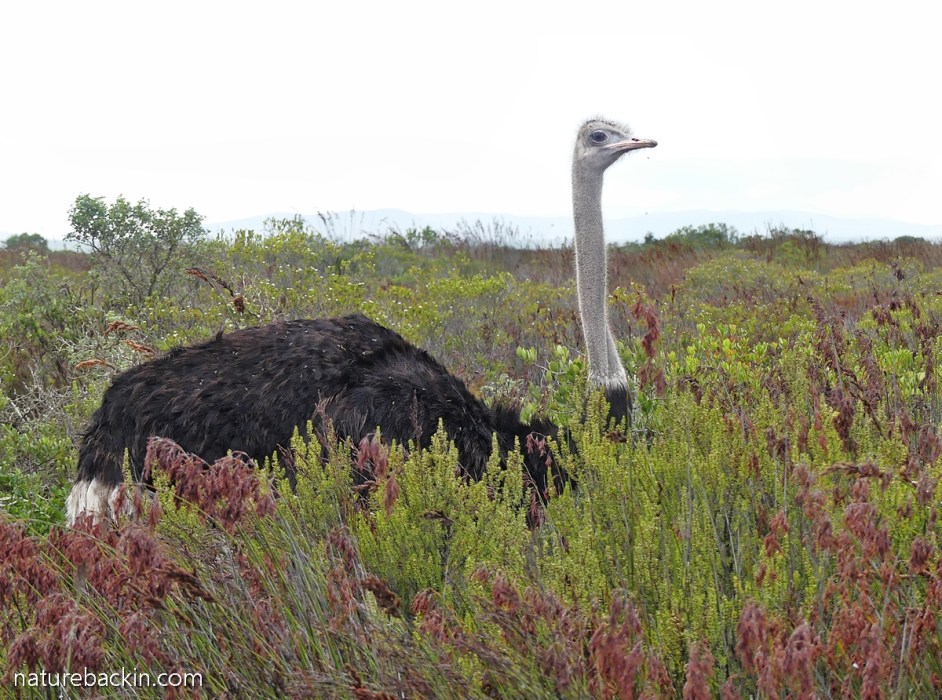
A male ostrich (Struthio camelus) striding through the dense fynbos vegetation
The reserve contains more than 1500 plant species. Of these, 108 fynbos species are threatened and/or endemic to De Hoop and its immediate vicinity. Over 260 species of birds have been recorded at the reserve, of which 97 are waterbirds that frequent the vlei (lake) system.
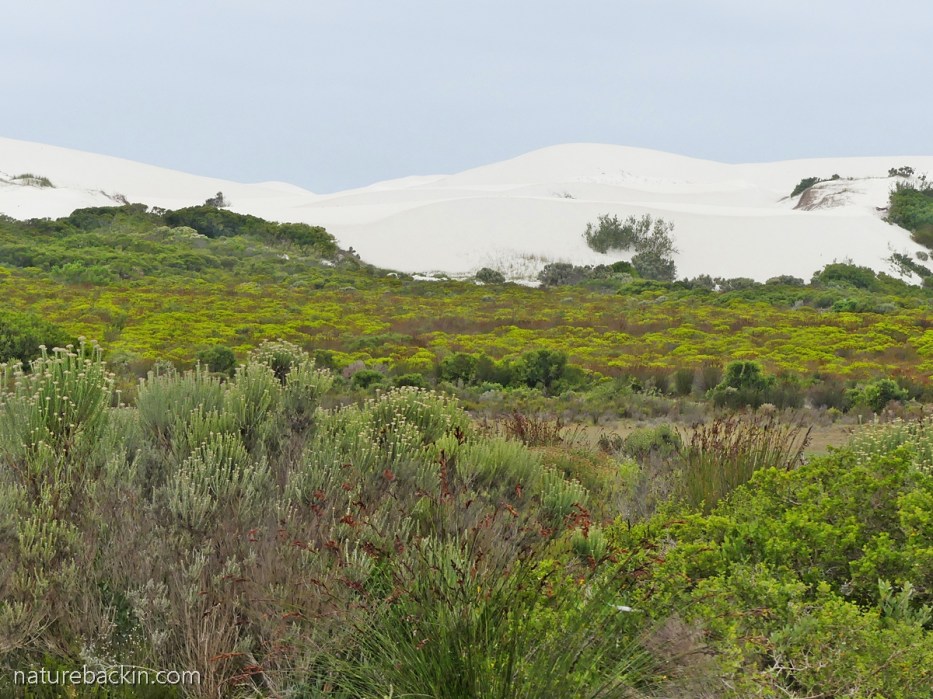
High sand dunes separate the vlei (lake) from the ocean

In the distance, shallow waters in a section of the vlei (lake), home to hundreds of waterbirds, can be seen beyond the fynbos. This view looks across to the neighbouring Denel Overberg Test Range (a weapons systems testing facility established in 1983) that – strange as it may seem – is managed as an ecological unit with the De Hoop Nature Reserve

The red arrow points to the De Hoop Nature Reserve. In the red circle the pale sand dunes can clearly be seen as well as the dark narrow vlei (lake) that extends inland adjacent to the sand dunes
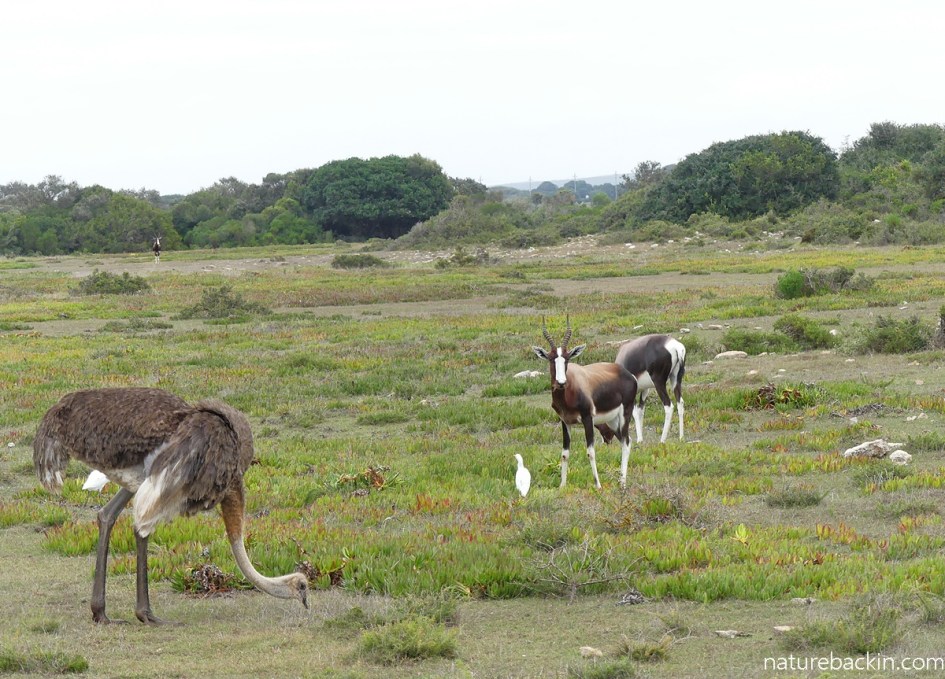
Bontebok with an attendant western cattle egret, and a female ostrich foraging nearby
De Hoop is home to a significant number of bontebok (Damaliscus pygargus pygargus). Historically, this subspecies of Damaliscus pygargus occurred naturallyin renosterveld or fynbos in the Western Cape. (The other subspecies, the blesbok (Damaliscus pygargus phillipsi), occurred naturally mostly in the Highveld.) By the 1800s bontebok were nearly extinct largely as a result of hunting and agricultural expansion. From only 22 individuals remaining, bontebok were saved from extinction by interventions that included the establishment of the Bontebok National Park in 1931.
It is estimated that the population in its natural range nowadays numbers from 514 to 1,618 individuals. On the IUCN Redlist, the bontebok is classed as vulnerable. Threats include lack of habitat within its natural range, inbreeding on the one hand, and hybridisation with the blesbok on the other. For more information see https://speciesstatus.sanbi.org/assessment/last-assessment/1845/

We were happy to see these three Eland (Taurotragus oryx), the largest antelope in southern Africa, foraging at the base of a vegetated sand dune

Looking down from a high dune to the beach at Koppie Alleen, where the Whale Trail ends

While walking down to the beach, we saw several Christmas berry bushes (Chironia baccifera) in fruit

The tide coming in on the rocky coastline

The sandy beach is generously strewn with shells and pebbles

A closer view of shells and pebbles on the beach
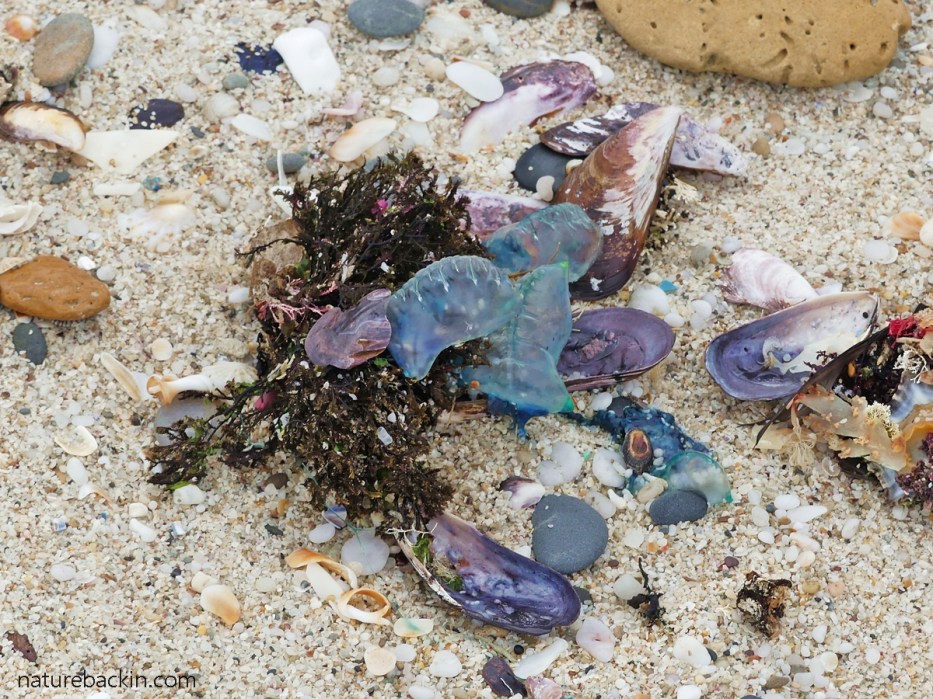
The shells and pebbles may be decorated with washed-up seaweed, and on this day also bluebottles or Portuguese man o’ war (Physalia physalis). For more on the fascinating complexity of bluebottles see https://en.wikipedia.org/wiki/Portuguese_man_o%27_war

A kelp gull (Larus dominicanus) jaw stretching or yawning widely as the tide rushes in

The tide was still low enough to reveal the flat-topped rock platform formations that are thickly covered in seaweed

Breakers crashing dramatically on the rocks, with eroded limestone rocks in the foreground. Some of the erosions created an intricate almost filigree effect
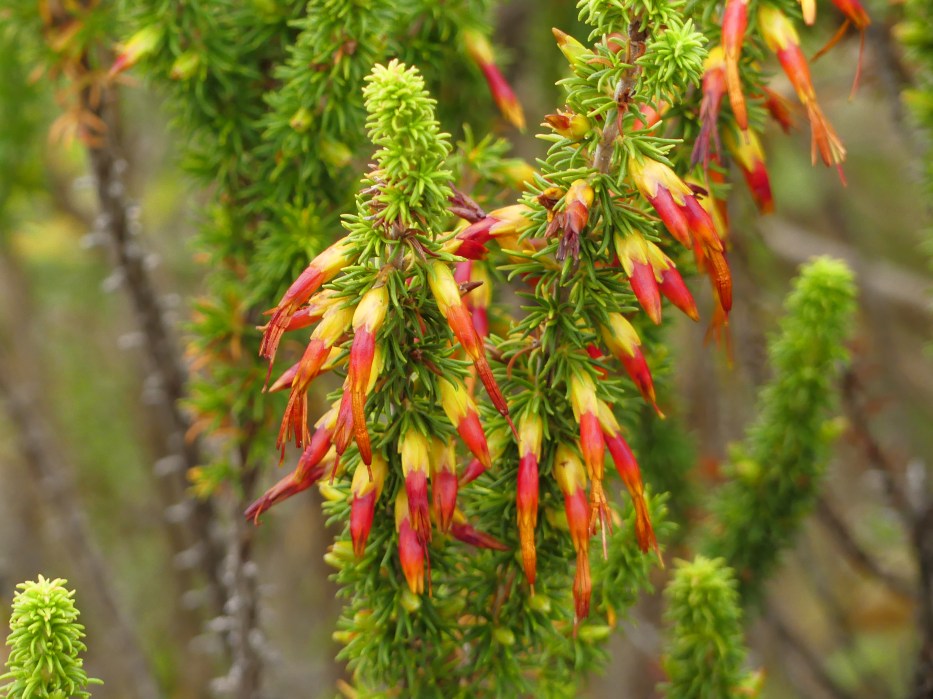
Moving a little way inland we came across a discrete area with several plants known as tassel heath (Erica coccinea) that were in flower. Although coccinea means red, the flowers of plants in this species may indeed be red, but some plants have orange or yellow or greenish flowers

I am yet to identify this unusual white-flowered plant
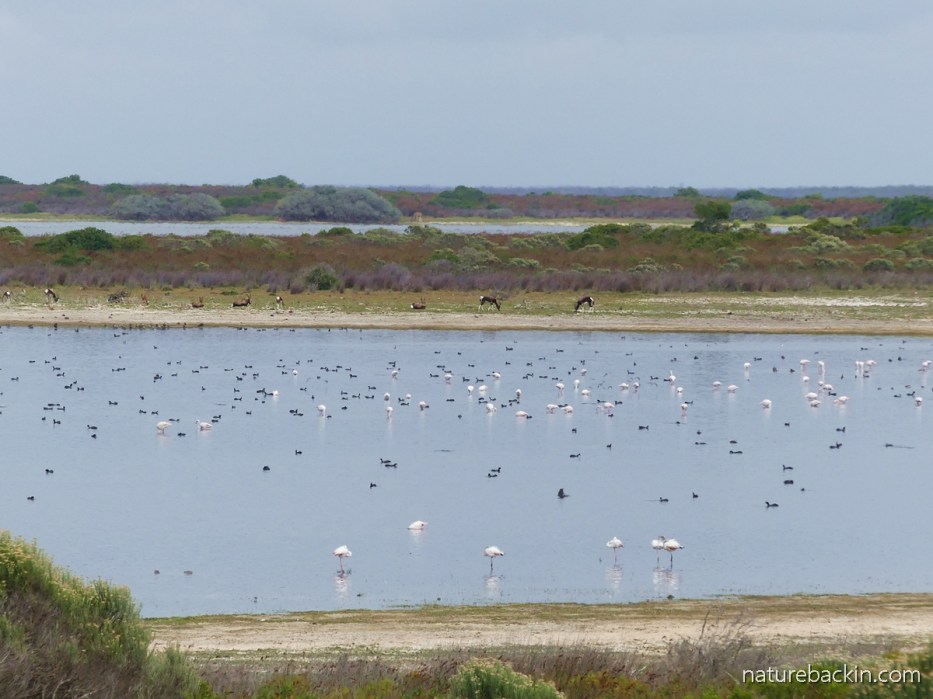
Back at the vlei, this photo provides some idea of the numbers of birds feeding in the shallow waters, including flamingos, several species of duck and very many red-knobbed coots. Bontebok can be seen grazing on the far bank

Greater flamingos (Phoenicopterus roseus) are wading birds that feed in shallow waters up to belly height. The greyer birds seen landing with wings still outstretched are juveniles. Sadly, in Africa numbers of greater flamingos are declining, and they are classed as Vulnerable in South Africa, and Near Threatened in Namibia. Three elands can be seen on the far bank

Another section of the vlei framed by restios. Restios are reed-like plants, several species of which form a significant component of fynbos habitats
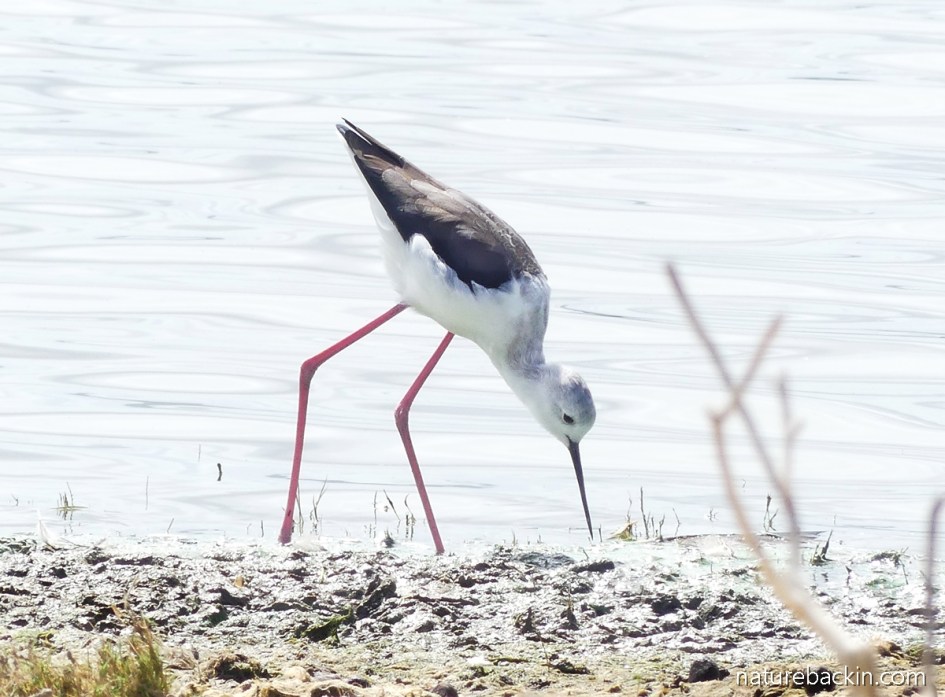
A black-winged stilt (Himantopus Himantopus) probing for food at the waters edge. According to Roberts Birds of Southern Africa (online edition), these birds have the longest legs proportional to body size of any bird. Regarding this photo, the light at the middle of the day was very harsh. The trouble with day trips is that for most of the visit, the light is not kind to photographers or to their subjects!

I was captivated by this low-growing pelargonium, a member of the Geraniaceae Family, which was growing in patches along one section of road further inland in the reserve. After looking at photos on iNaturalist, I would hazard a guess that this is Pelargonium suburbanum ssp. Bipinnatifidum, a subspecies of the dune pelargonium (Pelargonium suburbanum)

This photo was taken overlooking the more inland reaches of the vlei system where the water appears to be deeper. The coastal dunes can be seen at the distant horizon
This selection of photos scratched the surface of our visit, never mind the totality of the De Hoop Nature Reserve. De Hoop definitely warrants further visits and better still spending a few days there.
Even better would be to go on the 55 km (34 miles) Cape Nature’s Whale Trail, which has five overnight stops in cottages on the route that starts at Potberg in the mountains and ends at Koppie Alleen on the coast. This is a slack-packing trail so hikers need only carry a day pack, with their luggage transported to the next overnight stay each day. Reservations for the trail may be made for groups of six or twelve hikers.
Posted by Carol
Discover more from letting nature back in
Subscribe to get the latest posts sent to your email.


August 5, 2024 at 2:09 pm
Incredible images. What a special place.
LikeLiked by 1 person
August 5, 2024 at 7:12 pm
Thanks so much. It is a unique place in its wide diversity.
LikeLiked by 1 person
August 3, 2024 at 5:57 pm
Fantastic place. I love the rocky beaches a lot.
LikeLiked by 1 person
August 5, 2024 at 7:12 pm
It a a fantastic place, and there is lots of drama in those rocky beaches with such interesting rock formations.
LikeLiked by 1 person
August 3, 2024 at 8:03 am
I so enjoyed revisiting this wonderful reserve through your photos and commentary, Carol. Doing the Whale Trail there was one of the highlights of my life!
LikeLiked by 1 person
August 5, 2024 at 7:11 pm
Thanks Christine. The Whale Trail seems to have a powerful effect on those fortunate enough to do it.
LikeLike
August 2, 2024 at 5:40 pm
You certainly had a rich and diverse day. Thank you for taking me there through your photographs
LikeLiked by 1 person
August 5, 2024 at 7:09 pm
Lovely to do a day trip but now we are thinking again about doing the whale trail …
LikeLike
August 5, 2024 at 7:15 pm
Good idea. It’s on my bucket list
LikeLiked by 1 person
July 31, 2024 at 7:43 am
You seem to be enjoying a very different natural world at your new home Carol, as your wonderful photos demonstrate. I hope the move is living up to hopes and expectations.
LikeLiked by 1 person
August 1, 2024 at 7:20 pm
Thanks Margaret – it is very different here compared to our previous home – lots to learn about and enjoy. The move has been a good one, though the cold, windy and wet winters are altogether something else!
LikeLiked by 1 person
August 2, 2024 at 7:05 am
Ah. There’s always a downside.
LikeLiked by 1 person
July 31, 2024 at 7:21 am
As usual, your photographs are magnificent and well worth waiting for, Carol. I find it strange to see ostriches and eland among the fynbos 🙂 You have done De Hoop a great justice after even only a brief visit!
LikeLiked by 1 person
August 1, 2024 at 7:18 pm
Thanks very much Anne. I also thought seeing the eland there was a bit strange. After being used to seeing them in the Berg, seeing them being at home near the coast can be surprising. We do need to plan another visit to De Hoop – there is so much experience there.
LikeLiked by 1 person
July 31, 2024 at 4:33 am
Lovely tour of a wonderfully rich reserve. It’s great that these places were established before it was too late. I like the sound of the Whale Trail too. Day packs are all I can carry these days!
LikeLiked by 1 person
August 1, 2024 at 7:14 pm
I completely agree about not carrying heavy backpacks!
Absolutely, this reserve is packed with riches. The shoreline alone is almost incredible.
LikeLiked by 1 person
July 31, 2024 at 4:15 am
What an amazing nature preserve, Carol. Your photos show so many wonderful aspects and I can only imagine how much more there is to discover. When I saw your photo of the coastal dunes I thought they looked like snow.
The Whale Trail also sounds absolutely amazing.
LikeLiked by 1 person
August 1, 2024 at 7:11 pm
Thank you Tanja. Yes those high dunes sometimes look quite out of place. I am sure the park offers something different on each visit and we hope to return. Perhaps one day, even do the Whale Trail!
LikeLiked by 1 person
August 1, 2024 at 11:34 pm
I hope you can return and experience this place more deeply.
LikeLiked by 1 person
July 30, 2024 at 9:21 pm
Looks like a lovely park, Carol. I love that it harbors and protects so many species. Excellent photos 👏🏼
Sounds like you’re considering a return visit!
LikeLiked by 1 person
August 1, 2024 at 7:09 pm
Thanks very much Eliza – is in a wonderful sanctuary. We will be visiting there again. The spring-flowering plants must be amazing.
LikeLike
July 30, 2024 at 9:21 pm
Thank you for sharing the wonderful visual documentation of the landscapes, seascapes, flora, and fauna of your beautiful day trip!
LikeLiked by 1 person
August 1, 2024 at 7:07 pm
Thanks very much Carol. It is a stunning and diverse place.
LikeLiked by 1 person