
Impromptu stops to take in local sea views have provided some bright interludes in our cold and often wet winter. Here are some photos from one of the bright days when I remembered to take my camera along.
What would the seaside be like without seagulls? So far in the Overstrand region of the Western Cape, we have seen Hartlaub’s gull (Chroicocephalus hartlaubii) pictured above, which is endemic to the west coast of South Africa and Namibia, and the better known and much larger kelp gull (Larus dominicanus) with a range that extends across much of the southern hemisphere. In addition to the coastal areas of southern Africa and Madagascar kelp gulls occur in parts of South America, the Antarctic Peninsula, sub-Antarctic islands, New Zealand and Australia.
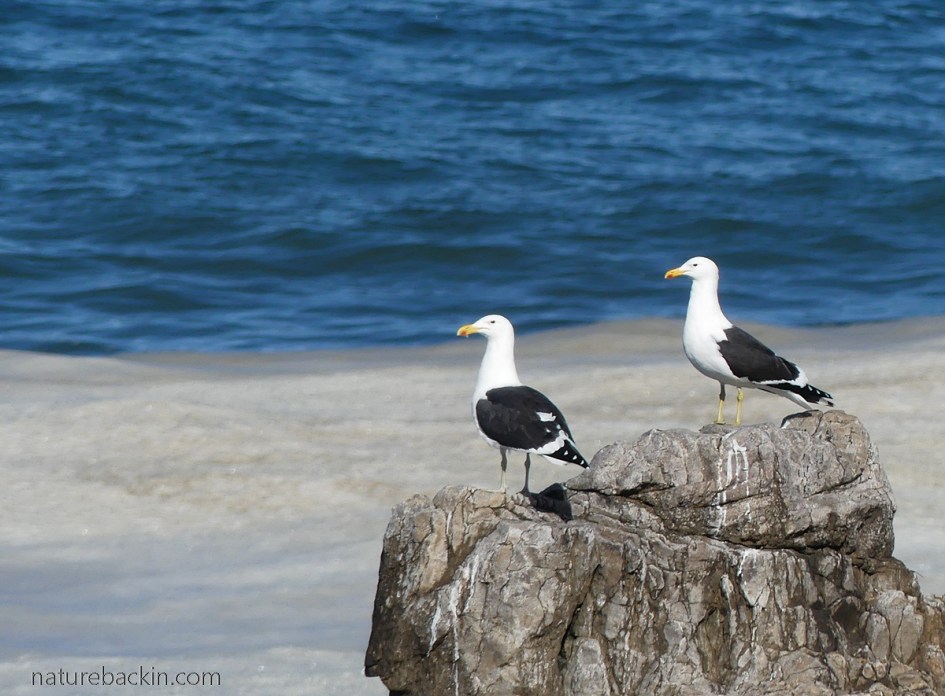
Kelp gulls are gregarious often roosting and foraging in groups. But on this occasion, we saw a lone pair looking out over the waves at an ocean view site popular with humans too. Kelp gulls form monogamous breeding pairs and although they can be solitary nesters, more usually they nest communally, on the offshore islands and at specific sites along the west and southern coasts, all areas near coastal kelp forests, hence their name. On the eastern coast kelp gulls visit as non-breeding migrants.

Male and female kelp gulls are similar in appearance, with the larger males weighing 1000 g (35 oz) on average and the female, 820 g (29 oz). The wingspan is 128-142 cm (50-56 inches). Two of the five sub-species of kelp gulls occur in southern Africa.

Above is the same kelp gull when it came in to land, tail flared like a parachute and yellow feet pointing downwards ready for the landing.

This pair of kelp gulls treated us to the sight of several take-offs and landings as they each interrupted their sea gazing with the occasional short circular flight.
Kelp gulls are generalist foragers and scavengers. Their large size and powerful bill enable them to have a varied diet that includes crustaceans, molluscs, fish and a wide range of marine and terrestrial invertebrates. When foraging large mussels they are known to fly up high above rocks and then deliberately drop a mussel so as to smash it and open the shell.
Kelp gulls actively hunt and forage at sea, along the shoreline and also inland, where their prey includes reptiles, small mammals, birds and eggs. They frequently rob food from other seabirds. They scavenge food from fishing harbours, rubbish dumps and scraps washed up on beaches.
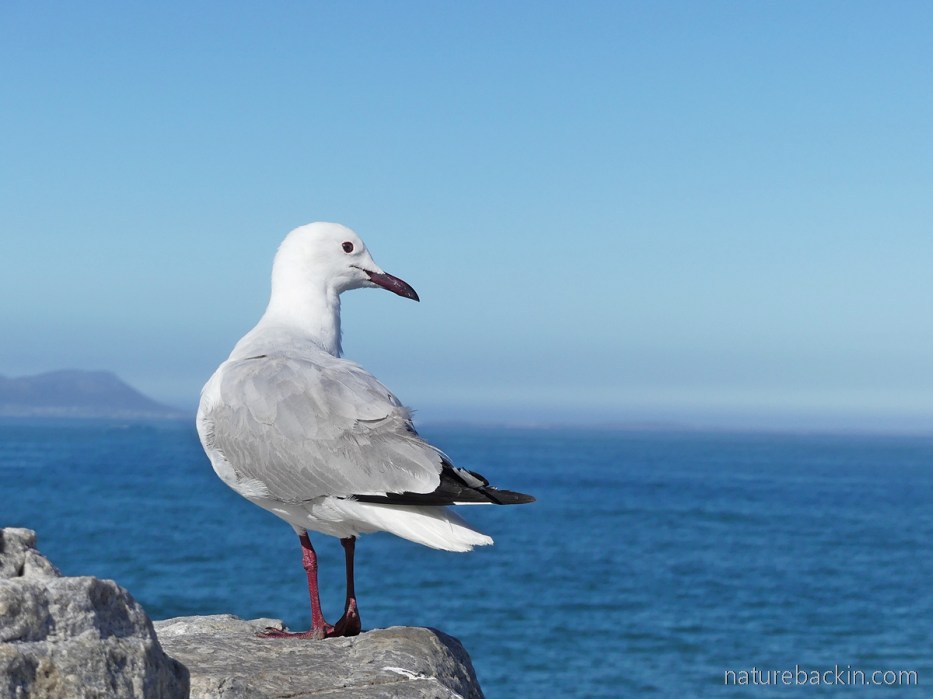
While we were scanning the bay on the lookout for whales, this Hartlaub’s gull landed a few meters from us. Perhaps it was hoping for a handout, but it seemed quite content to also spend some time taking in the view. The Hartlaubs’s gull is significantly smaller than the kelp gull with a wingspan of about 38 cm (15 cm). The male weighs in at only 290 g (10 oz), and the female 265 g (9 oz) on average. Adult Hartlaub’s gulls are sometimes killed by kelp gulls although they are not eaten.

I caught this snap of the Hartlaub’s gull also taking off for a recce flight. In addition to being smaller it is noticeably less powerfully built than the Kelp gull and it has a less powerful bill. It feeds predominantly on fish, molluscs and invertebrates, especially invertebrates associated with kelp. Reflecting this food preference, the natural distribution of Hartlaub’s gulls is largely associated with two species of kelp that grow in coastal waters. Like other species of gulls, it also scavenges waste.

In non-breeding Hartlaub’s gulls, such as this one, the head is entirely white, but in the breeding season the adults may have a pale lavender-grey hood or at least a slight circle edging the scarcely discernible hood. After flying off the gull landed again though on a different rocky perch, apparently gazing into the middle distance.
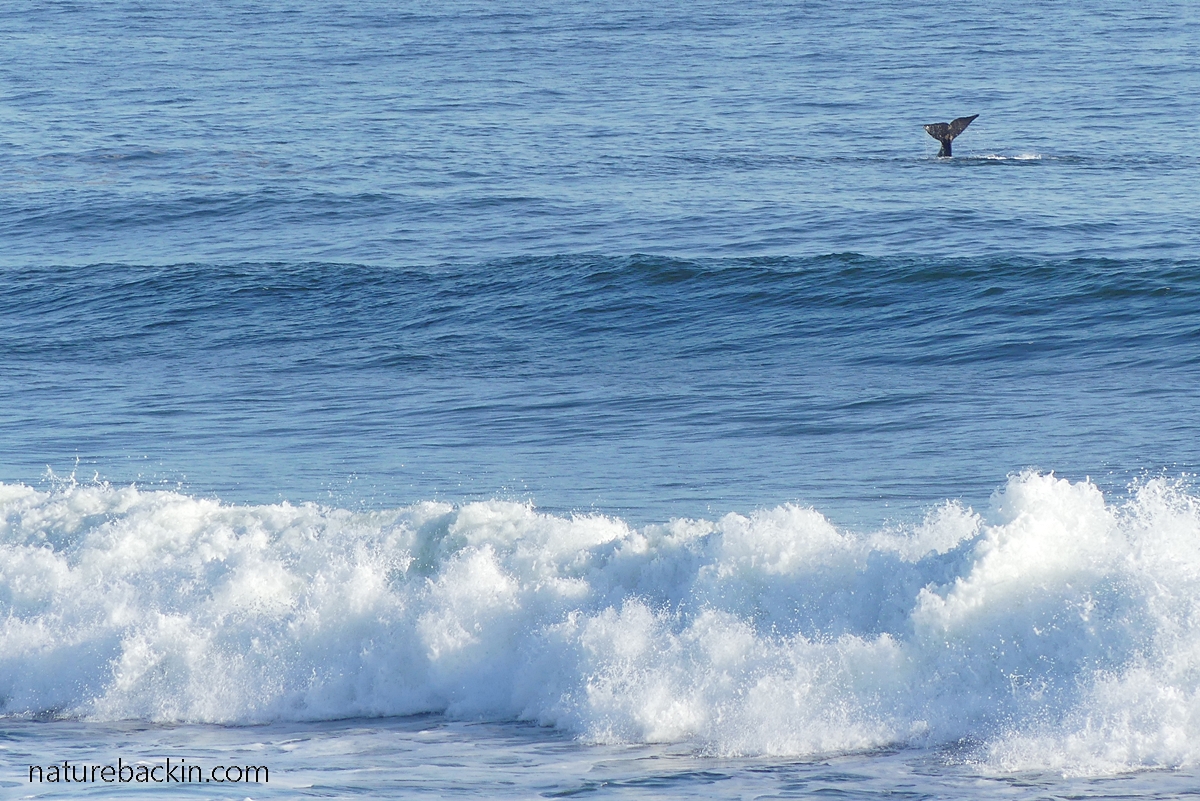
In fact, we did see whales that day, but not close enough for my camera to photograph. A few days later in another part of the bay I managed to photograph the tail of a southern right whale (Eubalaena australis) as it was repeatedly tail-slapping the surface when just beyond the breakers.
I hope to be posting more seaside photographs soon. I also hope to be posting more regularly as we get more on top of home maintenance and renovation issues, and as the weather warms up it will make it more possible to sit at my laptop and not be too cold. And most significantly, I am about to have cataract surgery (first one tomorrow!) that should not only make photography more viable as my sight improves, but also enable me to read more comfortably and catch up on badly neglected blog reading. So here’s to being more connected!
Sources:
Chittenden, Hugh, Davies, Greg & Weiersbye, Ingrid. 2016. Roberts Bird Guide: Illustrating nearly 1,000 Species in Southern Africa (2nd edition). Cape Town: Jacana; Roberts VII Multimedia Birds of Southern Africa: PC Edition. 1997-2016 Southern African Birding. For details go to http://www.sabirding.co.za/roberts7/portal.html
Posted by Carol

Discover more from letting nature back in
Subscribe to get the latest posts sent to your email.


August 12, 2023 at 3:01 pm
Now I know a good deal more about seagulls. Thank you Carol. I also enjoyed looking at your photographs, as always.
Strength with getting your new house in order and I trust that the cataract op went well.
LikeLiked by 1 person
August 15, 2023 at 6:28 pm
Hi Mariss – thanks and yes the first op went well. Second one tomorrow. Sending best wishes.
LikeLiked by 1 person
August 16, 2023 at 6:49 am
Good to know. Trust today’s will also go well
LikeLike
August 12, 2023 at 1:00 pm
So pleased to read that the surgery went well, Carol. Even without it, your camera skills have remained sharp. Looking forward to reading more from you when life permits.
LikeLiked by 1 person
August 15, 2023 at 6:27 pm
Thanks so much Sandra. I have the second eye done tomorrow and hope to be back in shape after a week or so. Sending best wishes.
LikeLiked by 1 person
August 11, 2023 at 2:47 pm
We wish you good luck with your eye surgery.
We live at the sea in Cley-next-the-Sea at the coast of North Norfolk. We have the blue sea at our doorstep but other gulls, mostly black headed gulls, herring gulls and arctic skuas.
Especially the first pictures of this kelp gull we like.
All the best
The Fab Four of Cley
🙂 🙂 🙂 🙂
LikeLiked by 1 person
August 11, 2023 at 3:18 pm
Thanks so much for getting in touch and for your good wishes. The first eye procedure is already yielding good results!
How lovely to have the sea at your doorstep. Having recently moved, we are enjoying being just a little inland, with the seashore within easy reach and we are enjoying getting acquainted with shore life.
All the best from a southerly seashore.
LikeLiked by 1 person
August 11, 2023 at 7:01 am
I really enjoy your newsletters having only recently joined as a subscriber. I found one dealing with mistbelt grassland flowers from a few years ago. We have about 4 acres in Hilton which used to be used for horses but which we are now trying make into a typical grassland for this area. How do I get plants such as those that grow naturally in the Dargle?
LikeLiked by 1 person
August 11, 2023 at 3:03 pm
Hi Colin, how good to hear from you. We used to live just ‘down the hill’ from Hilton. That is great that you are trying to restore the grassland in your area.
Of course in time some species that given half a chance reestablish themselves, but obviously you would like to provide a helping hand to restore diversity.
I wonder if you connect with some of the Conservancies in areas such as the Dargle you might get assistance with seeds or cuttings? Some of the Conservancies have monthly walks, which might be a good way of connecting with them. Here is a link https://midlandsconservanciesforum.wordpress.com/events/
Sending best wishes to you and your lovely part of KZN.
LikeLike
August 9, 2023 at 3:24 am
Good luck with the cataract surgery. I’ve known several people who’ve had it and it’s made the world of difference for them. Love the gull photos. They’re something we don’t have here apart from the occasional one that’s blown in or hopped aboard a ship!
LikeLiked by 1 person
August 11, 2023 at 2:54 pm
Thanks so much Graham. So far, the first eye surgery has made a remarkable difference already.
I am surprised to hear that there are no resident gulls in Hawaii.
I have just peeked at your blog to see if you are okay in the aftermath of the awful fires. I hope that remains the case for you? The devastation and loss of life especially on Maui is tragic and heartbreaking. I hope at least the winds have died down by now and that you keep safe.
LikeLiked by 1 person
August 12, 2023 at 4:48 am
I guess gulls like shallow waters and here the land tends to zoom straight into the deep water. We fared OK on the Big Island. Quite a bit of land charred, but not much damage and no injuries. It was just an inconvenience for 48 hours. Maui had it much worse. It’s almost apocalyptic there. And yes, the winds are back to normal now.
LikeLiked by 1 person
August 15, 2023 at 6:26 pm
That is an interesting observation about the gulls, The two species in my post are associates with kelp forests that grow in shallow (but cold) offshore water,
The destruction and loss of life in Maui is horrific. It is good to hear that the Big Island was not so seriously afflicted by comparison.
LikeLiked by 1 person
August 8, 2023 at 7:37 am
Good luck with the surgery. Happily, it seems to be a routine and successful procedure which should raise your game in the reading department. Gulls are a new departure for you I think? Your residents seem to be the same-but-different from the ones we’re used to. Looking forward to a resumption of more regular posts – when you’re good and ready
LikeLiked by 1 person
August 11, 2023 at 2:49 pm
Hi Margaret
Thanks so much, and as I have already replied to others all went well and the difference in my vision is already amazing.
Now that we live nearer to the ocean we will be coming across more shore birds I expect.
I look forward to catching up with your blog going forward!
LikeLike
August 11, 2023 at 3:26 pm
So glad things have been successful in the surgery department. Onwards and upwards!
LikeLiked by 1 person
August 11, 2023 at 3:29 pm
Thanks. Yes indeed. It is great to have lost the sepia tinge – at least thus far in one eye!
I look forward to catching up with your blog when reading is easier again and photographs can be better appreciated!
LikeLiked by 1 person
August 11, 2023 at 3:46 pm
‘See’ you soon, I hope!
LikeLike
August 8, 2023 at 6:16 am
Wishing you a successful surgery and a quick recovery, Carol. It certainly is nice to get an update from you every now and then!
LikeLiked by 1 person
August 11, 2023 at 2:46 pm
Hi Dries
Thanks for the good wishes. All went well with the first one and it certainly is incredible what a difference it has made already. I am looking forward to coping better with reading and photography. I will have a lot of catching up to do after the second eye has recovered!
LikeLiked by 1 person
August 8, 2023 at 4:37 am
It is wonderful to read a post from you again, Carol. I have had cataracts removed from both eyes – what a difference! I wish you a speedy recovery.
LikeLiked by 1 person
August 11, 2023 at 2:44 pm
Hi Anne
Thanks very much, and good to hear that you had great success with your cataract procedures. My first one went well and it is incredible how much brighter the vision is already!
Welcome home btw and I hope to catch up with your blog once over the next eye thing.
Best from Carol
LikeLiked by 1 person
August 8, 2023 at 1:49 am
Hello Carol,
So happy to see this latest update from you. Such beautiful photos of the sea and of course the beautiful birds too. All our best wishes from Japan too, for your surgery, and of course for the continued health and happiness of you and your dear ones.
Best wishes,
Takami
LikeLiked by 1 person
August 11, 2023 at 2:42 pm
Hi Takami
Thanks very much. All went well with the eye procedure. One down one more to go!
All the best to you and your family too and I hope all is well.
Take care
LikeLiked by 1 person
August 7, 2023 at 10:02 pm
Beautiful gulls, Carol. That shot from the back is a perfect lyre shape, great take.
Best wishes on your surgery tomorrow, may you have an uneventful recovery!
LikeLiked by 1 person
August 11, 2023 at 2:40 pm
Hi Eliza, thanks very much. The eye procedure went well. Already the vision is much brighter!
LikeLiked by 1 person
August 7, 2023 at 9:04 pm
Best Wishes for your eye surgery!! I loved this post. I live almost 2 hours from the seashore, so I mostly only get there once or twice a year. I just love seagulls. There is something so characterful about them.
Also, wishing you an end to renovations, etc., and a lovely warm season on the way!
Cheers,
Julie
LikeLiked by 1 person
August 7, 2023 at 9:09 pm
Hi Julie
Thanks so much for the good wishes. I hope to be more back in the swing of things soon. Not feeling so cold will make me come alive I am sure!
I agree about gulls having a lot of character. The kelp gulls in particular can be quite sassy.
Enjoy your summer – I hope you have not been experiencing heat extremes.
Best wishes from SA.
LikeLike