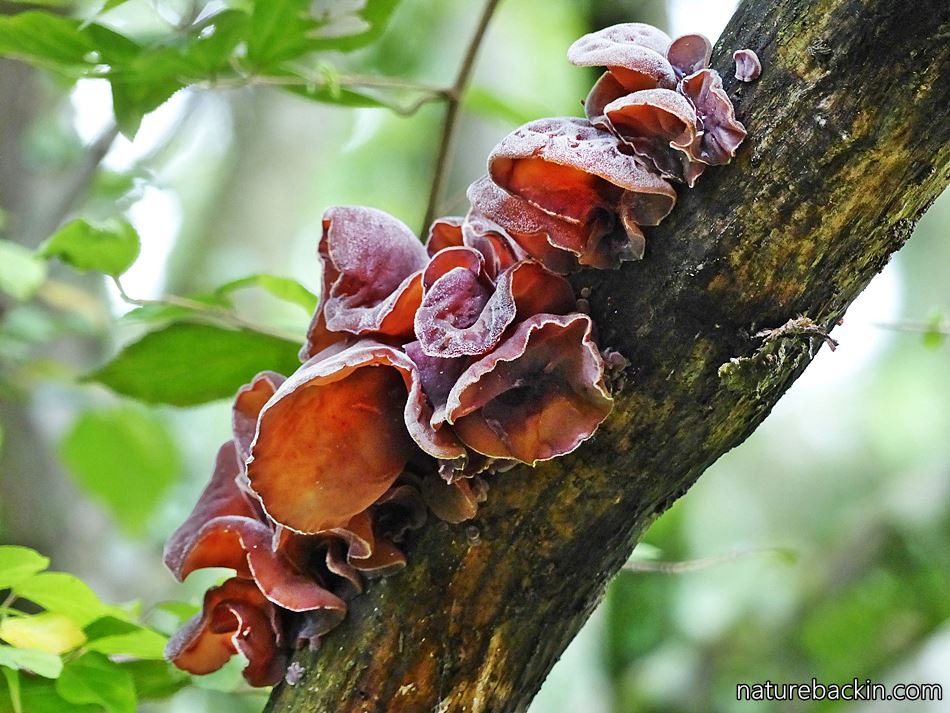
This strange fungus blooms occasionally on old wood on a small tree in our garden. For a few days only, it is thick and jelly-like before rapidly shriveling and drying.
It grows on a branch of a Crossberry tree (Grewia occidentalis) and provides a rare, albeit temporary surprise. It is known as a Jelly Ear Fungus on account of its gelatinous consistency and its ear-like shape. It scientific name, insofar as I have been able to find out, is Auricularia auricula-judae. This fungus can be used in cooking, and it is also used medicinally in many regions of the world. It is widespread throughout temperate and sub-tropical zones worldwide and occurs on all continents (https://en.wikipedia.org/wiki/Auricularia_auricula-judae).
Posted in response to the Weekly Photo Challenge with the theme temporary
Posted by Carol

Discover more from letting nature back in
Subscribe to get the latest posts sent to your email.


November 20, 2017 at 2:59 am
Thanks Joan. It is a beautiful fungus, though perhaps not conventionally so. Sorry to only be replying after such a long delay.
LikeLiked by 1 person
November 15, 2017 at 11:59 am
I love the way the image captures the beauty – it’s a shame that it’s so short-lived. Thank you for sharing that Carol!
LikeLiked by 1 person
November 14, 2017 at 6:37 pm
Thanks Anne. My Internet connection is sooo sloow I am having trouble posting a reply! I was hoping to say that yes, it is an interesting fungus, and I’d like to find out more about it.
LikeLiked by 1 person
November 12, 2017 at 11:28 pm
Thank you for sharing! I always like to keep a lookout for the fungi that pop up after a rain. I’m still learning the seasonality of the various ones that grow here. I have seen some similar to the Auricaria auricaria-judae, but growing on stumps and dead wood – I’ll have to try to pay attention to what wood it is in the future.
LikeLiked by 1 person
November 20, 2017 at 2:56 am
Thanks and sorry to only be responding now. Fungi are so incredibly diverse arn’t they? I notice that the branch on which this fungi is growing is now dying off. This is a tree that keeps on going even though periodically individual branches do die off, which then makes them suitable for some fungi, I suppose.
LikeLiked by 1 person
November 12, 2017 at 10:46 pm
I know this fungi, too! In New Zealand, I often see it on fallen trees. It always fascinated me how much it looked and felt like an ear. :D.
There is a fab history of its use in NZ (along with other fungi) in this NZ Geographic article here: https://www.nzgeo.com/stories/feasting-on-fungi/
-Emma
LikeLiked by 1 person
November 20, 2017 at 2:58 am
Thanks Emma. I am trying to ‘catch up’ while I have a weak and short-loved connection. Interesting that so many fungi are cosmopolitan. Thanks so much for the link – I will be interested to read it when my Internet connection is more stable.
LikeLiked by 1 person
November 21, 2017 at 11:37 am
No worries at all! 🙂
LikeLiked by 1 person
November 11, 2017 at 9:00 pm
Fascinating!
LikeLiked by 2 people
November 14, 2017 at 6:20 pm
Thanks, and I find them fascinating too.
LikeLiked by 1 person
November 11, 2017 at 2:12 pm
I know I have said this before, but I love your interpretation of the words. I really want to try this challenge too….. One day.
LikeLiked by 1 person
November 14, 2017 at 6:16 pm
Thanks Nikki. I look forward to seeing your photos.
LikeLike
November 10, 2017 at 8:29 am
I’ve only ever seen this ( or its European cousin?) while out walking, so I had no idea it was a short-lived one. I always thought of tree-residing fungus as being there for the long haul. Thanks for the lesson!
LikeLiked by 1 person
November 20, 2017 at 2:51 am
Thanks Margaret – thanks and sorry I have taken so long to reply. As far as I understand, the fungus itself is long-lived, but the ‘bloom’ only lasts a few days.
LikeLike
November 10, 2017 at 2:46 am
What an interesting fungi. Thanks for sharing.
LikeLike
November 20, 2017 at 2:48 am
Thanks Rebel GIrl. Apologies for the long delay in replying. Unfortunately, my usual Internet connection is still not restored and the other one I am using is not sufficient 😦
LikeLiked by 1 person
November 9, 2017 at 8:38 pm
What an interesting looking fungus – I have not come across it before.
LikeLiked by 1 person
November 20, 2017 at 2:46 am
Thanks Anne. I did respond before but with my iffy Internet connection my first response ‘disappeared’ and my second response didn’t thread properly, so I am not sure if you were aware of it.
LikeLike